10 best brush for Chow Chows in 2026: Dense-Coat Grooming Picks
A Chow Chow can look perfectly brushed on top while loose undercoat and tangles remain packed close to the skin. That dense double coat makes pin length, tooth spacing, and brushing technique more important than simply choosing the most aggressive shedding tool. We compared long-pin slickers, undercoat rakes, dematting tools, and finishing pin brushes against breed-specific coat-care guidance and current manufacturer specifications. By the end, you will know which tool fits routine line brushing, seasonal coat blow, stubborn tangles, and gentle finishing work.


Quick Comparison: All 10 Brushes Ranked
| # | Product | Best For | Rating | Badge | |
|---|---|---|---|---|---|
| 1 | Chris Christensen Big G Large Slicker | Full-coat line brushing | 4.9/5 | Best Overall | Buy → |
| 2 | Safari Double Row Undercoat Rake with Rotating Pins | Dense undercoat | 4.8/5 | Best Undercoat Rake | Buy → |
| 3 | FURminator Grooming Rake | Seasonal coat blow | 4.7/5 | Best for Coat Blow | Buy → |
| 4 | Safari Curved Firm Slicker Brush for Long Hair | Value slicker | 4.6/5 | Best Budget | Buy → |
| 5 | GoPets 2-in-1 Dematting Comb | Localized mats | 4.5/5 | Best for Mats | Buy → |
| 6 | JW GripSoft Double Row Undercoat Rake | Gentle raking | 4.5/5 | Best Gentle Rake | Buy → |
| 7 | Chris Christensen Original Oval Pin Brush 35mm | Long-coat finishing | 4.4/5 | Best Finishing Brush | Buy → |
| 8 | Safari Wire Pin Dog Brush with Bamboo Handle Large | Daily finishing | 4.3/5 | Best Everyday Pin | Buy → |
| 9 | Safari Shed Magic for Medium to Long Hair | Loose coat removal | 4.3/5 | Best De-Shedding Tool | Buy → |
| 10 | Andis Premium Large Firm Slicker Brush | Large body areas | 4.2/5 | Best Wide Slicker | Buy → |
How We Chose These Chow Chow Brushes
What we evaluated
We evaluated 10 current grooming tools across four tool types: slickers, undercoat rakes, dematting tools, and pin brushes. This ranking is specification- and use-case-based rather than a claim of a controlled hands-on laboratory test.
Our 3 scoring criteria
Every tool was scored using the same three Chow-specific criteria: undercoat reach, coat gentleness, and handling plus cleanup. Long pins or rotating teeth earned more credit when they could penetrate dense fur without relying on excessive force.
Breed guidance checked
No individual expert was represented as personally consulted. Instead, tool selection was cross-checked against Chow Chow breed-club guidance calling for regular down-to-the-skin brushing with slicker, pin-brush, rake, and comb-type tools.
What we cut — and why
We excluded short-coat-only bristle brushes as primary tools, very short slickers that mainly skim the surface, and discontinued products where current retail availability could not be confirmed. Finishing brushes stayed only when they added a distinct role.
What to Look for When Buying a Brush for a Chow Chow
The hardest part is not removing visible fluff; it is reaching the dense undercoat without scratching skin or repeatedly dragging through the guard coat. These factors help you choose a tool that matches the job rather than expecting one brush to do everything.
1. Pin or Tooth Length
A short slicker can make the outer coat look neat while leaving packed undercoat underneath. Long-pin slickers and rakes are more useful on rough-coated Chows because they can work deeper when you part the coat into sections. The goal is controlled reach, not hard pressure against the skin.
2. Slicker Versus Undercoat Rake
A slicker separates hair, loosens light tangles, and helps prepare the coat for combing. An undercoat rake is more efficient when seasonal shedding creates thick pockets of loose wool. Most rough-coated Chows benefit from owning both rather than forcing one tool to perform two different jobs.
3. Skin Safety and Tooth Movement
Rounded tips, flexible cushions, and rotating rake teeth can reduce snagging when used with light pressure. Chow skin can be hidden under several inches of coat, so you cannot judge pressure by sight alone. Stop if the skin reddens or the dog repeatedly flinches.
4. Head Size and Handle Control
Large heads cover the back, shoulders, and flanks quickly, while narrower tools are easier around the mane, legs, ears, and trousers. An ergonomic or nonslip handle matters because a full grooming session requires repeated short strokes. Better control also makes it easier to keep pressure light.
5. Ease of Cleaning
Dense Chow undercoat can fill a brush head quickly during shedding season. Open rakes are usually faster to clear than densely packed slickers, while self-cleaning designs can save time if loose hair is the main issue. Remove trapped hair after each session so pins remain effective and dry metal tools before storage.

Chris Christensen Big G Large Slicker — Deep Reach, Fast Coverage
If your main frustration is a slicker that skims over a Chow’s ruff instead of reaching through it, this is the strongest starting point. The Big G uses 27 mm stainless-steel pins, and the Large version has a head roughly 3.75 inches square, giving it both depth and useful body coverage. The flexible cushion and curved back make short line-brushing strokes easier to control than a rigid, flat head. Its limitation is that the densely packed pins collect undercoat quickly, so expect to stop and clear hair during a heavy coat blow.
- 27 mm pins penetrate long, dense coat
- Large curved head covers broad body sections
- Flexible cushion moderates pressure
- Dense pins require frequent hair removal during shedding season
| Pin length | 27 mm |
| Large head | About 3.75 in square |
| Pins | Stainless steel |
| Best role | Line brushing |
9.8/10
9.2/10
9.0/10

Safari Double Row Undercoat Rake — Built for Dense Undercoat
When a Chow starts blowing coat, loose wool can overwhelm a normal slicker in a few strokes. This Safari rake uses two rows of different-length pins specifically intended for thick, heavy undercoats, while rotating versions let the pins move as they travel through the coat. The standard double-row model is approximately 6.25 inches long and 3.5 inches wide, giving it a compact head that is easy to maneuver through the mane and trousers. It is more specialized than a slicker, so use it for loose undercoat rather than expecting it to finish and fluff the outer coat.
- Two rows target thick, dense undercoat
- Rotating pins reduce dragging through tangles
- Rounded tips improve comfort
- Does not replace a pin brush or slicker for finishing
| Rows | Double |
| Pin action | Rotating |
| Approx. size | 6.25 x 3.5 in |
| Best role | Undercoat removal |
9.7/10
9.1/10
9.3/10

FURminator Grooming Rake — Controlled Seasonal Shedding
If you want an undercoat tool without a cutting-style deShedding edge, this grooming rake is easier to fit into a regular maintenance routine. Its rotating metal teeth are designed for thick fur and dense double coats, with an ergonomic nonslip handle for control. FURminator recommends roughly 5–10 minutes per grooming-rake session, adjusting for coat condition and shedding level. That makes it particularly useful for working methodically rather than repeatedly scraping the same area. The trade-off is speed on compacted mats: severe tangles still need to be separated first rather than forced through with the rake.
- Rotating metal teeth target loose undercoat
- Designed specifically for thick fur
- Nonslip ergonomic handle improves control
- Not intended to force through severe compacted mats
| Teeth | Rotating metal |
| Session guide | 5–10 minutes |
| Handle | Nonslip |
| Best role | Seasonal undercoat |
9.5/10
9.0/10
9.3/10

Safari Curved Firm Slicker for Long Hair — Practical Long-Coat Pick
For owners who want a long-hair slicker without jumping straight to a professional premium brush, this Safari model covers the essentials. The Large version measures about 7.5 inches long and 4.125 inches wide, with extra-long stainless-steel tips and a curved head intended to follow the dog’s body. That curved shape is useful across shoulders and flanks where a flat head can contact unevenly. The tips are still firm, so technique matters around the chest, ears, and thinly padded areas; light strokes are safer than pressing until the pins touch skin.
- Extra-long tips suit longer coat
- Curved head improves body contact
- Nonslip ergonomic handle
- Firm pins demand careful pressure near sensitive areas
| Large length | 7.5 in |
| Large width | 4.125 in |
| Head | Curved |
| Best role | Routine slicker work |
9.1/10
8.6/10
9.1/10

GoPets 2-in-1 Dematting Comb — Targeted Tangle Control
When a mat has already formed behind the ears, in the trousers, or around the mane, a normal pin brush may simply bend around it. The GoPets tool uses a 12-blade side for tougher mats and a 23-blade side for finer deshedding work, giving you two levels of tooth spacing in one handle. The stainless-steel blades have rounded outer edges and the handle is designed to stay secure when your hand is working through resistance. Because this is a bladed dematting tool, it should be treated as a problem-solver rather than an everyday whole-body brush; overuse can unnecessarily thin coat.
- 12-blade side addresses tougher knots
- 23-blade side handles finer loose undercoat
- Rounded outer edges reduce scratching risk
- Too aggressive for routine daily whole-coat brushing
| Demat side | 12 blades |
| Deshed side | 23 blades |
| Material | Stainless steel |
| Best role | Spot dematting |
9.2/10
7.8/10
9.1/10

JW GripSoft Double Row Rake — Comfortable Everyday Control
If your Chow dislikes the pulling sensation of a rigid rake, the JW design prioritizes smoother contact. It uses two rows of round-tipped teeth, and the teeth are oriented about 90 degrees away from the skin to reduce the scraping action associated with conventional straight rakes. The tool measures about 8.5 by 5.5 by 1 inch and weighs roughly 0.47 pound, so it feels substantial without being a bulky salon rake. It is strongest on loose shedding hair and light matting; for tightly packed felted coat, work slowly with a separate dematting approach rather than increasing pressure.
- Round-tipped double-row teeth
- Teeth angle reduces direct skin raking
- GripSoft handle improves control
- Less effective on severe compacted mats
| Teeth | Double row |
| Tips | Rounded |
| Weight | About 0.47 lb |
| Best role | Loose undercoat |
8.9/10
9.3/10
9.0/10
 Save
SaveChris Christensen Oval Pin Brush 35mm — Long-Coat Finisher
After the loose undercoat is removed, Chow owners still need a brush that separates the long outer coat without attacking it like a rake. The 35 mm version of the Original Series Oval Pin Brush is the longest option in this line and is specifically positioned for long, thick, full coats. Its body is 8.5 inches long, while ground and polished stainless-steel pins sit in a firm cushioned backing. It is excellent for finishing and checking coat flow, but it should not be your only tool during a heavy shed because widely spaced pins cannot remove packed undercoat as quickly as a dedicated rake.
- 35 mm pins suit long, full coat
- Polished pin tips glide more smoothly
- Oval shape covers large body areas
- Not efficient enough for heavy coat-blow removal alone
| Pin length | 35 mm |
| Body length | 8.5 in |
| Body | Beechwood |
| Best role | Finishing |
8.4/10
9.6/10
9.0/10
 Save
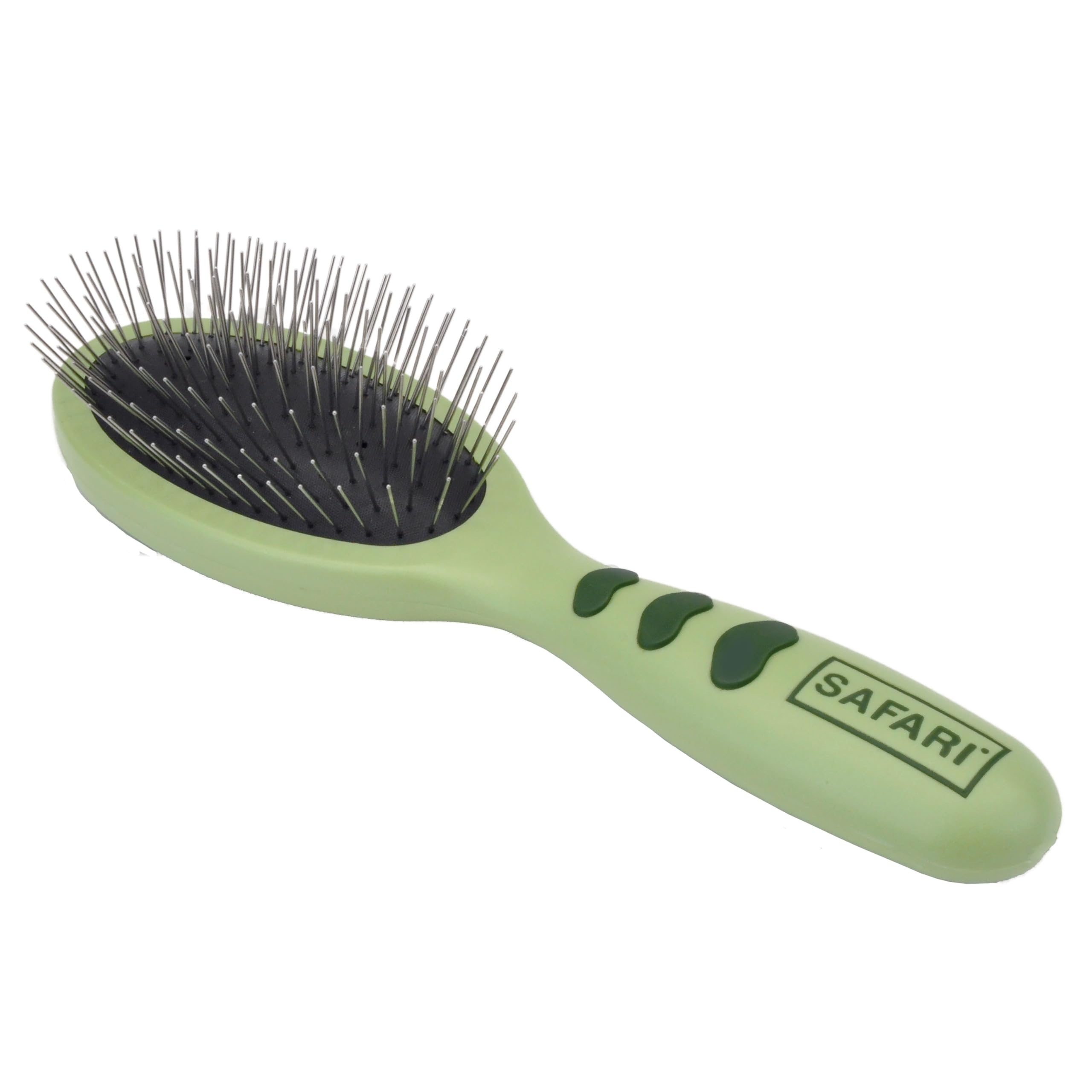
SaveSafari Wire Pin Bamboo Brush — Simple Daily Finishing
For maintenance between deeper grooming sessions, a straightforward pin brush is often easier to reach for than a rake. Safari’s large bamboo-handled wire pin brush measures about 9.75 inches long by 2.75 inches wide and is intended for both long and short coats. Short strokes help pick up debris while longer strokes can spread natural oils across the topcoat. Its weakness is also its strength: the gentle pin layout does not bite deeply into compacted Chow undercoat, so pair it with a rake or long-pin slicker rather than expecting it to replace one.
- Large 9.75-inch body suits bigger dogs
- Gentle wire pins support daily use
- Bamboo handle gives secure grip
- Too gentle for packed seasonal undercoat
| Large length | 9.75 in |
| Width | 2.75 in |
| Handle | Bamboo |
| Best role | Topcoat finishing |
7.2/10
9.5/10
9.1/10

Safari Shed Magic Medium-to-Long Hair — Focused Loose-Coat Removal
When shedding is the main problem and a simple rake is not collecting enough loose coat, the Shed Magic adds multiple rows of stainless-steel blades. The medium version is about 6.25 inches long by 3.675 inches wide, while the large is roughly 6.5 by 3.5 inches, making either manageable around a Chow’s body. Its comfort-grip handle is useful when working through a lot of loose fur. Because the head is more aggressive than a pin brush or rotating rake, use deliberate passes rather than repeatedly working the same patch; the goal is loose undercoat removal, not maximum hair extraction at any cost.
- Multiple stainless-steel blades collect loose hair
- Designed for medium-to-long coats
- Textured handle aids control
- More aggressive than needed for routine finishing
| Coat type | Medium-long |
| Blade material | Stainless steel |
| Medium length | 6.25 in |
| Best role | Deshedding |
9.2/10
7.6/10
8.8/10

Andis Premium Large Firm Slicker — Wide Body Coverage
If you want to cover the back and flanks quickly, the Andis Large Firm gives you a broad working surface rather than a narrow detail head. Its bristled area is approximately 5 inches across by 2.5 inches long, and the fine wire pins bend slightly at their tips. That makes it useful for medium-to-large dogs with dense fur and light-to-moderate matting. The wires are not coated, however, so it ranks lower for sensitive Chow areas; use light pressure and switch to a gentler tool around the face, ears, armpits, and any irritated skin.
- About 5-inch-wide bristled area
- Firm design suits dense body coat
- Large head reduces passes on broad sections
- Uncoated wires require extra care near sensitive skin
| Bristle width | About 5 in |
| Bristle length | About 2.5 in area |
| Pin tips | Fine, bent |
| Best role | Broad slicker work |
8.5/10
7.5/10
8.5/10
Top 3 Head-to-Head: Big G vs Safari Rake vs FURminator Rake
These three cover the most common final decision: one premium slicker for full grooming or one dedicated rake for heavy undercoat removal.
| Feature | #1 Big G | #2 Safari Rake | #3 FURminator Rake |
|---|---|---|---|
| Undercoat reach | 9.8/10 — Best | 9.7/10 | 9.5/10 |
| Coat gentleness | 9.2/10 — Best | 9.1/10 | 9.0/10 |
| Handling & cleanup | 9.0/10 | 9.3/10 — Best | 9.3/10 — Best |
| Choose if… | You want one premium primary brush | Dense undercoat is the main problem | You want simple rotating-tooth raking |
Who These Brushes Are NOT For
Not every coat problem should be solved by buying a stronger brush.
Smooth-coated Chows also need shedding control, but they generally do not require the same long-pin finishing setup as a full rough coat. Likewise, a dog with sores, hot spots, or unexplained skin sensitivity should have the underlying problem addressed before vigorous brushing resumes.
Common Mistakes to Avoid
Even a well-chosen Chow Chow brush performs poorly when technique leaves the dense undercoat untouched or repeatedly stresses the same area.
Frequently Asked Questions About Brushes for Chow Chows
What type of brush is best for a Chow Chow?
A long-pin slicker plus an undercoat rake is the most useful combination for a rough-coated Chow. Add a pin brush for finishing and a metal comb to check whether each section is fully detangled.
How often should I brush a Chow Chow?
A thorough down-to-the-skin brushing at least weekly is a common breed-club recommendation, with extra sessions during heavy shedding. Some owners brush more frequently around the mane, ears, and trousers because those areas tangle faster.
Should I use an undercoat rake on a Chow Chow?
Yes, an undercoat rake is useful for removing loose wool from a dense double coat, especially during seasonal shedding. Use light pressure and stop rather than forcing the rake through a tight mat.
Can I use a slicker brush every day?
You can use a suitable slicker frequently if the pressure is light and the skin remains comfortable. Daily aggressive brushing over the same areas is unnecessary and can irritate skin.
Do smooth-coated Chow Chows need the same brushes?
Not exactly. Smooth Chows still have a double coat and benefit from undercoat removal, but they usually need less long-pin finishing work than a rough-coated Chow.
Should you shave a Chow Chow to reduce shedding?
Routine shaving is generally discouraged for healthy double-coated dogs because the topcoat and undercoat serve protective and insulating functions. Regular brushing and appropriate undercoat removal are usually the preferred shedding-management approach.
Our Final Verdict
Chow Chow grooming is less about finding one magical brush and more about matching the tool to the layer of coat you are working on. Long-pin slickers separate and lift, rakes remove loose undercoat, and pin brushes finish the coat without unnecessary thinning.
If you want one primary brush, the Chris Christensen Big G is our strongest overall choice because its 27 mm pins combine deep reach with broad coverage. If seasonal undercoat is your biggest problem, the Safari Double Row Undercoat Rake is the more focused pick. If you need a more value-oriented long-hair slicker, the Safari Curved Firm Slicker gives you extra-long tips and a body-contouring head without the premium positioning of the Big G.

Thomas Cutter is a lifelong dog owner and the founder of FindOutAboutDogs.com. With over 10 years of hands-on experience owning multiple breeds, Thomas created this site to provide honest, research-based dog advice that real owners can actually trust.
