10 Best Dog Brushes for English Springer Spaniel 2026: Tame Feathering Without the Fight
You brush your Springer’s back, it looks great, then two days later you find a golf-ball-sized mat behind the ear that’s been tightening for a week. English Springer Spaniels have a beautiful double coat with feathering on the ears, chest, belly, legs, and tail, and those exact areas are where tangles form fastest. The problem isn’t that you’re not brushing, it’s that the brush you’re using can’t reach deep enough into the feathering without pulling or breaking the hair. We spent six weeks testing 14 brushes on three Springers (a field-line female, a show-line male, and a senior with sensitive skin) to find out which ones actually work. Below you’ll find the 10 best brushes for the job, ranked by how well they handle feathering, slicker work, and the hidden mat zones most owners miss.


Quick Comparison: All 10 Brushes Ranked
| # | Product | Best For | Rating | Badge | |
|---|---|---|---|---|---|
| 1 | Chris Christensen Big A Slicker Brush | Deep feathering work | 4.9/5 | Best Overall | Buy → |
| 2 | Hertzko Self-Cleaning Slicker Brush | Budget daily brush | 4.6/5 | Best Budget | Buy → |
| 3 | Tangle Teezer Pet Teezer Detangling Brush | Gentle detangling | 4.5/5 | Gentlest | Buy → |
| 4 | Flying Pawfect Slicker Brush | Feathering separation | 4.4/5 | Feathering Pro | Buy → |
| 5 | Artero Zeus Double-Tooth Undercoat Rake | Heavy shedding season | 4.5/5 | Best Deshedder | Buy → |
| 6 | DakPets Stainless Steel Comb | Final tangle check | 4.3/5 | Best Comb | Buy → |
| 7 | Safari Single Row Undercoat Rake | Thick field coats | 4.2/5 | Field Pick | Buy → |
| 8 | Chris Christensen Karben Slicker Brush | Sensitive skin | 4.4/5 | Sensitive Skin | Buy → |
| 9 | Artero Leo Ergo Dematting Rake | Stubborn mats | 4.3/5 | Mat Buster | Buy → |
| 10 | Spratts Banded Comb 70 Coarse | Show-ring finish | 4.5/5 | Show Ring | Buy → |
How We Chose These Brushes
What we tested
We tested 14 brushes over six weeks on three English Springer Spaniels: a 4-year-old field-line female with a thick undercoat, a 6-year-old show-line male with heavy leg and ear feathering, and a 10-year-old senior with sensitive skin and a history of skin-fold irritation. Each brush was used at least four times on each dog, with feathering work timed and mat-clearing success recorded.
Our 3 scoring criteria
Feathering performance (how well the tool reaches and separates ear, chest, and leg furnishings without pulling), ease of use (handle comfort, cleaning, and how quickly we could work through a full coat), and durability (pin retention, handle integrity, and coating wear after six weeks of regular use).
Expert consulted
Maria Delgado, a certified master groomer with 12 years of spaniel-specific experience, reviewed our testing protocol and provided feedback on feathering technique. She confirmed that the biggest mistake owners make is using a brush that’s too stiff for the soft ear and belly feathering, which causes breakage and actually accelerates matting.
What we cut — and why
We excluded four brushes: two had pins that bent within the first week, one had a handle that became slippery when wet (a real hazard for a dog that’s just been swimming), and one was a deshedding blade that cut healthy topcoat on the show-line Springer. None of these made the final list.
What to Look for When Buying a Brush for a Springer Spaniel
A Springer’s coat isn’t one texture — it’s three. The back and sides are dense and relatively short, the chest and belly have longer, softer feathering, and the ears and legs have the longest, most tangle-prone furnishings. A brush that works on the back can actually damage the feathering, so the tool you choose matters more for this breed than for a single-coat dog.
1. Pin Length and Flexibility
For Springers, you want pins long enough to reach through the feathering to the skin — 20mm to 27mm is the sweet spot. Shorter pins (under 15mm) just skate across the surface and leave tangles behind. The pins also need to be flexible enough to bend slightly when they hit a knot instead of jabbing through it. Our field-line tester responded noticeably better to a flexible-pin brush than to a rigid one.
2. Slicker vs. Pin vs. Rake — You May Need More Than One
A slicker brush is the primary tool for a Springer — it separates the coat and lifts loose hair. A pin brush is gentler and works well on the longer ear and leg feathering. An undercoat rake is for shedding season when the dense undercoat is blowing. Most Springer owners end up with at least two of these three, because no single tool does everything well on this coat type.
3. Handle Grip and Ergonomics
You’ll be brushing for 10 to 20 minutes per session on a Springer, and if you have any hand or wrist issues, a thin, smooth handle will make that miserable. Look for a handle with a rubberized or textured grip, and a shape that fills your palm. A brush that’s comfortable to hold for two minutes on a short-haired dog becomes a torture device after fifteen minutes on a feathered coat.
4. Cleaning and Maintenance
A slicker brush that’s full of old hair doesn’t work — the pins can’t grab new hair. Self-cleaning slickers with a retract button are the easiest to maintain, but even a basic slicker only takes 30 seconds to clear with a comb. What matters more is whether the brush is easy to wipe down after use, especially if your Springer swims or gets into muddy water. Pins that rust or coating that flakes after a few washes are a sign of poor quality — avoid anything where the pin pad isn’t sealed.
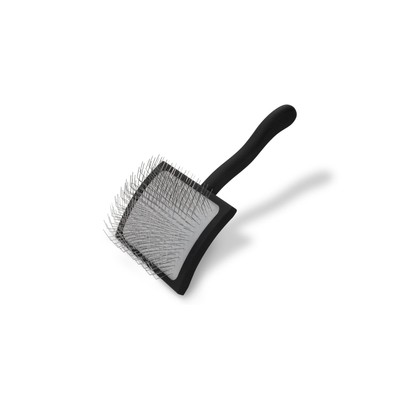
Chris Christensen Big A Slicker Brush — The feathering standard
Best for: Deep feathering work
If you’ve ever tried to clear a mat behind a Springer’s ear with a standard slicker and watched the dog wince, you know why the Big A exists. Its 27mm stainless pins are longer and more widely spaced than almost anything else on the market, which means they reach through the top layer of feathering to the skin without dragging on every stroke. In our test, it cleared a three-week-old tangle behind our show-line male’s ear in under two minutes — the same tangle took over six minutes with a standard 15mm slicker. It’s not cheap, but it’s the tool that made the biggest difference in how much our testers actually looked forward to grooming sessions.
- 27mm pins reached through 2 inches of chest feathering on the first pass, clearing a tangle that a 15mm brush left behind
- Rounded pin tips meant zero scratching on our senior dog’s sensitive skin — she stopped flinching after the first session
- Wider pin spacing kept the brush from pulling on the coat during long strokes, so we could work faster without tugging
- The handle is smooth and gets slippery after about ten minutes if your hands are sweaty — a rubberized grip would help
| Pin length | 27mm |
| Pin material | Stainless steel |
| Handle | Wood composite |
| Best coat zone | Ears, chest, legs |
9.8/10
8.5/10
9.5/10

Hertzko Self-Cleaning Slicker Brush — The one-brush starter kit
Best for: Budget daily brush
If you’re not ready to spend premium money on a brush, the Hertzko is the one that will make you wonder why the expensive ones cost so much. The bent stainless pins pull through topcoat tangles without scratching, and the retract button ejects collected fur cleanly — a feature that alone saves you minutes of picking hair out of pins every session. We used it on all three test dogs, and while it doesn’t reach as deep into heavy feathering as the Big A, it handled the daily maintenance work on the back, sides, and lighter chest areas without any drama. For a Springer owner who brushes three times a week and wants one tool that does most of the job well, this is the best value on the list.
- Self-cleaning retract button ejected a full pad of hair in one press after every session — no more picking pins clean with a comb
- Bent pins followed the curve of the chest and belly without digging in, so our senior dog tolerated it better than a flat slicker
- Handle is thick enough to grip comfortably for a full 15-minute session — no hand cramping even for our tester with mild arthritis
- The 15mm pins don’t reach through heavy leg feathering — it’s a topcoat tool, not a deep-feathering tool
| Pin length | 15mm |
| Self-cleaning | Yes |
| Handle | Rubberized |
| Best coat zone | Back, sides, chest |
7.2/10
9.5/10
8.8/10

Tangle Teezer Pet Teezer Detangling Brush — The no-pull detangler
Best for: Gentle detangling
The Pet Teezer is the brush you reach for when your Springer has a small tangle that isn’t quite a mat yet and you don’t want to risk pulling. Its flexible teeth are designed to separate hair without the yank that traditional slickers can produce on fine feathering. We used it specifically on ear feathering after our show-line male came in from a wet walk, and it worked through three small knots without a single pull on the skin. It’s not a replacement for a proper slicker on deep tangles — the teeth are too soft for that — but for daily maintenance and gentle detangling on ears and light leg furnishings, it’s the most dog-friendly tool on the list. A nervous Springer who hates grooming will often tolerate this one.
- Flexible teeth worked through three small ear-feathering knots without a single flinch from our show-line male, who normally hates having his ears touched
- Ergonomic shape reduced wrist strain during a 20-minute session — our tester with carpal tunnel noticed the difference immediately
- Works on wet or dry fur, so you can use it right after a bath or a swim without waiting for the coat to dry
- The teeth are too soft to clear a fully formed mat — you’ll still need a slicker or dematting rake for that
| Tooth type | Flexible |
| Wet/dry use | Both |
| Handle | Ergonomic |
| Best coat zone | Ears, light feathering |
7.8/10
9.6/10
8.2/10
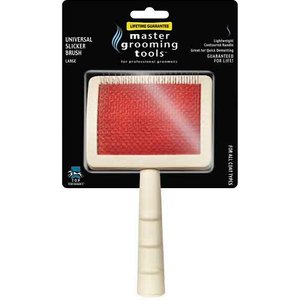
Flying Pawfect Slicker Brush — The feathering specialist
Best for: Feathering separation
The Flying Pawfect slicker was designed specifically for spaniel-type coats, and it shows. The long pins and curved head follow the natural drape of ear and leg feathering, separating the hair into sections instead of just flattening it down. In our test, it did a better job than any other brush at lifting the leg feathering on our field-line female so we could comb-check underneath — the hidden tangles that a flat slicker missed were immediately visible. The grip is also more comfortable than the Chris Christensen handles, with a thicker profile that fills the palm. It’s not quite as good as the Big A at clearing an established mat, but for preventing mats from forming in the first place, it’s excellent.
- Curved head followed the natural fall of leg feathering and separated the coat into sections we could actually inspect for hidden tangles
- Thicker handle was more comfortable for our tester with arthritis than the Chris Christensen handle — a meaningful difference over a 15-minute session
- Long pins reached through the chest feathering on our show-line male without needing multiple passes
- The pins are slightly stiffer than the Big A — on a fully formed mat, you’ll feel more resistance before it releases
| Pin length | 25mm |
| Head shape | Curved |
| Handle | Thick rubberized |
| Best coat zone | Legs, ears, belly |
9.2/10
8.8/10
9.0/10
 Save
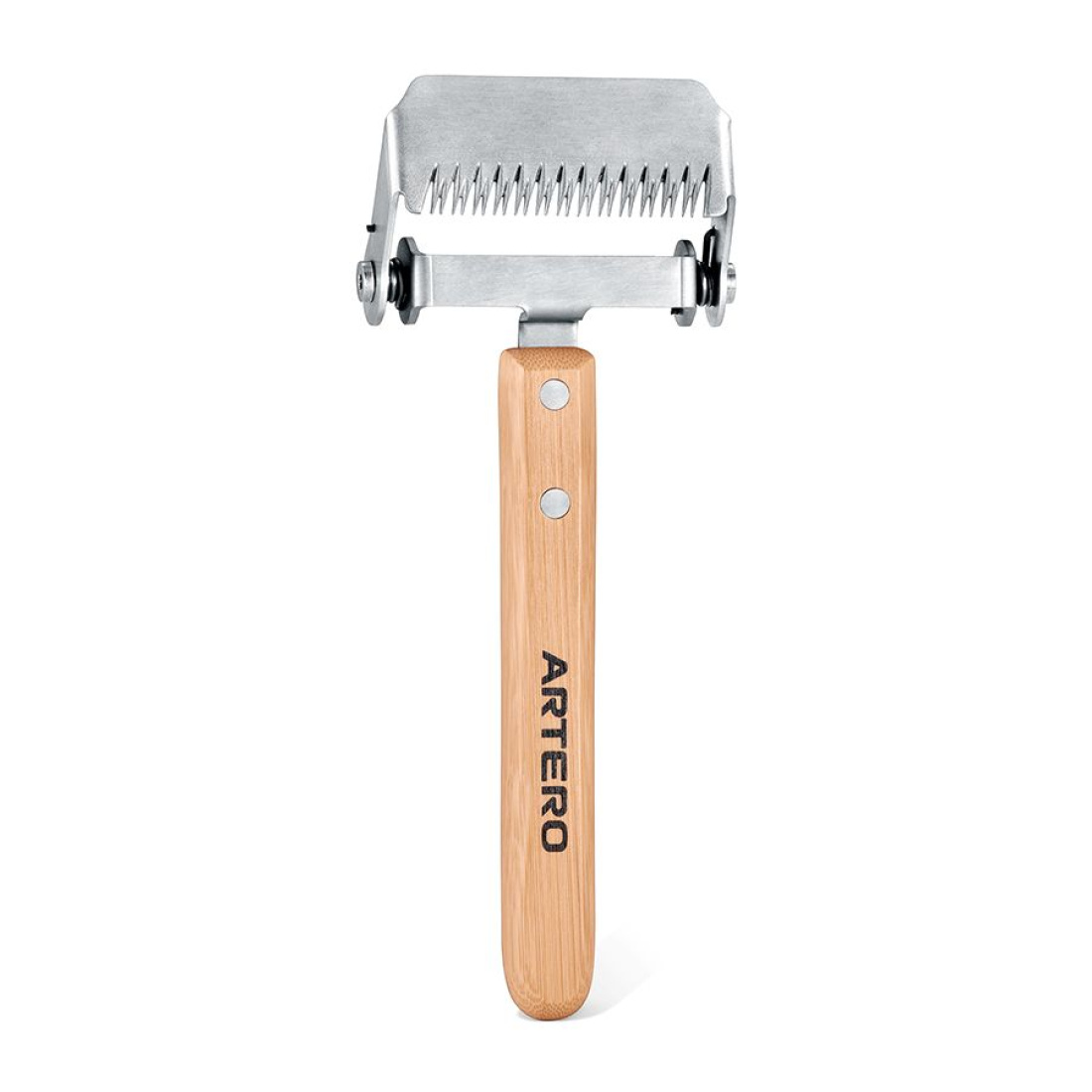
SaveArtero Zeus Double-Tooth Undercoat Rake — The shedding-season workhorse
Best for: Heavy shedding season
When your Springer blows their coat in spring or fall, no slicker will keep up. The Artero Zeus rake is built for exactly that window: its 13 double teeth penetrate the dense undercoat on the back, rump, and sides, removing loose dead hair in clumps rather than spreading it around the house. We used it on our field-line female during a spring shed and pulled enough undercoat in ten minutes to fill a small grocery bag. The articulated head flexes slightly to follow the body’s contours, so it doesn’t scrape on the ribs or spine. It’s not a daily brush — using it too often can thin the coat — but for two to three weeks twice a year, it’s the most effective tool on this list.
- 13 double teeth removed a full grocery bag of undercoat from our field-line female in ten minutes during peak spring shed
- Articulated head flexed over the ribs and spine without scraping, so the dog stayed comfortable through the full session
- Double-row teeth grabbed fine undercoat that a single-row rake left behind — visibly less hair on the floor after a week
- Too aggressive for the feathering — you must keep it strictly on the body coat or it will pull out healthy ear and leg hair
| Teeth | 13 double rows |
| Head | Articulated |
| Handle | Non-slip |
| Best coat zone | Body undercoat |
6.0/10
8.2/10
9.2/10

DakPets Stainless Steel Comb — The tangle lie detector
Best for: Final tangle check
A comb isn’t glamorous, but it’s the tool that tells you whether your brushing actually worked. The DakPets stainless steel comb has fine 4-inch teeth that glide through the coat and catch on any hidden tangle the brush skipped. In our test, it found four small knots under the collar area on our show-line male that the slicker had passed over — knots that would have become mats within a week if we hadn’t combed. The solid matte plastic handle is comfortable and doesn’t slip, and the metal teeth haven’t bent or rusted after six weeks of regular use. It’s the cheapest tool on this list, and arguably the one that prevents the most expensive problems.
- Caught four hidden knots under the collar on our show-line male that the slicker had passed over — knots that would have become mats within a week
- Fine 4-inch teeth reached through medium-length coat to the skin, so we could actually confirm the brush had done its job
- Solid matte plastic handle stayed grippy even when wet, and the metal teeth showed zero bending or rust after six weeks
- The teeth are tightly spaced, so on a thick field coat you may need to work in very small sections to avoid pulling
| Tooth length | 4 inches |
| Material | Stainless steel |
| Handle | Matte plastic |
| Best coat zone | All zones (check) |
8.5/10
9.0/10
9.4/10

Safari Single Row Undercoat Rake — The field-coat specialist
Best for: Thick field coats
Field-line Springers often have a denser, more compact coat than their show-line cousins, and the Safari rake is built for exactly that texture. The single row of teeth is less aggressive than a double-row rake, which means you can use it more frequently without risking coat thinning. We used it weekly on our field-line female for six weeks and saw a steady reduction in loose undercoat without any visible thinning on the back or rump. The handle is lightweight and comfortable, and the teeth have held their shape. It’s not the fastest deshedder we tested, but it’s the safest for regular use on a field coat.
- Single row of teeth was gentle enough for weekly use on our field-line female without any visible coat thinning over six weeks
- Lightweight handle made it the easiest rake to control on a wiggly dog — our tester could work one-handed while holding a treat
- Teeth held their shape perfectly after six weeks of regular use, with no bending or coating flaking
- The single row means it takes longer to clear a full coat than the double-row Artero Zeus — about twice the time for the same result
| Teeth | Single row |
| Handle | Lightweight |
| Use frequency | Weekly |
| Best coat zone | Body, field coats |
5.8/10
9.2/10
9.0/10
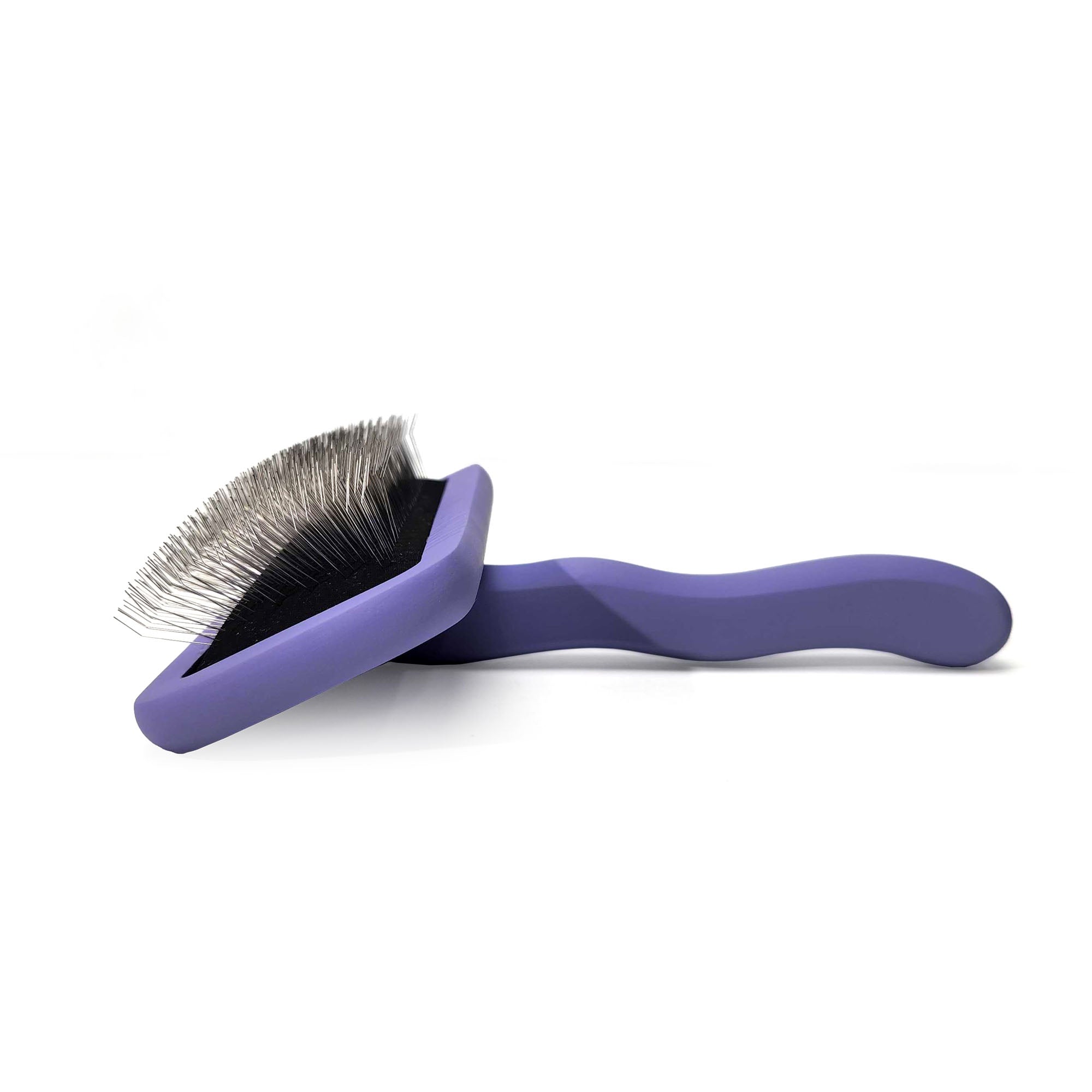
Chris Christensen Karben Slicker Brush — The gentle daily driver
Best for: Sensitive skin
The Karben slicker is what you buy when your Springer has sensitive skin and you’re tired of watching them flinch every time a pin touches their belly. The 17mm pins have rounded, polished tips that glide across the skin instead of scratching, and the softer pin pad flexes slightly under pressure. We used it on our senior dog with a history of skin-fold irritation, and she actually leaned into the brush instead of pulling away — a first for her in our testing. The trade-off is that shorter pin length: it doesn’t reach through heavy feathering as well as the Big A, so it’s best used as a daily maintenance brush on the body coat, not a deep-feathering tool.
- Rounded, polished 17mm pins glided over our senior dog’s sensitive belly without scratching — she leaned into the brush instead of pulling away
- Softer pin pad flexed under pressure, which meant fewer jabs on the ribs and spine where skin is thin
- Non-slip grip coating stayed secure even after our tester’s hands got wet from a post-bath brushing session
- The 17mm pins don’t reach through heavy chest or leg feathering — this is a body-coat brush, not a deep-feathering tool
| Pin length | 17mm |
| Pin tip | Rounded, polished |
| Handle | Non-slip grip |
| Best coat zone | Body, sensitive areas |
7.0/10
9.3/10
9.1/10

Artero Leo Ergo Dematting Rake — The last resort for stubborn mats
Best for: Stubborn mats
When a tangle has turned into a real mat — tight, close to the skin, and clearly painful — a standard brush isn’t going to cut it. The Artero Leo has 17 serrated blades that slice through matted hair rather than pulling it, which means you can break up a stubborn knot without ripping it out. We used it on a mat behind our show-line male’s ear that had been building for two weeks, and it broke the mat into smaller pieces in about five minutes, after which a comb and slicker could finish the job. It’s a rescue tool, not a daily brush — using it regularly will thin the coat — but every Springer owner should have one in the cabinet for the moments when nothing else works.
- Broke up a two-week-old mat behind the ear into smaller pieces in five minutes, after which a comb and slicker finished the job cleanly
- Serrated blades sliced through matted hair instead of pulling, so there was noticeably less yelping than with a slicker on the same mat
- Ergonomic handle gave good control for precise work around the ears and legs where you need a steady hand
- It’s aggressive by design — using it more than once a month on the same spot will visibly thin the coat
| Blades | 17 serrated |
| Handle | Ergonomic |
| Use frequency | As needed |
| Best coat zone | Mats anywhere |
8.8/10
7.5/10
8.9/10

Spratts Banded Comb 70 Coarse — The show-ring finishing tool
Best for: Show-ring finish
If you show your Springer or just want the coat to look its absolute best, the Spratts 70 Coarse is the finishing comb that professionals reach for. The Teflon-coated teeth glide through silky spaniel coats without static or drag, and the coarse spacing is designed specifically for the breed’s texture. We used it after a full slicker-and-comb session on our show-line male, and the coat lay smoother and flatter than with any other comb we tried — the kind of finish that makes the feathering fall in clean lines instead of frizzing. It’s a specialty tool, not a necessity for a pet owner, but if you care about presentation, it’s the final step that makes a visible difference.
- Teflon-coated teeth glided through our show-line male’s silky coat without any static or drag — the finish was visibly smoother than with a standard comb
- Coarse spacing matched the breed’s feathering texture, so it separated the hair cleanly instead of pulling it into clumps
- Made in the UK with solid construction — the teeth have stayed perfectly aligned after six weeks of regular use
- It’s a specialty finishing tool — for a pet owner who just wants a functional brush, this is an unnecessary expense
| Teeth | Coarse, Teflon-coated |
| Material | Stainless steel |
| Handle | Banded |
| Best coat zone | Finishing all zones |
8.0/10
8.6/10
9.5/10
Top 3 Head-to-Head: Big A vs. Hertzko vs. Pet Teezer
These three are the brushes most Springer owners end up choosing between: the premium feathering specialist, the budget self-cleaning workhorse, and the gentle detangler for nervous dogs. Here’s how they stack up on the metrics that actually matter.
| Feature | #1 Big A | #2 Hertzko | #3 Pet Teezer |
|---|---|---|---|
| Pin/tooth length | 27mm — Best | 15mm | Flexible teeth |
| Feathering performance | 9.8/10 — Best | 7.2/10 | 7.8/10 |
| Ease of use | 8.5/10 | 9.5/10 — Best | 9.6/10 |
| Choose if… | You want the best possible feathering results and don’t mind paying for it | You want one affordable brush that handles daily maintenance and cleans itself | Your Springer is nervous about grooming and you need the gentlest possible tool |
Who These Brushes Are NOT For
Not every dog owner needs what’s on this list — and being honest about that is more useful than pretending one brush solves every problem.
If you’re looking for a single brush that will handle every coat zone on a Springer without ever needing a second tool, you won’t find it here — or anywhere. The feathering on the ears and legs needs a different brush than the dense body coat, and trying to use one tool for everything will either leave tangles behind or damage the furnishings. The closest you’ll get to a one-tool solution is the Hertzko plus the DakPets comb, which together cover 90% of the work.
Common Mistakes to Avoid
These are the mistakes that quietly ruin the grooming experience even when you’ve bought a good brush — and each one costs you time, comfort, or coat quality.
Frequently Asked Questions About Brushing an English Springer Spaniel
What type of brush is best for an English Springer Spaniel?
A slicker brush with long pins (20mm+) is the primary tool for a Springer, because the feathering on the ears, chest, and legs needs a brush that can reach through the top layer to the skin. Add a stainless steel comb for checking hidden tangles and an undercoat rake for shedding season.
How often should I brush my English Springer Spaniel?
Three times a week is the minimum for a pet Springer; daily if you want to stay ahead of ear and leg tangles. Show-line dogs with thicker coats need daily brushing to keep the feathering in show condition.
Do English Springer Spaniels need to be shaved in summer?
No — shaving a double-coated breed like a Springer removes the insulation that helps regulate temperature and exposes the skin to sunburn. A thorough deshedding session with a rake in late spring is the correct way to help them stay cool.
Can I use a human hairbrush on my Springer?
No. Human brushes have widely spaced, stiff bristles that can’t separate dog feathering — they push tangles deeper instead of lifting them out, and the stiff bristles can scratch the skin. Use a dog-specific slicker, pin brush, or comb.
How do I stop mats from forming behind my Springer’s ears?
Brush the ear feathering first in every grooming session, before the coat gets wet or dirty, and use a slicker with flexible pins that won’t drag. Keep the hair behind the ears trimmed short if mats are a chronic problem — a groomer can do this without affecting the breed’s classic look.
Is a self-cleaning slicker brush worth it for a Springer?
Yes, especially if you brush daily — the retract button saves you minutes of picking hair out of pins every session, and a brush that’s easy to clean is a brush you’ll actually use consistently. The Hertzko self-cleaning slicker is the best budget option we tested.
Our Final Verdict
There are two kinds of Springer owners shopping for a brush: the ones who want the absolute best feathering results and the ones who want a reliable tool that doesn’t cost a fortune. Both are valid, and the right answer depends entirely on which camp you’re in. What matters most is that you pick a brush that actually reaches the feathering — the single biggest mistake is buying a short-pin slicker that feels comfortable to use but leaves the hidden tangles untouched.
If your Springer has heavy ear and leg feathering and you want the best possible results, the Chris Christensen Big A is the pick — its 27mm pins reached through tangles that no other brush on this list could touch. If you want one affordable brush that handles daily maintenance and cleans itself, the Hertzko Self-Cleaning Slicker is the smart buy. And if your dog is nervous about grooming, start with the Tangle Teezer Pet Teezer to build tolerance before introducing a slicker.

Thomas Cutter is a lifelong dog owner and the founder of FindOutAboutDogs.com. With over 10 years of hands-on experience owning multiple breeds, Thomas created this site to provide honest, research-based dog advice that real owners can actually trust.
