How to Brush a Goldendoodle: A Step-by-Step Guide
Quick Answer
To brush a Goldendoodle, work through the coat in small sections with a slicker brush, brushing from near the skin toward the ends. Finish every section with a metal comb so you can catch tangles hidden beneath the fluffy outer coat, a technique that follows general dog coat-care guidance from VCA.
How to brush a Goldendoodle quickly
- Prepare the coat: Start with a dry, comfortable dog and remove collars or harnesses.
- Divide the hair: Lift the coat so you can see a narrow line close to the skin.
- Brush small sections: Use short, gentle slicker strokes from the roots toward the hair ends.
- Work upward: Release another thin layer of hair and repeat the process.
- Check with a comb: Run a steel comb from skin to tip after brushing each area.
- Inspect mat zones: Check behind the ears, armpits, legs, chest, collar area, and tail.
The finishing test
- Comb to the skin: If the comb glides through without catching, that section is finished.
Goldendoodles can look perfectly fluffy while tight tangles are forming underneath. That hidden matting is why simply brushing across the surface often isn’t enough.
The method I recommend is simple: slicker brush first, metal comb second. Once you learn to work in narrow sections, keeping a Goldendoodle’s coat manageable becomes much easier.


What Is Line Brushing a Goldendoodle?
Line brushing is a grooming method where you separate the coat into thin horizontal sections and brush each section from near the skin outward. You gradually move across the dog instead of brushing only the visible top layer.
This technique matters because a Goldendoodle’s curly or wavy hair can hide knots close to the body. A fluffy-looking coat isn’t proof that the hair underneath is tangle-free.
- Surface brushing: Mostly smooths the visible outer hair.
- Line brushing: Separates and brushes the coat down near its roots.
- Comb checking: Confirms that hidden tangles aren’t left behind.
My practical rule is straightforward. If a metal comb can’t move from the roots through the ends, I don’t consider that section finished.
What Brush Should You Use on a Goldendoodle?
For most medium-to-long Goldendoodle coats, start with a slicker brush and finish with a stainless-steel grooming comb. A pin brush can help with light maintenance, but it shouldn’t replace the comb check on a mat-prone coat.
The American Kennel Club’s dog-brush guidance recommends slicker brushes for curly and longer coats and stresses using a light touch.
| Tool | Best Use | Goldendoodle Role | Main Caution |
|---|---|---|---|
| Long-pin slicker | Separating dense, curly hair | Primary brushing tool | Don’t press hard against skin |
| Steel comb | Finding hidden knots | Final tangle check | Never force through a tight mat |
| Pin brush | Light coat maintenance | Optional finishing tool | May miss deeper tangles |
| Detangling spray | Adding slip to minor tangles | Optional helper | Doesn’t fix severe matting |
Choose a brush size you can control easily. Oversized brushes save little time if you can’t maneuver them around legs, armpits, ears, and other tight areas.
How Do You Brush a Goldendoodle Step by Step?
 Save
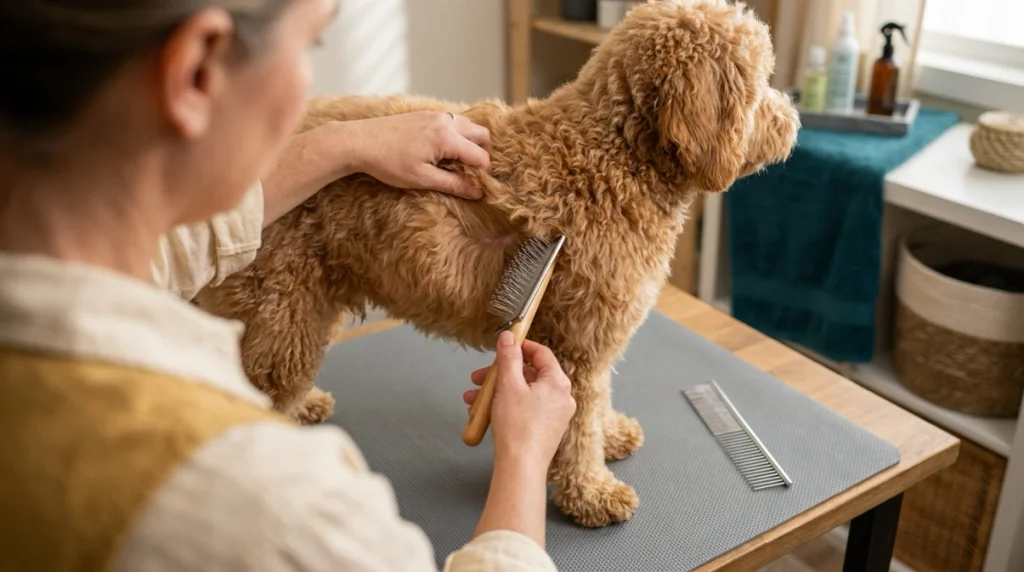
SaveBrush your Goldendoodle by starting low on the body and exposing one narrow section of coat at a time. Brush that section thoroughly, check it with a comb, then release the next layer.
Here’s the complete process I would use for a routine home session.
- Choose a calm location. Use a nonslip surface where your dog can stand or lie comfortably.
- Remove the collar and harness. Hair beneath straps is a common place for friction tangles.
- Start with dry hair. Don’t soak an already tangled coat before you inspect it.
- Lift the coat with one hand. Expose a narrow line of hair close to the skin.
- Use short slicker strokes. Brush in the direction the hair naturally lies without scraping the skin.
- Move from roots toward ends. Work through small snags gradually rather than pulling the entire knot at once.
- Release another layer. Continue upward in thin sections until the area is complete.
- Run a steel comb through it. The comb should reach close to the skin and travel through the ends.
- Revisit anything that catches. Separate the tangle and gently brush it before combing again.
- Reward your dog. Short breaks and treats help prevent grooming from becoming a wrestling match.
Avoid dragging the slicker repeatedly across bare skin. The pins need to move through hair, not scrape the same spot over and over.
Where should you start brushing?
I find it easier to work systematically instead of jumping between areas. You can start on one rear leg, move across the body, then finish the chest, neck, front legs, tail, and head.
- Rear legs and feet
- Hindquarters
- Sides and back
- Belly and armpits
- Chest and shoulders
- Front legs and feet
- Neck and collar area
- Tail
- Ears, cheeks, and head
The exact order matters less than consistency. Following the same pattern helps you avoid accidentally skipping an entire area.
How Often Should You Brush a Goldendoodle?
Most Goldendoodles need brushing several times each week, while longer or curlier coats may need attention daily. Coat length, curl, activity, moisture, and friction all change how quickly tangles develop.
PetMD’s Goldendoodle care guide recommends regular brushing at least a few times weekly and notes that professional grooming is often needed every four to eight weeks.
| Coat Situation | Practical Starting Schedule | What to Watch |
|---|---|---|
| Long, curly or dense coat | Daily or every other day | Deep tangles near the skin |
| Medium wavy coat | About 3-4 times weekly | Behind ears and friction zones |
| Shorter clipped coat | About 2-3 times weekly | New growth and overlooked knots |
| After swimming or wet outdoor play | Inspect once fully managed and dried | Tangles tightening as hair dries |
These frequencies are starting points, not rigid rules. A comb gives you better feedback than a calendar.
If the comb begins catching between scheduled sessions, brush more often. If it consistently glides through easily, your current routine is probably working.
Where Do Goldendoodles Mat the Most?
 Save
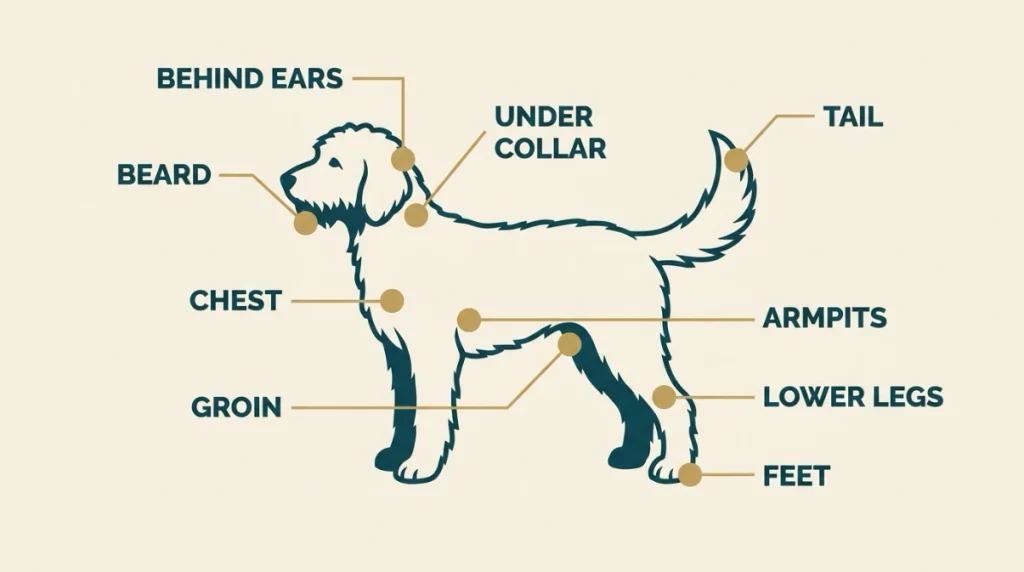
SaveGoldendoodles often mat where hair rubs, bends, stays damp, or gets compressed. These areas deserve a quick check even when you don’t have time for a full-body grooming session.
- Behind the ears: Soft hair rubs whenever the ears move.
- Under the collar: Constant friction can twist hair together.
- Armpits: Leg movement repeatedly compresses the coat.
- Chest: Harnesses and lying down create friction.
- Groin: Fine hair can tangle quickly in this sensitive area.
- Lower legs: Water, dirt, grass, and movement increase knotting.
- Feet: Hair between and around the toes collects debris.
- Tail: Long hair easily tangles around itself.
- Beard: Food, water, and moisture can create knots.
For a fast daily check, I would prioritize the ears, armpits, collar area, legs, and tail. Finding a small tangle early is much easier than dealing with a tight mat later.
How Do You Brush a Goldendoodle’s Face and Ears?
Use smaller tools and slower movements around the face and ears. Support the hair with your fingers so you’re not pulling directly against delicate skin.
The dog’s eyes, ear edges, lips, and ear canal need special care. Never push a slicker brush or comb toward an eye or into the ear canal.
- Cheeks: Brush outward in short strokes.
- Beard: Separate food-stiffened hair before combing gently.
- Behind ears: Feel with your fingers before using the brush.
- Ear leather: Support the ear in your hand while brushing the hair.
- Topknot: Work in small sections away from the eyes.
If your dog keeps jerking away, don’t respond by holding harder and brushing faster. Stop, reduce the size of the section, reward calm behavior, and try again.
What Should You Do If Your Goldendoodle Is Already Matted?
Don’t repeatedly pull a tight mat with a slicker brush. Severe mats can sit close to the skin, making aggressive home removal painful and potentially unsafe.
PetMD’s matting guidance warns against forcing serious mats out with a comb and advises against scissors close to the skin.
- Loose tangle: Separate it with your fingers and brush a few hairs at a time.
- Small knot: Use controlled slicker strokes while supporting the hair near the skin.
- Tight mat: Stop if the skin moves or your dog shows discomfort.
- Large or skin-tight mat: Ask an experienced groomer or veterinarian for help.
Scissors are especially risky because folded skin can become trapped inside a mat. What looks like a safe gap between hair and skin may not be one.
What Are the Most Common Goldendoodle Brushing Mistakes?
The most common mistake is making the coat look neat without confirming that it’s tangle-free underneath. A metal comb exposes that problem immediately.
- Brushing only the top: Hidden knots continue tightening near the roots.
- Skipping the comb: You lose your best test for unfinished areas.
- Pressing too hard: Slicker pins can irritate skin when used aggressively.
- Pulling through mats: This turns grooming into a painful experience.
- Ignoring friction zones: Collars, harnesses, and leg movement accelerate tangling.
- Waiting too long: Small knots become harder to manage.
- Making sessions stressful: Dogs learn to resist brushing when every session involves force.
Another mistake is trying to complete the whole dog when both you and your Goldendoodle are frustrated. Ten calm minutes are more useful than a long session that teaches your dog to fear the brush.
How Can You Make Goldendoodle Brushing Easier?
Make grooming predictable, comfortable, and rewarding. Dogs usually cooperate better when brushing becomes part of normal life instead of an occasional battle with a tangled coat.
- Keep the brush and comb in the same easy-to-reach place.
- Brush after exercise when your dog is calmer.
- Use a nonslip mat or stable grooming surface.
- Give small treats during difficult areas.
- Keep early puppy sessions short.
- Handle paws, ears, tail, and legs outside grooming sessions.
- Stop before your dog becomes overwhelmed.
As of 2026, the basic principle hasn’t changed despite all the new grooming tools available. Consistent technique matters more than owning a drawer full of brushes.
Goldendoodle Brushing Tools I Would Choose
 Save
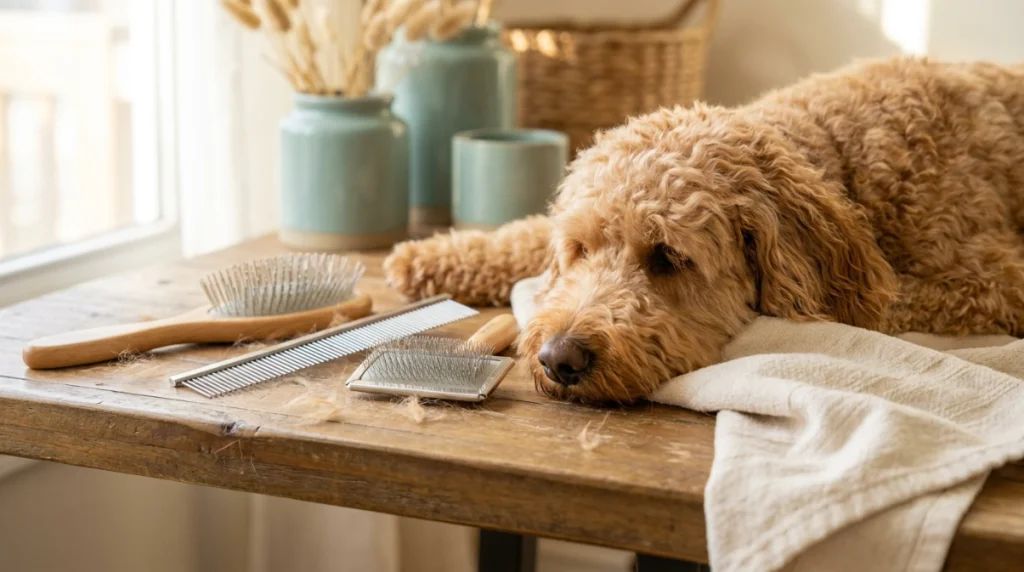
SaveIf you’re building a simple home-grooming kit, I’d start with one capable slicker and one reliable metal comb. You don’t need a dozen specialized tools to maintain a manageable coat.
🏆 Best for Dense Doodle Coats
Chris Christensen Big G Slicker Brush
★★★★★ 4.9/5 editorial fit
The Big G uses 27 mm stainless-steel pins and is designed for long, dense, curly coats. I’d choose it for a longer Goldendoodle coat where reaching through thick hair matters more than having the cheapest brush.
🔎 Best Tangle Check
Andis 7-1/2-Inch Steel Comb
★★★★★ 4.8/5 editorial fit
This 7.5-inch steel comb has coarse and fine tooth spacing for detangling and finishing. For me, the comb is non-negotiable because it tells you whether your slicker actually reached through the coat.
💰 Budget Slicker Pick
Andis Medium Firm Slicker Brush
★★★★☆ 4.5/5 editorial fit
This is a simpler firm slicker from an established grooming-tool brand and costs far less than premium long-pin options. I’d consider it for shorter clips or owners learning the technique before investing in a professional-style brush.
Frequently Asked Questions
Should you brush a Goldendoodle wet or dry?
For routine detangling, inspect and brush a manageable coat when it’s dry rather than soaking existing mats. Water can make some established tangles tighten, so remove knots before bathing and make sure the coat is properly dried afterward.
Can I use a human hairbrush on my Goldendoodle?
A human brush usually isn’t the best primary tool for a dense Goldendoodle coat. A dog slicker brush can reach through curly hair more effectively, while a metal grooming comb lets you check whether tangles remain close to the skin.
Why is my Goldendoodle still matted even though I brush every day?
You may be brushing only the outer coat rather than working down through small sections. Switch to line brushing and use a steel comb afterward, paying extra attention to the ears, armpits, collar area, chest, legs, and tail.
How long should it take to brush a Goldendoodle?
The time varies with coat length, size, condition, and how cooperative your dog is. Don’t rush to finish the whole coat; short, thorough sessions are better than fast surface brushing that leaves hidden tangles underneath.
Can I cut a mat out of my Goldendoodle with scissors?
It’s safer not to use scissors on mats sitting close to the skin because loose skin can be pulled into the tangled hair. For large, tight, painful, or skin-level mats, ask a professional groomer or veterinarian to assess the safest removal method.
The Bottom Line
Learning how to brush a Goldendoodle comes down to one habit: brush in sections and verify your work with a comb. That combination catches the hidden tangles that ordinary surface brushing misses.
Keep sessions gentle, check high-friction areas often, and get professional help when matting becomes tight or painful. A consistent routine is much easier on both you and your Goldendoodle than trying to repair weeks of tangled coat at once.

Thomas Cutter is a lifelong dog owner and the founder of FindOutAboutDogs.com. With over 10 years of hands-on experience owning multiple breeds, Thomas created this site to provide honest, research-based dog advice that real owners can actually trust.
