How to Check a Dog Coat for Hidden Mats
Quick Answer
To check a dog coat for hidden mats, part the hair in small sections and feel from the skin outward with your fingers. Then run a metal comb from the roots to the tips, paying extra attention behind the ears, under the legs, around the collar, groin, tail base, and paws. This veterinary coat-care guidance explains why regular skin-level checks matter.
Quick mat-check steps
- Settle your dog: Start when your dog is relaxed and comfortable being touched.
- Part the coat: Separate the hair until you can see or feel the skin underneath.
- Feel for resistance: Small knots often feel like firm bumps or flattened patches near the skin.
- Use a metal comb: Comb from skin to tip without forcing the teeth through resistance.
- Check friction zones: Inspect behind the ears, armpits, chest, groin, collar area, legs, and tail.
- Stop if it hurts: Tight mats, irritated skin, or painful areas should be handled by a groomer or veterinarian.
A fluffy dog can look perfectly brushed on top while tight knots hide close to the skin. That is why I never judge a coat only by how smooth the surface looks.
The most useful habit is simple: check the coat with your hands and a comb, not your eyes alone. This guide shows you exactly how to do that safely.


What Is a Hidden Mat in a Dog’s Coat?
 Save
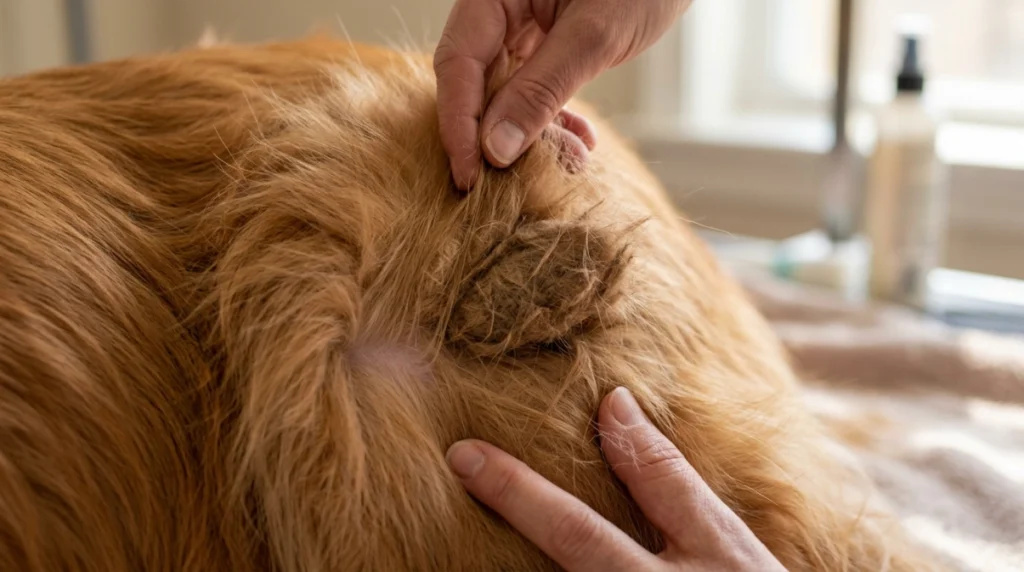
SaveA hidden mat is a compact clump of tangled hair that forms underneath the visible outer coat. It may sit close enough to the skin that normal surface brushing passes right over it.
Mats usually begin with loose hairs, friction, moisture, or small tangles that twist together. Once they tighten, surrounding hairs can become trapped too.
Simple definition: A dog coat mat is a tightly tangled mass of hair that no longer separates normally with gentle finger-combing or an ordinary pass of a comb.
Long, silky, curly, woolly, and dense coats tend to need closer attention. Double coats can also hide compacted loose undercoat beneath a smooth-looking top layer.
As of 2026, veterinary grooming guidance still emphasizes checking beneath the visible coat rather than relying only on surface brushing.
How Do You Check a Dog Coat for Hidden Mats?
The best method is a slow, section-by-section inspection that reaches the skin. You should be able to move your fingers and then a comb through each section without hitting a solid barrier.
1. Start With a Calm, Dry Dog
Choose a quiet time when your dog is relaxed. A dog that is bouncing, twisting, or worried makes a careful coat inspection much harder.
Check the coat while it is dry unless your groomer has told you otherwise. Wet hair can make existing tangles harder to judge and manage.
- Use a stable, non-slip surface.
- Keep treats nearby if they help your dog stay comfortable.
- Work in short sessions with nervous puppies or sensitive dogs.
- Never pin or force a frightened dog into position.
2. Part the Coat Until You Reach the Skin
Use your fingers to make a narrow line through the fur. You should be able to see or clearly feel the skin beneath the hair.
Move across the body in small sections instead of grabbing large handfuls. This makes small knots much easier to find.
3. Feel Before You Brush
Run your fingertips through the hair near the roots. A hidden mat may feel like a small lump, thick patch, rope-like knot, or flattened piece of felt.
Pay attention when your fingers stop moving freely. That resistance tells you where to inspect more carefully.
- Soft snag: Often a minor tangle that may separate gently.
- Firm clump: More likely to be a developing mat.
- Hard felted patch: Often too tight for routine home brushing.
- Pain or skin pulling: Stop and avoid forcing the area.
4. Use the Metal-Comb Test
After finger-checking a section, pass a stainless-steel grooming comb from near the skin toward the ends. Use light pressure and stop when the comb meets resistance.
My rule is simple: if the comb cannot pass smoothly from the roots to the tips, I do not consider that section fully mat-free.
A slicker brush can make the outer coat look polished while leaving a knot underneath. The comb is your final check.
Where Do Hidden Mats Usually Form on Dogs?
Hidden mats form most often where hair rubs against hair, equipment, moisture, or moving body parts. These areas deserve extra attention during every coat check.
| Area | Why mats hide there | Best check |
|---|---|---|
| Behind the ears | Fine hair moves and rubs constantly | Finger-part, then use the narrow end of a comb |
| Armpits | Leg movement creates repeated friction | Lift the leg gently and inspect from skin outward |
| Collar or harness area | Straps rub the same hair repeatedly | Remove gear before checking |
| Groin and belly | Soft hair and body movement encourage tangles | Use fingers first because the skin is sensitive |
| Back of the legs | Long feathering tangles during movement | Section feathering into thin layers |
| Tail and tail base | Dense hair can conceal knots | Separate the coat with fingers before combing |
| Between toes | Moisture, debris, and fine hair collect together | Spread toes gently and inspect visually |
The American Kennel Club’s home-grooming guidance specifically notes that mats frequently appear behind the ears and under the legs.
VCA also recommends watching the armpits, groin, behind the ears, and backs of the legs. These are the areas I would check first if you only have a few minutes.
How Can You Tell a Tangle From a True Mat?
 Save
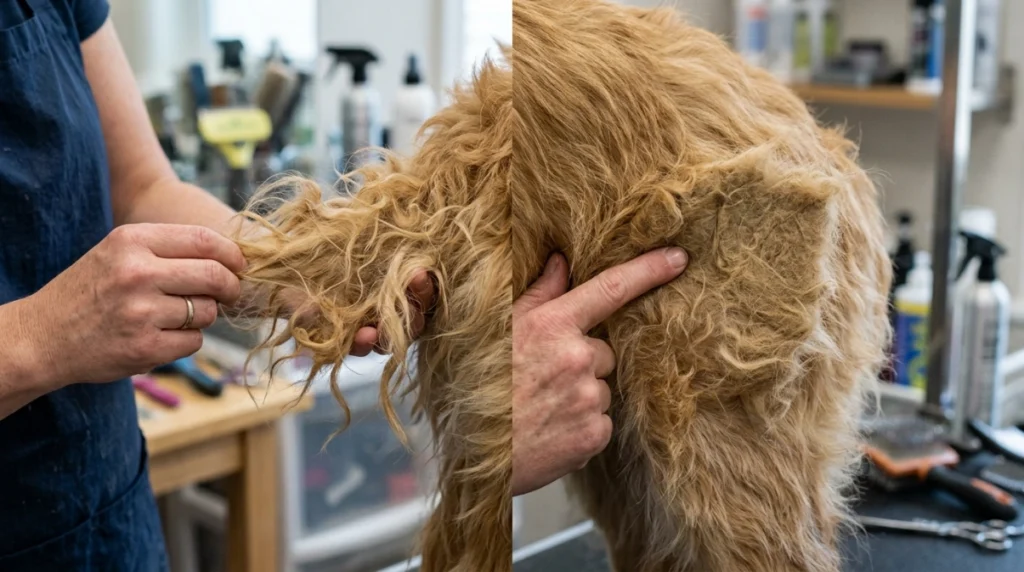
SaveA loose tangle usually separates with gentle finger work and a comb. A mat feels denser and pulls several hairs together as one compact mass.
Do not judge the problem only by size. A tiny mat sitting tightly against thin skin may require more caution than a larger loose knot near the ends.
| What you find | How it feels | Best response |
|---|---|---|
| Loose tangle | Soft and movable | Work gently with fingers and comb |
| Developing mat | Firm clump with limited movement | Use caution and stop if the skin pulls |
| Tight mat | Dense, felt-like, close to skin | Professional groomer is usually safest |
| Mat with irritated skin | Painful, damp, red, odorous, or sore | Contact your veterinarian |
What Tools Make Hidden Mats Easier to Find?
You do not need a huge grooming kit for a basic mat inspection. Your fingers, the correct brush for the coat, and a sturdy metal comb cover most checks.
Metal Grooming Comb
A metal comb is my favorite final-check tool because its teeth expose resistance that surface brushing can miss. A combination comb with wider and narrower spacing works well for many medium and long coats.
Slicker Brush
A slicker brush uses closely spaced wire pins to lift loose hair and work through minor tangles. It is especially useful on many curly, woolly, and longer coats.
Use a light hand because repeated scraping can irritate sensitive skin. You can review AKC’s dog grooming resources when matching grooming techniques to coat type.
Undercoat Rake
An undercoat rake can help with dense double coats when loose undercoat begins compacting beneath the guard hairs. It is not a replacement for the comb test.
- Curly or wool coat: Slicker brush plus metal comb.
- Long silky coat: Pin or slicker brush plus metal comb.
- Dense double coat: Appropriate brush, undercoat tool, and comb.
- Short smooth coat: Bristle or rubber grooming tool plus hand inspection.
Should You Remove a Hidden Mat Yourself?
You can sometimes work through a small, loose tangle if it separates without pulling the skin. Tight, extensive, painful, or skin-level mats are different.
Never keep pulling because you want to finish the job. Dog skin moves with the coat, so forcing a mat can hurt.
Safety warning: Do not slide household scissors underneath a tight mat. Skin can be pulled into the mat and may be much closer to the blades than it appears.
VCA’s coat-care safety guidance also advises against reaching for scissors around mats and tangles.
Get professional help when you find any of these problems:
- A mat that lies tightly against the skin.
- Several mats connected across a larger area.
- Red, damp, smelly, crusted, or bleeding skin.
- A dog that cries, snaps, freezes, or repeatedly pulls away.
- A mat around the eyes, ears, genitals, or other delicate areas.
- Debris or a foreign object trapped inside the mat.
A professional groomer can decide whether careful clipping is safer than dematting. Skin irritation or wounds deserve veterinary attention.
How Often Should You Check Your Dog for Hidden Mats?
The inspection schedule should match the coat. Dogs with long, silky, curly, or continuously growing hair generally need much more frequent coat checks than smooth-coated dogs.
For high-mat coats, a quick daily hand check is easier than dealing with a neglected mat later. Give extra attention after swimming, rain, muddy walks, harness use, or active outdoor play.
- Curly or woolly coats: Check problem areas daily.
- Long silky coats: Check daily, especially ears, legs, and friction points.
- Dense double coats: Check regularly and increase grooming during heavy shedding.
- Short smooth coats: Use routine brushing sessions to inspect the skin and coat.
The goal is not to spend an hour grooming every day. A focused two-minute check of the common friction zones can catch a knot while it is still small.
How Can You Prevent Hidden Mats From Coming Back?
Prevention comes from reaching all the way through the coat during routine grooming. Brushing only the fluffy outer layer creates a false sense of progress.
Finish each section with the comb test whenever your dog’s coat type allows it. The comb should travel through without repeatedly catching.
- Brush before small tangles tighten.
- Dry the coat thoroughly after bathing or swimming.
- Inspect underneath collars, sweaters, and harnesses.
- Remove burrs and outdoor debris promptly.
- Keep professional grooming appointments appropriate for the coat.
- Ask your groomer to show you the exact home technique your dog’s coat needs.
Consistency matters more than aggressive brushing. Gentle grooming done often is easier on both you and your dog.
Dog Grooming Tools I Would Consider for Mat Checks
 Save
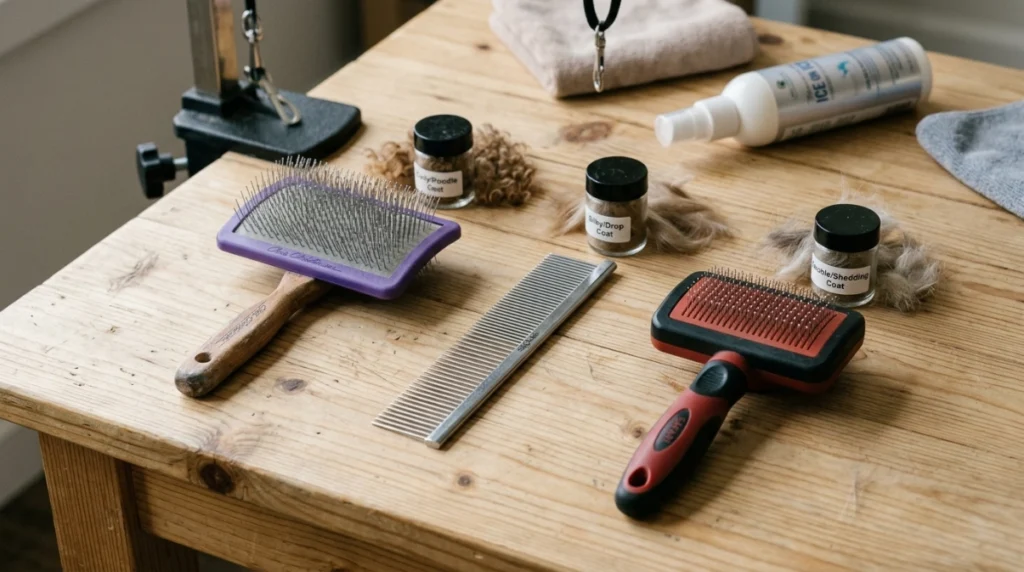
SaveIf you are building a simple home grooming kit, I would start with tools that help you reach the coat properly rather than buying several gadgets that do the same job.
🏆 Best for curly and dense coats
Chris Christensen Big G Slicker Brush
★★★★★ 4.8/5
The long-pin slicker design makes it useful for working through fuller curly and dense coats in small sections. I would pair it with a metal comb rather than using the slicker alone as proof that the coat is mat-free.
🔎 Best for finding hidden knots
Andis Steel Pet Comb
★★★★☆ 4.7/5
A sturdy metal comb is one of the simplest ways to expose tangles hiding beneath a brushed surface. I like a combination of wider and finer teeth because it gives you more control across different coat sections.
💰 Practical everyday option
Safari Self-Cleaning Slicker Brush
★★★★☆ 4.5/5
This is a straightforward slicker option for routine loose-hair and tangle control on suitable coats. The self-cleaning design also makes frequent short grooming sessions easier to manage.
Frequently Asked Questions
Can a dog have mats even if the coat looks brushed?
Yes. A brush can smooth the visible outer coat while small tangles remain closer to the skin. Part the hair into sections and finish with a metal comb to check whether the coat is truly free of hidden resistance.
What do hidden dog mats feel like?
Hidden mats often feel like firm bumps, rope-like knots, flattened clumps, or felted patches beneath the outer coat. A developing mat usually moves less freely than the surrounding hair and may pull the skin when touched.
Where should I check first for mats?
Start behind the ears, underneath the front legs, around the collar or harness, in the groin, along the backs of the legs, around the tail, and between the toes. Friction and fine hair make these areas common trouble spots.
Should I cut a mat out with scissors?
No. Tight mats can pull skin upward into the hair, making it difficult to see where the skin ends. A groomer or veterinarian is safer for close, extensive, painful, or difficult mats.
Should I brush a dog before or after a bath if mats are present?
Check for tangles and mats before bathing. Water can tighten or complicate tangled hair, so deal with existing coat problems before the bath whenever it is safe to do so.
Final Takeaway
Learning how to check a dog coat for hidden mats comes down to one habit: inspect from the skin outward. Part the coat, feel each section, and use a metal comb to confirm that nothing is hiding underneath.
Pay extra attention to friction zones and never force a painful mat. Catching a tiny knot today is far easier than dealing with a tight mat next week.

Thomas Cutter is a lifelong dog owner and the founder of FindOutAboutDogs.com. With over 10 years of hands-on experience owning multiple breeds, Thomas created this site to provide honest, research-based dog advice that real owners can actually trust.
