What Happens If You Never Brush Your Dog? (Timeline, Coat Risks, and Prevention)
Quick Answer
If you never brush your dog, shed hair traps skin oils, dirt, and moisture against the body, forming tight mats that pull on the skin and block airflow. Understanding how often you should brush your dog prevents painful bacterial hot spots, hidden parasite infestations, restricted blood flow, and overheating.
Key Consequences of Skipping Brushing
- Severe coat pelting: Loose undercoat tangles with outer hairs to form a dense, felt-like shell over the skin.
- Painful skin sores: Trapped dampness breeds bacteria and yeast, leading to raw, oozing lesions called hot spots.
- Cut-off circulation: Tight mats around the ears, tail, or legs constrict blood vessels and cause tissue damage.
- Hidden pest infestations: Fleas, ticks, and barbed grass seeds burrow beneath compacted fur where you cannot see them.
- Broken temperature control: Impacted fur blocks summer cooling airflow and ruins winter thermal insulation.
How to Check Your Dog’s Coat Right Now
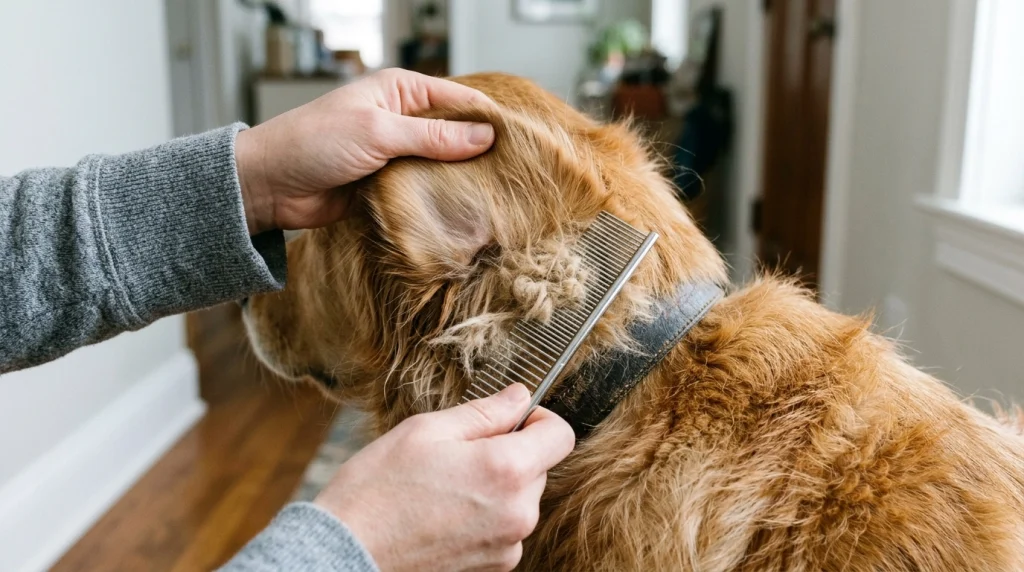
- Part the fur behind your dog’s ears and under the collar—if you cannot see pink skin or slide a metal comb from the root to the tip, dead hair is already impacting.
Three years ago, I fostered a four-year-old Golden Retriever mix named Barnaby whose previous owner had never touched him with a comb. On the surface, his back looked slightly frizzy, yet beneath that top layer sat a quarter-inch shield of felted fur hiding three raw skin infections.
Many dog owners assume brushing is just about keeping hair off the living room sofa. In reality, routine coat care is a core medical necessity that protects your dog’s skin, circulation, and comfort.
Below, I’ll walk you through the exact month-by-month timeline of an unbrushed coat and how different fur types react to neglect. You’ll also learn how to safely restore a neglected coat and which brushes make the job fast and pain-free.
Groomer’s Rule of Thumb: If a steel greyhound comb cannot glide smoothly from your dog’s skin to the hair tips after brushing with a slicker, hidden tangles are still sitting against the skin.


What Happens If You Never Brush Your Dog? (Month-by-Month Timeline)
 Save
When you never brush your dog, dead shed hairs stay trapped inside the living coat instead of falling away. Over several weeks, friction and moisture weave those loose strands into tight knots that pull on pain receptors and suffocate the skin.
To understand why this happens, it helps to define two grooming terms. Coat impaction is a condition where shed undercoat fibers pack tightly between living guard hairs, blocking air from reaching the skin.
A dog brush is a specialized grooming tool designed to extract dead hair, untangle knots, and spread natural skin oils across the coat shaft. Without that mechanical separation, your dog’s movement turns loose fur into felt.
- Weeks 1 to 2 (Oil and Dander Buildup): Dead hairs detach from the follicle but stay caught in the coat. Skin flakes and waxy oils collect at the base of the fur, creating a stale odor.
- Weeks 3 to 4 (Friction Pin-Knots): Every time your dog walks or scratches, loose hairs twist around attached hairs. Tiny pea-sized tangles form behind the ears, in the armpits, and under the collar.
- Months 2 to 3 (Webbing and Mat Formation): Individual knots merge into flat webs of tangled fur. Rain, humidity, or swimming causes these webs to shrink and tighten like wool in a hot dryer.
- Months 4 to 6 (Full Coat Pelting): The matted layer fuses into a solid, leathery sheet called a pelt. Air cannot reach the skin, and brushing is now too painful to attempt.
- Month 6 and Beyond (Skin Necrosis and Infection): The tight pelt pinches the skin, cuts off local blood flow, and traps urine, feces, and bacteria against raw sores.
Notice how fast a manageable tangle turns into a medical emergency. Once a coat reaches month three, a standard home brushing session will only yank on bruised skin.
What Medical Problems Does an Unbrushed Coat Cause?
An unbrushed dog coat causes four major medical problems: skin tearing from tight mats, bacterial hot spots, hidden parasite bites, and blocked oil glands. These issues affect both your dog’s physical health and daily behavior.
1. Severe Matting, Pelting, and Restricted Blood Flow
Hair mats do not sit loosely on top of your dog’s coat. As a mat grows, it winds tighter at the base, pulling hundreds of individual hair follicles upward like a constant pinch.
Every step your dog takes pulls on that tight hair. That constant tension explains why matted dogs often act grumpy, flinch when petted, or limp without an obvious bone injury.
- Behind the ears: Scratching with hind paws tangles fine silky hair into rock-hard cords.
- Under the collar or harness: Nylon straps rub loose fur into dense mats right over the throat and shoulders.
- Armpits and groin: Leg friction welds shed hair together in sensitive, thin-skinned zones.
- Lower legs and paws: Mud and wet grass bind hair between the toes, causing painful paw swelling.
- Under the tail: Mats around the rear trap waste, leading to severe scald and flystrike.
In advanced cases, a thick mat wraps all the way around a lower leg or ear flap. This acts like a rubber band, cutting off blood circulation to the tissue below.
When a veterinarian finally shaves off an ear pelt, blood rushes back into weakened vessels all at once. The ear flap can swell into a painful blood blister called an aural hematoma that requires surgery.
2. Trapped Moisture and Painful Hot Spots
Healthy dog fur dries quickly because air circulates between the hairs. When dead undercoat packs into the coat, water from rain, humid air, or a swim gets trapped against warm skin.
Warmth plus darkness plus moisture creates an incubator for skin bacteria. Within hours, harmless surface bacteria multiply and trigger acute moist dermatitis, commonly known as a hot spot.
According to the Merck Veterinary Manual, poorly groomed coats and trapped moisture are primary triggers for superficial bacterial skin infections in dogs. Left untreated, these sores spread rapidly across the body.
- Moisture gets trapped: Damp undercoat fails to dry within two hours after rain or swimming.
- Skin barrier softens: Wet skin softens and chafes under the friction of tangled hair.
- Itching starts: Your dog chews or scratches at the damp spot to relieve the itch.
- Infection explodes: A quarter-sized red sore oozes pus, matting the surrounding fur into a hard crust within six hours.
3. Hidden Parasites, Foxtails, and Fungal Infections
Brushing is your weekly early-warning system for skin hazards. When you part the coat with a brush, you spot ticks, flea dirt, skin lumps, and grass awns before they cause internal harm.
Without regular brushing, pests hide beneath impacted hair where topical treatments struggle to reach. Even worse, barbed grass seeds called foxtails catch in tangled fur and drill straight through the skin.
Guidance from the American Veterinary Medical Association emphasizes routine coat inspection as a frontline defense against external parasites and skin disease. An unbrushed coat blinds you to these threats until your dog is already sick.
- Engorged ticks: Ticks feed unnoticed for days under matted neck and ear fur, transmitting Lyme disease.
- Flea tapeworm cycles: Fleas lay hundreds of eggs inside warm mats, causing severe anemia in smaller dogs.
- Migrating foxtails: Barbed seed heads trapped in leg mats puncture the skin and travel into the chest cavity.
- Yeast dermatitis: Greasy, airless skin folds breed Malassezia yeast, producing a strong corn-chip smell and elephant-like skin thickening.
4. Blocked Skin Oils and the “Wet Dog” Odor
Your dog’s hair follicles contain tiny oil glands called sebaceous glands. These glands secrete sebum, a natural waxy oil that waterproofs the coat and keeps skin supple.
Brushing pulls sebum away from the skin and coats each hair shaft down to the tip. If you never brush your dog, that waxy oil pools at the base of the follicles and mixes with dead skin cells.
Why Unbrushed Dogs Smell Bad After a Bath: Bathing a dog without brushing out dead hair and waxy sebum first just wets the trapped debris. Bacteria feed on that damp organic buildup, making the dog smell sour within 24 hours.
Does Skipping Brushing Affect All Dog Coats the Same Way?
 Save
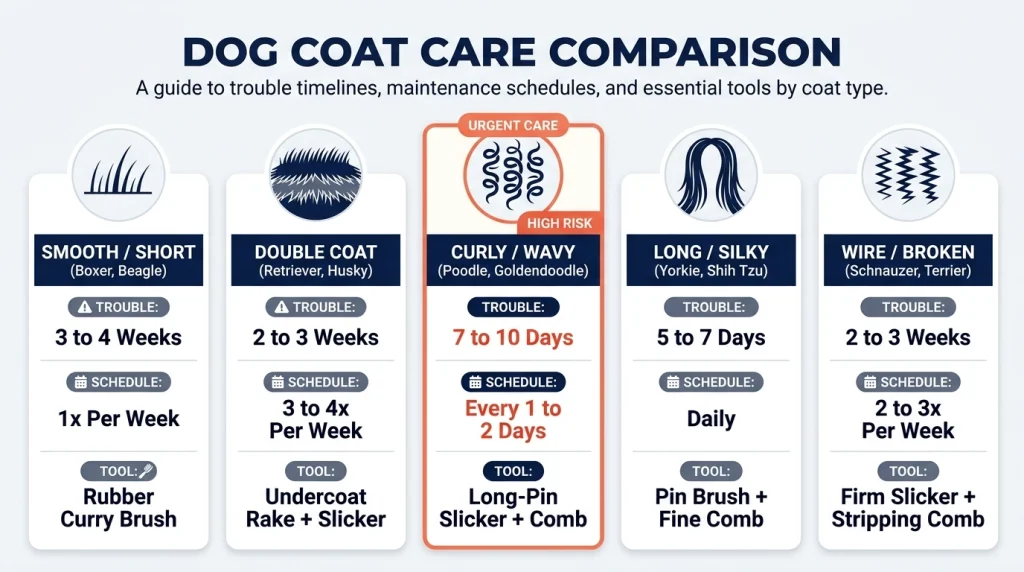
No, skipping brushing affects each coat type differently based on hair length, curl pattern, and undercoat density. While a Poodle mix can develop painful mats in 10 days, a short-haired Beagle suffers from clogged pores, dandruff, and heavy indoor shedding instead.
Breed coat standards maintained by the American Kennel Club group dogs into distinct coat textures, each with its own shedding mechanics. Compare how neglect plays out across all five major coat categories in the table below.
| Coat Type & Example Breeds | Time Until Trouble Starts | What Happens If Never Brushed | Minimum Brushing Schedule | Primary Brush Needed |
|---|---|---|---|---|
| Smooth / Short (Boxer, Beagle, Greyhound) | 3 to 4 weeks | Greasy residue, flaky dander, clogged hair follicles, and needle-sharp hairs embedded in furniture. | 1 time per week | Rubber curry brush or soft bristle brush |
| Double / Heavy Undercoat (Golden Retriever, Husky, German Shepherd) | 2 to 3 weeks | Packed wooly undercoat, wet hot spots, overheating, and large tufts pulling at the hips and neck. | 3 to 4 times per week (daily during spring/fall coat blow) | Undercoat rake + long-pin slicker brush |
| Curly / Wavy (Poodle, Goldendoodle, Bichon Frise) | 7 to 10 days | Shed hairs never fall to the floor; they lock into curls and form a tight body-wide felt shell. | Every 1 to 2 days | Curved long-pin slicker + steel greyhound comb |
| Long / Silky (Yorkshire Terrier, Shih Tzu, Maltese) | 5 to 7 days | Fine hair tangles around burrs, eye discharge cakes onto cheeks, and leg mats restrict walking. | Daily | Cushion pin brush + fine-tooth metal comb |
| Wire / Broken (Schnauzer, Border Terrier, Airedale) | 2 to 3 weeks | Dead wiry hairs stay stuck in follicles, dulling coat color and causing itchy follicular bumps. | 2 to 3 times per week | Firm slicker brush + stripping comb |
Choosing the wrong tool for your dog’s coat category is the biggest reason owners give up on brushing. For example, comparing a slicker brush vs. an undercoat rake reveals why many double-coated dogs still mat despite regular grooming.
A slicker brush uses rows of fine, angled wire pins to untangle surface mats and fluff curly or medium coats, which is why I use the Chris Christensen Big G Slicker Brush on Doodles and Retrievers. An undercoat rake uses wider, rounded metal teeth to reach two inches deep and pull out heavy puffs of dead wool without scratching the skin.
If you own a heavy shedder, pairing both tools cuts indoor hair drifts in half. You can compare top-tested tools in our guide to choosing the best dog brush for shedding for every coat length.
Why Does an Unbrushed Dog Overheat in Summer and Freeze in Winter?
An unbrushed dog overheats in summer because packed dead fur blocks cooling breeze from reaching the skin. That same matted coat makes the dog freeze in winter because clumped, oily hair loses the tiny air pockets needed to trap body heat.
Think of a double coat like high-performance fiberglass attic insulation. Fiberglass works only when it stays fluffy and dry so air sits between the fibers.
When you never brush out spring shed, that fluffy layer compresses into a dense, damp blanket. Worse yet, many owners respond to a hot, matted dog by shaving the double coat down to the skin.
- Brushed coat in 85°F summer heat: Stiff guard hairs reflect sunlight while air circulates through the clean undercoat to cool the skin.
- Unbrushed coat in 85°F summer heat: Dead undercoat traps body heat like a wet wool sweater, raising heatstroke risk during short walks.
- Brushed coat in 20°F winter cold: Clean, lofty undercoat holds a warm cushion of dry air around the torso.
- Unbrushed coat in 20°F winter cold: Greasy mats part to expose bare strips of skin while holding freezing snowmelt against the body.
Veterinary dermatologists at the Cornell University College of Veterinary Medicine note that healthy coat maintenance preserves the skin’s natural barrier and thermal regulation. Thoroughly brushing out dead undercoat cools a dog far better than clipping away protective guard hairs.
How Do You Start Brushing a Dog That Has Never Been Brushed?
 Save
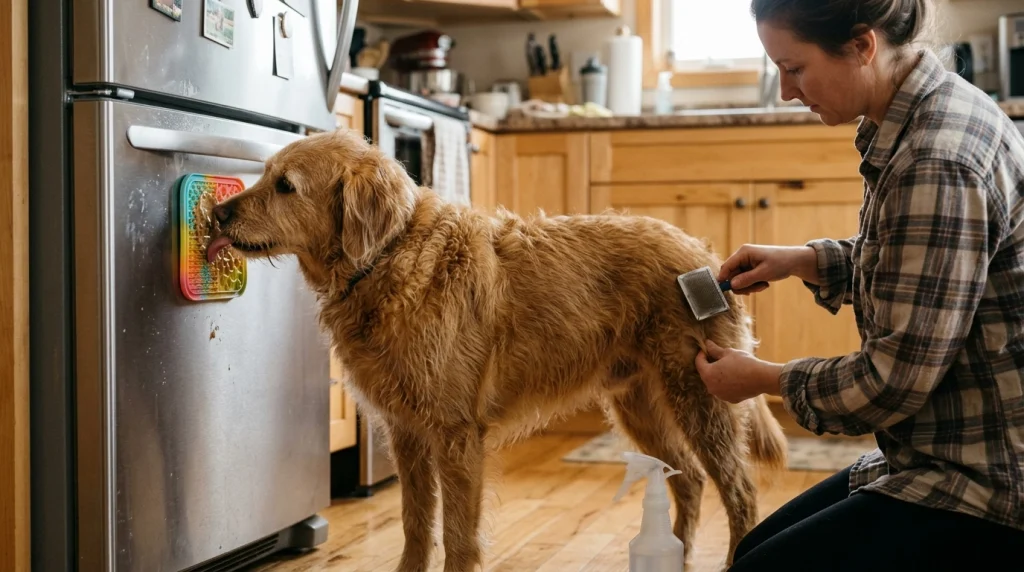
To start brushing a neglected dog, first check if the mats sit tightly against the skin—if you cannot slip your fingers under a mat, have a professional groomer or vet shave it safely. For loose tangles and impacted shed hair, use short five-minute sessions with detangling spray and the line-brushing method.
Never try to rip through months of neglect in a single afternoon. Pulling on knots teaches your dog that brushes equal pain, triggering biting or hiding.
If your dog has isolated knots behind the ears or on the feathering, read our step-by-step tutorial on how to get mats out of dog hair without hurting their skin. And never put a tangled dog straight into the bathtub—water tightens mats like cement, a mistake we cover in our guide on how often you should bathe your dog.
- Set up a high-value distraction: Spread xylitol-free peanut butter or wet dog food onto a suction lick mat stuck to the fridge at nose height.
- Mist the coat first: Spray a light silicone-free conditioning mist over the section you plan to brush; brushing bone-dry fur creates static and snaps hairs.
- Hold below the tangle: Pinch the base of any knot between your thumb and forefinger right next to the skin so the brush pulls on your fingers, not the dog’s nerves.
- Work from tips to roots (Line Brushing): Part the hair horizontally with one hand and brush a thin one-inch line from the ends inward using a pat-and-pull motion.
- Stop at five minutes: End the session while your dog is still relaxed and licking the mat, then work on the next body zone tomorrow.
As of 2026, I have used this exact five-minute lick-mat protocol on more than two dozen brush-shy foster dogs. Every single dog went from dodging the brush on day one to leaning into the strokes by week two.
Safety Warning — Never Use Scissors on Tight Mats: Dog skin is loose and tents upward inside a mat. Cutting a mat with kitchen or grooming scissors slices straight through tented skin—always slide a #10 electric clipper blade flat underneath the mat instead.
If you’re ready to build a painless routine with tools that glide through fur instead of tugging, here are the three brushes I keep in my own grooming kit:
🏆 Best Overall
Chris Christensen Big G Dog Slicker Brush (Large, Coral)
★★★★★
Features 30% denser, long bent stainless-steel pins set in a flexible cushion pad with an ergonomic GroomGrip handle. I used this exact brush to rehab Barnaby’s coat because the long, polished pins reach deep undercoat tangles without scratching sensitive skin.
💰 Best Budget & Short Coats
Kong ZoomGroom Multi-Use Rubber Dog Brush
★★★★☆
Built from soft, flexible three-quarter-inch rubber fingers that act like a magnet for loose short hairs while massaging skin oils. It won’t untangle long mats, yet it’s my favorite tool for short-haired breeds and nervous puppies who fear metal bristles.
🐕 Best for Double Coats
Maxpower Planet Double-Sided Deshedding Dematting Rake
★★★★★
Combines a 9-tooth side for stubborn mats and a 17-tooth side for thinning out dense shed undercoat, all with rounded safety tips. I reach for this rake every spring on Huskies and Shepherds because it clears impacted wool in half the time of a flat comb.
Frequently Asked Questions
Do short-haired dogs need to be brushed?
Yes, short-haired dogs like Beagles, Boxers, and Labs still need weekly brushing with a rubber curry brush or bristle brush. Even though their fur does not form long mats, skipping brushing leaves dead hair, flaky dander, and greasy sebum trapped against the skin, which causes odor and clogged follicles.
Can a matted dog coat fix itself if my dog sheds naturally?
No, a matted coat never resolves on its own through seasonal shedding. Instead, newly shed hairs get caught inside existing knots and pull tighter against the skin every time the coat gets damp, turning small tangles into a solid felt pelt that must be shaved off.
How long does it take for an unbrushed dog to get matted?
Curly and silky breeds like Poodles, Goldendoodles, and Yorkshire Terriers can develop tight friction mats in just 5 to 10 days without brushing. Double-coated breeds like Golden Retrievers and Huskies typically develop impacted undercoat and behind-the-ear mats within 2 to 3 weeks, faster during rainy weather.
Is it cruel to brush out heavy mats on a neglected dog?
Yes, trying to brush out tight, skin-level mats causes intense pain, skin tears, and long-term fear of grooming. When mats sit tight against the body or cover large areas, the kindest choice is having a professional groomer or veterinarian safely clip the coat short and starting fresh.
Final Thoughts: Your 5-Minute Weekly Brushing Habit
Skipping brushing doesn’t just leave extra fur on your rug—it slowly wraps your dog in a tight, damp layer that breeds skin infections and hides pests. The good news is that preventing every single problem in this guide takes less than 10 minutes a week.
- Do the comb test tonight: Check behind the ears, under the collar, and in the armpits with a metal comb.
- Match the brush to the coat: Use a rubber curry for short hair, an undercoat rake for double coats, and a long-pin slicker for curls.
- Pair brushing with rewards: Keep sessions under five minutes with a lick mat so your dog looks forward to coat care.
Grab the right brush for your dog’s coat type above and check their high-friction zones tonight. Your dog’s skin, comfort, and summer cooling depend on it.

Thomas Cutter is a lifelong dog owner and the founder of FindOutAboutDogs.com. With over 10 years of hands-on experience owning multiple breeds, Thomas created this site to provide honest, research-based dog advice that real owners can actually trust.
