What Makes a Good Dog Brush? 7 Features That Protect Your Dog’s Coat and Skin
Quick Answer
A good dog brush combines coat-specific bristle geometry, polished stainless steel or natural boar pins, and a vented air-cushion pad that absorbs excess hand pressure. Following professional canine coat care standards, the right tool lifts dead undercoat and distributes natural skin oils without scratching the epidermis or snapping healthy guard hairs.
5 Core Traits of a High-Quality Dog Brush
- Coat-matched pin length: Pins must reach through the topcoat to the undercoat without bottoming out against bare skin.
- Polished tip finish: Smooth, ground metal ends glide through tangles without micro-tearing the skin barrier.
- Vented cushion base: A flexible rubber pad with an air hole lets pins yield the moment they hit a tight knot.
- Anti-static materials: Stainless steel, natural boar hair, or carbon-infused bodies prevent static shocks During dry weather.
- Single-piece ergonomic handle: A contoured, non-slip grip reduces wrist torque during twenty-minute brushing sessions.
Quick Forearm Verification Test
- Run the inner-wrist check: Drag the brush across your bare inner forearm using normal grooming pressure; if it leaves red scratch lines on you, it will cause brush burn on your dog.
I still keep a plastic bin in my garage filled with fourteen discarded dog brushes that promised miracles and delivered nothing but static and yelps. Most pet owners find out the hard way that price tags and flashy packaging rarely tell you how a tool performs on live fur.
After testing dozens of slickers, rakes, and pin brushes across everything from wiry terriers to heavy-shedding shepherds, I learned that small engineering details make all the difference. In this guide, I’ll show you the exact pin materials, angles, cushion mechanics, and handle designs that separate a lifetime grooming tool from a painful mistake.


What Makes a Good Dog Brush Worth Buying in 2026?
 Save
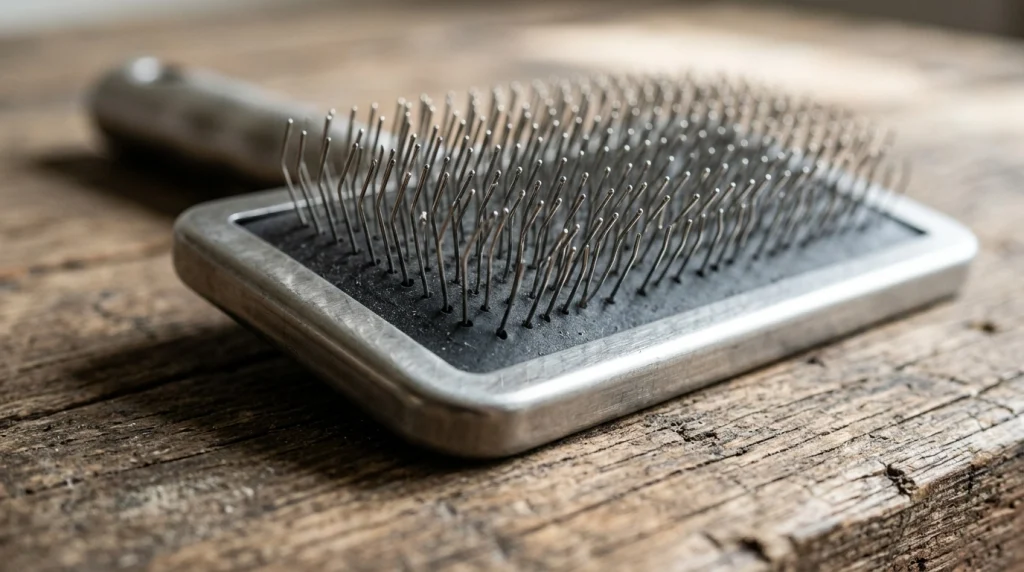
A good dog brush is a precision grooming tool engineered to separate tangled hair fibers, extract trapped dead fur, and stimulate the skin without cutting healthy hair shafts. As of 2026, top-tier brushes rely on medical-grade stainless steel pins, breathable elastomer pads, and balanced handles rather than stiff molded plastic.
When a dog runs out of the room at the sight of a brush, the dog usually isn’t being stubborn. Cheap bristles snag healthy hair follicles and yank them from the root.
Every brush that earns a permanent spot in my grooming bag passes seven mechanical checks before it ever touches a dog.
- Pin tip smoothness: Under a magnifying glass, quality metal pins show rounded, polished ends rather than jagged wire cuts.
- Wire memory and spring: Bent slicker pins flex backward under load and snap back to their original angle without warping.
- Pad air-venting: A tiny pinhole in the rubber cushion lets air escape so the pad compresses smoothly over bony hips and shoulders.
- Deep pin anchoring: Pins sit locked behind a reinforced fabric backing inside the rubber pad so they don’t sink into the brush head.
- Zero static build-up: Metal and natural hair fibers neutralize friction charges so flying loose fur doesn’t stick to your hands.
- Full-tang neck strength: The core of the brush head extends deep into the handle so the neck never snaps on a dense hip mat.
- Waterproof hygiene seal: Closed seams keep bath water, dander, and bacteria from rotting the inside of the brush pad.
If a brush misses even two of those benchmarks, grooming turns into a wrestling match. You spend twice as long brushing while removing half as much dead undercoat.
How Do Pin Material and Bristle Geometry Protect Your Dog’s Skin?
Pin material and bristle angle control how much friction transfers to your dog’s skin during each stroke. High-grade stainless steel pins bent at a 135-degree angle slide parallel to the skin surface instead of digging in like needles.
Low-cost manufacturers stamp wire pins in bulk using dull cutting dies. That fast stamping leaves microscopic metal burrs on the tip of every single wire.
“When I tested a budget $7 slicker brush against a dark piece of craft foam, those unpolished wire burrs carved deep white grooves on the first pass. A tumbled stainless steel brush left the foam completely untouched under the exact same two-pound hand load.”
Wire angle matters just as much as tip polish. A straight 90-degree wire meets the skin like a garden rake hitting concrete.
Quality slicker brushes bend each pin near the top third of the shaft at roughly 135 degrees. When you pull the brush forward, the angled knee rides over the skin while the tip lifts loose hair upward.
- 304-grade stainless steel pins: Resist rust after damp grooming sessions and glide through thick double coats without bending.
- Natural boar bristles: Feature microscopic scales that trap dust and pull natural sebum from the hair root down to dry tips.
- Soft thermoplastic rubber cones: Massage sensitive skin on short-haired breeds while acting like a magnet for shedding surface hair.
- Nylon bristles: Work well for light surface smoothing on puppies, though cheap nylon creates static electricity in winter.
Why Are Plastic Ball-Tipped Pins Bad for Double Coats?
Plastic ball-tipped pins snag and rip dense undercoats because the wider epoxy bead acts like a hook inside tangled wooly fur. While ball tips feel soft in your palm, they catch on tight knots and pull healthy hairs out by the root.
I learned this lesson years ago while brushing a friend’s Samoyed with a drugstore ball-pin brush. Halfway through her flank, I heard a faint popping sound with every stroke.
Those tiny epoxy beads were sliding past the loose fur, wedging behind dense cottony clumps, and snapping the hair shaft on the way out. Worse yet, once a few plastic balls chip off, the raw wire underneath scratches the dog’s skin.
- When to avoid ball tips: Skip them completely on Golden Retrievers, Huskies, Poodles, Doodle mixes, and any long or curly coat.
- What to choose instead: Pick ground, polished bare stainless steel pins that enter and exit a tangle at the exact same diameter.
- When ball tips are safe: Use them only on thin, tangle-free single coats where the pins never meet knotted undercoat.
If you are managing heavy seasonal blowouts, pairing the right pin structure with proven ways to reduce dog shedding will cut your vacuuming time in half. Good pins release dead fur cleanly instead of shredding the live coat.
Why Does Cushion Pad Flexibility Matter More Than Brush Size?
A flexible cushion pad acts as a built-in shock absorber that keeps heavy-handed brushing from scraping your dog’s skin. When pins hit a stubborn mat, a soft air-vented rubber pad collapses inward so the wires release instead of gouging the flesh.
Many owners shop by paddle width alone, assuming a wider brush finishes the job faster. A wide, rigid board can’t contour around a dog’s curved ribcage, hocks, or elbows.
According to veterinary preventive pet care guidelines, skin irritation from harsh grooming tools frequently leads to secondary hot spots and bacterial infections. The rubber cushion is your best insurance policy against accidental pressure spikes.
- Check for the breather hole: Look at the top or bottom edge of the rubber pad for a single small ventilation hole that lets air move in and out.
- Press the center with your thumb: The pad should sink at least a quarter inch with gentle thumb pressure and rebound right away.
- Tug three corner pins upward: High-end pads anchor each wire with a wide internal foot behind heavy canvas mesh so pins never pull loose.
- Flex the brush body itself: For sensitive dogs, flexible twin-head slickers bend in the middle to limit maximum downward force.
Pay close attention to how the rubber smells and feels out of the box. Cheap synthetic pads turn brittle and crack within six months, while natural latex-blend cushions stay supple for years.
Which Dog Brush Design Matches Your Dog’s Specific Coat Type?
 Save
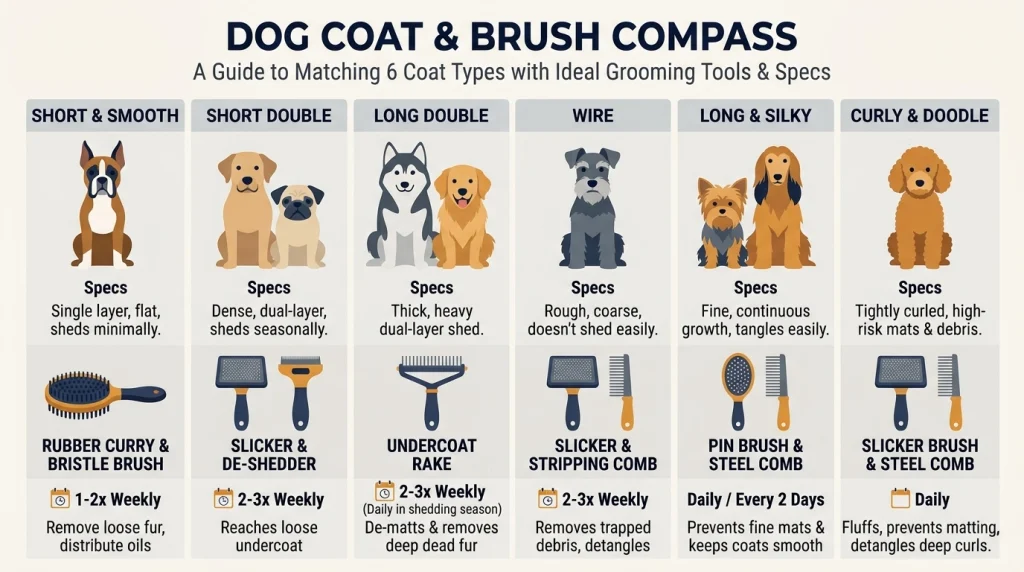
No single brush works on every dog because hair shaft thickness, curl pattern, and undercoat density vary wildly across breeds. Matching the brush style and pin length to your dog’s specific coat prevents surface-only brushing that leaves hidden mats against the skin.
A short-coated Beagle needs oil distribution and surface hair pickup, not long metal wires. Put that same soft rubber brush on a Bernese Mountain Dog, and it won’t even penetrate the top quarter-inch of fur.
Before buying any tool, compare your dog’s coat structure against the specifications in the table below.
| Dog Coat Type | Best Brush Style | Ideal Pin / Bristle Spec | Design Flaw to Avoid | Recommended Frequency |
|---|---|---|---|---|
| Short & Smooth (Boxer, Beagle, Greyhound) | Rubber Curry or Natural Boar Bristle | Conical rubber fingers (8–10mm) or dense medium boar hair | Metal wire slickers that scrape bare skin | 1–2 times per week |
| Medium Double Coat (Labrador, Corgi, Australian Shepherd) | Firm Slicker + Single-Row Undercoat Rake | 16–20mm angled stainless pins + rotating steel rake teeth | Sharp bladed stripping tools that slice healthy topcoat | 3–4 times per week |
| Heavy / Long Double Coat (Husky, Golden Retriever, Malamute) | Long-Pin Slicker + Stainless Greyhound Comb | 22–27mm polished stainless steel pins on a high-density pad | Short 10mm pins that only polish the surface fur | 4–5 times per week |
| Curly, Wooly, or Doodle (Poodle, Goldendoodle, Bichon) | Curved Long-Pin Slicker + Metal Comb | 25mm angled bare steel pins with high pin count per square inch | Ball-tipped pins that catch and tear tight curls | Daily line brushing |
| Silky & Drop Coat (Yorkie, Shih Tzu, Maltese, Afghan) | Cushioned Polished Pin Brush (No Balls) | 20–27mm straight, smooth-ground stainless steel pins | Stiff wire slickers that snap delicate hair shafts | Daily gentle brushing |
| Wirehaired (Schnauzer, Border Terrier, Airedale) | Medium Firm Slicker + Stiff Boar Bristle | 15–18mm firm stainless steel wires with dense spacing | Soft nylon bristles that bend flat against coarse hair | 2–3 times per week |
Notice how curly and double coats demand longer, bare metal pins. If you own a Doodle or Poodle mix, standard ten-millimeter pet store slickers glide right over deep root tangles without touching them.
Professional groomers always verify their brush work by sliding a steel comb through the coat afterward. If you want to build a complete home setup, check out our step-by-step dog grooming guide for beginners to master proper line brushing technique.
What Handle and Build Features Prevent Groomer Wrist Fatigue?
An ergonomic handle keeps your wrist in a neutral handshake position so your forearm muscles don’t cramp during long coat-out sessions. Look for a curved neck angle, non-slip rubberized grip ribs, and a weight balance centered near your index finger.
When your hand gets tired, your technique gets sloppy. Tired owners flick their wrists at the end of each stroke, which hooks the wire pins upward and scratches the dog’s skin.
A well-balanced brush like the Chris Christensen Big G Slicker Brush uses an extra-long, curved beechwood handle coated in high-friction elastomer. That curve lets the brush head sit flat against your dog’s coat without forcing you to bend your wrist downward.
- Angled neck shank: A 15-to-25-degree bend between the handle and paddle keeps your knuckles from bumping against the dog’s body.
- Thumb rest indentation: A sculpted thumb groove on the back of the neck prevents the brush from twisting in wet or conditioned hands.
- Solid beechwood or molded core: Hardwood and solid composite bodies absorb vibration far better than hollow two-piece plastic shells.
- Skip push-button self-cleaning gimmicks: Retractable plastic plates rattle loose over time, trap wet dander inside the mechanism, and shorten useable pin length.
How Do You Test a Dog Brush Before Using It on Your Pet?
You can verify any dog brush in under sixty seconds using three hands-on checks before touching your dog’s coat. Testing the tool on your own skin and clothing exposes rough pin tips, stiff cushions, and weak joints right away.
Canine skin is significantly thinner than human skin, averaging only three to five cell layers on the epidermis compared to ten to fifteen in humans, as documented by Cornell University’s Riney Canine Health Center. If a brush feels harsh on your arm, it is way too rough for your dog.
- The Inner-Forearm Pat-and-Pull Test: Press the brush lightly against your bare inner wrist and pull two inches parallel to your skin; you should feel gentle tingling, never red welts or white scratch marks.
- The Knit Sweater Snag Check: Brush lightly across an old wool sock or fleece blanket; unpolished metal burrs will catch and pull fabric loops immediately.
- The Handle Torque Twist: Hold the paddle in one hand and twist the handle firmly with the other; any creaking or flexing at the neck joint means the plastic will snap under load.
I run all three checks on every new brush that arrives on my workbench. Roughly one out of every three budget brushes fails the knit sweater snag check right out of the box.
What Are the Red Flags of a Cheap Dog Brush?
 Save
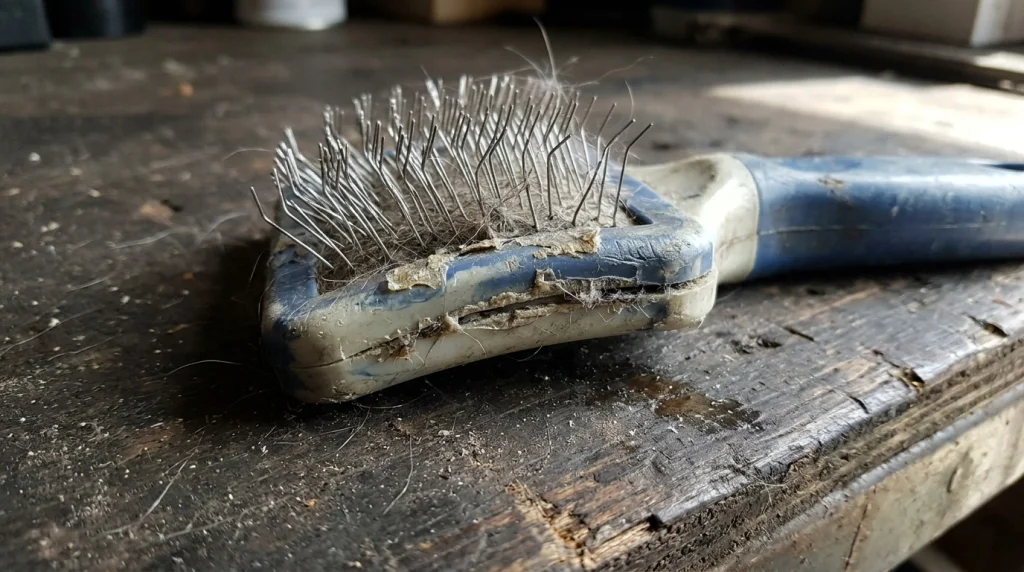
The biggest red flags of a low-quality dog brush are sharp stamped deshedding blades, glued foam pads, uneven wire heights, and hollow plastic seams. These shortcuts damage your dog’s healthy guard hairs and turn a shiny coat dull and frizzy.
Let’s talk honestly about bladed deshedding tools for a moment. Many heavy metal deshedders use a modified clipper blade that slices through hair rather than pulling out loose dead fur.
Groomer Warning on Bladed Tools: Overusing sharp-edged deshedding blades on double-coated breeds strips away weather-resistant guard hairs, leaving behind a fuzzy, patchy undercoat that mats faster and absorbs dirt like a sponge.
According to ASPCA dog grooming safety tips, regular brushing should keep the natural coat intact so it can insulate your dog against heat and cold. Watch out for these five warning signs when inspecting any brush in store or online.
- Sinking pins: If pushing on a wire causes it to vanish inside the rubber pad, the brush lacks internal canvas backing.
- Glued foam cushions: Cheap open-cell foam soaks up skin oils and bath water, turning into a breeding ground for mold and odor.
- Sharp plastic mold flashing: Raised plastic seams along the handle or paddle edge can nick your dog’s ears and armpits.
- Crossed or crooked wire rows: Uneven rows leave bald channels in the brushing path and pull hair at painful sideways angles.
- Chemical rubber odor: A strong tire-factory smell signals low-grade recycled rubber that degrades quickly and stains white coats.
Keeping your grooming tools sanitized is also part of protecting sensitive skin. Pair a sealed, washable brush with the right cleanser from our guide to choosing dog shampoo for sensitive skin so bath day and brush day work together.
Which Dog Brushes Meet All These Quality Standards?
If you’re ready to pick a tool that checks every box we covered above, here are the three brushes I personally keep in my grooming caddy and recommend to fellow dog owners:
🏆 Best Overall
Chris Christensen Big G Dog Slicker Brush
★★★★★
Features 27mm round-ground stainless steel pins, a super-plush vented latex cushion, and a curved GroomGrip beechwood handle with 30% more pins than standard slickers. I’ve used my coral Big G on thick Golden Retriever and Doodle coats for four years without losing a single pin or scratching sensitive skin.
💰 Best For Sensitive Dogs
Safari Flexible Slicker Dog Brush
★★★★☆
Built with a split, dual-flex head that bends with your dog’s body contours, paired with fine angled stainless steel pins and an ergonomic non-slip rubberized grip. I reach for this affordable brush whenever I’m working on brush-shy rescue dogs or bony areas around the legs and tail.
🐕 Best For Short Coats
Kong ZoomGroom Rubber Dog Brush
★★★★★
Molded from single-piece natural thermoplastic elastomer with three-quarter-inch conical rubber fingers that attract loose fur and massage capillaries. It’s the only brush my short-haired Lab mix leans into like a belly rub, and it doubles as a fantastic lathering tool in the bathtub.
Frequently Asked Questions About Choosing a Quality Dog Brush
Is a slicker brush or a pin brush better for dogs?
A slicker brush is better for breaking up tangles and pulling dead undercoat out of medium, curly, and double-coated breeds. A pin brush works best for daily fluffing and finishing on long, silky single coats like Maltese or Yorkshire Terriers after tangles are already removed.
How often should you replace a dog brush?
A well-made stainless steel dog brush lasts three to five years for a single-dog household, while budget brushes often wear out in six months. Replace your brush immediately if pins bend out of alignment, plastic ball tips fall off, or the rubber cushion pad cracks and loses its bounce.
Can the wrong dog brush cause skin infections?
Yes, unpolished wire pins and stiff cushion pads create tiny scratches on the epidermis known as groomer’s brush burn. When your dog licks or scratches those raw spots, surface bacteria enter the broken skin and can trigger painful, oozing hot spots within twenty-four hours.
Why do professional dog groomers hate self-cleaning slicker brushes?
Push-button self-cleaning brushes replace the soft air-cushioned rubber pad with a hard, perforated plastic plate that slides over the pins. That rigid plastic backing removes all shock absorption on your dog’s skin, shortens effective pin length, and traps dirty bath water inside the hollow shell.
Do short-haired dogs still need a good brush?
Short-haired breeds like Boxers, Beagles, and Pit Bulls shed year-round and benefit greatly from weekly brushing with a soft rubber curry or boar bristle brush. These tools lift loose surface hairs before they land on your couch and spread natural skin oils for a healthy, odor-free shine.
Final Thoughts on Picking the Right Grooming Brush
Upgrading to a properly engineered dog brush is one of the fastest ways to turn stressful grooming sessions into quiet bonding time. Focus on polished 304-grade stainless steel pins, a responsive air-vented cushion pad, and a pin length that reaches all the way through your dog’s specific coat.
Grab the brush you currently own tonight and run the sixty-second inner-forearm test before your next grooming session. Your dog’s skin and coat will thank you for making the switch.

Thomas Cutter is a lifelong dog owner and the founder of FindOutAboutDogs.com. With over 10 years of hands-on experience owning multiple breeds, Thomas created this site to provide honest, research-based dog advice that real owners can actually trust.
