Can You Use the Same Grooming Glove for Cats and Dogs?
Quick Answer
Yes, you can physically use the same grooming glove on both cats and dogs if the rubber nodules are soft and both pets are healthy. However, sharing one unwashed mitt transfers canine skin oils, outdoor allergens, and parasites, so following sound pet grooming hygiene practices or assigning one glove from a pair to each pet is much safer.
Key Factors Before Sharing a Grooming Glove
- Skin thickness differences: Feline skin is roughly half as thick as canine skin and requires softer silicone tips with lighter hand pressure.
- Scent and pheromones: Rubbing dog sebum onto a cat masks natural feline scent markers and often triggers hissing or hiding.
- Parasite and fungal risk: Unwashed rubber tips easily pass flea eggs, mites, and ringworm spores between animals.
- Outdoor allergen transfer: Dogs carry grass pollen and dust in their coats that can make an indoor cat itch or sneeze when licked off.
- Coat density mismatch: Stiff pegs built for a thick canine undercoat will scratch a fine, single-coated cat.
Smartest Multi-Pet Shortcut
- Split the pair: Since most mitts sell in two-packs, mark the right glove for your dog and keep the left glove exclusively for your cat.
When I brought home my tabby cat, Cleo, I figured I could brush her with the same silicone mitt I used on my Golden Retriever mix, Barnaby. That shortcut lasted about ten seconds before Cleo smelled Barnaby on the rubber palm, swatted my wrist, and bolted under the couch.
Packaging on most mitts claims universal compatibility for every furry pet in your house. In this guide, I will break down the skin biology, scent triggers, and sanitation steps you need to know before sharing one glove across species.


What Is a Pet Grooming Glove and How Does It Work?
A pet grooming glove is a flexible, five-fingered mitt lined with soft rubber or silicone nodules across the palm and fingers that traps loose fur through gentle friction. Instead of pulling metal pins through tangles like a slicker brush, the glove mimics a normal petting motion while lifting dead hair from the coat.
Understanding how dog grooming gloves work helps explain why companies market them for both dogs and cats. As of 2026, nearly ninety percent of deshedding mitts sold online use the same universal mold regardless of the animal pictured on the box.
- Thermoplastic elastomer palm: A pliable rubber sheet molded with 180 to 255 rounded tips that grip shedding hair using static electricity and surface drag.
- Breathable mesh back: Woven polyester fabric on the top of the hand that lets body heat escape and allows water to drain during bath scrubbing.
- Adjustable wrist strap: A hook-and-loop cuff that secures the mitt around narrow or wide wrists so the palm does not twist mid-stroke.
- Finger articulation channels: Thin flex grooves between each finger that let you contour around bony areas like elbows, chins, and tail bases.
Because your fingers sit right behind the rubber tips, your hand controls the brushing intensity. Pressing firmly reaches deep into a heavy dog coat, while skimming with feather-light fingertips grooms a delicate cat.
The tool itself does not change between animals. However, the skin, oil glands, and behavior of the pet underneath your hand change dramatically.
Why Do Cats and Dogs React Differently to the Same Grooming Glove?
 Save
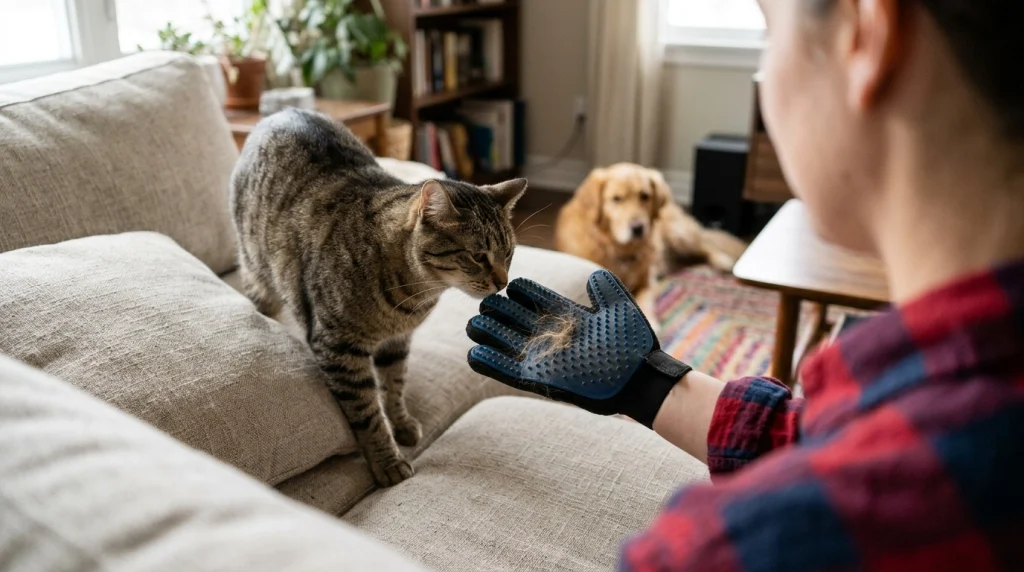
Cats and dogs react differently to the same grooming glove because cats have thinner skin, sharper nerve sensitivity, and a strict reliance on personal scent markers. A mitt that feels like a soothing deep-tissue massage to a dog can feel abrasive and smell threatening to a cat.
Skin Thickness and Epidermal Sensitivity
Canine skin is built to absorb rough play, brushwood, and weather. Depending on the breed, a dog’s skin measures between 0.5 and 5 millimeters thick, giving the animal plenty of padding under its fur.
Feline skin is much more fragile, measuring just 0.4 to 2 millimeters across most of the body. Cats also possess sensitive touch receptors called tylachi around their hair follicles that fire rapidly when rubber drags across their spine.
- Canine pressure tolerance: Most medium and large dogs enjoy firm, sweeping strokes that press the silicone nodules all the way down to the skin surface.
- Feline hyperesthesia risk: Firm pressure with stiff rubber tips overstimulates feline back nerves, causing skin rippling, tail thrashing, and sudden nipping.
- Micro-abrasion vulnerability: Hard nodules over 6 millimeters long can leave tiny red scratches along a cat’s shoulder blades and hips.
- Static shock differences: Dry feline fur builds static charge faster against cheap rubber than oily dog fur, creating uncomfortable zaps during winter brushing.
When I tested a stiff, heavy-duty equine and canine scrubbing glove on Barnaby, he leaned into my hand and closed his eyes. When I touched that exact same dry glove to Cleo’s back, her skin rippled immediately and she walked away.
Scent Transfer and Feline Territorial Stress
Dogs produce a thick lipid coating called sebum from their sebaceous glands to waterproof their hair. Every time you run a silicone mitt down your dog’s back, that waxy oil coats the rubber pegs and sinks into the fabric seams.
Cats groom themselves to maintain a clean, recognizable scent profile made of natural facial and flank pheromones. Wiping a dog-scented glove over your cat covers up those calming pheromones with canine oil and dander.
Field Test Note: Even when two pets sleep on the same sofa, cats distinguish between ambient household smell and direct coat transfer. After I brushed Cleo with Barnaby’s unwashed glove, she spent forty-five minutes frantically licking her sides to strip the dog oil off her fur.
That frantic post-brushing bath defeats the entire point of deshedding your cat. Every loose hair the glove missed ends up swallowed, leading straight to extra hairballs on your rug.
| Grooming Factor | Dogs | Cats | Impact on Sharing One Glove |
|---|---|---|---|
| Average Skin Thickness | 0.5 mm to 5.0 mm | 0.4 mm to 2.0 mm | Gloves must have soft, flexible tips safe for the thinner feline epidermis. |
| Ideal Nodule Length | 5 mm to 10 mm | 3 mm to 6 mm | Long pegs built for thick dog coats can poke and irritate a cat. |
| Sebum (Skin Oil) Output | Moderate to heavy | Low and lightly scented | Canine oil coats the rubber quickly and leaves a greasy film on cat fur. |
| Scent Tolerance | Rarely bothered by cat scent | Highly territorial about scent | Unwashed mitts trigger feline stress, swatting, and excessive self-licking. |
| Outdoor Debris Load | High (pollen, mud, burrs, pests) | Minimal for indoor cats | Brushing the dog first transfers outdoor allergens straight to an indoor cat. |
When Should You Never Share a Grooming Glove Between Pets?
You should never share a grooming glove when either animal has fleas, mites, fungal infections, open scabs, or seasonal allergies. Textured rubber palms trap microscopic spores and parasite eggs at the base of the pegs, turning the mitt into a direct disease vector.
Public health guidance from the Centers for Disease Control and Prevention notes that skin fungi and external parasites move easily between dogs, cats, and people via shared brushes. Even healthy-looking pets can harbor asymptomatic skin conditions that flare up once transferred to a housemate.
- Ringworm (Microsporum canis): Fungal spores cling to trapped hairs on a glove and survive for over a year if not disinfected.
- Fleas and flea dirt: Adult fleas and sticky microscopic eggs hide in the fabric seams around the thumb and wrist strap.
- Walking dandruff (Cheyletiella mites): Highly contagious surface mites hop freely between canine and feline hosts on shared grooming gear.
- Bacterial hot spots and yeast: Moist skin infections leave Staphylococcus bacteria on rubber tips that can infect a cat’s chin acne or small scratch marks.
- Outdoor pollen and lawn chemicals: Dogs rolling in treated grass pick up fertilizers and ragweed pollen that cats later ingest while grooming their fur.
According to veterinary dermatologists at the Cornell Feline Health Center, cats can act as silent carriers of ringworm without losing a single patch of hair. If you brush a silent feline carrier and then groom your dog, your dog can develop scaly, circular lesions within two weeks.
Pollen transfer is another overlooked problem in multi-pet homes. Dogs walk through tall weeds daily, and rubbing that pollen onto an indoor cat means your cat swallows those allergens during its next bath.
How to Inspect Both Pets Before Using a Shared Glove
Before you slip on a shared mitt, spend thirty seconds checking your pets’ skin under bright light. Run through this quick five-step inspection every time you groom.
- Part the hair at the tail base: Look for black pepper-like specks of flea dirt or tiny red bite bumps near the rump.
- Check behind the ears and under the chin: Inspect both animals for crusty scabs, circular hairless spots, or black waxy buildup.
- Feel along the spine and belly: Use your bare fingers to check for scabs, ticks, greasy patches, or damp hot spots.
- Sniff the coat: A musty, corn-chip, or sour odor on your dog signals a yeast or bacterial overgrowth that requires a dedicated tool.
- Wipe the dog’s coat first: If your dog just came inside from the yard, wipe its back with a damp towel before using any shared glove.
Which Coat Combinations Can Share a Single Glove Safely?
Short-haired and medium-haired dogs pair best with short-haired cats when sharing a single grooming glove. If your dog and cat sit at opposite ends of the coat thickness spectrum, one glove design will either underperform on the dog or scratch the cat.
When owners ask are grooming gloves good for dogs of every breed, I always point out that rubber nodule length matters. A soft 4-millimeter tip glides smoothly over a Beagle and a Domestic Shorthair cat, making them ideal candidates for a shared tool.
| Dog Coat Type | Cat Coat Type | Can They Share One Glove? | Best Nodule Style |
|---|---|---|---|
| Short Single Coat (Beagle, Boxer, Pug) | Short Hair (Domestic Shorthair, Siamese) | Yes, ideal match after washing | Short (3–5 mm), soft silicone tips |
| Medium Double Coat (Labrador, Corgi) | Short to Medium Hair (Tabby, Ragdoll) | Yes, with light pressure on the cat | Medium (5–6 mm), flexible tapered tips |
| Heavy Double Coat (Husky, German Shepherd) | Fine or Short Hair (Abyssinian, Devon Rex) | No, requires separate tools | Stiff pegs for dog; ultra-soft mitt for cat |
| Curly or Wool Coat (Poodle, Bichon) | Long Hair (Persian, Maine Coon) | Only for bath lathering or surface fuzz | Wide-spaced rounded nodules plus a metal comb |
Long-haired cats like Persians and Maine Coons develop deep undercoat knots behind their armpits and hindquarters. A rubber glove only collects loose surface floaters on these breeds and can roll underlying tangles tighter if you press too hard.
- Best pairing for one glove: Smooth-coated dogs (Labradors, Greyhounds, French Bulldogs) paired with standard short-haired house cats.
- Workable pairing with care: Golden Retrievers or Australian Shepherds paired with medium-haired cats, provided you use a flexible mitt and wash it between sessions.
- Worst pairing for one glove: Wire-haired terriers or arctic sled dogs paired with thin-coated cats like Cornish Rexes, Sphynxes, or senior cats with thin skin.
How Do You Sanitize a Grooming Glove Between Your Dog and Cat?
 Save
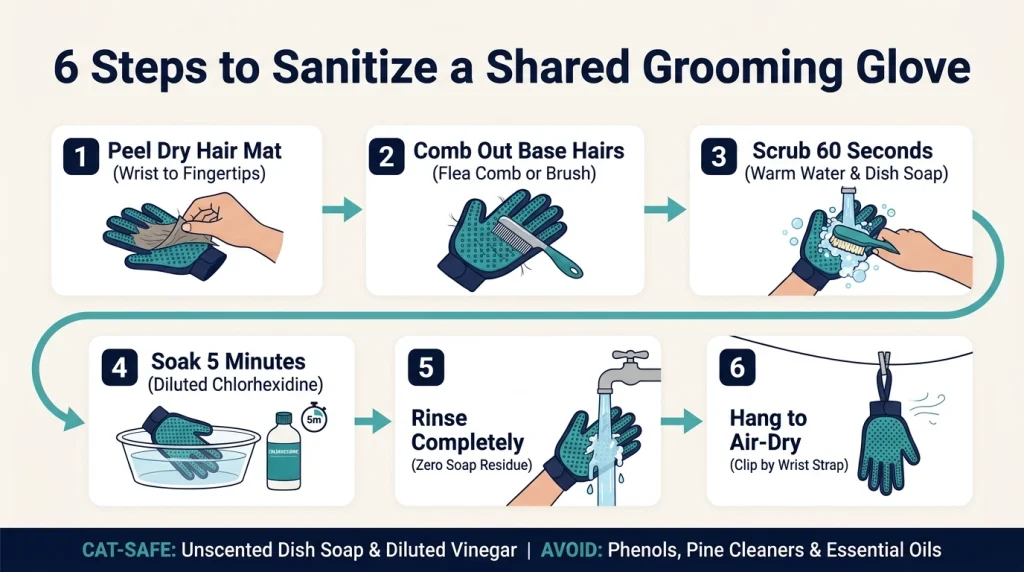
To sanitize a grooming glove between your dog and cat, peel off all trapped hair, scrub the palm with warm water and degreasing dish soap, and let it air-dry completely. Rinsing with cold tap water alone leaves sticky canine skin oil and odor behind on the silicone tips.
If you want a deeper dive into maintaining your mitts over time, check out my complete walkthrough on how to clean dog grooming gloves without warping the rubber. When switching between a dog and a cat on the same day, follow this six-step sanitation routine.
- Peel away the hair mat: Pull the sheet of collected fur from the wrist toward the fingertips while the glove is still bone-dry.
- Lift stubborn hairs with a fine comb: Run a flea comb or old toothbrush across the base of the nodules to flick out short hairs wedged in the seams.
- Scrub with grease-cutting dish soap: Lather the rubber palm and fabric back in warm water using a few drops of unscented liquid dish soap for sixty seconds.
- Disinfect when needed: Soak the palm for five minutes in a diluted, pet-safe chlorhexidine solution or veterinary disinfectant if either pet has been outdoors around other animals.
- Rinse until squeaky clean: Flush both the inside lining and outside mesh under warm running water until zero soap suds or fragrance remain.
- Hang to dry before touching your cat: Clip the wrist strap to a hanger in a breezy spot until the fabric mesh is dry, or use the damp palm only if your cat enjoys water-mist brushing.
Never pour straight household bleach, pine cleaners, or tea tree oil soap onto a grooming mitt. Routine care guidelines from the American Veterinary Medical Association remind pet owners that cats lack the liver enzymes needed to process phenols and concentrated essential oils.
Even tiny traces of tea tree oil or citrus cleaner left on a silicone palm will transfer to your cat’s coat. When your cat licks its fur dry ten minutes later, those chemical residues go straight into its stomach.
- Safe cleaners for shared gloves: Plain Dawn dish soap, unscented castile soap, diluted white vinegar (one part vinegar to four parts water), and veterinary chlorhexidine wash.
- Cleaners to keep away from cats: Pine-Sol, Lysol sprays containing phenols, citrus degreasers, eucalyptus or peppermint soaps, and undiluted chlorine bleach.
How Can You Use One Pair of Grooming Gloves for Two Pets Without Washing Every Time?
The easiest way to avoid washing a glove between pets is to split a two-glove pair, dedicating the right-hand mitt to your dog and the left-hand mitt to your cat. Because almost every manufacturer sells grooming gloves as a left-and-right set, you already own two separate tools in one box.
That simple system solved my problem with Barnaby and Cleo overnight. I bought one pair of the Delomo Pet Grooming Glove and assigned the right-hand glove to Barnaby and the left-hand glove to Cleo.
- Mark the wrist straps immediately: Write a clear “D” and “C” on the fabric hook-and-loop tabs with a permanent laundry marker before your first brushing session.
- Store them in separate spots: Hang the dog’s glove by the leash hook near the back door, and keep the cat’s glove inside a drawer near the cat tree.
- Never clap the palms together: Keep the two gloves from touching in the laundry basket so dog hair and oil never rub onto the cat’s mitt.
- Wash your bare hands if switching mid-session: If you pet your dog with your free hand while brushing, rinse your hands before putting on your cat’s glove.
Brushing your cat with your non-dominant left hand actually works in your favor. Your non-dominant hand naturally applies lighter, gentler pressure, which prevents you from pressing too hard on your cat’s sensitive spine.
Meanwhile, your stronger dominant hand handles the heavier scrubbing required to pull dead undercoat out of your dog. You save money by buying a single package while giving each animal a dedicated, scent-free grooming tool.
Best Grooming Gloves for Multi-Pet Households in 2026
 Save
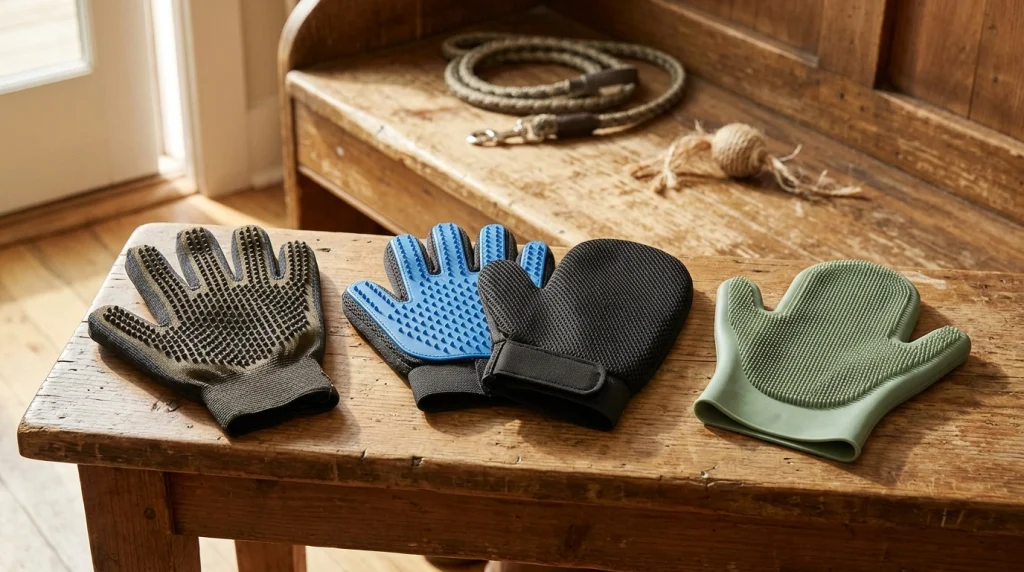
Not every mitt on the market has flexible enough rubber to keep both a dog and a cat happy. After testing over a dozen styles on Barnaby’s thick golden coat and Cleo’s sensitive tabby fur, here are the three pairs I recommend for dog-and-cat homes:
🏆 Best Overall
HandsOn Pet Grooming Gloves
★★★★★
Sold in five true wrist-to-finger sizes with non-abrasive rounded nodules across the fingers and palm. I love that these fit snug like gardening gloves instead of bulky oven mitts, giving me total finger control when switching from my dog’s back to my cat’s chin.
💰 Best Value Pair
Delomo Upgrade Pet Grooming Glove Pair
★★★★☆
Features 255 soft silicone tips per glove with a breathable mesh back and comes as a left-and-right two-pack. This is the exact budget pair I split between Barnaby and Cleo, and the hair peels off the palm in one satisfying sheet.
🐱 Best for Sensitive Skin
Mr. Peanut’s Hand Gloves Grooming & Deshedding Aid
★★★★☆
Built with extra-pliable thermoplastic elastomer tips and a soft interior lining that never scratches delicate skin. If your cat flinches at standard brushes or your dog has sensitive skin folds, these gentle nodules glide smoothly without pulling.
Frequently Asked Questions
Can a cat get sick from using a dog’s brush or grooming glove?
Yes, a cat can catch ringworm, fleas, walking dandruff mites, and bacterial skin infections from a dog’s unwashed grooming glove. Indoor cats can also swallow outdoor lawn chemicals, fertilizers, and grass pollen transferred onto their fur from a dog’s mitt during self-grooming.
Why does my cat hiss at the grooming glove after I brush my dog?
Your cat hisses because the silicone palm is coated in canine sebum and dander, which smells like an intruder to a scent-driven feline. Cats rely on familiar facial and body pheromones to feel secure, and rubbing dog oil onto their coat triggers a defensive response.
Should I brush my cat or my dog first if I only have one glove?
Always brush your indoor cat first and your dog second if you only own a single glove. Starting with a clean, dry mitt on your cat prevents transferring heavy dog oils, outdoor dirt, and yard allergens onto your cat’s delicate skin and fur.
Can I put pet grooming gloves in the washing machine to sanitize them?
Most mesh-backed silicone grooming gloves can go in the washing machine inside a zippered delicates bag on a gentle, warm cycle with unscented detergent. However, you must peel off all loose hair first and always air-dry the gloves so dryer heat does not melt the rubber tips.
Final Thoughts on Sharing Grooming Gloves Between Cats and Dogs
Sharing one grooming glove between your dog and cat is safe as long as the silicone tips are soft, both animals are parasite-free, and you scrub off the dog oils before touching your cat. If you want to skip the sink scrubbing altogether, buy a two-glove pack and give your dog the right hand while keeping the left hand strictly for your cat.
Grab a permanent marker today, label each wrist strap for its rightful owner, and turn brushing time back into a calm, purr-worthy routine for both pets.

Thomas Cutter is a lifelong dog owner and the founder of FindOutAboutDogs.com. With over 10 years of hands-on experience owning multiple breeds, Thomas created this site to provide honest, research-based dog advice that real owners can actually trust.
