Can Grooming Gloves Replace Traditional De-Shedding Tools?
Quick Answer
Grooming gloves cannot fully replace traditional de-shedding tools for double-coated or thick-haired dogs, but they excel as gentle daily maintenance tools. While metal rakes and blades reach deep into the secondary undercoat to pull compacted dead fur, rubber gloves primarily collect loose surface hair while doubling as a soothing massage. Understanding how these tools function within a broader dog grooming routine helps you choose the right balance for your pet’s coat.
Key Differences at a Glance
- Penetration Depth: Traditional rakes reach deep down to the skin, while rubber glove nodules only skim surface hairs.
- Pet Anxiety: Gloves mimic hands-on petting to soothe skittish dogs, whereas metal teeth often trigger fear or flinching.
- Coat Suitability: Gloves work wonders on short, sleek coats but fail to clear heavy, blowing double undercoats.
- Skin Safety: Flexible silicone tips cannot cut sensitive skin, eliminating the brush burn common with bladed de-shedders.
- Bath Utility: Gloves work cleanly during baths to lather shampoo and pull wet dead fur in the tub.
The Recommended Approach
- Use grooming gloves for daily 3-minute sweeps, and reserve an undercoat rake for thorough weekly or seasonal sessions.
Every spring, my living room rug turns into an ocean of flying dog hair. If you live with a heavy shedder, you know that relentless cleanup battle all too well.
I tested five popular grooming gloves against my trusted metal undercoat rakes and de-shedding blades to see if a simple pair of silicone mitts could finally retire rigid metal tools. What I discovered will save your dog unnecessary discomfort and keep your vacuum from burning out.


What Are Dog Grooming Gloves and How Do They Work?
 Save
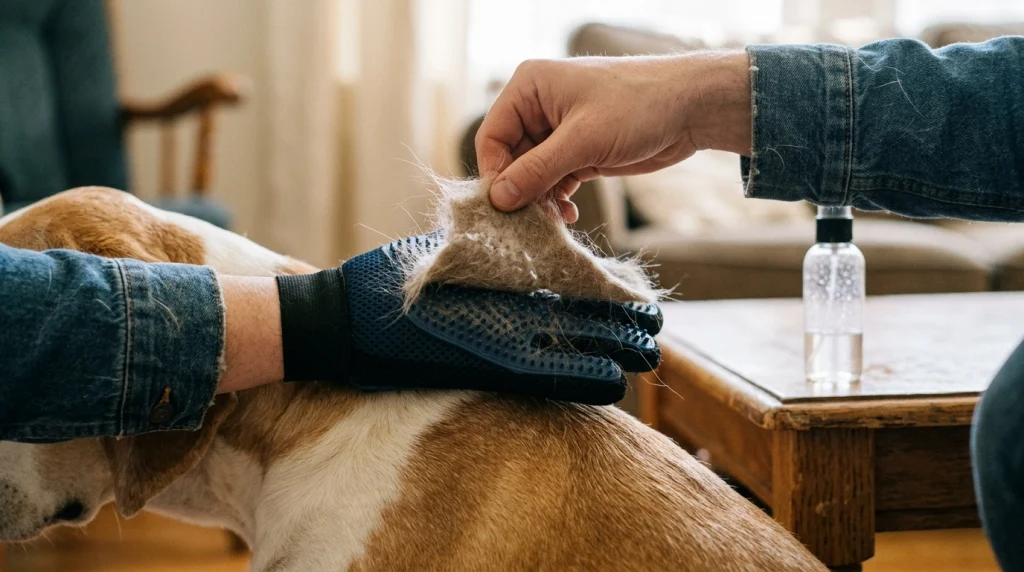
A dog grooming glove is an everyday slip-on mitt featuring an array of flexible silicone or rubber nodules across the palm and fingers. It transforms normal petting into a gentle grooming sweep.
These gloves rely on friction and electrostatic grip rather than sharp tines. As you stroke your dog, the rubber nubs rub against dead hair shafts.
That contact creates mild static tension, drawing loose topcoat hairs away from the body. The collected fur binds against the rubber nubs, forming a uniform layer you can peel off by hand.
Because the silicone bristles flex freely, they glide smoothly over bony hips, shoulder blades, and sensitive ribs. That pliable surface keeps your dog relaxed throughout the session.
Field Observation: Grooming gloves generate their highest static pull on clean, dry coats, but adding a single spritz of water to the palm keeps flyaway hairs from floating into the air.
What Makes Traditional De-Shedding Tools Different?
Traditional de-shedding tools use machined stainless steel teeth designed to bypass outer guard hairs and pull dead fur out from the undercoat. They solve problems deep beneath the coat surface.
These tools generally fall into two categories: bladed deshedders and undercoat rakes. Bladed de-shedders feature finely spaced steel micro-teeth that catch trapped dead fuzz without cutting healthy hair.
Undercoat rakes feature longer, rounded metal pins that sink cleanly through dense outer fur. They hook loose, woolly hair strands near the skin surface.
This mechanical clearance provides intense airflow through the dog’s coat. However, using rigid metal teeth requires a steady, light hand.
Applying too much downward pressure quickly causes brush burn, red scrapes, and follicle irritation. The American Veterinary Medical Association cautions handlers to inspect skin regularly for redness whenever using rigid metal grooming implements.
Can Grooming Gloves Replace Traditional De-Shedding Tools Completely?
Grooming gloves cannot completely replace traditional de-shedding tools on double-coated, long-haired, or wire-haired dog breeds. They simply lack the tooth length and structural rigidity required to penetrate thick outer fur.
On thick coats, rubber nubs merely glide over the durable guard hairs. They gather loose surface debris while leaving dense, dead undercoat wool trapped right next to your dog’s skin.
Trapped undercoat fur poses genuine health hazards. It restricts skin airflow, holds excess moisture after swimming, and rapidly mats into dense felted pads.
You can check our detailed guide on how to de-shed a dog safely to see how deep undercoat removal protects canine skin health. Gloves only replace traditional brushes for specific coat structures.
If your dog possesses a single, smooth coat, gloves handle the entire job with ease. For multi-layered coats, they serve as a companion tool rather than a total replacement.
Grooming Gloves vs. Traditional De-Shedding Tools: Head-to-Head Comparison
 Save
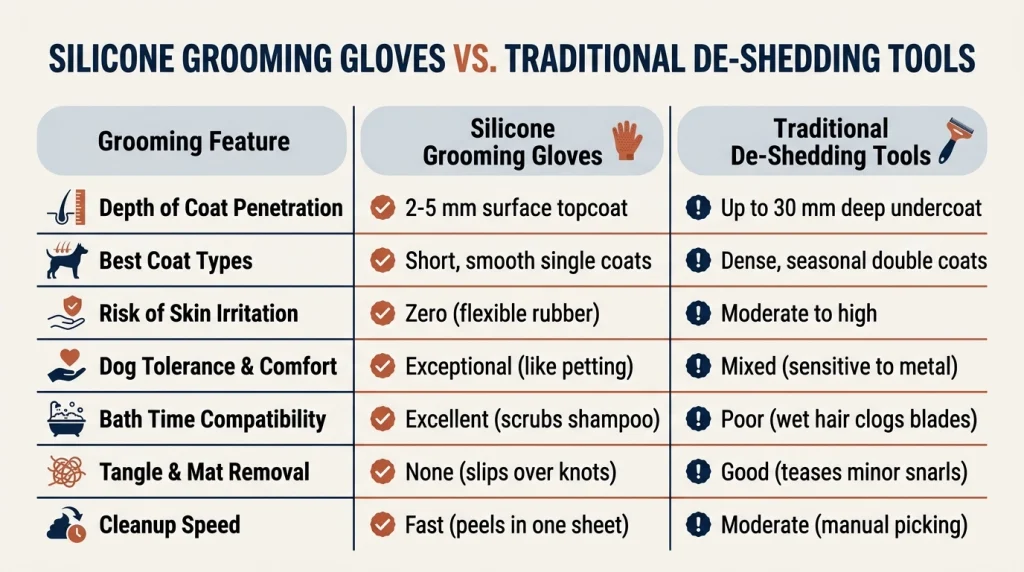
Choosing the right tool comes down to your dog’s coat genetics and tolerance for handling. Both tools offer distinct advantages depending on the job at hand.
The table below summarizes how these two options compare across key grooming factors as of 2026:
| Grooming Feature | Silicone Grooming Gloves | Traditional De-Shedding Tools |
|---|---|---|
| Depth of Coat Penetration | Surface to shallow topcoat only (2-5 mm) | Deep undercoat down to skin level (up to 30 mm) |
| Best Coat Types | Short, smooth, and sleek single coats | Dense, heavy, seasonal double coats |
| Risk of Skin Irritation | Zero; flexible rubber bends under pressure | Moderate to high if pressed too hard against skin |
| Dog Tolerance & Comfort | Exceptional; feels like affectionate petting | Mixed; sensitive dogs often shy away from metal teeth |
| Bath Time Compatibility | Excellent; scrubs in shampoo and catches wet fur | Poor; wet hair clumps and clogs steel blades instantly |
| Tangle & Mat Removal | None; slips over knots without separating them | Good; rakes tease apart early webbing and minor snarls |
| Cleanup Speed | Fast; hair peels off in one cohesive sheet | Moderate; requires ejector buttons or manual picking |
As the data shows, each tool excels at different tasks. Neither option handles every single grooming challenge alone.
When Do Grooming Gloves Perform Better Than Traditional Brushes?
Grooming gloves outperform traditional metal tools whenever comfort, contouring, and stress reduction take priority. They turn high-stress grooming sessions into pleasant bonding moments.
Here are the specific scenarios where gloves beat metal rakes:
- Working with Nervous Dogs: Anxious rescue dogs often panic at the sight of metal tools. Gloves hide the grooming action behind familiar, comforting hand strokes.
- Navigating Sensitive Body Contours: Metal blades scrape roughly over protruding hip points, knees, and hocks. Flexible finger tips let you trace safely around delicate joints.
- Managing Face and Tail Areas: Dogs dislike rigid gear near their muzzles and ears. Soft glove nubs clean facial dirt and stray hair without poking sensitive eyes.
- Scrubbing During Baths: Wearing gloves while lathering shampoo pulls twice as much dead fur as bare hands. The water lubricates hair shafts for effortless shedding removal.
- Maintaining Smooth Single Coats: Short-haired breeds shed constantly but lack deep undercoats. Gloves lift dead surface dander without irritating delicate skin.
During my shelter volunteer work, I met a fearful hound mix who snarled whenever a slicker brush appeared. Slipping on a textured glove let me groom her entire back while she happily leaned in for ear scratches.
That psychological comfort is a major advantage. A tool that removes slightly less fur without terrifying your dog is often the superior choice.
Where Do Traditional De-Shedding Tools Remain Irreplaceable?
Traditional de-shedding tools remain essential whenever you deal with high-volume seasonal coat blows. Spring shedding brings massive shifts in canine coat density.
During spring and autumn, double-coated dogs shed their dense inner winter wool. This process is commonly called blowing coat.
The American Kennel Club notes that seasonal coat blowing requires specialized tools to prevent severe matting near the skin. Gloves simply cannot manage this sheer volume of wool.
These heavy grooming tasks require traditional steel tools:
- Hooking Deep Secondary Wool: Steel tines slip directly through guard hairs to extract compacted dead undercoat fibers.
- Preventing Felted Mats: Dense dead undercoat binds with body oils to create solid mats. Rakes slice through this fuzz before it seals against the skin.
- Clearing Massive Fur Volumes: During seasonal shedding, an undercoat rake can easily fill an entire grocery bag with dead wool in twenty minutes.
- Maintaining Wire Coats: Wire-haired breeds require firm comb tension to clear dead wire strands without tearing healthy follicles.
Relying exclusively on gloves for a shedding German Shepherd or Siberian Husky leaves dense felted mats beneath the surface. You must clear that lower layer with steel teeth.
Neglecting the undercoat can trap heat in summer and hold moisture in winter. That trapped moisture creates ideal conditions for painful bacterial hot spots.
How to Match the Right Tool to Your Dog’s Coat Type
Your dog’s genetic coat type determines which tool setup will keep your home clean and your pet comfortable. For an overview of different coat structures, explore our guide to identifying your dog’s coat type before buying new equipment.
Using the wrong tool wastes effort and can cause coat damage. Match your tools to the specific coat profiles below.
Short, Smooth Single Coats
Short-haired breeds have shallow hair roots and no insulating undercoat. Boxers, Pugs, Dalmatians, and Doberman Pinschers belong in this group.
For these breeds, grooming gloves easily replace traditional de-shedding tools. Metal blades can strike their ribs and backbones, causing painful scrapes.
Silicone glove nodules pick up sharp, needle-like hairs cleanly. They also distribute natural sebum across the skin to leave a healthy, glossy sheen.
Dense Double Coats
Double-coated breeds have a tough outer guard coat over dense, woolly undercoat insulation. Golden Retrievers, German Shepherds, Great Pyrenees, and Huskies fit this category.
For these dogs, gloves cannot replace traditional gear. You need a dedicated undercoat rake or bladed tool to pull out packed wool.
However, pairing both tools creates the ultimate shedding routine. Use your steel rake for a deep weekly session, then run gloves over the topcoat daily to catch strays.
To choose the best implement for this routine, consult our tested recommendations for the best brushes for shedding dogs across every breed group.
Curly and Wavy Non-Shedding Coats
Poodles, Bichon Frises, and many Doodle mixes grow continuous hair rather than shedding seasonally. Their shed hairs get caught in surrounding curls rather than falling to the floor.
Grooming gloves do not work well on curly coats. The soft rubber nubs drag against curls, pulling hairs painfully without clearing out tangles.
These coats require slicker brushes with fine wire pins and metal greyhound combs. Those tools separate dense curls down to the root without frizzing hair shafts.
Pro Grooming Tip: Always test tool resistance on your dog’s coat. If a tool snags or tugs, stop immediately and gently comb through the knot with your fingers.
Professional Tips for Getting Maximum Hair Off a Grooming Glove
 Save
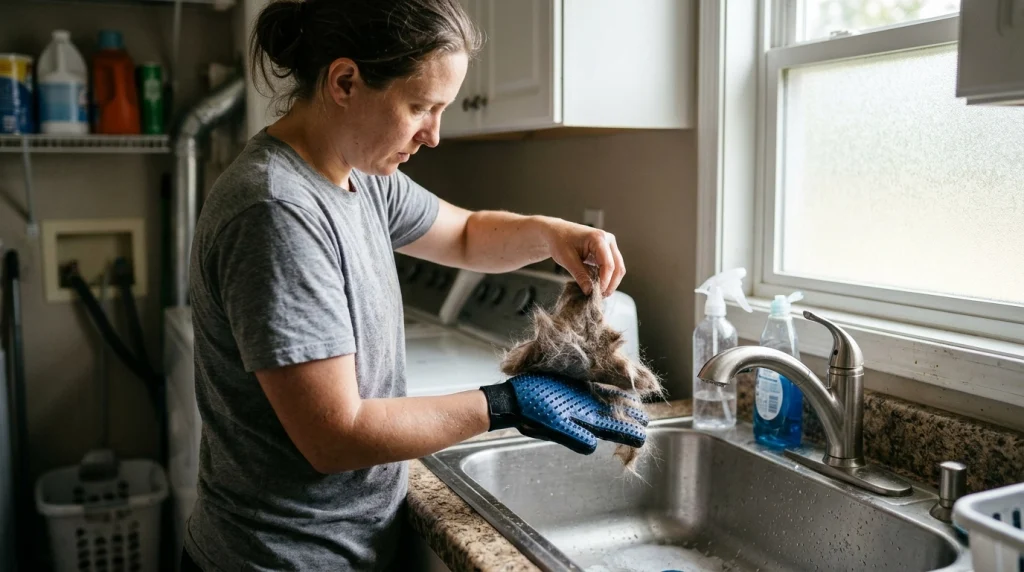
Using a grooming glove looks simple, but proper technique dramatically increases how much loose fur you collect. A few minor adjustments make a huge difference.
Apply these practical methods during your next brushing session:
- Stroke in Short, Overlapping Bursts: Avoid long, continuous passes down your dog’s back. Short, sweeping 6-inch strokes generate more static pull and lift dead hair faster.
- Build a Fur Base Layer First: Resist peeling the glove clean after just three strokes. Hair clings to other hair much better than bare rubber, making thick mats far easier to peel off cleanly.
- Lightly Dampen the Palms: Spray your gloves with clean water before grooming. Moisture prevents fine hairs from flying away and helps dead fur stick to the nubs.
- Wash Gloves with Degreasing Soap: Canine skin oils coat silicone nubs over time, reducing their grip. Wash your gloves weekly with basic dish soap to restore tacky friction.
- Groom Against the Grain Gently: On short-coated breeds, stroke backward against hair growth for three passes, then smooth it back down. This lifts deeply embedded loose fur out of follicles.
Following this system keeps stray fur contained on the glove instead of floating through your house. It cuts clean-up time in half.
Now that you know how each tool performs, you can pick the right gear for your pet’s routine.
If you are ready to upgrade your grooming toolkit, here are the gear options I personally use and recommend:
🏆 BEST OVERALL GLOVE
HandsOn Pet Grooming Gloves
★★★★★
Tough textured rubber nodules cover the palms and all five fingers with an adjustable hook-and-loop wrist strap. These gloves won’t crack or slip off when soaked, making them my top choice for everyday coat sweeps and bath sessions.
⚡ BEST FOR DENSE UNDERCOATS
Pat Your Pet Undercoat Rake
★★★★★
A dual-sided head features 9 rounded teeth for clearing mats on one side and 17 thinning teeth on the other. This tool penetrates deep double coats safely, pulling out dense seasonal undercoat wool that gloves cannot touch.
💰 BEST BLADED DESHEDDER
FURminator deShedding Tool
★★★★☆
A durable stainless steel edge with micro-grooves targets trapped loose fur beneath short-to-medium guard coats. It strips out shedding hair quickly, though you must use light pressure to protect delicate skin.
Frequently Asked Questions
Do grooming gloves hurt dogs?
No, quality grooming gloves do not hurt dogs. Their flexible silicone nubs bend easily over curves and bones, mimicking a soothing petting motion that relaxes nervous pets.
Can you use grooming gloves during bath time?
Yes, grooming gloves perform exceptionally well in the bath. Wet hair clings tightly to the rubber nubs, letting you scrub shampoo deep into the coat while catching loose fur before it clogs the tub drain.
How often should you use a grooming glove on your dog?
You can safely use grooming gloves daily because they do not pull on skin or scrape the epidermis. Regular three-minute sessions lift loose hair before it settles on your rugs and furniture.
Why won’t loose hair peel off my grooming glove?
Hair fails to peel when there is not enough fur accumulated on the palm. Let a dense layer of fur collect before peeling, or spritz the nubs with water to help hairs bind together.
Choosing between grooming gloves and traditional de-shedding tools is not an all-or-nothing decision. For short single coats, gloves handle everything you need while keeping your dog completely relaxed.
For double-coated breeds, combining both tools delivers the best results. Use an undercoat rake to clear out dense undercoat wool, then finish with grooming gloves for quick daily touch-ups.
Start with a short five-minute glove session tonight to see how your dog responds. Your pup gets a soothing massage, and you get a cleaner couch tomorrow.

Thomas Cutter is a lifelong dog owner and the founder of FindOutAboutDogs.com. With over 10 years of hands-on experience owning multiple breeds, Thomas created this site to provide honest, research-based dog advice that real owners can actually trust.
