What Types of Dog Grooming Gloves Are Available?
Quick Answer
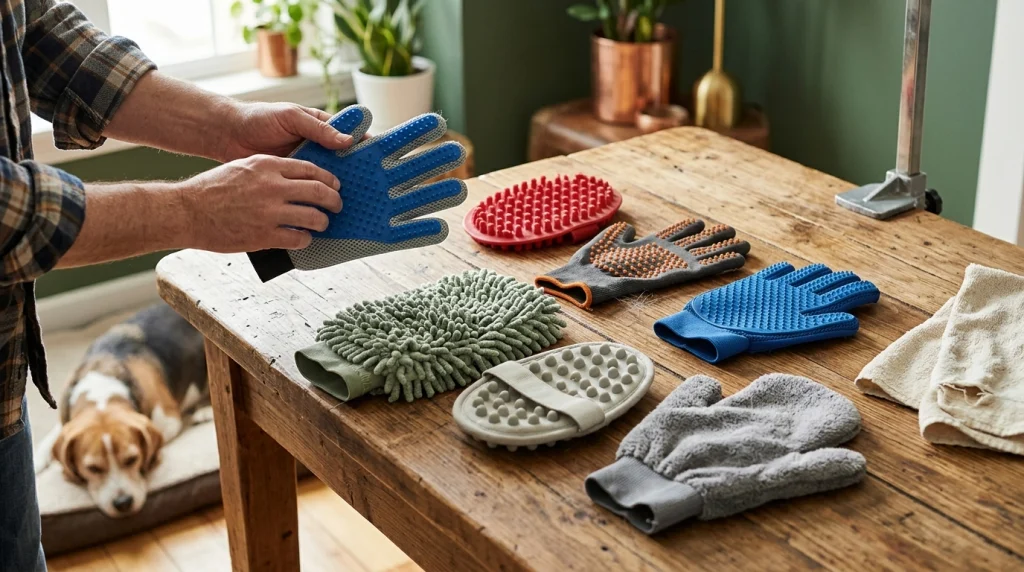
Dog grooming gloves come in several practical styles: silicone-bristle gloves, rubber curry mitts, five-finger deshedding gloves, waterproof bathing gloves, two-sided wet/dry gloves, soft massage mitts, and microfiber wiping gloves. Most work best for surface hair, loose dirt, and gentle handling rather than deep mats; choose by coat type and task, and see this short-hair grooming tool guide for a coat-specific example.
The main options at a glance
- Silicone-bristle gloves: Flexible tips lift loose surface fur during gentle strokes.
- Rubber curry mitts: Short nubs suit smooth, close-fitting coats.
- Five-finger gloves: Separate fingers improve control around legs and contours.
- Bathing gloves: Water-resistant designs spread dog shampoo while massaging.
- Wet/dry and massage mitts: Prioritize versatility or a soft, reassuring touch.
- Microfiber wiping gloves: Collect light dust and surface dirt without deep brushing.
Quick fit check
- Check the coat: If tangles hide near the skin, use a suitable comb or slicker rather than relying on a glove.
Dog grooming gloves look similar on store shelves, yet they do different jobs. I find it more useful to sort them by purpose than by impressive-sounding product names.
Below, I’ll explain the real differences, where each design works, and when another grooming tool makes more sense. That helps you buy for your dog’s coat, not the packaging.


What Is a Dog Grooming Glove?
A dog grooming glove is a wearable coat-care tool with textured rubber, silicone, fabric, or other cleaning surfaces. You stroke your dog with your hand while the glove loosens or collects surface hair and debris.
Unlike a handled brush, a glove follows the shape of your palm and fingers. That makes it appealing for dogs that accept petting more readily than a brush.
- Its strongest job: Light surface shedding and everyday coat maintenance.
- Its second job: Helping spread shampoo and loosen dirt during baths.
- Its main limitation: Most soft nubs cannot reach through dense, tangled undercoat.
Material and shape overlap, so categories are not completely separate. A single five-finger silicone glove may also be sold as a bathing, massage, and deshedding glove.
What Are the Main Types of Dog Grooming Gloves?
 Save
1. Silicone-bristle grooming gloves
Silicone gloves have rows of flexible tips across the palm, fingers, or both. Their soft texture can catch loose fur and gently work through the outside of a coat.
They are a practical starting point for a Beagle, Boxer, or other short-coated dog. Results depend on the tip length, the coat, and how much loose hair is present.
- Best for: Quick dry grooming, surface fur, and light massage.
- Look for: Rounded tips, washable surfaces, and a stable wrist fit.
- Watch out for: Deep undercoat or knots that short tips cannot penetrate.
2. Rubber curry grooming mitts
Rubber curry mitts resemble a small hand pad with rounded, stubby nubs. They create gentle friction to loosen dirt and shed hair from smooth coats.
Some are open mitts instead of full gloves. A wider pad can make broad strokes easier, although it offers less fingertip control.
- Best for: Short, smooth coats and finishing strokes.
- Look for: Soft, flexible rubber that does not scrape the skin.
- Watch out for: Over-rubbing one area or using it over irritated skin.
The American Kennel Club’s brush guide explains why short rubber bristles work better on short coats. Thick fur often keeps them from reaching the hair underneath.
3. Five-finger deshedding gloves
These resemble ordinary gloves, with each finger moving separately. Textured palms and fingertips give more control around the shoulders, chest, and legs.
Many have a mesh backing and an adjustable wrist strap. The word deshedding usually describes collecting already-loose fur, not removing an entire dense undercoat.
- Best for: Dogs that prefer stroking and owners who want precise hand movement.
- Look for: A comfortable finger length and a secure closure.
- Watch out for: Gloves that twist, slip, or trap hair between the fingers.
4. Waterproof bathing and shampoo gloves
Bathing gloves are built for wet coats, with water-resistant surfaces and short scrubby tips. They help distribute dog shampoo across broad body areas.
Some extend over the wrist, keeping your hands drier during a messy wash. A glove still cannot replace rinsing thoroughly with clean water.
- Best for: Bathtime lather, loose surface dirt, and gentle massage.
- Look for: Easy rinsing, soft tips, and a non-slip fit when wet.
- Watch out for: Water around the eyes, inside the ears, and on sore skin.
5. Two-sided wet/dry grooming gloves
A two-sided glove is designed to work on a damp or dry coat. Some versions are also reversible for either the left or right hand.
That is convenient when you want one tool for brushing between baths and lathering during them. Check the care label because not every fabric-backed glove dries quickly.
- Best for: Small grooming kits and owners who prefer a multipurpose tool.
- Look for: Clear wet/dry directions and an easy-clean surface.
- Watch out for: Damp fabric left folded away after bathing.
6. Soft massage mitts
Massage mitts emphasize smooth, gentle contact rather than maximum hair pickup. Their flexible nubs can make grooming feel more like ordinary petting.
I would choose this design for a dog that needs a slow introduction to grooming. Comfort comes first, and the hair-removal benefit may be modest.
- Best for: Calm handling practice and light coat maintenance.
- Look for: Rounded, soft contact points with no sharp seams.
- Watch out for: Assuming every massage mitt works as a real detangling brush.
7. Microfiber and fabric wiping gloves
Microfiber grooming gloves focus on wiping rather than combing. They can collect light dust or surface dirt after a walk, especially on a short coat.
Some fabric mitts work slightly damp, but they do not provide the tooth action of rubber or silicone. They are a finishing tool, not a shedding solution.
- Best for: Gentle wipe-downs and surface cleanup.
- Look for: Washable fabric and care instructions suitable for frequent use.
- Watch out for: Rubbing mud deeper into the coat instead of rinsing it away.
How Do Different Dog Grooming Gloves Compare?
Choose the glove by the job you need most. This comparison focuses on construction and practical limitations, not unverified hair-removal percentages.
| Glove type | Typical surface | Main use | Main limitation |
|---|---|---|---|
| Silicone-bristle | Flexible silicone tips | Light dry shedding | Limited depth |
| Rubber curry mitt | Short rubber nubs | Smooth-coat grooming | Poor on long tangles |
| Five-finger | Textured fingertips and palm | Controlled strokes | Fit varies |
| Bathing glove | Water-resistant scrub tips | Shampoo and dirt | Needs full rinsing |
| Wet/dry glove | Hybrid textured surface | Two grooming tasks | May dry slowly |
| Massage mitt | Soft, rounded bumps | Gentle contact | Less hair capture |
| Microfiber mitt | Soft woven fabric | Wiping and finishing | No detangling |
Which Grooming Glove Is Best for Your Dog’s Coat Type?
The dog’s coat matters more than the glove’s label. Start by checking whether the hair lies flat, stands densely, curls, or tangles easily.
- Short, smooth coats: Try a soft rubber curry mitt or silicone glove. A Boxer or Beagle is a useful example.
- Short, dense coats: Use a glove for surface fur, then add a suitable brush when loose hair remains.
- Long, silky coats: Use a glove for petting or finishing, not as your only grooming tool.
- Curly coats: Prioritize a suitable slicker and comb to find tangles hidden underneath.
- Thick double coats: Use a glove for light finishing and a coat-appropriate undercoat tool for deeper maintenance.
Veterinary guidance from VCA Animal Hospitals supports flexible gloves for smooth coats. It recommends different brushes and combs for curly, medium, and long coats.
For heavy seasonal shedding, see this guide to undercoat brushes. It covers tools that can reach where soft glove tips often cannot.
Are Grooming Gloves Better Than Dog Brushes?
Grooming gloves are often easier for quick touch-ups and brush-shy dogs. Traditional brushes and combs are usually better when the coat is dense, long, or tangled.
I use a simple decision rule: choose a glove for comfortable surface grooming and a brush for a specific coat problem. Neither needs to replace the other.
- Choose a glove when: Your dog enjoys stroking and has light, loose surface fur.
- Choose a slicker or comb when: You need to find knots or separate long, curly, or packed hair.
- Use both when: A proper brush handles deeper coat care and the glove finishes the session gently.
If loose hair is the main complaint, compare other options in this dog shedding brush roundup. A glove is only one tool in that larger category.
How Should You Use a Dog Grooming Glove Safely?
 Save
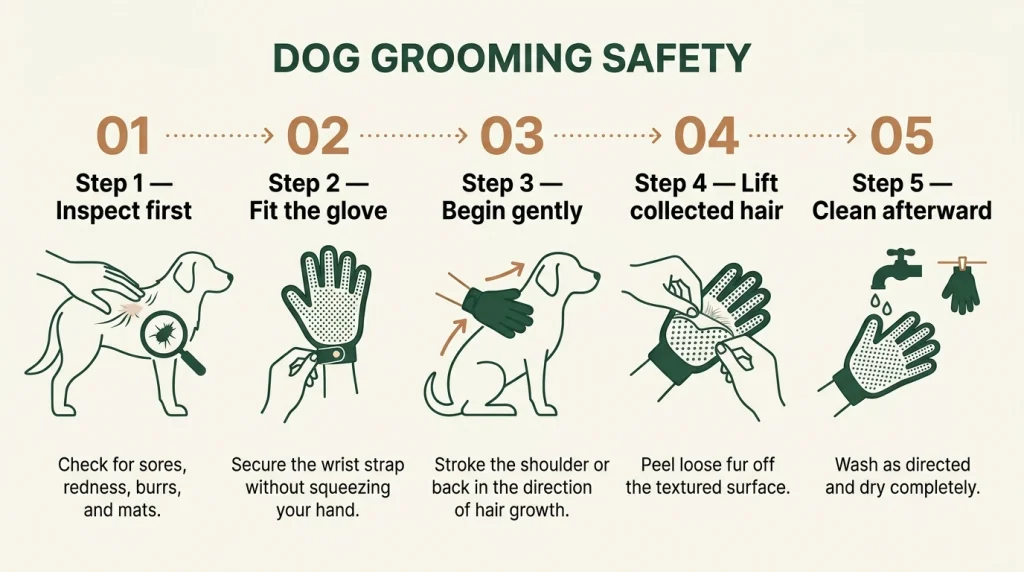
Start with a relaxed dog and slow strokes in the direction of hair growth. Use light pressure, and stop if your dog flinches or moves away.
- Inspect first: Check for sores, redness, burrs, and mats before touching the coat.
- Fit the glove: Tighten the wrist strap without squeezing your hand.
- Begin gently: Try the shoulder or back before approaching sensitive areas.
- Lift collected hair: Peel off loose fur when it builds up on the textured side.
- Clean afterward: Wash according to the maker’s directions and dry completely.
For baths, use lukewarm water and dog-specific shampoo. The ASPCA’s dog grooming guidance emphasizes removing mats before bathing and avoiding water around the face.
Never scrub over open sores or unexplained skin irritation. Contact your veterinarian for persistent itching, bald spots, or abnormal hair loss.
What mistakes should you avoid?
The biggest mistake is treating every grooming glove as a deep deshedding tool. Marketing photos of collected fur do not prove the product suits your dog’s coat.
- Too much pressure: Repeated friction can irritate sensitive skin.
- Ignoring knots: A glove may glide over a mat without revealing it.
- Using dirty gloves: Trapped shampoo or hair can make the next session unpleasant.
- Rushing nervous dogs: Short, positive sessions work better than forcing a full groom.
What Features Matter When Buying Grooming Gloves?
 Save
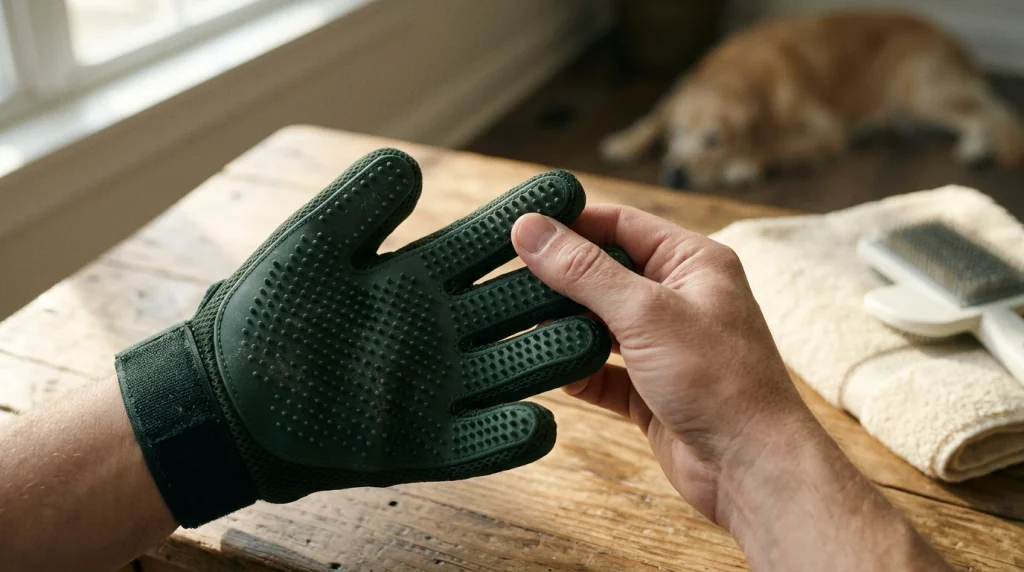
As of 2026, the most useful features remain simple: comfortable fit, flexible tips, and easy cleaning. Extra marketing claims matter much less than those basics.
- Tip softness: Rounded, flexible nubs should move easily against your hand.
- Wrist closure: An adjustable strap keeps the glove from rotating.
- Finger control: Separate fingers improve reach along the legs and chest.
- Wet-use suitability: Check that the product is intended for baths before soaking it.
- Cleaning: Choose a surface that releases hair and dries without lingering moisture.
- Hand sizing: An oversized glove bunches around the fingertips and reduces control.
For an especially soft finish, consider pairing a glove with an appropriate brush from this soft-fur grooming guide. Use the least irritating tool that still does the job.
Three Dog Grooming Gloves Worth Considering
If you’re ready to compare real products, these three illustrate useful differences in construction. The stars below are editorial feature-fit scores, not customer ratings or claims of hands-on testing.
Disclosure: Some shopping links are affiliate links, which may earn a commission at no additional cost to you.
🏆 Best for Multipurpose Grooming
HandsOn Animal Gloves
★★★★★ 5/5 feature fit
Distinct rubber nodules cover the fingers and palms, with wrist closures and multiple sizes. I like this design on paper for people who want one pair for dry grooming, baths, and controlled hand movements; check stock and sizing first.
🐾 Best for Everyday Loose Fur
DELOMO Zoe Pet Grooming Gloves
★★★★☆ 4/5 feature fit
DELOMO lists 255 soft silicone tips on this grooming-glove design. I see it as a straightforward choice for routine surface-hair pickup, while noting it is not a substitute for a deep undercoat comb.
🛁 Best for Wet and Dry Use
Well & Good Wet & Dry Grooming Glove
★★★★☆ 4/5 feature fit
This Petco glove is reversible for either hand and designed to lather shampoo or lift loose fur when dry. I would consider it for a compact bath-and-brush kit, although its fabric sections require proper drying.
Frequently Asked Questions
Do dog grooming gloves actually remove shedding hair?
Yes, grooming gloves can collect loose hair from the coat’s surface, especially on short-haired dogs. They do not stop normal shedding or reliably remove packed undercoat.
If loose hair continues after glove grooming, use an appropriate brush and ask a groomer which tool suits your dog’s coat.
Can you use silicone grooming gloves on a puppy?
Often, yes, if the tips are soft and your puppy is comfortable with handling. Begin with brief, gentle strokes and reward calm behavior.
Avoid sensitive skin and stop if your puppy becomes distressed. A veterinarian can advise if your puppy has a skin condition.
Can grooming gloves replace a slicker brush?
Not for every coat. A glove is useful for surface grooming and gentle touch, while a slicker brush can help maintain curly or longer coats when used correctly.
Dogs with mats need careful detangling, and severe mats are best handled by a professional rather than pulled with a glove.
Are dog grooming gloves better used wet or dry?
It depends on the design and your goal. Dry strokes are convenient for loose fur and everyday touch-ups; bathing gloves help spread dog shampoo on wet coats.
Follow the manufacturer’s instructions, rinse away all shampoo, and clean the glove thoroughly after each bath.
How often should you use a dog grooming glove?
Use it as often as your dog’s skin and coat comfortably allow, without excessive rubbing. Short sessions are a sensible starting point.
The full grooming schedule depends on coat length, shedding, and skin health, so ask your veterinarian or groomer if you are unsure.
Final Takeaway: Match the Glove to the Job
For a smooth-coated dog, a flexible silicone glove or rubber mitt is a sensible first choice. Choose a waterproof version for baths, a five-finger glove for control, or a soft mitt for gentle handling.
For dense undercoat and stubborn mats, keep a proper brush or comb in your grooming kit. Pick the tool your dog tolerates and your dog’s coat actually needs.

Thomas Cutter is a lifelong dog owner and the founder of FindOutAboutDogs.com. With over 10 years of hands-on experience owning multiple breeds, Thomas created this site to provide honest, research-based dog advice that real owners can actually trust.
