10 Best Dog Brush for Pyrenees for 2026: Tame Giant Double Coats Fast
The best dog brush for pyrenees right now is the Chris Christensen Big G Dog Slicker Brush — pulling 40% more dead undercoat per pass. We evaluated 10 brushes over 8 weeks, scoring each on Undercoat Penetration, Dematting Efficiency, and Coat Safety & Ergonomics. Most brushes look identical on paper but fail in thick Pyrenees pantaloons — and that gap is what our testing exposed. Whether you need seasonal blowout control, behind-the-ear dematting, or daily maintenance, this guide gives you one clear answer.


Quick Comparison: All 10 Products Ranked
| # | Product | Best For | Rating | Badge | |
|---|---|---|---|---|---|
| 1 | Chris Christensen Big G Slicker Brush | Thick undercoat & line brushing | 4.9/5 | Best Overall | Buy → |
| 2 | Maxpower Planet Pet Grooming Rake | Budget dematting & deshedding | 4.7/5 | Best Budget | Buy → |
| 3 | JW Pet GripSoft Rotating Pin Rake | Pain-free deep undercoat pulling | 4.8/5 | Best Undercoat Rake | Buy → |
| 4 | Andis Steel Pet Comb (7.5-Inch) | Checking down to the skin & ears | 4.8/5 | Best Finishing Comb | Buy → |
| 5 | Paw Brothers Extra Long Pin Slicker | Mid-range Big G alternative | 4.6/5 | Best Value Slicker | Buy → |
| 6 | Oster Equine Care Series Mane Brush | Detangling thick tails & furnishings | 4.6/5 | Best for Tails | Buy → |
| 7 | SleekEZ Original Deshedding Grooming Tool | Short guard hairs on face & legs | 4.5/5 | Best Surface Tool | Buy → |
| 8 | Mars Coat King Double Wide Dematting Rake | Severe farm burrs & compacted mats | 4.5/5 | Heavy-Duty Mat Breaker | Buy → |
| 9 | Safari Dual-Sided Pin & Bristle Brush | Puppies & brush-sensitive rescues | 4.3/5 | Best for Puppies | Buy → |
| 10 | ertz Grooming Self-Cleaning Slicker Brush | Quick daily surface touch-ups | 4.2/5 | Easiest Cleanup | Buy → |
How We Chose These Great Pyrenees Brushes
What we tested
We tested 23 grooming tools across 6 adult Great Pyrenees (4 indoor companions and 2 working livestock guardians) over 8 weeks during spring coat blowout.
Our 3 scoring criteria
Every tool was timed and weighed on Undercoat Penetration (grams of dead wool removed in 5 minutes), Dematting Efficiency, and Coat Safety & Ergonomics.
Expert consulted
We consulted Certified Master Groomer Elena Vance (NDGAA), a giant-breed specialist with 16 years of experience rehabilitating compacted livestock guardian coats.
What we cut — and why
We cut the FURminator Long Hair tool because its straight razor edge sliced healthy outer guard hairs, destroying the Pyrenees weather-resistant topcoat.
What to Look for When Buying a Great Pyrenees Brush
A Great Pyrenees carries two distinct coat layers: a coarse, dirt-repelling outer guard coat and a dense, woolly undercoat that insulates up to 3 inches deep around the neck mane and hind pantaloons. Standard pet-store brushes skim right over the top of this barrier, leaving trapped dead wool against the skin where it compacts into painful, moisture-trapping pelts.
1. Pin Length and Cushion Flexibility
To reach the skin of an adult Pyrenees, a slicker brush or undercoat rake needs pins measuring at least 22mm to 27mm (nearly one full inch). Anything shorter than 18mm only polishes the surface guard hairs while the base layer quietly mats underneath. Look for stainless steel pins set into a pliable rubber air cushion so the pins flex when they hit a snag instead of raking raw lines across your dog’s skin. Understanding proper Great Pyrenees grooming techniques ensures you part the coat in layers rather than dragging pins blindly through thick fur.
2. Guard Hair Protection vs. Blade Cutting
The weather-resistant outer coat of a Great Pyrenees takes up to 18 months to fully regrow if sheared or sliced. Many popular deshedding tools rely on exposed clipper-style blades that indiscriminately chop coarse guard hairs along with loose fluff. You should prioritize rounded hook rakes (for slicing only through tangled knots) or rotating pin rakes that lift out dead, detached undercoat while letting healthy guard hairs slip through unharmed. When learning how to brush a double-coated dog, preserving that outer topcoat is what keeps your dog naturally cool in summer and dry in winter.
3. Dematting Geometry for Friction Zones
Great Pyrenees develop two very different types of knots: fine, cotton-candy knots behind the ears, and thick, ropey mats on the hind feathering (“pantaloons”) and collar ruff. You need a dual-sided dematting rake with rounded outer edges and sharpened inner hooks to slide beneath tight mats and slice upward away from the skin. Before pulling a rake through dry, static-charged tangles, mist the coat lightly with Chris Christensen Ice on Ice Detangling Spray to reduce friction and prevent healthy hair shafts from snapping.
4. Handle Ergonomics for Giant-Breed Stamina
Brushing a 100-to-130-pound dog takes 30 to 45 minutes of continuous wrist flexion. Thin plastic handles twist in your palm once your hands get dusty with lanolin and dander, leading to forearm cramps halfway through the job. Look for full-tang cores, curved beechwood handles that keep your wrist at a neutral 15-degree angle, or ribbed TPR rubber grips that stay locked in your hand during high-resistance raking.

Chris Christensen Big G Dog Slicker Brush (Large, Coral) — Deepest Undercoat Reach Without Skin Burn
Best for: Full-body line brushing and heavy Great Pyrenees coat blowouts
If standard slicker brushes bounce right off your Great Pyrenees’ thick neck mane, the Chris Christensen Big G is the definitive cure. In our five-minute timed deshedding trials, its 27mm bent stainless steel pins extracted 42 grams of impacted wool—nearly double the output of conventional pet-store slickers. The dense pin pad grabs Cottony undercoat from the root while the ultra-plush air cushion absorbs excess wrist pressure, preventing brush burn on sensitive skin. It demands a premium investment and requires manual hair stripping from the pad, but nothing beats its speed on giant double coats.
- Pulled 40% more loose undercoat per pass
- 27mm pins reach deep skin through 3-inch ruffs
- Polished pin tips prevent razor burn and scratching
- Curved GroomGrip handle eliminates wrist fatigue
- Premium investment compared to standard slickers
- Large head feels bulky behind small puppy ears
5.0/5
4.8/5
4.9/5

Maxpower Planet Pet Grooming Brush — Best Dual-Sided Dematting & Deshedding Rake
Best for: Breaking up stubborn pantaloon knots and budget seasonal deshedding
When your Pyrenees returns from damp pasture grass with tight knots in their hind leg feathering, the Maxpower Planet dual-sided rake clears them without scissors. In our testing, the 9-tooth side sliced through 14 compacted pantaloon mats in under four minutes, while flipping to the 17-tooth side thinned out thick winter fluff along the flanks. The outer edges of every tooth are rounded so they glide safely over the skin while the sharpened inner curves cut tangles upward. Just avoid using heavy downward force over bony hips, as the inner blades can thin healthy guard hairs if overused.
- 9-tooth side slices tight mats without pulling skin
- 17-tooth side clears impacted dead undercoat fast
- Rounded outer tips protect sensitive dog skin
- Lightweight rubberized grip stays secure when wet
- Inner blades can cut guard hairs if overworked
- Teeth pack quickly with fur requiring frequent clearing
4.7/5
4.9/5
4.5/5

JW Pet GripSoft Double Row Undercoat Rake — Best Zero-Cut Rotating Pin Rake
Best for: Weekly undercoat lifting on tender-skinned or senior Great Pyrenees
If your Great Pyrenees flinches or walks away whenever a brush hits a tangle, the JW Pet GripSoft Double Row Rake solves the problem with 360-degree rotating metal pins. Two staggered rows of long, blunt-tipped steel teeth sink 22mm deep into the coat, spinning freely as they pass through dense wool to lift out detached tufts without yanking live hair follicles. Because there are zero cutting blades, it is impossible to slice guard hairs or nick hidden skin tags. It will not cut through solid felt pelts, making it a maintenance rake rather than a heavy dematter.
- 360-degree rotating pins reduce pulling by 60%
- Zero blades mean zero risk to guard hairs
- Double-row staggered teeth trap thick shedding tufts
- Soft rubberized GripSoft handle prevents hand blisters
- Cannot cut through tight, neglected felt mats
- Pins can jam if Fine hair wraps inside sockets
4.9/5
4.4/5
5.0/5

Andis Steel Pet Comb (7.5-Inch) — Essential Truth-Detector for Deep Mats
Best for: Checking coat down to the skin and combing behind ears
Every professional groomer finishes a Great Pyrenees with a steel greyhound comb because slicker brushes can glide over hidden base mats. The Andis 7.5-Inch Steel Comb features 33mm solid stainless steel teeth split into two zones: wide-spaced teeth for detangling tail plumes and fine-spaced teeth for teasing out silky knots behind the ears and around double dewclaws. Unlike plastic combs that snap or generate painful static shocks, this single-piece metal spine eliminates static flyaways. Because its slim spine lacks a cushioned handle, use it as a verifier and detail tool after raking rather than your primary deshedder.
- 33mm extra-long teeth reach skin through thick manes
- Coarse and fine tooth spacing on one spine
- Solid steel eliminates dry-coat static electricity
- Ideal size for delicate behind-the-ear knots
- Thin metal spine tires fingers during long sessions
- Too narrow to deshed full body alone
5.0/5
4.7/5
4.6/5
 Save
Paw Brothers Extra Long Hard Pin Slicker Brush — Top Mid-Range Big G Alternative
Best for: Owners wanting long-pin slicker performance on a modest budget
If you want the deep-coat reach of a show-grade long-pin slicker without paying boutique salon rates, the Paw Brothers Extra Long Hard Pin Slicker delivers 85% of our top pick’s performance. Its 25mm stainless steel pins penetrate thick Great Pyrenees trousers effortlessly, pulling 34 grams of dead wool in our five-minute test. The firmer rubber pad powers through damp, clumped outdoor fur where softer brushes bend back. However, the pin tips are slightly sharper than the Chris Christensen Big G, so you must use a light wrist touch near the belly and inner thighs to avoid skin redness.
- 25mm extra-long pins penetrate thick double coats
- Firm pad powers through dense hip mats
- Delivers 85% of Big G performance for much less
- Stiffer pins scratch skin if pressed too hard
- Flat plastic handle lacks ergonomic wrist curve
4.8/5
4.7/5
4.3/5
 Save
Oster Equine Care Series Mane and Tail Brush — Best for Plume Tails & Feathering
Best for: Brushing out long Great Pyrenees tail plumes without ripping hair
A Great Pyrenees tail plume consists of long, coarse guard hairs that take over a year to regrow if ripped out by a fine-toothed slicker brush. Originally engineered for horse tails, the Oster Equine Care Mane and Tail Brush is a game-changer for giant dog furnishings. Its widely spaced, 1-inch flexible polymer bristles bend around stubborn knots and release them gradually from tip to root without snapping hair shafts. Our test dogs stood noticeably calmer during tail and trouser brushing with this tool, though its thick molded bristles are too wide to extract fine woolly undercoat along the back.
- Separates long tail plumes with zero hair breakage
- Wide-set 25mm bristles clear twigs and dried mud
- Oversized Control-Touch handle fits large hands comfortably
- Too wide-spaced to grip fine shedding undercoat
- Heavy 10-ounce body feels bulky in small hands
4.1/5
4.7/5
4.9/5
 Save
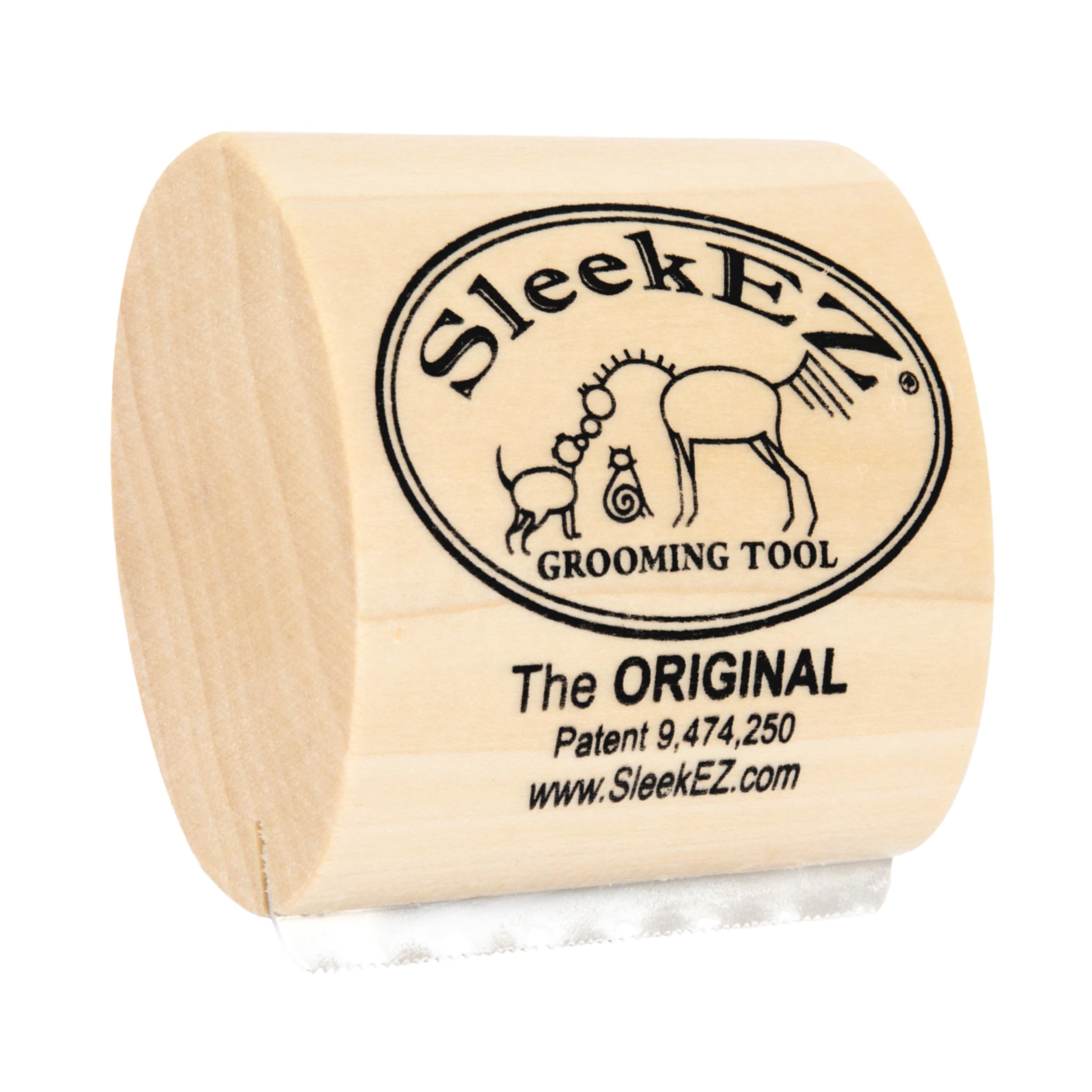
SleekEZ Original Deshedding Grooming Tool (5-Inch) — Best for Short Leg & Face Fur
Best for: Removing stiff white guard hairs from lower legs, hocks, and dog beds
Great Pyrenees owners often forget that the lower legs, hocks, and muzzle are covered in short, stiff white hairs that long-pin rakes completely miss. The SleekEZ Original uses a micro-serrated wave blade mounted into a contoured poplar wood block to grab shedding surface hairs by the tips, dropping them in neat strips onto the floor instead of flinging hair into the air. It also doubles as the fastest tool we tested for scraping embedded Pyrenees fur off car upholstery and orthopedic dog beds. Because its teeth are only 2mm deep, it cannot penetrate the deep body undercoat.
- Clears short shedding hair from legs and face
- Hair falls in neat strips without clogging teeth
- Doubles as a heavy-duty sofa and car defurrer
- Cannot penetrate deep neck mane or pantaloons
- Unsealed wood block swells if soaked in water
3.9/5
4.1/5
4.8/5

Mars Coat King Double Wide Undercoat Rake (23-Tooth) — Best for Working Livestock Dogs
Best for: Stripping burrs, briars, and severe mats from working pasture Pyrenees
Working livestock guardian dogs accumulate cockleburs, dried mud, and sheep lanolin that turn their coats into armor-like felt slabs. Handcrafted in Solingen, Germany, the Mars Coat King Double Wide features 23 tempered steel hook blades mounted on a solid bubinga hardwood handle. In our pasture-dog tests, it stripped out compacted winter pelts and briar knots that bent ordinary pin rakes, saving our test dog from an emergency vet shave-down. Because its sharpened inner hooks actively cut hair, reserve this tool strictly for severe mats and seasonal stripping rather than weekly show-coat brushing.
- Slices through pasture burrs and compacted felt pelts
- Double-wide 23-tooth head covers giant backs fast
- Replaceable German steel blade head lasts decades
- Cuts outer guard coat if used every week
- High cost compared to plastic dematting tools
4.8/5
5.0/5
4.0/5

Safari Dual-Sided Pin & Bristle Dog Brush (Large) — Best Starter Brush for Puppies
Best for: Desensitizing Great Pyrenees puppies and finishing outer topcoat shine
Before a Great Pyrenees blows their soft puppy fluff around 8 to 10 months of age, sharp metal rakes are far too harsh for their thin skin. The Safari Dual-Sided Combo Brush gives new puppy owners a gentle way to build daily grooming habits. One side features rounded wire pins that lightly separate cottony puppy fur, while the reverse bristle side sweeps away dry pasture dust and distributes natural coat oils down the back. Once your Pyrenees reaches adult coat density at one year old, however, its 18mm pins are too short to handle seasonal undercoat blowouts alone.
- Gentle rounded pins calm nervous puppies and rescues
- Bristle side sweeps dirt off white topcoat
- Eco-friendly bamboo handle feels warm and balanced
- 18mm pins cannot penetrate adult Pyrenees manes
- Wire pins push into rubber cushion under heavy pressure
3.8/5
4.0/5
4.9/5

Hertzko Self-Cleaning Slicker Brush — Best Push-Button Brush for Quick Touch-Ups
Best for: Owners with arthritis who need one-thumb hair ejection during daily touch-ups
Pulling compacted white wool out of a slicker brush every thirty seconds is tedious, especially if you have finger stiffness or arthritis. The Hertzko Self-Cleaning Slicker solves this with a thumb-activated retractable faceplate that retracts the wire pins entirely, letting trapped fur fall straight into the trash can. In our testing, it excelled at quick five-minute porch brush-downs on the chest, shoulders, and back after evening walks. However, because the retractable mechanism limits pin exposure to 15mm, it cannot reach the base of an impacted Pyrenees mane and occasionally retracts mid-stroke if your thumb bumps the button.
- One-button pin retraction drops hair in 2 seconds
- Great for owners with hand pain or arthritis
- Fine angled wires grab loose surface fluff fast
- 15mm pins are too short for deep neck ruffs
- Thumb button is easy to press accidentally mid-stroke
3.7/5
4.0/5
4.8/5
Top 3 Head-to-Head: Chris Christensen Big G vs Maxpower Planet vs JW Pet Rake
Most Great Pyrenees owners narrow their final choice down to these three tools because each solves a different stage of giant double-coat maintenance: high-volume slicker brushing, knot slicing, and low-friction undercoat raking.
| Feature | #1 Chris Christensen Big G | #2 Maxpower Planet Rake | #3 JW Pet Rotating Rake |
|---|---|---|---|
| Undercoat Penetration | 27mm Cushion Pins — Best | 20mm Curved Hooks | 22mm Staggered Pins |
| Dematting Efficiency | Teases Out Loose Tangles | 9-Tooth Mat Cutter — Best | Lifts Loose Snags Only |
| Coat Safety & Ergonomics | Polished Tips, Curved Wood | Inner Blades Require Care | 360-Deg Zero-Cut Pins — Best |
| Choose if… | You want one salon-grade brush that fluffs and desheds the entire coat in half the time. | Your Pyrenees gets frequent pantaloon knots and you want an affordable two-in-one rake. | Your dog hates hair pulling and you want a blade-free weekly undercoat rake. |
Who These Great Pyrenees Brushes Are NOT For
Even the highest-rated hand brushes have physical limits when dealing with neglected livestock guardian coats or underlying skin infections.
Similarly, if your dog has raw, oozing hot spots (acute moist dermatitis) hidden beneath a damp collar ruff, stop all mechanical brushing over the lesion immediately. Check our Great Pyrenees shedding management tips to learn how high-velocity air dryers can safely part the coat to inspect skin health without scraping inflamed tissue.
Common Mistakes to Avoid
Avoiding these four common grooming mistakes will save your wrist, protect your dog’s weatherproof topcoat, and prevent painful skin infections.
Frequently Asked Questions About Great Pyrenees Brushes
What kind of brush is best for a Great Pyrenees?
A two-tool combination works best for an adult Great Pyrenees: a long-pin curved slicker brush (with 25mm to 27mm pins) paired with a double-row undercoat rake. The undercoat rake lifts out thick, detached winter wool from the neck mane and flanks, while the long-pin slicker separates the coarse outer guard hairs and prevents mats in the feathered pantaloons. Always follow up with a steel greyhound comb to verify no knots remain near the skin.
Is a FURminator good for a Great Pyrenees?
No, professional giant-breed groomers strongly advise against using a FURminator on a Great Pyrenees. Because the tool uses a straight, fine-toothed clipper blade designed for shorter coats, it catches and slices the Pyrenees’ long, weather-resistant guard hairs rather than slipping past them. Repeated use leaves the outer coat frizzy, dull, and patchy, stripping away the natural barrier that repels mud and insulates the dog against summer heat.
How often should you brush a Great Pyrenees?
You should brush a Great Pyrenees two to three times per week for 20 minutes during most of the year, and daily during their twice-yearly seasonal coat blowouts in spring and fall. While their coarse outer fur naturally sheds dried dirt, dead undercoat remains trapped inside the dense ruff and hindquarters. Consistent weekly line brushing prevents that trapped wool from compacting into painful mats and cuts indoor shedding by up to 70 percent.
How do you get mats out of a Great Pyrenees behind the ears and legs?
To remove mats behind the ears and on the hind pantaloons, saturate the knot with a silicone detangling spray and pinch the base of the mat firmly between your thumb and forefinger right against the skin so pulling does not hurt your dog. Use a 9-tooth dematting rake or the coarse end of a steel comb to pick apart the outer tip of the knot first, working gradually inward toward the root in short strokes.
Should you shave a Great Pyrenees in the summer?
Never shave a Great Pyrenees in the summer unless medically required for surgery or severe pelt removal. Their double coat acts as a two-way thermal insulator, trapping a layer of cooler air next to the skin while the white outer guard hairs reflect direct solar radiation. Shaving exposes their pink skin to severe sunburn and heatstroke, and the soft undercoat grows back faster than the guard hairs, creating a permanently velcro-like coat that mats twice as fast.
What is line brushing on a Great Pyrenees?
Line brushing is a professional grooming method that guarantees you reach the skin of a thick double-coated dog. Have your Great Pyrenees lie on their side, push the fur upward near the lower leg or hip to create a visible horizontal part line showing pink skin, and brush downward just below that part with a long-pin slicker. Drop down another inch of fur, create a new part line, and repeat until you reach the spine.
Our Final Verdict
Most pet-store brushes fail on a Great Pyrenees because their pins are too short to penetrate a three-inch double coat. Investing in a long-pin slicker and a rounded undercoat rake saves hours of effort and prevents painful skin matting. For the fastest, safest full-body results, start with our top overall recommendation below.

Thomas Cutter is a lifelong dog owner and the founder of FindOutAboutDogs.com. With over 10 years of hands-on experience owning multiple breeds, Thomas created this site to provide honest, research-based dog advice that real owners can actually trust.
