What Is a Slicker Brush Used For? Dog Grooming Guide
Quick Answer
A slicker brush is used to remove loose hair, separate tangles, prevent small mats, and work through medium, long, curly, wire, or dense dog coats. Its closely spaced wire pins can reach farther into the coat than a basic bristle brush, but the right dog brush depends on coat type, so a slicker is not automatically the best tool for every dog.
What a slicker brush does best
- Removes loose hair: Fine pins collect dead hair before much of it lands around your home.
- Loosens tangles: Short, controlled strokes can separate minor knots before they tighten into mats.
- Prevents matting: Regular brushing removes shed hair that might otherwise become trapped in longer coats.
- Reaches dense coats: Longer slicker pins can work through thick outer hair toward loose material underneath.
- Fluffs the coat: Groomers also use slickers to separate and lift curly or fluffy hair during finishing.
One rule matters most
- Use light pressure and stop if the skin becomes pink, irritated, or uncomfortable.
A slicker brush looks simple, but technique matters more than most dog owners expect. The same fine pins that handle loose coat well can irritate skin when you press too hard.
I treat a slicker as a precision grooming tool rather than something to scrub across every coat. Once you understand what it does, choosing and using one becomes much easier.


What exactly is a slicker brush?
A slicker brush is a grooming brush with many fine metal pins set closely together on a flat or curved pad. The pins are usually angled or bent so they move through hair and collect loose coat.
Its design gives it more reach than a normal bristle brush. That makes it useful when loose hair and tangles are sitting below the coat’s surface.
- Fine metal pins: Separate individual hairs and catch loose coat.
- Dense pin spacing: Helps work through fluffy, curly, or moderately tangled hair.
- Cushioned or curved pad: Allows some flexibility while brushing.
- Different pin lengths: Shorter pins suit shorter coats, while long pins reach farther into thick coats.
- Multiple head sizes: Small heads fit legs and tight areas, while large heads cover the body faster.
The American Kennel Club describes slickers as useful for medium, long, wire, and curly coats. It also stresses using a light touch because excessive pressure can cause discomfort.
What is a slicker brush used for on a dog?
A slicker brush has several jobs, but detangling and removing loose hair are its main purposes. Those two jobs also help prevent future matting.
1. Removing loose and dead hair
Dogs naturally release old hair as their coats renew themselves. A slicker catches much of that loose hair before it works deeper into surrounding coat or drops around the house.
This is especially useful on longer or dense coats. During heavier shedding, however, a dedicated undercoat rake may remove deep loose undercoat more efficiently.
2. Separating small tangles
Slicker pins can tease apart minor tangles when you use short, gentle strokes. I prefer starting at the outside of a tangle instead of dragging the brush straight through its center.
That approach reduces pulling. Holding the hair near the skin can also keep tension from transferring directly to the dog.
3. Helping prevent mats
Mats develop when loose and attached hairs twist together and tighten. Friction areas such as behind the ears, under the legs, around collars, and along feathered legs often need extra attention.
Regular brushing removes material before those knots become compacted. PetMD’s guidance on preventing matting also recommends combining a slicker with a metal comb for many longer coats.
4. Working through dense or double coats
A longer-pin slicker can pass through the outer layer of many dense coats and collect loose hair underneath. This makes it useful on breeds such as Golden Retrievers, Collies, Pomeranians, and similar heavily coated dogs.
It does not replace every undercoat tool. Heavy seasonal shedding may still call for a properly sized rake or de-shedding tool.
5. Fluffing curly and groomed coats
Slickers are also finishing tools. Curly and cottony coats can be lifted and separated after drying, which helps create an even, fluffy appearance.
This is one reason professional-style slickers often have long pins and curved backs. Their design lets the user work through more coat while keeping individual hairs separated.
Which dogs benefit most from a slicker brush?
Slicker brushes are most useful when a dog’s coat can trap loose hair or develop tangles. Coat structure matters more than breed name alone.
| Coat type | Slicker suitability | Main use | Watch for |
|---|---|---|---|
| Long or silky | Excellent | Tangles, loose hair, mat prevention | Hidden knots near skin |
| Curly or cottony | Excellent | Separating, fluffing, detangling | Surface brushing only |
| Double coat | Very good | Loose coat and light tangles | Deep seasonal undercoat |
| Wire coat | Good | Loose hair and tangles | Breed-specific coat maintenance |
| Short, smooth coat | Sometimes | Loose hair on dense coats | Pins may be unnecessary or harsh |
For a short, smooth dog with little undercoat, I normally look at a rubber grooming tool or bristle brush first. The ASPCA dog grooming guidance similarly matches different brush styles to different coat types.
How do you use a slicker brush safely?
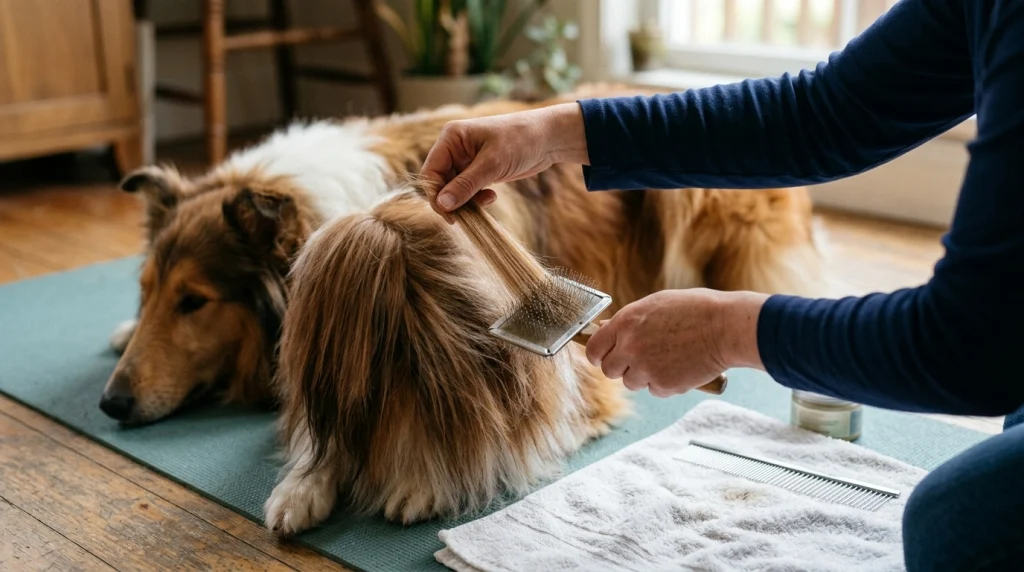 Save
SaveUse a slicker with light pressure, small sections, and short controlled strokes. The goal is to move through hair, not scrape the skin underneath it.
- Check the coat and skin first. Look for redness, sores, scabs, lumps, burrs, or painful areas before brushing.
- Start where the coat is easy. Begin on a comfortable body area instead of attacking the worst knot immediately.
- Work in small sections. Lift longer hair so you can reach more than the coat’s top surface.
- Brush with light pressure. Let the pins move through the coat without pushing them hard against skin.
- Clear trapped hair often. A brush packed with fur becomes less effective.
- Check with a metal comb. On longer coats, a comb should pass through the finished section without catching.
- Stop before irritation starts. Repeated strokes over one area can make skin sore even when each stroke feels gentle.
Line brushing is useful on long or dense coats. You lift a small layer of hair, brush the exposed section, then gradually move through the coat.
VCA Animal Hospitals’ coat-care guidance also recommends gentle grooming and avoiding excessive pulling when dealing with tangles.
Can a slicker brush hurt a dog?
Yes, a slicker can irritate or scratch skin when used with excessive pressure or repeated strokes. Fine metal pins are effective precisely because they can reach into the coat.
That does not make slicker brushes inherently harsh. It means pressure control matters.
- Stop for redness: Pink or irritated skin means you have worked the area too aggressively.
- Watch body language: Flinching, turning toward the brush, sitting suddenly, or trying to leave can signal discomfort.
- Don’t force severe mats: Tight mats may sit close to skin and can make brushing painful.
- Avoid injured skin: Do not brush directly across sores, inflamed patches, or unexplained lesions.
- Match pin length: Long aggressive pins are unnecessary for many thin or short coats.
Severely matted coats are different from ordinary tangles. Trying to brush through a solid mat can pull painfully on skin.
If matting is extensive, professional grooming may be safer. VCA also advises using clippers rather than scissors near tight mats because skin can become trapped inside the matted hair.
Slicker brush vs pin brush vs bristle brush: what’s the difference?
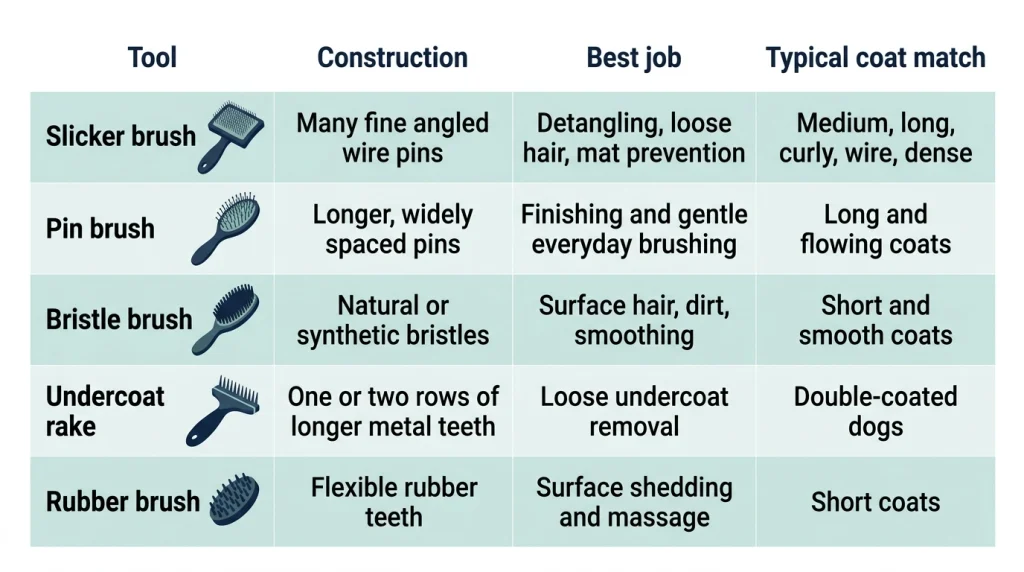 Save
SaveThese brushes overlap slightly, but they are not interchangeable. I choose the tool according to the job rather than assuming one brush should handle the entire grooming session.
| Tool | Construction | Best job | Typical coat match |
|---|---|---|---|
| Slicker brush | Many fine angled wire pins | Detangling, loose hair, mat prevention | Medium, long, curly, wire, dense |
| Pin brush | Longer, widely spaced pins | Finishing and gentle everyday brushing | Long and flowing coats |
| Bristle brush | Natural or synthetic bristles | Surface hair, dirt, smoothing | Short and smooth coats |
| Undercoat rake | One or two rows of longer metal teeth | Loose undercoat removal | Double-coated dogs |
| Rubber brush | Flexible rubber teeth | Surface shedding and massage | Short coats |
A double-coated dog may need both a slicker and undercoat rake. A curly dog may need a slicker followed by a metal comb.
That combination approach usually makes more sense than buying the most aggressive single tool available.
How often should you use a slicker brush?
Brushing frequency depends on coat length, density, matting risk, and shedding. There is no safe universal schedule for every dog.
- Long, silky coats: Often need attention daily or every few days.
- Curly coats: Frequent brushing helps prevent small tangles from becoming compacted mats.
- Medium double coats: Several sessions per week may be useful, especially during shedding periods.
- Short dense coats: Weekly grooming may be enough for many dogs.
- Heavy seasonal shedding: Temporarily increase grooming frequency and consider an undercoat tool.
The condition of the coat should guide you. If a comb continually catches between sessions, your dog probably needs more frequent or more thorough brushing.
The AKC’s shedding guidance also notes that grooming frequency varies with coat type and seasonal shedding patterns.
What mistakes should you avoid with a slicker brush?
Most slicker-brush problems come from technique rather than the brush itself. A few habits make grooming much less comfortable.
- Pressing hard: More pressure does not automatically remove more hair.
- Scraping one spot repeatedly: Skin irritation can appear after too many strokes over the same area.
- Only brushing the surface: A fluffy top layer can hide tangles closer to the skin.
- Pulling through tight mats: Severe matting needs a different approach.
- Using the wrong pin length: Choose a slicker that matches the depth and density of the coat.
- Ignoring the dog’s reaction: Grooming should not become a wrestling match.
- Skipping the comb check: On long coats, a smooth-looking surface does not prove the coat is tangle-free underneath.
My simplest rule is to make every stroke productive. Once an area feels smooth and a comb passes cleanly, move on.
When should you not use a slicker brush?
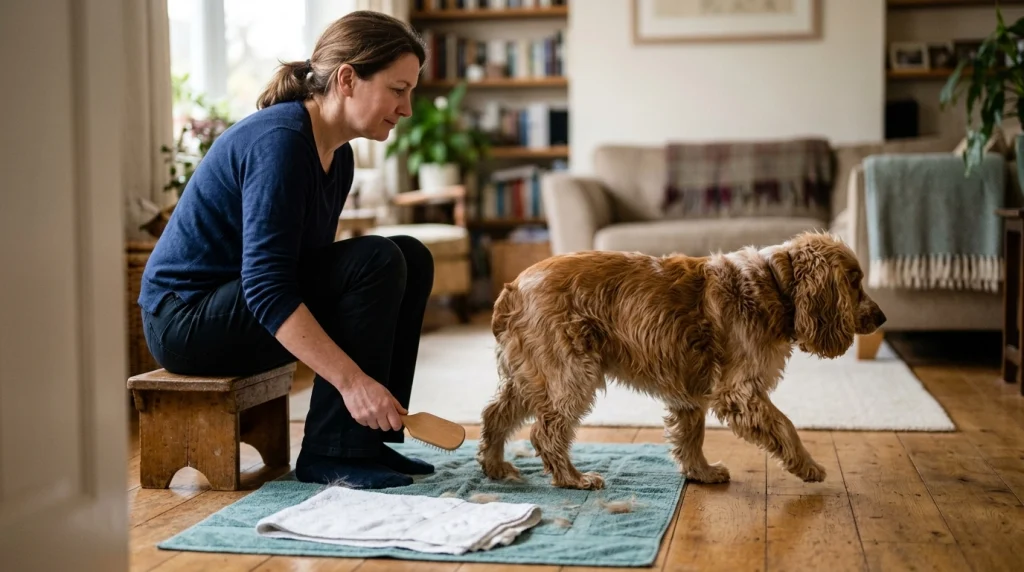 Save
SaveA slicker is not the right answer for every grooming problem. Sometimes another tool or professional help is safer.
- Open sores, inflamed skin, or painful unidentified bumps are present.
- The coat has severe, tight matting against the skin.
- Your dog has an extremely short, thin coat that does not need wire pins.
- Your dog becomes distressed despite slow introductions and gentle handling.
- You are trying to remove large amounts of deep seasonal undercoat that a rake handles better.
For unexplained hair loss, persistent itching, significant redness, or skin lesions, speak with a veterinarian rather than treating the problem as ordinary shedding.
Which slicker brushes are worth considering?
If you’re ready to choose one, I would match pin length and brush size to your dog’s coat before worrying about extra features. These three options cover noticeably different grooming needs.
🏆 Best for Dense Long Coats
Chris Christensen Big G Slicker Brush
★★★★★
The Big G uses 27 mm stainless-steel pins, a flexible cushion pad, and a curved head designed for long, dense coats. I’d choose it for Poodles, Doodles, and other substantial coats where shorter pins struggle to reach through the hair.
💰 Best Easy-Clean Pick
Safari by Coastal Dog Self-Cleaning Slicker Brush
★★★★☆
Retractable stainless-steel pins push collected hair away from the brush head, and multiple sizes make it easier to fit different dogs. I’d pick this for routine home grooming when fast cleanup matters more than professional-style extra-long pins.
🎯 Best for Medium Coats
Chris Christensen Kärben Slicker Brush
★★★★☆
Its 17 mm stainless-steel pins sit between the brand’s shorter 12 mm and longer 27 mm slickers. I’d consider it when a medium-length coat needs more reach than a basic slicker without jumping straight to extra-long professional pins.
Frequently asked questions
Does a slicker brush remove undercoat?
Yes, a slicker can collect loose undercoat, especially when its pins are long enough to reach through the outer coat. During heavy seasonal shedding, however, a properly sized undercoat rake may remove deep loose hair faster.
Can I use a slicker brush every day?
Some long, curly, or mat-prone coats benefit from frequent grooming, but daily use should still be gentle. Adjust the schedule to your dog’s coat condition and stop if you notice redness, tenderness, or irritation.
Is a slicker brush good for short-haired dogs?
It can be useful on some short, dense coats, particularly when loose hair becomes trapped. For thin, smooth coats, a rubber grooming tool or bristle brush is often more comfortable and practical.
Should I use a slicker brush on wet or dry fur?
For routine detangling, follow the grooming method appropriate for your dog’s coat and the brush manufacturer’s instructions. Avoid soaking an already matted coat because water can make compacted tangles tighter and harder to manage.
How do I know when I am finished brushing?
The section should feel smooth without repeated snagging. On medium or long coats, run an appropriate metal comb through the hair afterward to find any tangles the slicker missed.
Can a slicker brush remove severe mats?
A slicker may loosen small tangles and early mats, but tightly compacted mats can pull painfully on skin. Extensive matting is a good reason to ask a professional groomer or veterinarian for help instead of repeatedly brushing the area.
Final takeaway
A slicker brush is mainly used for loose hair, tangles, mat prevention, and coat separation. It earns its place in a grooming kit because those jobs apply to many medium, long, curly, and double-coated dogs.
The important part is matching the brush to the coat and using a light hand. Choose the correct pin length, work in sections, check your progress with a comb when appropriate, and stop before the skin becomes irritated.
Used that way, a slicker is not an aggressive de-shedding shortcut. It is a controlled everyday tool that can make regular coat care far easier in 2026 and beyond.

Thomas Cutter is a lifelong dog owner and the founder of FindOutAboutDogs.com. With over 10 years of hands-on experience owning multiple breeds, Thomas created this site to provide honest, research-based dog advice that real owners can actually trust.
