Dog Hair vs Dog Fur for Grooming: How to Pick the Right Brush for Your Dog’s Coat
Quick Answer
When evaluating dog hair vs dog fur for grooming, the main difference comes down to growth cycles and coat layers. Dog hair has a long growth cycle and is usually single-layered, requiring pin brushes and steel combs to prevent painful mats. Dog fur grows to a fixed point, sheds seasonally from a dense double coat, and requires undercoat rakes or slicker brushes according to American Kennel Club coat care standards.
Key Grooming Differences at a Glance
- Growth cycle length: Dog hair grows continuously for years, while dog fur stops at a genetically predetermined length and falls out.
- Coat structure layers: Hair-coated breeds usually have a single layer, whereas fur-coated dogs almost always sport an insulating undercoat beneath tough guard hairs.
- Primary grooming goal: Grooming dog hair focuses on detangling and haircuts, while grooming dog fur centers on removing trapped dead undercoat.
- Best brush types: Use pin brushes and greyhound combs for hair, and reach for undercoat rakes and deshedding tools for dense fur.
- Clipper shaving rules: You must regularly trim dog hair, but shaving double-coated dog fur permanently damages its natural heat regulation.
How to Check Your Dog’s Coat Right Now
- Part your dog’s coat down to the skin on their lower back; if you see a single curtain of silky strands with clear skin visible, it is hair, whereas a dense, fuzzy, cotton-like layer hiding the skin means fur.
Walking down the pet store grooming aisle feels overwhelming when fifty different brushes promise miracle results. I ruined my first Golden Retriever’s topcoat years ago because I used a sharp deshedding blade meant for short fur on his delicate feathering.
Understanding the biology of your dog’s coat saves you money and spares your pup from painful brush burn. Below, I’ll show you how to identify what grows on your dog and match it to the exact brush they need.


What Is the Biological Difference Between Dog Hair and Dog Fur?
 Save
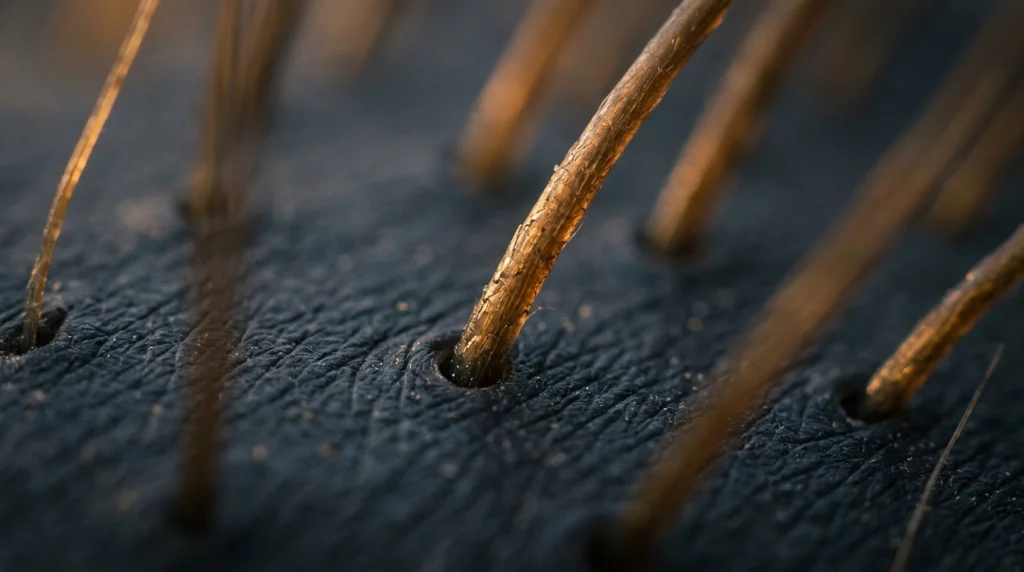
Scientifically, dog hair and dog fur are both made of **keratin**, the exact same protein found in human fingernails. The practical difference lies in the **hair follicle growth cycle**, which dictates how long the strand grows, how densely it packs together, and how often it sheds.
Every canine coat goes through a four-stage growth process. How long your dog’s follicles stay in the first phase determines whether you are sweeping up tumbleweeds every Tuesday or booking monthly salon trims.
- Anagen (Growth Phase): The follicle actively builds the strand; dogs with hair stay in this phase for years, while dogs with fur only stay in it for a few weeks or months.
- Catagen (Transition Phase): The hair follicle shrinks and detaches from the blood supply, signaling that the strand has reached its maximum programmed length.
- Telogen (Resting Phase): The strand sits dormant in the follicle while a new hair begins forming underneath it, waiting for seasonal daylight changes.
- Exogen (Shedding Phase): The old strand releases and falls out, either dropping quietly onto your sofa or getting trapped inside surrounding curls.
Because hair stays in the **anagen phase** so long, it acts just like the hair on your own head. It grows past the eyes, drags on the floor, and never hits an automatic stopping point.
Fur rushes through all four phases on a strict timer controlled by daylight and temperature. You cannot train fur to stop shedding any more than you can train a tree to keep its leaves in November.
How Can You Tell If Your Dog Has Hair or Fur at Home?
You can tell if your dog has hair or fur by parting the coat down to the bare skin and checking the layer density, texture, and shedding pattern. Dog hair parts cleanly like human hair to reveal skin, while dog fur resists parting because of a dense, woolly undercoat.
I always run a quick three-step hands-on check whenever I work with a new rescue mix. You don’t need a DNA test to figure out what brush to buy.
- The Skin Part Test: Use both thumbs to press the coat flat in opposite directions on your dog’s shoulder; if a crisp line of pink or pigmented skin appears immediately, you are dealing with single-layer hair.
- The Undercoat Pinch: Pinch a small tuft near the base of the neck and roll it between your fingers; feeling two distinct textures—stiff outer bristles and soft, cottony fluff underneath—confirms a double fur coat.
- The Shedding Pull Check: Gently tug the tips of the coat during spring or fall; fur releases several short, uniform strands into your fingers, while healthy hair stays anchored or leaves one long strand.
Watch how the coat reacts to bath water, too. Dog hair soaks through to the skin within thirty seconds of turning on the hose.
Thick dog fur repels water at first because oily **guard hairs** shield the downy **undercoat**. You often have to massage shampoo in for several minutes just to reach a Husky’s skin.
Dog Hair vs Dog Fur for Grooming: Full Comparison Table
 Save
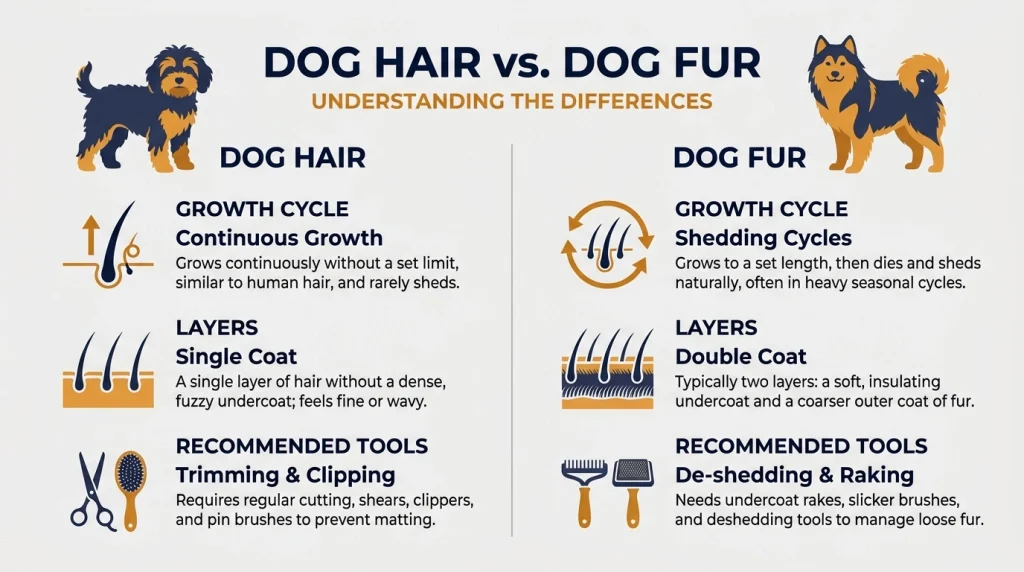
Comparing dog hair vs dog fur for grooming side by side reveals why using the wrong tool causes tangles or skin irritation. Check the breakdown below to match your dog’s traits to the proper routine.
| Coat Feature | Dog Hair | Dog Fur |
|---|---|---|
| Growth Cycle (Anagen) | Continuous (grows for 2+ years) | Short and fixed (stops at set length) |
| Coat Layers | Single layer (no dense undercoat) | Usually double-layered (undercoat + guard hairs) |
| Shedding Pattern | Minimal; loose strands trap in coat | Year-round with heavy spring/fall coat blows |
| Texture & Feel | Silky, fine, wavy, or tightly curled | Coarse outer coat with dense, fluffy base |
| Biggest Grooming Risk | Severe matting and skin-pulling pelts | Impacted undercoat and hot spots |
| Primary Dog Brushes | Pin brush, curved slicker, steel comb | Undercoat rake, rubber curry, deshedder |
| Professional Clipping | Required every 4 to 8 weeks | Never shave (outline trim only) |
| Common Breed Examples | Yorkshire Terrier, Maltese, Afghan Hound, Poodle | Labrador, German Shepherd, Husky, Pug |
Which Dog Breeds Have Hair Instead of Fur?
Only about 10% to 15% of recognized dog breeds grow true hair instead of fur, mostly belonging to the Toy, Non-Sporting, and Water Dog groups. These breeds were historically bred either for indoor companionship or for water retrieval where heavy wet undercoats would weigh them down.
Many owners buy these dogs thinking “hair” means zero maintenance. In reality, trading floor shedding for hair means you become your dog’s daily hairdresser.
- Silky Drop-Coat Breeds: Yorkshire Terriers, Maltese, Shih Tzus, Lhasa Apsos, and Afghan Hounds grow straight or slightly wavy hair that hangs to the floor if left uncut.
- Curly and Wool-Coat Breeds: Poodles, Bichon Frises, Portuguese Water Dogs, and Irish Water Spaniels grow tightly coiled hair that traps every shed strand inside the curl.
- Wavy Fleece-Coat Mixes: Goldendoodles, Labradoodles, and Bernedoodles often inherit a hybrid coat that mixes Poodle hair with Retriever or Shepherd undercoat fur.
- Soft-Coated Terriers: Soft Coated Wheaten Terriers, Kerry Blue Terriers, and Bedlington Terriers carry single-layer plush hair that requires scissor shaping rather than hand-stripping.
Wait before assuming all Doodles have pure hair. In my experience grooming dozens of first-generation crosses, over half of them develop a sneaky combination coat.
They grow long Poodle hair on top while packing dense Retriever fur at the roots. That hidden combination creates the fastest, tightest mats in the dog world.
Does Dog Hair Mean a Dog Is Truly Hypoallergenic?
No dog is 100% hypoallergenic because canine allergies are triggered by proteins in **dander** (dead skin flakes), saliva, and urine rather than the hair strand itself. Dogs with hair simply trigger fewer reactions because they shed less hair into the air to carry that microscopic dander around your home.
According to the American Academy of Allergy, Asthma & Immunology, the primary allergen **Can f 1** sticks to skin cells and coat oils on every single breed. A Maltese produces those proteins just like a shedding Hound does.
Why do allergy sufferers still feel better around hair-coated dogs? The answer comes down to particle delivery and bathing frequency.
- Trapped Shed Strands: When a Poodle sheds a dead hair, neighboring curls grab it and hold it against the body until you pull it out with a brush.
- Less Airborne Dander: Without millions of short fur needles flying off every time the dog shakes, far less dander lands on your pillows, curtains, and HVAC filters.
- Frequent Bathing Routines: Hair-coated dogs get bathed and blow-dried every 3 to 4 weeks, which washes away water-soluble saliva and dander proteins before they build up.
If you have allergies and own a hair-coated dog, wear a mask while brushing them. Brushing releases all the trapped dander at once, so do it outside on the patio whenever the weather cooperates.
What Is the Best Dog Brush for Hair vs Fur?
The best dog brush for hair is a smooth-tipped **pin brush** paired with a **curved slicker brush** and a **stainless steel greyhound comb** to detangle long strands without snapping them. For dog fur, the best brushes are an **undercoat rake** for thick double coats or a **rubber curry brush** for short single coats.
Using a fur brush on dog hair is like running a garden rake through human extensions. It rips healthy follicles right out of the skin and leaves frizzy, broken ends.
Best Brushes for Dog Hair (Silky, Wavy, and Curly Coats)
Hair is fragile and stretches slightly when pulled. You need tools that glide through knots and reach the skin without scraping.
- Oval Pin Brush (No Little Balls): Look for polished stainless steel pins set in a flexible air cushion; skip the cheap brushes with plastic balls on the tips because those balls snag tangles and rip hair out.
- Long-Pin Slicker Brush: Essential for Poodles, Bichons, and Doodles; the angled wire pins separate individual curls and pull out dead, trapped hairs before they felt into mats.
- Stainless Steel Greyhound Comb: Your truth-teller tool; after brushing with a pin or slicker brush, run this metal comb from the skin outward to verify no hidden knots remain near the roots.
- Dematting Rake (Used Sparingly): Features curved safety blades that slice through stubborn armpit or behind-the-ear knots when conditioner and slicker brushing aren’t enough.
Always mist dog hair with a detangling spray or diluted conditioner before picking up a pin brush. According to veterinary dermatology guidance from the American Veterinary Medical Association, gentle coat maintenance prevents microscopic skin tears that lead to bacterial hot spots.
Brushing bone-dry hair generates static electricity. Static makes fine Yorkie or Maltese hair tangle twice as fast five minutes after you finish.
Best Brushes for Dog Fur (Short Smooth and Thick Double Coats)
Fur doesn’t need delicate detangling along a six-inch shaft. Instead, your brush must penetrate dense layers and lift out dead wool before it compacts against the skin.
- Undercoat Rake (Rotating Pins): Designed for Huskies, Malamutes, Golden Retrievers, and Samoyeds; the long, rounded teeth reach past stiff guard hairs to scoop out clumps of dead undercoat fluff.
- Rubber Curry Brush (Zoom Groom Style): The top choice for short-furred dogs like Boxers, Beagles, Pugs, and Pit Bulls; soft rubber cones act like magnets to pull loose fur needles out of smooth coats while massaging skin oils.
- Natural Boar Bristle Brush: Finishes short fur by sweeping away surface dust and spreading natural **sebum** (skin oil) from the roots to the tips for a glossy shine.
- Edge Deshedding Tool: Works well on dense, flat double coats like Labs and Corgis during peak spring shedding, provided you limit use to once a week so you don’t slice healthy topcoat.
Pro Groomer Tip: Press a slicker brush against the inside of your own forearm before touching your dog with it. If the pressure scratches your skin or leaves red lines, you are pushing way too hard for your dog’s sensitive epidermis.
How Do You Brush Dog Hair Without Causing Painful Mats?
 Save
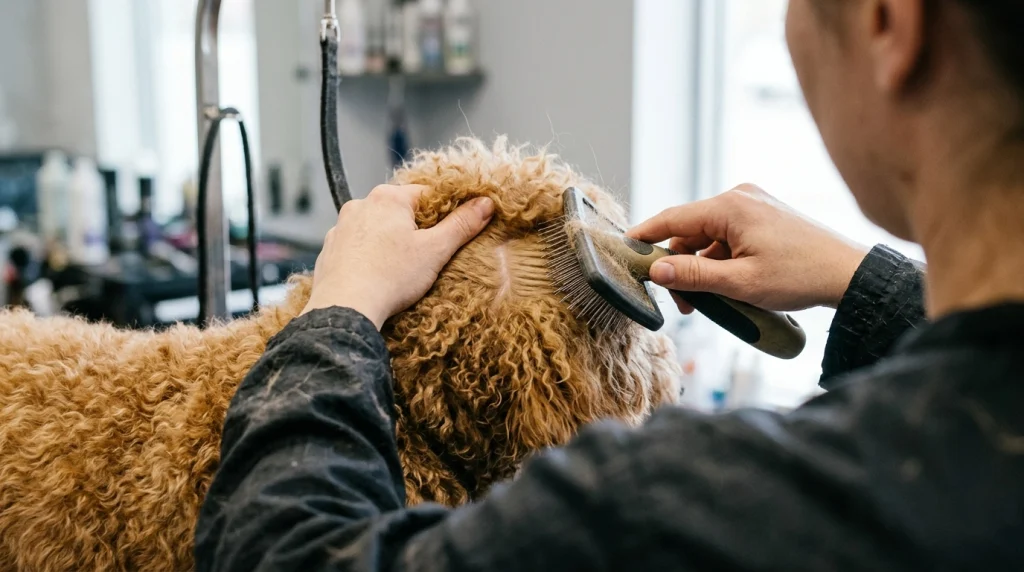
To brush dog hair without pain, use the professional **line brushing technique** rather than sweeping the brush across the top layer of the coat. Part the hair horizontally so you can see the skin, brush small quarter-inch sections downward, and work your way up the body systematically.
Ninety percent of Doodle and Yorkie owners I meet experience “surface brushing syndrome.” The top half-inch of the dog looks fluffy and gorgeous, but a solid felt cast is strangling the skin underneath.
- Mist the Section Lightly: Spray a light coat conditioning mist onto the area so the pins slide smoothly without snapping dry keratin fibers.
- Pin the Hair Upward: Use your non-dominant hand to lift the hair on your dog’s leg or flank and hold it flat against their body, exposing a horizontal line of bare skin at the bottom.
- Brush Out From the Skin: Place your slicker or pin brush right below your holding hand and pull downward, watching the metal pins touch the skin and pull straight through the tips.
- Drop Down Another Quarter Inch: Release a thin curtain of hair from under your holding hand and brush that new layer down into the freshly detangled section below it.
- Verify With a Steel Comb: Slide the coarse end of a metal greyhound comb from the skin to the ends; if the comb stops or snags, go back over that exact spot with your slicker brush.
Never try to rip through a tight mat in one yank from the root. Hold the base of the hair between your thumb and forefinger right against the skin so your dog doesn’t feel the pull.
Work on the outer edge of the tangle first, picking it apart in tiny taps until the comb slides free. Check the friction zones first—behind the ears, under the collar, and inside the armpits.
Why Should You Never Shave a Dog With Double-Coated Fur?
You should never shave a dog with double-coated fur because their coat acts as year-round thermal insulation, keeping them warm in winter and deflecting solar heat in summer. Shaving removes the protective guard hairs while leaving the fast-growing undercoat exposed, which often causes permanent **clipper alopecia** and increased overheating.
Every June, well-meaning owners ask groomers to shave their Huskies or Australian Shepherds down to the skin to help them beat the summer heat. As of 2026, virtually every veterinary dermatologist and certified master groomer strongly advises against this practice unless a medical skin emergency requires it.
Here is what happens inside the hair follicle when you take a #7 or #10 clipper blade to double-coated fur:
- Loss of Cooling Airflow: Healthy undercoat raking leaves tiny air channels between stiff guard hairs, allowing cool breeze to reach the skin while the outer coat blocks UV radiation.
- Velcro Undercoat Regrowth: Fluffy undercoat grows back three times faster than slow guard hairs, creating a patchy, wool-like mess that traps dirt, burrs, and moisture against the skin.
- Sunburn and Skin Cancer Risk: Double-coated dogs have thin, pale skin underneath their fur because evolution assumed that skin would never see direct sunlight.
- Post-Clipping Alopecia: In Nordic breeds like Pomeranians, Huskies, and Malamutes, shaved follicles frequently go into shock and stop growing altogether, leaving permanent bald spots.
Instead of shaving fur, book a professional **deshedding bath and high-velocity blowout**. When you wash a double coat with deshedding shampoo and blast it with a cool-air force dryer, pounds of dead insulating wool fly right out.
Your dog walks out feeling ten degrees cooler, and their glossy guard hairs stay intact to bounce sunlight away. According to the ASPCA, regular brushing to remove dead undercoat is the safest way to keep thick-coated dogs comfortable during hot weather.
How Often Should You Groom Dog Hair vs Dog Fur?
Dogs with hair longer than one inch need daily or every-other-day brushing plus professional haircuts every 4 to 6 weeks to stay mat-free. Dogs with fur need brushing 1 to 3 times per week during normal months, increasing to daily undercoat raking during spring and autumn shedding seasons.
Grooming schedules aren’t one-size-fits-all. Your commitment depends entirely on how long you keep the coat and what grows underneath.
- Long Hair (1.5+ Inches — Doodles, Poodles, Shih Tzus): Brush 10 minutes daily with a slicker and metal comb; schedule full clipper trims every 4 to 6 weeks.
- Short Puppy-Cut Hair (Under 0.5 Inches): Brush 2 times per week with a pin or soft slicker brush; book professional trims every 6 to 8 weeks.
- Long Double Fur (Goldens, Aussies, Huskies, Shepherds): Rake and comb 2 to 3 times weekly year-round; brush daily during the 3-week spring and fall coat blows.
- Short Double Fur (Labs, Corgis, Pugs): Use a rubber curry or deshedding tool once or twice a week; add a warm deshedding bath once a month.
- Smooth Single Fur (Boxers, Greyhounds, Dobermans): Wipe down and massage with a rubber curry brush or hound glove once a week to lift dead hairs and dust.
If you realize you don’t have ten minutes a day to line-brush a Goldendoodle, don’t feel guilty. Just ask your groomer for a neat 3/8-inch sporting clip all over the body.
Keeping hair short cuts your home brushing time by 80% while leaving a cute fluffy tail and ears. Your dog would much rather sport a short summer haircut than endure an hour of painful dematting on the grooming table.
If you’re ready to put together a proper grooming kit for your dog’s specific coat, here are the three brushes I keep in my own workspace and recommend to every owner:
🏆 BEST FOR DOG HAIR & CURLS
Chris Christensen Big G Slicker Brush
★★★★★
Features 40% more long, angled stainless steel pins on a flexible cushion pad with an ergonomic Beechwood handle. I’ve used my medium coral Big G for four years on Poodles and Doodles, and nothing else reaches down to the skin to clear mats half as fast.
🐕 BEST FOR DOUBLE-COATED FUR
Maxpower Planet Double Row Undercoat Rake
★★★★☆
Dual-sided head with a 9-tooth dematting side for stubborn clumps and a 17-tooth thinning rake for dense undercoats. It pulls basketfuls of dead winter wool out of Golden Retrievers and Huskies without slicing their glossy outer guard hairs like sharp blades do.
💰 BEST FOR SHORT SMOOTH FUR
KONG ZoomGroom Rubber Dog Brush
★★★★★
Made of durable, flexible 3/4-inch rubber fingers designed to massage skin capillaries and attract loose short fur like a magnet. I use this dry in circular motions on Boxers and Labs, and then take it right into the tub to scrub shampoo down to the skin.
Frequently Asked Questions About Dog Hair vs Dog Fur
Do Golden Retrievers have hair or fur?
Golden Retrievers have a dense **double fur coat**, not true hair, despite their long, flowing feathering. They grow a water-resistant outer coat of longer guard hairs over a thick, soft insulating undercoat that sheds heavily in spring and fall, requiring an undercoat rake rather than full-body clipping.
Can a dog have both hair and fur at the same time?
Yes, mixed-breed dogs—especially Poodle crosses like Goldendoodles, Labradoodles, and Aussiedoodles—frequently inherit a combination coat containing both continuously growing hair and shedding undercoat fur. These hybrid coats require the highest level of grooming maintenance because shedding undercoat fur gets trapped inside the curling hair shaft and mats rapidly.
Why does my dog with hair still shed on my clothes?
Dogs with hair still lose dead strands when individual follicles complete their growth cycle, just like humans lose 50 to 100 hairs in the shower every day. If you notice hair on your furniture, your dog either needs more frequent line brushing to catch loose strands or has dry, brittle hair breaking off at the ends.
Can I use a FURminator deshedding tool on a dog with hair?
No, you should never use a bladed deshedding tool like a FURminator Undercoat deShedding Tool on single-coated dog hair such as Yorkies, Maltese, Shih Tzus, or Poodles. The toothed steel edge is engineered to grab dense undercoat fur and will snag, slice, and rip healthy continuous hair straight out of the root.
Which smells worse when wet, dog hair or dog fur?
Dog fur usually smells stronger when wet because double-coated breeds produce more **sebum** (natural waterproofing oil) to coat their guard hairs and protect their undercoat from freezing water. When moisture mixes with skin bacteria and heavy sebum oils, it releases the classic musky “wet dog” odor much faster than less oily dog hair.
Final Takeaway: Start With the Right Brush Today
Knowing the difference between dog hair vs dog fur for grooming turns brushing from a weekly wrestling match into ten minutes of easy bonding. Walk over to your dog right now, part the coat on their lower back down to the skin, and see whether you are looking at a single curtain of hair or a plush bed of undercoat fur.
Once you match your brush to their follicle biology—a pin brush or long slicker plus a steel comb for hair, or an undercoat rake and rubber curry for fur—you will stop fighting tangles and shedding for good.

Thomas Cutter is a lifelong dog owner and the founder of FindOutAboutDogs.com. With over 10 years of hands-on experience owning multiple breeds, Thomas created this site to provide honest, research-based dog advice that real owners can actually trust.
