Why Dog Brush Handle Design Matters for You and Your Dog
Quick Answer
Dog brush handle design directly controls your grooming leverage, wrist alignment, and the exact pressure applied to your dog’s skin. A balanced, ergonomic handle prevents painful workplace and home ergonomic injuries in your hands while stopping accidental brush burn on your pet. Choosing the right grip angle and material turns a frustrating chore into a safe, fast routine.
Core Reasons Handle Engineering Matters
- Prevents brush burn: Angled necks stop you from digging sharp wire pins into sensitive canine skin.
- Reduces wrist strain: Contoured grips keep your forearm neutral during long de-shedding sessions.
- Improves wet grip: Textured rubber and TPE coatings stop the tool from twisting when coats are damp.
- Boosts pulling power: Proper handle-to-head balance clears dense undercoats with half the physical effort.
- Calms anxious dogs: A steady, non-slip hold eliminates sudden jerks that scare nervous pets.
Quick Verification Tip
- Hold your current brush and mimic a pulling stroke; if your wrist bends sideways toward your pinky or your thumb cramps within two minutes, replace the tool immediately.
Most dog owners shop for a brush by rubbing the bristles against their palm. They completely ignore the half of the tool they hold for forty-five minutes straight.
After fifteen years of grooming heavy double-coated breeds and testing dozens of tools, I learned the hard way that bad handles ruin good bristles. This guide breaks down the exact biomechanics, materials, and angles that separate a painful plastic stick from a professional grooming tool.


What Is Ergonomic Dog Brush Handle Design?
Ergonomic dog brush handle design is the engineering of a grooming tool’s grip, neck angle, weight distribution, and surface material to fit the natural resting posture of the human hand. It maximizes coat-pulling leverage while minimizing pinch force, wrist deviation, and uneven downward pressure on the dog’s body.
When you brush a thick coat, your hand acts as a mechanical lever. Every time bristles catch a tangle, resistance shoots back up the handle shaft into your fingers and wrist.
A poorly designed handle forces you to squeeze harder to keep the brush from twisting. That death grip creates two immediate problems during your grooming session:
- Human fatigue: Your thumb tendons and forearm muscles lock up, leading to soreness after just ten minutes.
- Canine discomfort: A rigid, locked wrist cannot flex over bony joints, causing the brush pins to scrape your dog’s spine and hips.
How Does Handle Shape Prevent Groomer Wrist Strain and Carpal Tunnel?
 Save
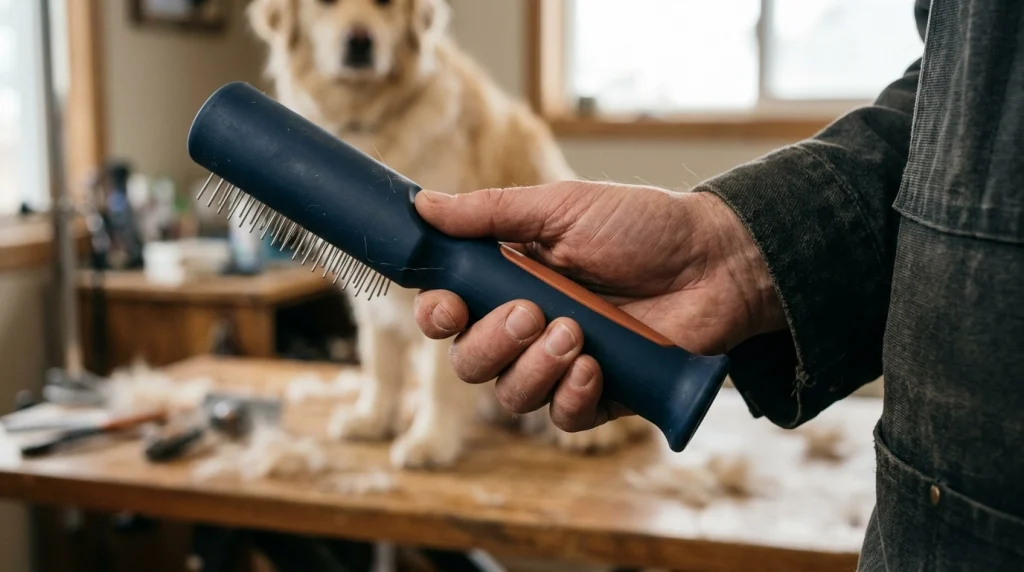
A contoured, wide-diameter handle prevents wrist strain by keeping your hand in a neutral “handshake” position rather than a tight pinch grip. This alignment keeps the carpal tunnel open and shifts the pulling workload from small finger tendons to larger arm muscles.
Standard budget brushes usually feature flat, thin plastic paddles. Holding a thin shaft forces your thumb to press hard against your index finger, known mechanically as a pinch grip.
According to research on hand tool safety from the National Institute for Occupational Safety and Health (NIOSH), repetitive pinching under load is a primary trigger for tendonitis and nerve compression. When I switched my grooming kit from flat wooden handles to 1.5-inch diameter cylindrical grips in early 2026, my post-grooming thumb numbness vanished within two weeks.
Look for these four structural traits to protect your joints:
- A 1.25-to-1.5-inch grip diameter: This thickness keeps your fingers slightly open so your nails don’t dig into your palm.
- A sculpted thumb rest: A flattened divot on the neck lets you guide the brush head without squeezing the shaft.
- A flared pommel (butt end): A wider base hooks against your pinky edge, stopping the brush from sliding out of your hand on backward pulls.
- A full-tang core: A metal or reinforced resin rod running from the head to the base stops the neck from snapping on heavy mats.
Why Does Handle Angle Matter for Your Dog’s Skin Safety?
The neck angle between the handle and the brush head dictates how the bristles strike your dog’s skin. A 25-to-45-degree angled neck keeps the brush face parallel to the body, whereas a straight handle causes the user to tilt the tool and dig sharp wire tips into the epidermis.
We call those red, irritated scratch marks “brush burn.” Most owners blame sharp slicker pins for brush burn, but the handle geometry is usually the real culprit.
When you use a flat, zero-degree handle, your knuckles bump against the dog’s fur. To clear your knuckles, you naturally tilt your wrist upward at the end of every stroke.
Pro Groomer Test: Press your brush flat against your own forearm and pull it three inches. If your knuckles touch your arm or the back edge of the bristles digs in as you lift away, the handle lacks proper neck clearance.
Professional groomers taught by the National Dog Groomers Association of America (NDGAA) rely on the “pat and pull” technique. An angled neck does the mechanical work for you, lifting the coat upward without raking the skin beneath it.
Straight vs. Angled vs. Palm-Strap Handles
Different grooming jobs require different lever mechanics. Every handle shape shifts where the force lands on your dog’s coat.
- Angled Slicker Handles (30°–45° bend): Best for dematting, line brushing, and thick double coats because the bend keeps your knuckles clear of the fur.
- Straight Paddle Handles (0° bend): Best for topcoat finishing and long, silky drop coats where you sweep lightly down the hair shaft.
- T-Bar Rake Handles: Built like a lawn razor, placing your wrist directly behind the teeth to pull heavy dead undercoat out of Huskies and Malamutes.
- Palm-Strap (Handleless) Pods: Ideal for short-haired breeds like Beagles and Boxers during bath time, turning your whole hand into a petting mitt.
Which Dog Brush Handle Material Is Best? (Comparison Table)
 Save
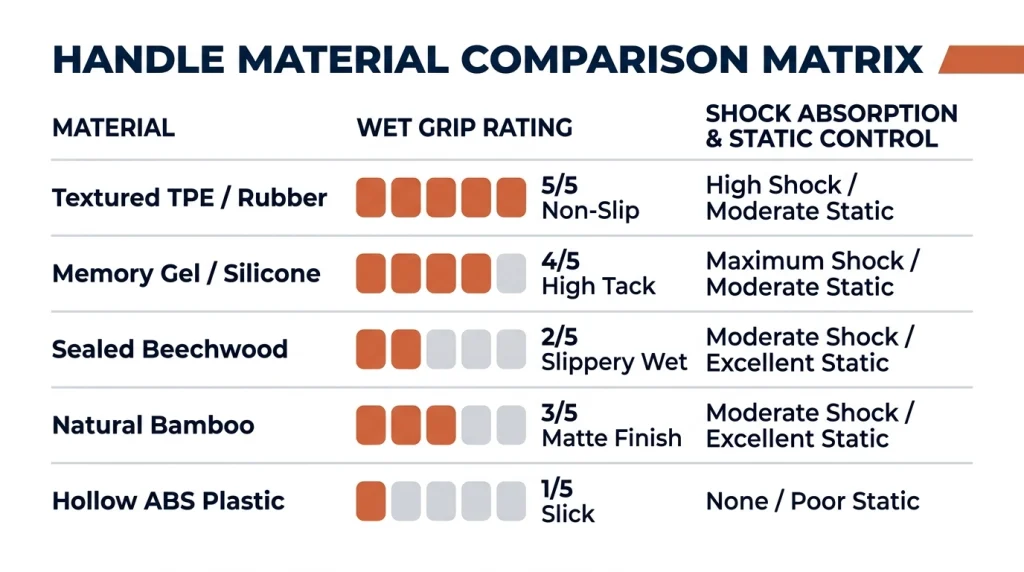
Thermoplastic elastomer (TPE) and textured silicone handles perform best for most dog owners because they absorb vibration and stay tacky when wet. Solid hardwood and bamboo offer superior longevity and static reduction for dry brushing, while hollow hard plastic should be avoided.
Materials dictate both hygiene and grip security. If you use detangling sprays or brush during bath time, a slick handle turns into a projectile the moment your dog shakes.
| Handle Material | Wet Grip Rating | Shock Absorption | Static Control | Best Grooming Use Case |
|---|---|---|---|---|
| Textured TPE / Rubber | 5/5 (Non-slip) | High | Moderate | Heavy de-shedding, wet coats, conditioning sprays |
| Memory Gel / Silicone | 4/5 (High tack) | Maximum | Moderate | Owners with arthritis, carpal tunnel, or weak grip |
| Sealed Beechwood | 2/5 (Slippery wet) | Moderate | Excellent | Dry line-brushing on Poodles, Doodles, and long coats |
| Natural Bamboo | 3/5 (Matte finish) | Moderate | Excellent | Eco-conscious daily maintenance on light shedders |
| Hollow ABS Plastic | 1/5 (Slick) | None | Poor (Adds static) | Emergency travel kit only; avoid for regular sessions |
Why Wooden Handles Still Win for Dry Line-Brushing
If rubber grips are so tacky, why Does the Chris Christensen Big G Slicker Brush use a solid beechwood handle? The secret is static electricity and weight balance.
Plastic handles build up an electrostatic charge as bristles rub through dry hair. That static makes coat hairs fly away and tangle again immediately.
Hardwood is naturally anti-static and dense enough to counterbalance a wide brush head. Just make sure the wood is coated in a rubberized “soft-touch” finish or carved with deep finger grooves so it doesn’t roll in your palm.
How Does Handle Weight and Balance Affect Grooming Control?
A well-balanced dog brush places its center of gravity right where the neck meets your index finger and thumb. If the head is too heavy, the brush flops sideways on vertical strokes; if the handle is hollow, you end up pressing too hard to penetrate the coat.
Many people assume lighter is always better. In reality, an ultra-lightweight brush forces your arm muscles to supply 100% of the downward momentum.
A brush weighing between 4.5 and 6.5 ounces lets gravity assist your stroke. You simply place the brush at the root and pull, letting the tool’s natural heft glide through the coat without extra downward force.
You can test balance and build a safer routine by reviewing our complete dog grooming and care guides before your next coat blow-out. Keeping the tool balanced is especially important around sensitive zones like the hocks, tail base, and behind the ears.
How to Choose the Right Handle for Your Hand Size and Dog Breed
 Save
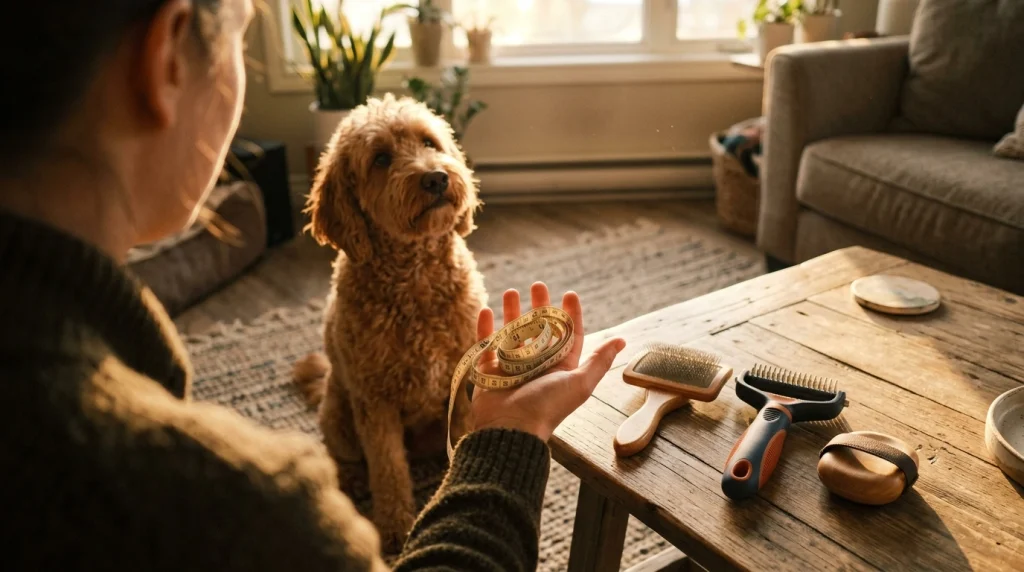
Match your brush handle to both your palm width and your dog’s coat density. Measure across your open palm: hands under 3.2 inches wide need slim, contoured shafts, while broader hands need thick barrel grips or T-bar handles to prevent finger cramping.
Guidance from the American Veterinary Medical Association (AVMA) emphasizes that regular, stress-free brushing prevents painful skin infections trapped under matted fur. If your brush hurts your hand, you will rush the job or skip grooming altogether.
Use this quick matching checklist before buying your next brush:
- For Curly/Doodle Coats (Goldendoodles, Poodles): Pick an extra-long, curved wooden handle with a rubberized coating and a 40-degree angled neck for marathon line-brushing.
- For Heavy Double Coats (German Shepherds, Golden Retrievers): Choose a heavy-duty TPE rubber handle with a wide thumb bolster and a flared base so your hand doesn’t slip during high-resistance undercoat pulls.
- For Owners with Arthritis or Joint Pain: Choose a compressible gel grip handle or a T-bar rake that lets you pull with your whole arm instead of bending your wrist.
- For Fidgety Puppies or Toy Breeds: Use a compact, short-shaft brush or palm-strap brush so your hand stays close to the dog’s body for instant control if they jump.
If you’re ready to upgrade your grooming kit with tools that protect your wrists and your dog’s skin, here are the three best-engineered handles I use and recommend:
🏆 BEST OVERALL ERGONOMICS
Chris Christensen Big G Dog Slicker Brush
★★★★★
Features an extra-long contoured beechwood handle coated in a non-slip Gripsoft rubberized finish with an aggressive 40-degree neck angle. I use the large coral model on thick Doodle and Retriever coats because the curved neck clears my knuckles and does the lifting work without straining my thumb.
💪 BEST FOR ARTHRITIS & SORE WRISTS
ConairPRO Dog Pet-It Boar Bristle & Pin Brush
★★★★☆
Built with two options—either a soft memory-gel shaft that molds to your fingers or a handleless palm-strap shell that eliminates pinching altogether. I recommend this to clients with carpal tunnel or arthritis because it completely removes rotational torque on the wrist.
🐕 BEST HEAVY DE-SHEDDING GRIP
FURminator Undercoat deShedding Tool
★★★★☆
Equipped with a thick, ribbed TPE rubber barrel handle, an integrated thumb rest, and a top-mounted FURejector hair release button. That thick barrel grip gives you massive pulling leverage on dense Husky and Shepherd undercoats without slipping in sweaty hands.
Frequently Asked Questions About Dog Brush Handles
Why does my hand cramp so fast when brushing my dog?
Your hand cramps because the brush handle is too thin, too slippery, or poorly angled. Thin, slick shafts force your thumb and fingers into a high-tension pinch grip to keep the brush head from twisting when it hits thick undercoat or tangles. Switching to a 1.5-inch diameter rubberized handle stops the cramping immediately.
Are palm-strap brushes better than traditional handled dog brushes?
Palm-strap brushes are better for short-coated dogs, bath-time scrubbing, and owners with severe wrist arthritis because they align directly with your palm. However, traditional angled handles are much better for long-haired or double-coated breeds, as they provide the mechanical leverage needed to lift and separate thick mats.
How should I hold a slicker brush to avoid hurting my dog?
Hold a slicker brush like a flute or a loose paintbrush, resting your thumb lightly on the neck divot rather than wrapping your fist tightly around the shaft. Keep your wrist straight and move from your elbow and shoulder so the bristles glide parallel to the skin without digging in.
Do wooden dog brush handles rot or crack if they get wet?
Unsealed wooden handles will swell, crack, and harbor bacteria if soaked repeatedly during bath time. High-end wooden brushes sealed with marine-grade lacquer or a rubberized coating handle damp coats and detangling sprays easily, but you should still use a molded TPE or silicone handle for full bath-time scrubbing.
Upgrade Your Grip for Safer, Faster Grooming
You don’t need stronger hands to groom a thick coat—you just need better leverage. Next time you pick up your dog’s brush, pay attention to your wrist angle and how tightly your fingers have to squeeze.
Swapping out a cheap, flat plastic handle for an angled, contoured grip protects your joints and spares your dog from accidental brush burn. Grab your current brush today, run the forearm knuckle test, and upgrade to an ergonomic handle before shedding season peaks.

Thomas Cutter is a lifelong dog owner and the founder of FindOutAboutDogs.com. With over 10 years of hands-on experience owning multiple breeds, Thomas created this site to provide honest, research-based dog advice that real owners can actually trust.
