Does Dog Brush Size Matter? A Groomer’s Guide to Pin Length and Head Width
Quick Answer
Yes, dog brush size matters for both grooming speed and your dog’s safety. Choosing the wrong head width or pin length causes painful brush burn or leaves hidden mats near the skin. You must match the brush dimensions to your dog’s body contours and coat depth, as outlined in veterinary canine preventive care guidelines.
Key Sizing Rules by Dimension
- Brush head width: Match the pad width to your dog’s torso so you cover flat areas fast without hitting bony joints.
- Pin and bristle length: Choose pins long enough to reach through the topcoat into the dense undercoat without scraping bare skin.
- Pin density and spacing: Use wider pin spacing for thick, curly coats and tight spacing for smooth, short hair.
- Detail zone sizing: Keep a mini brush on hand for tight friction zones like armpits, behind the ears, and the sanitary area.
- Handle ergonomics: Pick a handle grip that fits your palm size to prevent wrist fatigue during long de-shedding sessions.
How to Verify Your Current Brush Size
- Part your dog’s hair down to the skin after brushing; if dead undercoat remains trapped at the base, your brush pins are too short.
Standing in the grooming aisle can feel overwhelming when you see five sizes of the exact same brush. Over my years testing grooming gear on everything from teacup Chihuahuas to giant Newfoundlands, I have watched owners make one common mistake. They buy a massive brush just to get the chore done faster.
That shortcut usually backfires and leaves your dog dreading grooming day. In this guide, I will show you how to match pad width and pin depth to your dog’s exact coat and body shape.


What Defines Dog Brush Size?
 Save
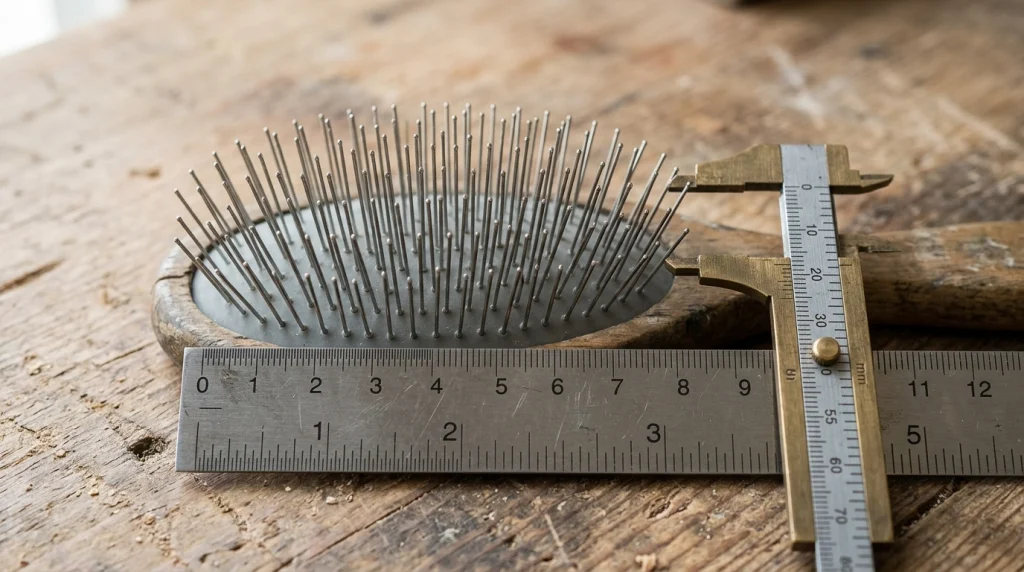
Dog brush size is the measurement of two separate physical traits: the surface area of the brush head and the length of the bristles or metal pins. Both dimensions work together to determine how well the tool penetrates hair and navigates canine anatomy.
Most people only look at the plastic or wooden paddle when shopping. That surface area dictates how much fur you catch in a single stroke. However, the hidden measurement is the pin length.
Pin length determines how deep the brush reaches into the coat. If you ignore either dimension, your grooming routine will fail. Here are the four specific measurements that make up a brush’s true size:
- Pad width: Measured in inches across the face of the brush head, usually ranging from 1.5 inches to 5 inches.
- Pin length: Measured in millimeters from the rubber cushion to the tip of the wire, ranging from 10mm to 27mm.
- Pin gauge: The thickness and flexibility of each individual wire pin, which controls how much tension it pulls through tangles.
- Cushion firmness: The give of the rubber pad holding the pins, which absorbs excess downward pressure from your hand.
Why Does Brush Head Width Matter for Your Dog’s Body Size?
Brush head width matters because a pad that is too wide bridges across your dog’s curved bones instead of hugging the skin. Using an oversized head on a small dog knocks painfully against their hips, spine, and leg joints.
Imagine trying to sweep a narrow staircase with a four-foot warehouse push broom. You miss all the corners and bang into the walls. The exact same thing happens when you use a large slicker brush on a fifteen-pound terrier.
Dogs are not flat tables. Their bodies are made of curved ribs, tucked waists, and sharp elbows. When a brush pad is wider than the flattest part of your dog’s leg, the outer edges of the brush hang in the air while the center digs hard into the bone.
- Toy and small breeds (under 20 lbs): Need a miniature or small brush head between 1.5 and 2.5 inches wide to navigate tight curves safely.
- Medium breeds (20 to 50 lbs): Work best with a medium pad around 3 to 3.5 inches wide for balanced coverage and agility.
- Large and giant breeds (over 50 lbs): Can handle a 4 to 4.5-inch wide paddle across their broad backs and deep chests.
Even if you own a 90-pound Golden Retriever, a large brush cannot do the whole job alone. Professional groomers always keep a small detail brush on their table. You need that tiny head to safely brush behind the ears, under the armpits, and down the lower hocks.
How Does Pin and Bristle Length Affect Your Dog’s Coat Type?
 Save
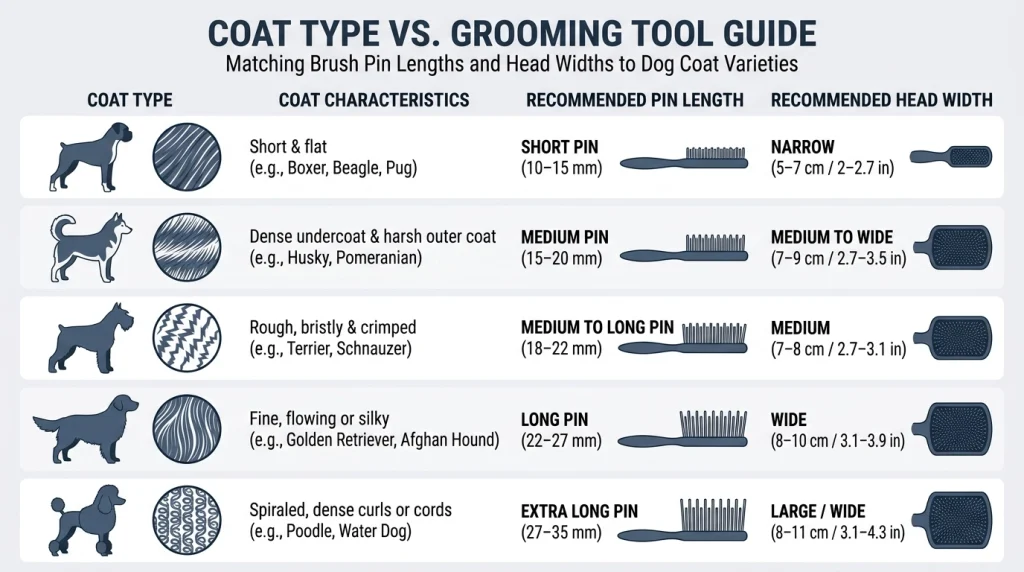
Pin and bristle length determines whether your brush reaches the root of the hair or just skims across the surface. Short pins glide over thick double coats without removing trapped undercoat, while overly long pins scratch the skin on short-haired dogs.
I learned this lesson the hard way early in my career with a friend’s Samoyed. The owner brushed her dog every single day using a standard pet store slicker with short 12mm pins. On the outside, the dog looked like a fluffy white cloud.
When I parted the hair, I found a solid, felted cast of matted fur pressed tight against the skin. Those short pins were only brushing the top half-inch of hair. They never touched the dense undercoat sitting an inch deeper.
| Coat Type | Example Breeds | Ideal Pin / Tooth Length | Recommended Head Width |
|---|---|---|---|
| Smooth & Short | Beagle, Boxer, Pug | 5mm–10mm rubber curry nubs or soft bristles | 2.5″ to 3.5″ palm pad |
| Medium Double Coat | Labrador, Corgi, GSD | 15mm–20mm slicker pins or medium rake | 3″ to 4″ curved head |
| Long & Heavy Double Coat | Husky, Malamute, Rough Collie | 22mm–27mm long pins & 1″ undercoat rake | 3.5″ to 4.5″ wide paddle |
| Curly, Wavy & Doodles | Poodle, Goldendoodle, Bichon | 25mm–27mm extra-long angled pins | 3″ to 3.5″ contoured head |
| Silky & Drop Coats | Yorkie, Shih Tzu, Maltese | 15mm–20mm polished steel pin brush | 1.5″ to 2.5″ mini oval head |
For Poodle mixes and long-haired breeds, long-pin slicker brushes are non-negotiable. As of 2026, grooming standards for heavy Doodle coats rely on 25mm to 27mm pins paired with a technique called line brushing. You part the coat horizontally with one hand and brush from the skin outward in small sections.
To check if your pins are doing their job, follow up with stainless steel greyhound combs right after brushing. Slide the comb teeth all the way to the skin and pull through. If the comb snags, your brush pins are too short or you missed a spot.
What Happens If You Use the Wrong Size Dog Brush?
Using the wrong size dog brush causes either skin trauma from excessive scraping or deep coat matting from shallow penetration. Both outcomes turn routine grooming into a painful experience that makes dogs fearful or aggressive toward brushes.
When a brush is too small or has short pins on a thick coat, you naturally press harder to make it work. That extra hand pressure drives wire tips straight into the epidermis. Veterinarians refer to the resulting red, oozing welts as brush burn, a painful form of traumatic dermatitis.
According to veterinary clinical overviews in the Merck Veterinary Manual, broken skin barriers quickly invite secondary bacterial or yeast infections. Even worse, trapped mats pinch the skin every time your dog moves. Those tight knots cut off air circulation and hide parasites like fleas or ticks.
- Pelted undercoat: Short bristles gloss over the topcoat while dead hair weaves into a tight, suffocating mat underneath.
- Joint bruising: Wide, stiff paddles slam into ankle bones, hip points, and spinal ridges on slender or small dogs.
- Static and coat breakage: Dense, short bristles snap delicate drop coats instead of gently separating individual hair shafts.
- Behavioral resistance: Dogs quickly associate oversized, clumsy tools with pain and start hiding or snapping when they see the brush.
How Does Brush Size Differ Across Grooming Tool Types?
Each style of dog brush uses a different sizing system based on whether it is built to detangle, de-shed, or polish. While slicker brushes are sized by pad width and pin depth, de-shedding tools and rakes are sized by blade width and tooth spacing.
You cannot apply the same sizing rules across every tool in your grooming caddy. Different breed coat types require specific combinations of brushes. Here is how sizing works across the four main brush categories:
1. Slicker Brushes
Slickers feature fine wire pins set at an angle inside a flexible rubber cushion. They come in mini, small, medium, and large pad widths, with pin lengths split between standard (12mm to 15mm) and long-pin (22mm to 27mm) models.
2. Undercoat Rakes
Rakes look like miniature shaving razors fitted with one or two rows of thick, rounded metal teeth. Their size is determined by tooth length—ranging from 0.5 inches for Labradors to 1.25 inches for Malamutes—rather than head width.
3. De-Shedding Blades
Tools with fine stainless steel stripping edges are color-coded and sized strictly by dog weight and hair length. Using a wide 4-inch long-hair blade on a short-haired Beagle will scrape the skin raw along their narrow ribs.
4. Bristle and Pin Paddles
Traditional oval brushes mimic human hairbrushes and are used for finishing smooth or silky coats. As noted by animal care specialists at Cornell University’s College of Veterinary Medicine, routine brushing with properly sized soft tools distributes natural skin oils without irritating sensitive follicles.
How Do You Measure Your Dog for the Right Brush Size?
 Save
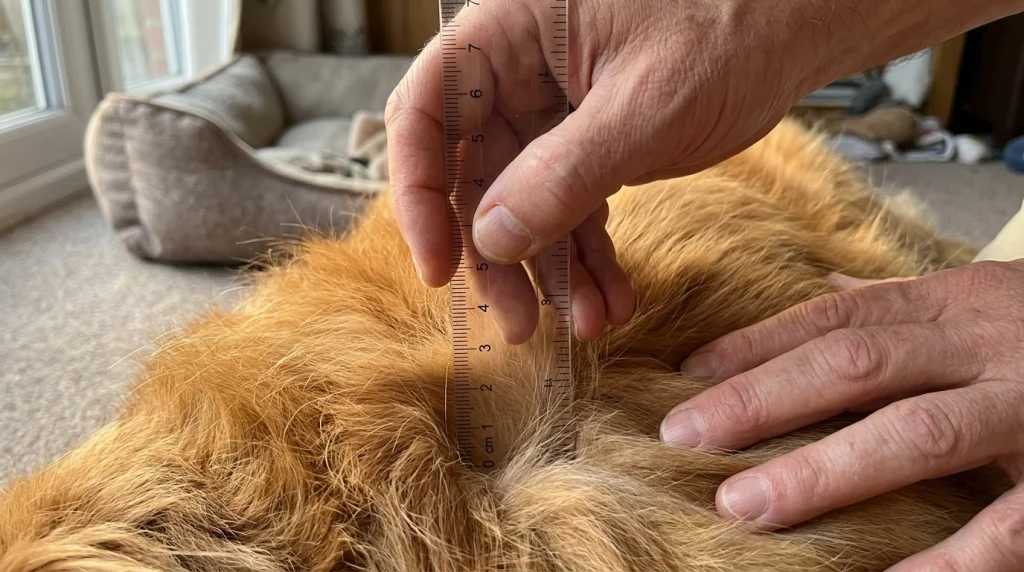
To measure your dog for the right brush size, measure the depth of their parted coat with a ruler and compare the brush pad width against their front leg. This two-minute check guarantees you buy a tool that reaches the skin without overpowering their frame.
Before you click buy on any grooming tool, grab a standard ruler or measuring tape. Follow these four steps right on your living room floor:
- Measure the coat depth: Part your dog’s fur on their rump or shoulders until you see bare skin, then measure from the skin to the top of the dense undercoat layer.
- Select your pin length: Choose a brush with pins or teeth at least 3mm to 5mm longer than your undercoat depth measurement so the tips reach the base without flattening out.
- Check the leg-width rule: Look at the width of your dog’s upper front leg; your primary all-over brush head should never be more than double that width.
- Test your own grip: Measure your palm and pick an ergonomic handle that doesn’t force your fingers to cramp during a twenty-minute brushing session.
If you’re ready to pick one, here’s what I’d actually recommend based on your dog’s coat and size:
🏆 BEST FOR THICK & CURLY COATS
Chris Christensen Big G Slicker Brush
★★★★★
Features 27mm extra-long angled pins in Three sizes: Baby G (2″ head), Medium (3″ head), and Large (3.75″ head). I use the Medium size on 90% of Goldendoodles and Poodles because the long pins dig out deep mats while the 3-inch head still fits around their legs.
🐕 BEST FOR DOUBLE COAT SHEDDING
Safari Double Row Undercoat Rake
★★★★☆
Built with dual staggered rows of rounded stainless steel pins measuring 0.6 inches and 0.8 inches deep on a 3.5-inch head. It is my budget go-to for Huskies and German Shepherds because those staggered teeth pull out compacted winter fuzz without cutting the topcoat.
🐾 BEST FOR SMALL BREEDS & DETAIL ZONES
Li’l Pals Coated Tips Slicker Dog Brush
★★★★☆
Compact 2.2-inch by 1.4-inch brush head with soft, plastic-coated wire pins designed for sensitive skin. I keep one of these in my apron pocket for toy breeds and for brushing delicate armpits and ear edges on big dogs.
Frequently Asked Questions
Is it better to get a medium or large dog brush?
A medium dog brush (around 3 inches wide) is the safer, more versatile choice for most dogs between 25 and 65 pounds. While a large brush covers the back slightly faster, a medium head maneuvers much better around legs, chest curves, and hip bones without bumping sensitive joints.
Can I use a large slicker brush on a small dog?
You should avoid using a large slicker brush on a small dog because the wide, flat pad cannot contour to their tiny ribcage or legs. The rigid edges will knock against their bones, and you risk accidentally poking their eyes, ears, or belly with the exposed corners.
What size pin brush does a Goldendoodle need?
A Goldendoodle with a plush or wool coat needs a slicker or pin brush with extra-long pins measuring 25mm to 27mm (about 1 inch long). Shorter pins will only skim the top curls and leave a dense layer of matted fur trapped right against their skin.
Do puppies need a smaller brush than adult dogs?
Yes, puppies need a smaller, softer brush to fit their miniature frames and protect their delicate skin. Starting with a mini soft-pin slicker or puppy bristle brush lets you gently navigate their narrow legs and builds positive grooming habits before their heavy adult coat grows in.
Final Takeaway on Choosing the Right Brush Size
Picking the right dog brush size comes down to one simple rule: size the pin length to the coat depth, and size the brush head to the body part you are brushing. If you ever get stuck choosing between two head widths, always size down for better control and comfort.
Grab a ruler tonight, part your dog’s coat to check its true depth, and take a look at the brush sitting in your drawer. Making a simple switch to the proper pin length and head width will cut your brushing time in half and keep your dog wagging through every session.

Thomas Cutter is a lifelong dog owner and the founder of FindOutAboutDogs.com. With over 10 years of hands-on experience owning multiple breeds, Thomas created this site to provide honest, research-based dog advice that real owners can actually trust.
