Which Brush Is Best for Curly-Coated Dogs?
Quick Answer
For most curly-coated dogs, the best brush is a long-pin slicker brush paired with a sturdy metal comb. The slicker separates curls and removes loose hair before tangles tighten, while the comb checks whether you reached all the way through the coat. This matches AKC dog-brush guidance, which recommends slicker brushes for curly-coated dogs.
What works best for curly coats
- Long-pin slicker: Reaches deeper into thick curls than a short surface brush.
- Metal comb: Finds hidden tangles that the brush may have missed.
- Flexible pin bed: Helps the brush move with the coat instead of dragging aggressively.
- Light pressure: Prevents wire pins from scraping or irritating the skin.
- Section brushing: Makes it easier to reach the roots instead of brushing only the curl tips.
My simple setup
- Use a slicker first, then run a metal comb through the same section before moving on.
Curly coats can look perfectly tidy on top while small tangles tighten underneath. That is why choosing the right brush matters more than simply brushing often.
I prefer a two-tool approach because it gives me a clear check at the end. The slicker does most of the work, and the comb tells me whether the section is truly tangle-free.


Why Do Curly-Coated Dogs Need a Different Type of Brush?
Curly coats tend to hold loose hair inside the surrounding coat instead of letting it fall away easily. That trapped hair can twist together with neighboring curls and form tangles or mats.
A brush therefore needs enough reach to separate the coat without repeatedly scraping the skin. Short bristles that skim the surface usually do not solve that problem.
A curly dog coat is a coat in which the hair shaft bends or coils rather than lying straight. Poodles are the classic example, although many Poodle mixes, Bichon Frises, Portuguese Water Dogs, and other breeds also carry curled or woolly coats.
- Loose hair stays trapped: Shed or broken hairs can remain inside neighboring curls.
- Friction creates tangles: Armpits, legs, ears, collars, and harness areas are especially vulnerable.
- Surface brushing can mislead: The top may look fluffy while knots remain closer to the skin.
- Longer coat means more work: A short pet trim is usually easier to maintain than a long fluffy coat.
VCA Animal Hospitals also notes that curly-coated dogs often need frequent brushing to prevent tangles and matting. Their grooming guidance specifically identifies slicker brushes as useful for curly, non-shedding coats.
Which Brush Is Best for Curly-Coated Dogs?
For most curly-coated dogs, I would start with a long-pin slicker brush. It combines coat separation, loose-hair removal, and light detangling in one tool.
The key phrase is “long-pin.” A small slicker with shallow pins may work on a short trim but struggle to reach through a longer Poodle or Doodle coat.
Long-pin slicker brush
A long-pin slicker uses many fine, angled metal pins mounted in a padded or flexible base. Those pins move between curls and help separate compacted hair.
- Best for everyday coat maintenance
- Useful for line brushing
- Helps remove loose hair
- Can loosen small tangles before they become mats
- Works well during blow-drying and fluffing
The American Kennel Club lists slicker brushes among the most useful tools for curly-coated dogs. The important part is using gentle pressure rather than digging the pins into the skin.
Metal comb
I treat a metal comb as the quality-control tool. If the comb passes through the brushed section without catching, I know I have probably reached the full depth of the coat.
A comb is especially helpful behind the ears, around the legs, under the collar, and in the armpits. These spots often hide the first small tangles.
Slicker Brush vs Pin Brush vs Comb: Which Is Better?
 Save
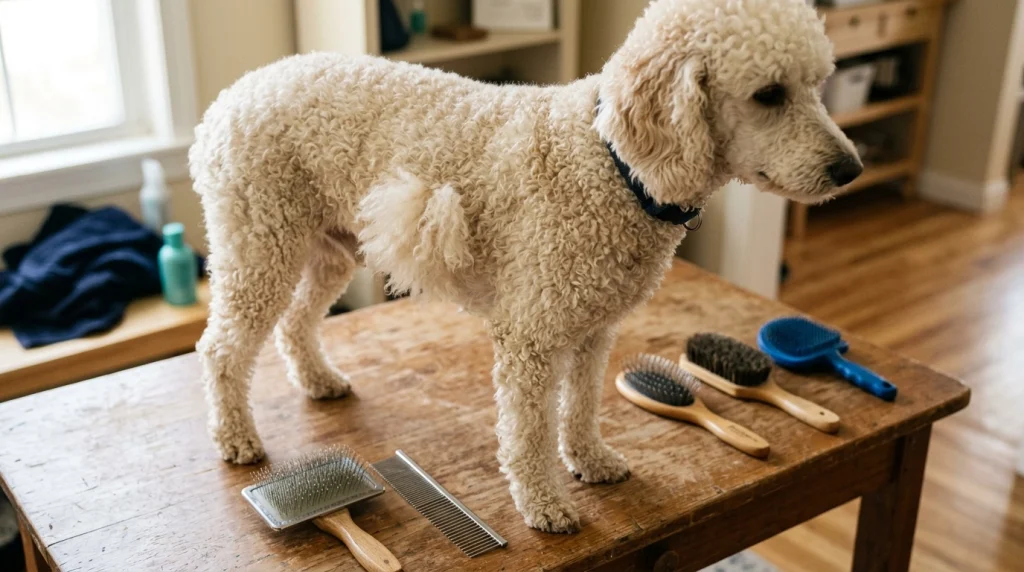
SaveA slicker brush does the best all-around job for most curly coats, but it is not the only useful tool. Each option has a different purpose.
| Tool | Best Use | Coat Reach | Main Limitation |
|---|---|---|---|
| Long-pin slicker | Routine brushing, separating curls, light tangles | High | Can irritate skin if pressed too hard |
| Pin brush | Fluffing and maintaining a loose, already-detangled coat | Medium | May miss tighter tangles |
| Metal comb | Checking roots and finding hidden knots | High | Slow as the main whole-body tool |
| Bristle brush | Surface smoothing | Low | Usually too shallow for thick curls |
| Rubber grooming brush | Bath-time massage and surface hair | Low | Does not reliably reach deep curls |
If your dog has a different coat structure, tool choice changes. For example, a dense double coat needs a different strategy, as explained in this guide to choosing a brush for a Husky.
How Should You Brush a Curly-Coated Dog?
The best technique is to work in small sections and brush from the ends toward the base. Trying to drag a brush through the full depth at once can pull painfully.
- Check the coat first. Feel for mats, tender spots, moisture, burrs, or skin irritation.
- Separate a small section. Lift the coat so you can see closer to the skin.
- Start near the ends. Use short, light slicker strokes rather than forcing through resistance.
- Work gradually toward the roots. Keep the brush moving instead of repeatedly scraping one spot.
- Follow with a metal comb. Stop if it catches and return to the slicker.
- Move to the next section. Continue until the entire coat has been checked.
I use the comb as my stopping test. I do not keep brushing simply because a few loose hairs still appear on the brush.
AKC grooming advice also recommends brushing down toward the skin while taking care not to scratch it. Gentle, controlled strokes matter more than speed.
How Often Should You Brush a Curly-Coated Dog?
 Save
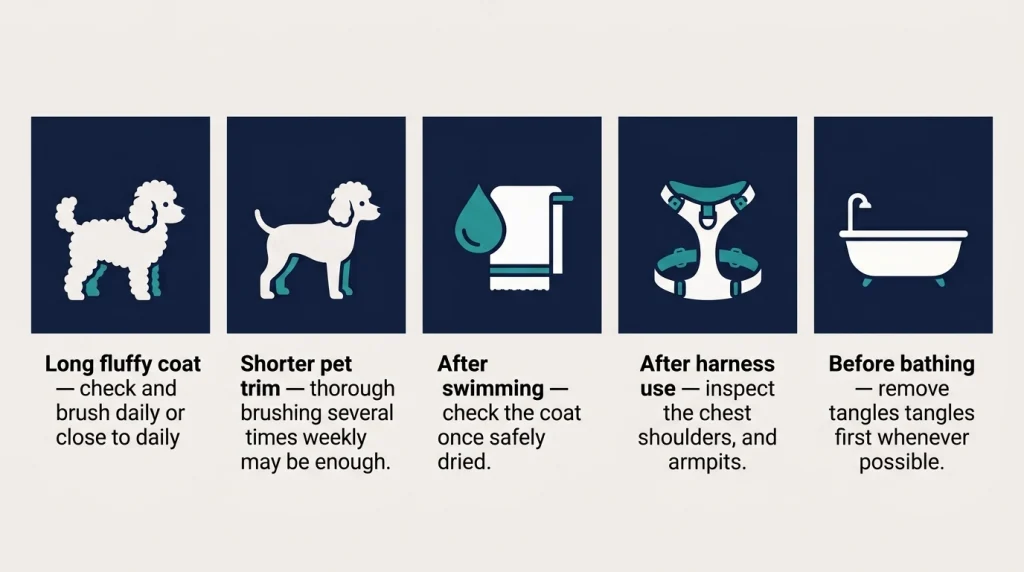
SaveMany long or curly coats benefit from daily or near-daily checking, especially when the hair is kept long. A shorter pet trim may need less intensive maintenance.
VCA recommends daily brushing for long, silky, or curly coats because these textures can tangle easily. The exact schedule still depends on coat length, activity, humidity, clothing, and the individual dog.
- Long fluffy coat: Check and brush daily or close to daily.
- Shorter pet trim: A thorough brushing several times weekly may be enough.
- After swimming: Check the coat once it is safely dried because moisture can encourage tangles.
- After harness use: Inspect friction areas around the chest, shoulders, and armpits.
- Before bathing: Remove tangles first rather than soaking a compacted coat.
As of 2026, the basic rule has not changed: brushing frequency should increase as coat length and tangle risk increase.
What Features Should You Look for in a Curly-Coat Brush?
Do not buy based only on a “for all dogs” label. Look closely at the pin length, pin finish, cushion, size, and handle.
- Long pins: Longer pins reach through thick or fluffy curls more effectively.
- Smooth pin tips: Rough metal can make grooming uncomfortable.
- Flexible cushion: A little movement helps the brush follow the body.
- Curved head: A curved brush can give better contact on larger coat sections.
- Comfortable handle: Frequent brushing puts repetitive strain on your hand and wrist.
- Correct head size: Large heads suit body areas, while smaller brushes give better control on legs and tight spaces.
One detail I pay close attention to is pin length. The Chris Christensen Big G, for example, currently uses 27 mm stainless-steel pins and is designed for long, dense, and curly coats.
What Are the Most Common Curly-Coat Brushing Mistakes?
The biggest mistake is making the top of the coat look fluffy while leaving tangles underneath. A comb check exposes that problem quickly.
- Brushing only the surface: Lift the coat and work in sections.
- Using too much pressure: Wire pins should move through hair, not scrape skin.
- Pulling through knots: Stop and loosen the tangle gradually.
- Skipping friction areas: Check ears, collar areas, armpits, legs, and the base of the tail.
- Bathing over mats: Remove tangles before the bath whenever possible.
- Waiting too long: Small tangles are easier to manage than tight mats.
VCA advises professional help when matting becomes extensive. Tight mats can sit close to the skin, so cutting blindly with scissors can cause injury.
Curly coats and double coats create different grooming problems. If shedding is the main issue instead, see this guide to managing heavy Husky shedding.
When Should You Stop Brushing and Call a Groomer or Vet?
 Save
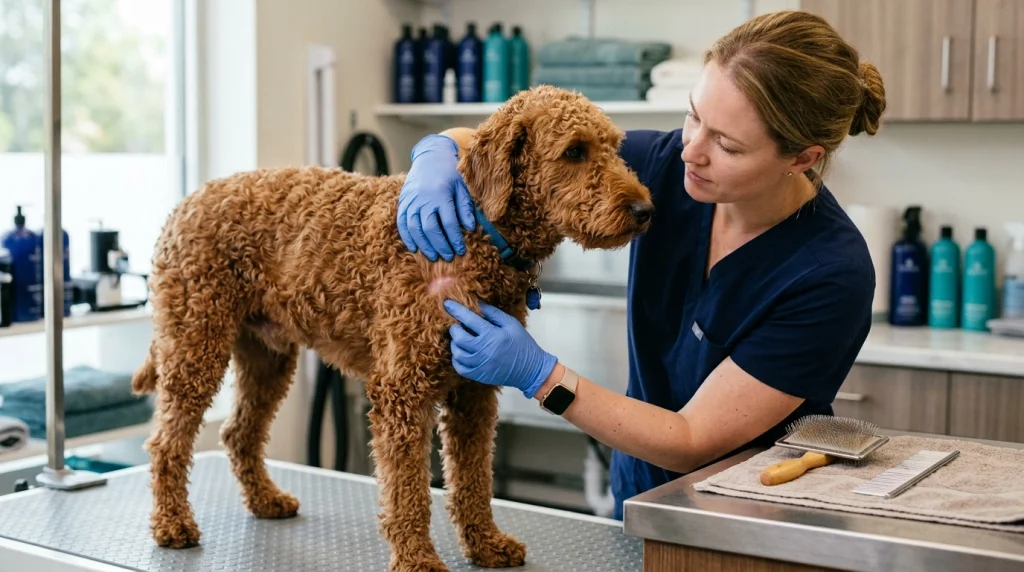
SaveRoutine tangles are a grooming issue, but painful matting or abnormal skin changes deserve more caution. Do not keep brushing harder when the dog is clearly uncomfortable.
- Large mats sitting tightly against the skin
- Red, moist, bleeding, or crusted areas
- Persistent scratching or chewing
- Bald patches or sudden coat thinning
- Strong odor coming from the skin
- Pain when a specific area is touched
The VCA grooming and coat-care guide recommends professional help for severe tangles and veterinary attention when matting has irritated the skin.
Regular grooming is also a useful inspection time. AKC recommends checking for cuts, sore spots, parasites, and other unusual changes while you brush.
Brushes I Would Consider for Curly-Coated Dogs
If you are ready to put together a simple grooming kit, I would choose tools that solve different parts of the job rather than buying three similar brushes.
🏆 Best Overall
Chris Christensen Big G Slicker Brush
★★★★½
Its 27 mm stainless-steel pins are designed for long, dense, and curly coats. I like this style when a short slicker keeps skating over the surface instead of reaching into the coat.
✨ Best Medium-Pin Option
Chris Christensen Kärben Slicker Brush
★★★★☆
The Kärben uses 17 mm pins, making it more suitable for medium-length coats than the longer Big G. I would consider it for shorter curly trims where 27 mm pins feel unnecessary.
🐾 Essential Finishing Tool
Andis Steel Pet Comb
★★★★☆
A basic steel comb is less glamorous than a premium slicker, but I consider it essential. I use it after brushing to find small knots hiding near the roots.
Frequently Asked Questions
Is a slicker brush good for curly-haired dogs?
Yes. A slicker brush is one of the most useful tools for curly-coated dogs because its fine angled pins separate curls, collect loose hair, and help loosen small tangles. Choose a pin length that matches the coat depth and use light pressure to protect the skin.
Should I use a slicker brush or pin brush on a Poodle?
A slicker brush is usually more useful for detangling and routine maintenance, especially on dense or fluffy Poodle coats. A pin brush can work well for fluffing and maintaining an already-detangled coat, so many owners use both rather than choosing only one.
How do I know if I brushed my curly dog properly?
Run a metal comb through each finished section from the outer coat toward the roots. If the comb catches, there is still a tangle or compacted area that needs attention. A coat can look smooth on top while hiding knots closer to the skin.
Can I brush a curly dog every day?
Yes, gentle daily brushing can be appropriate for many dogs with long curly coats. Daily coat checks are especially useful around the ears, legs, armpits, collar, and harness areas. Shorter pet trims may need less frequent full-body brushing.
Can a slicker brush hurt a dog?
It can if you press too hard, scrape repeatedly over one area, or force the pins through a tight mat. Use short, controlled strokes and stop if the skin becomes red or your dog shows discomfort. Severe matting is better handled by a professional groomer.
Final Takeaway: Use a Slicker Brush and Comb Together
For most curly-coated dogs, my first choice is a long-pin slicker brush followed by a metal comb. The slicker separates the curls, while the comb confirms that hidden tangles are gone.
Match the pin length to your dog’s coat, work in small sections, and keep the pressure light. That simple routine is far more effective than aggressively brushing the surface once tangles have already tightened.
Start before matting becomes obvious. A few calm minutes of regular maintenance can save both you and your dog from a much harder grooming session later.

Thomas Cutter is a lifelong dog owner and the founder of FindOutAboutDogs.com. With over 10 years of hands-on experience owning multiple breeds, Thomas created this site to provide honest, research-based dog advice that real owners can actually trust.
