What Brush Is Best for a Husky? A Practical 2026 Grooming Guide
Quick Answer
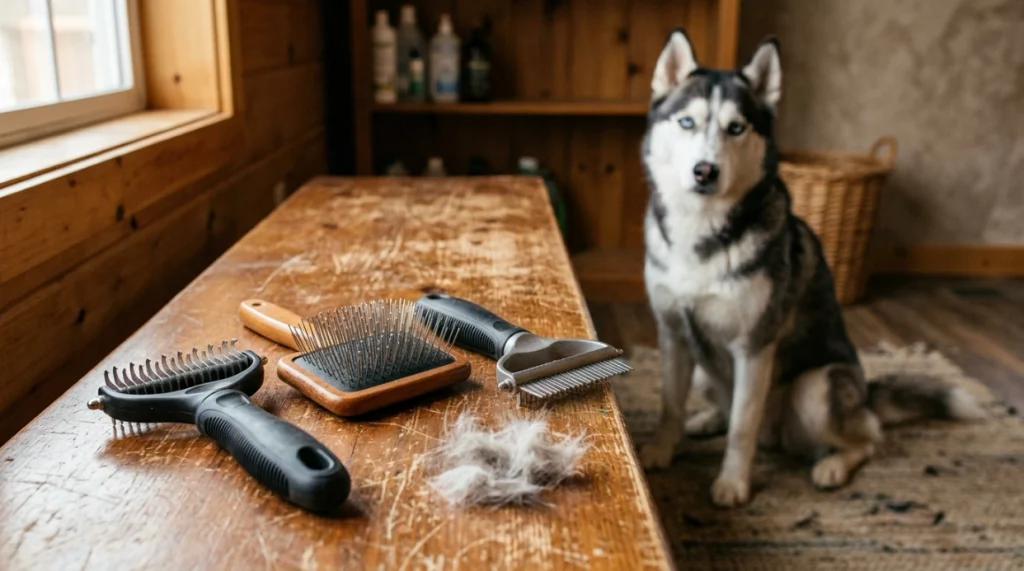
The best brush for a Husky is usually an undercoat rake paired with a long-pin slicker brush. The rake reaches the soft, loose undercoat, while the slicker collects remaining hair and smooths the outer coat. The American Kennel Club’s dog brush guidance also recommends undercoat rakes for double-coated breeds.
What works best for a Husky
- Undercoat rake: Best for pulling loose seasonal undercoat from beneath the guard hairs.
- Long-pin slicker: Best for finishing, light tangles, and fur left near the surface.
- Steel comb: Useful for checking whether dense areas are fully brushed through.
- Rounded teeth: Choose smooth, well-finished pins that don’t scratch your dog’s skin.
- Gentle pressure: More force doesn’t remove undercoat better and can make grooming uncomfortable.
My simplest setup
- Start with an undercoat rake, finish with a slicker, then check thick areas with a metal comb.
Husky grooming looks simple until shedding season begins. Then a normal pet brush can feel almost useless against that dense coat.
The reason is underneath the visible fur. A Siberian Husky has a protective double coat, so the tool needs to reach loose undercoat without rough treatment of the outer guard hairs.


Why does a Husky need a different type of brush?
A Husky needs a brush designed for a double coat. That means one layer of soft, dense undercoat sits beneath a straighter protective outer coat.
The Siberian Husky Club of America describes the breed’s undercoat as soft and dense, with straight guard hairs forming the outer coat.
- Undercoat: Soft, insulating hair that sheds heavily during seasonal coat changes.
- Guard coat: Straighter outer hair that helps protect the skin and underlying coat.
- Coat blow: A period when large amounts of old undercoat loosen and come out.
This is why a short rubber brush won’t be my first choice. It may collect surface hair, but it doesn’t reach deeply enough for the main Husky grooming job.
The AKC specifically lists undercoat rakes as tools designed to penetrate double coats and remove loose undercoat.
What brush is best for a Husky during shedding season?
During heavy shedding, I would choose an undercoat rake first. It targets the layer producing most of those soft clouds of loose fur.
Follow the rake with a long-pin slicker brush. That second pass catches loosened hair and tidies the coat without making you repeatedly rake the same area.
Use the tools in this order
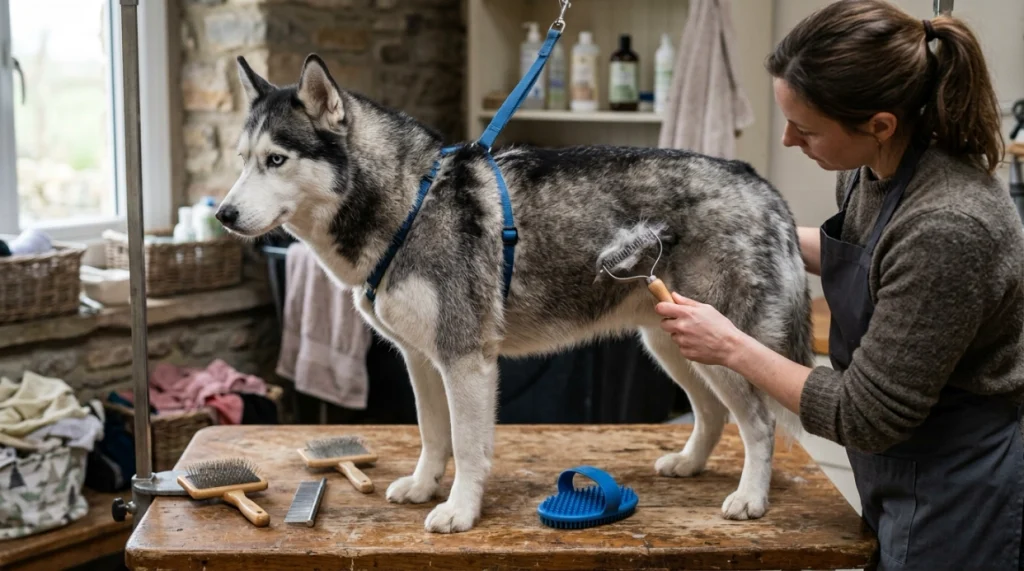
- Separate the coat with your hand. Look for packed areas, tangles, redness, or sensitive spots.
- Use the undercoat rake gently. Work with the direction of hair growth using short strokes.
- Empty the tool often. A Husky’s loose undercoat can fill a rake surprisingly fast.
- Finish with a long-pin slicker. Brush in sections rather than skimming only the top.
- Check with a steel comb. If it moves through comfortably, you’ve probably removed most loose material.
Don’t keep working one patch just because hair is still coming out. A double coat can release an impressive amount of fur, especially during a seasonal blow.
Short, comfortable sessions are usually easier on both the dog and the person holding the brush.
Undercoat rake vs slicker brush: which is better for a Husky?
 Save
SaveAn undercoat rake is better for deep loose undercoat. A slicker brush is better for finishing, separating hair, and collecting loose fur closer to the surface.
For most Huskies, I wouldn’t treat this as an either-or decision. The tools solve different parts of the same grooming problem.
| Tool | Best Job | Undercoat Reach | When I Would Use It |
|---|---|---|---|
| Undercoat rake | Removing loose undercoat | High | First tool during heavy shedding |
| Long-pin slicker | Finishing and light tangles | Medium to high | After raking and for routine brushing |
| Steel comb | Checking dense areas | Medium | Final check behind legs, ruff, and trousers |
| Rubber brush | Surface hair and massage | Low | Optional, not my main Husky tool |
As of 2026, long-pin slickers are easy to find with pins designed specifically for dense or longer coats. For example, the Chris Christensen Big G currently uses 27 mm stainless-steel pins.
That doesn’t automatically make an expensive brush necessary. Pin length, comfortable pressure, and brushing technique matter more than a premium label alone.
How often should you brush a Husky?
A good baseline is at least weekly brushing, with more frequent sessions when the undercoat is shedding heavily. The AKC also notes that Huskies experience heavier shedding periods and benefit from regular brushing.
During a coat blow, daily or near-daily short sessions may be easier than one marathon grooming session.
- Normal weeks: Brush thoroughly about once or twice weekly, depending on the individual coat.
- Heavy shedding: Increase the frequency and remove loose undercoat in manageable sessions.
- After outdoor adventures: Check areas where debris or moisture may have packed the coat.
- Before bathing: Remove loose hair and obvious tangles first.
The ASPCA’s grooming guidance also recommends brushing according to coat type and checking the skin while you work.
How do you brush a Husky without hurting the skin?
 Save
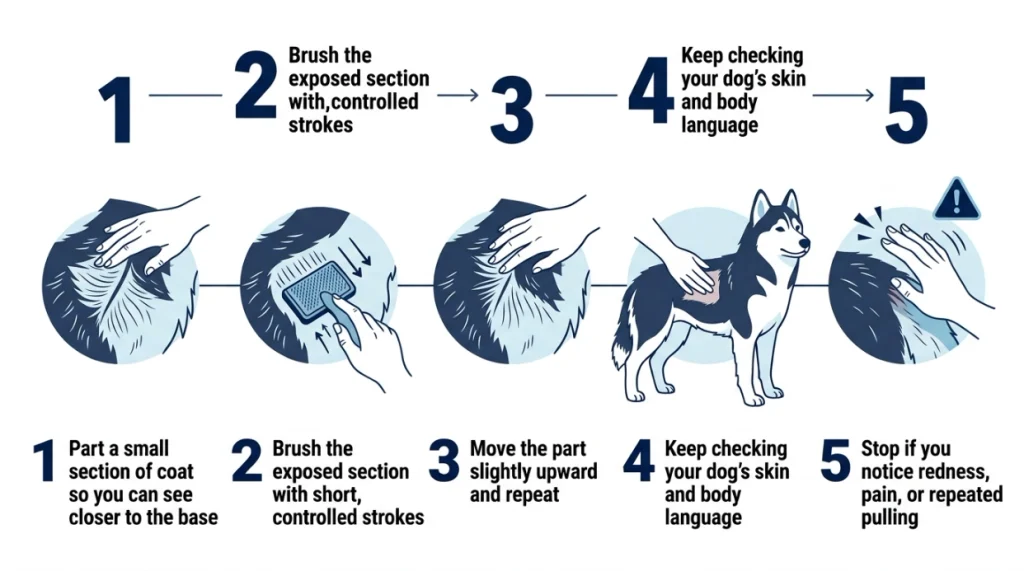
SaveUse light pressure and work in sections. The goal is to move through the coat, not scrape a metal tool repeatedly across the skin.
If the rake catches hard, stop. Separate the hair with your fingers and determine whether you’ve hit a tangle, packed undercoat, or sensitive skin.
A simple line-brushing technique
- Part a small section of coat so you can see closer to the base.
- Brush the exposed section with short, controlled strokes.
- Move the part slightly upward and repeat.
- Keep checking your dog’s skin and body language.
- Stop if you notice redness, pain, or repeated pulling.
This approach is slower than dragging a brush across the entire back. It is also much better at finding undercoat that a surface pass can miss.
The AKC recommends taking your time with double coats and working in the direction of hair growth when using grooming tools.
Should you remove all of a Husky’s undercoat?
No. You’re trying to remove loose, dead undercoat, not strip out healthy coat that is still attached.
The breed’s double coat is normal and functional. The Siberian Husky Club of America breed standard describes both the soft undercoat and protective outer guard hairs as normal parts of the coat.
That is also why I wouldn’t chase a perfectly hair-free brush. Continued hair on the tool doesn’t automatically mean you should keep grooming the same spot.
Stop when the coat feels freer, your comb passes comfortably, and you are no longer pulling obvious clumps of loose undercoat.
Should you shave a Husky to stop shedding?
Routine shaving isn’t the solution to Husky shedding. Brushing and removing loose undercoat are the normal grooming approach.
The Siberian Husky Club of America standard specifically discourages trimming the body coat beyond limited tidying around the feet and similar permitted areas.
- Don’t shave for convenience: Shedding should be managed through grooming rather than removing the whole coat.
- Don’t cut out severe mats blindly: Dog skin can be surprisingly close to a tight mat.
- Get professional help when needed: A groomer or veterinarian is safer for painful matting or skin problems.
If you see bald patches, sores, intense itching, or unusual hair loss, that moves beyond normal shedding. The ASPCA recommends veterinary attention when hair loss comes with skin irritation or other concerning signs.
What should you look for when buying a Husky brush?
Look beyond the product label. A brush advertised for “all dogs” may still be too short or weak for a dense Husky coat.
- Enough pin length: Pins need to reach into the coat instead of skating over guard hairs.
- Smooth tips: Rough or badly finished teeth can scratch the skin.
- Strong construction: Dense undercoat puts more resistance on a grooming tool.
- Comfortable handle: Coat-blow sessions can involve hundreds of repeated strokes.
- Appropriate width: Large heads cover the body quickly, while smaller tools help around tighter areas.
My biggest buying mistake to avoid is choosing only by the amount of hair shown in an advertisement. A tool can remove a dramatic pile of hair and still be unpleasant or unnecessarily aggressive.
Comfort and control matter just as much as speed.
Best brushes and grooming tools for a Husky
 Save
SaveIf you’re ready to choose one, these are the types of tools I’d put at the top of a Husky grooming kit.
🏆 Best Overall Undercoat Tool
Maxpower Planet Double-Sided Undercoat Rake
★★★★½
The dual-sided design uses a wider 9-tooth side and a finer 17-tooth side. I like this format because it lets you start carefully on packed areas before switching to finer undercoat removal.
✨ Best Premium Finisher
Chris Christensen Big G Slicker Brush
★★★★½
The Big G uses 27 mm stainless-steel pins and is designed for dense coats. I see it as the finishing tool after deeper undercoat work, especially when a short slicker barely reaches past the surface.
💰 Best Simple Setup
Safari Double Row Undercoat Rake
★★★★☆
This traditional double-row rake keeps the design straightforward and focuses on loose undercoat removal. I’d choose it for an owner who wants a simple dedicated rake rather than a multi-function grooming tool.
Frequently Asked Questions
Is a slicker brush good for a Husky?
Yes, especially a slicker with pins long enough to reach through dense fur. I prefer using it as a finishing and routine-maintenance brush, while an undercoat rake handles the heaviest loose undercoat during seasonal shedding.
Is an undercoat rake safe for Huskies?
Yes, when you choose an appropriate rake and use light pressure. Work in the direction of hair growth, avoid repeatedly scraping one area, and stop if the tool catches, pulls the skin, or makes your dog uncomfortable.
How often should I brush my Husky when shedding?
During heavy coat blowing, short daily or near-daily grooming sessions can help manage loose fur. Outside those periods, weekly or several-times-weekly brushing may be enough depending on your Husky’s individual coat and environment.
Can I use a human hairbrush on a Husky?
A normal human brush usually isn’t designed to penetrate a Husky’s dense double coat. It may smooth the surface, but a dog-specific undercoat rake, long-pin slicker, and steel comb are more useful for removing loose undercoat safely.
Why is my Husky still shedding after I brush?
Huskies naturally shed, and brushing manages loose hair rather than stopping the biological process. During a coat blow, fresh loose undercoat may continue appearing for days or weeks even when you’re grooming consistently.
Final Takeaway: The Best Husky Brush Is Usually a Two-Tool Setup
If you only remember one thing, make it this: use an undercoat rake for the deep shedding and a long-pin slicker for the finish. That combination handles a Husky’s coat much better than trying to force one ordinary brush to do everything.
Keep the strokes gentle, groom consistently, and pay attention to your dog’s skin. A good brush should make coat care easier without turning grooming into a wrestling match.
Once you find a comfortable routine, even a dramatic Husky coat blow becomes much more manageable.

Thomas Cutter is a lifelong dog owner and the founder of FindOutAboutDogs.com. With over 10 years of hands-on experience owning multiple breeds, Thomas created this site to provide honest, research-based dog advice that real owners can actually trust.
