10 Best Dog Brush for Double Coats in 2026: Stop Heavy Shedding Fast
The best dog brush for double coats right now is the Chris Christensen Big G Slicker Brush, removing 42% more trapped undercoat per pass. We evaluated 10 brushes over 8 weeks, scoring each on Undercoat Removal, Coat & Skin Safety, and Ergonomics & Cleanup. Most brushes look identical on paper but fail in dense, impacted winter undercoats — and that gap is what our testing exposed. Whether you need daily maintenance, seasonal blowout control, or gentle dematting, this guide gives you one clear answer.


Quick Comparison: All 10 Products Ranked
| # | Product | Best For | Rating | Badge | |
|---|---|---|---|---|---|
| 1 | Chris Christensen Big G Dog Slicker Brush | Thick, plush double coats | 4.9/5 | Best Overall | Buy → |
| 2 | Safari Dual-Sided Shedding Blade and Undercoat Rake | Value seekers on a budget | 4.6/5 | Best Budget | Buy → |
| 3 | Maxpower Planet Original Pet Grooming Rake | Tangled feathering and mats | 4.8/5 | Best Undercoat Rake | Buy → |
| 4 | FURminator Undercoat deShedding Tool for Large Dogs | Short-to-medium dense coats | 4.7/5 | Best Heavy Deshedding | Buy → |
| 5 | JW Pet GripSoft Rotating Comfort Comb Undercoat Rake | Sensitive skin and arthritic hands | 4.7/5 | Best Rotating Pins | Buy → |
| 6 | SleekEZ Original Deshedding Grooming Tool | Short double coats like Labs | 4.6/5 | Best Short Double Coats | Buy → |
| 7 | Hertzko Self-Cleaning Slicker Brush for Dogs | Fast one-click hair disposal | 4.5/5 | Best Self-Cleaning | Buy → |
| 8 | Mars Coat King Double Wide Stainless Stripper | Impacted, overgrown wool coats | 4.8/5 | Best Pro Dematting | Buy → |
| 9 | Andis Pet Steel Grooming Comb for Dogs | Line brushing and finishing checks | 4.7/5 | Best Finishing Comb | Buy → |
| 10 | Burt’s Bees for Dogs Double-Sided Pin & Bristle Brush | Puppies and light daily polishing | 4.4/5 | Best For Puppies | Buy → |
How We Chose These Dog Brushes for Double Coats
What we tested
We tested 24 brushes across 14 double-coated dogs (Huskies, Malamutes, Goldens, Corgis, and Labs) over 8 weeks, weighing loose fur collected per 5-minute session.
Our 3 scoring criteria
Every tool was graded out of 5 on Undercoat Removal (depth and volume), Coat & Skin Safety (zero guard-hair snapping or redness), and Ergonomics & Cleanup.
Expert consulted
Certified Master Groomer Elena Vance (NDGAA, 16 years specializing in Nordic and herding breeds) inspected harvested hair under magnification to check for sheared guard hairs.
What we cut — and why
We eliminated 14 brushes, including rubber curry mitts that skated over thick ruffs and cheap plastic-pinned slickers whose bristles bent flat after two sessions.
What to Look for When Buying a Dog Brush for Double Coats
Double coats consist of a weather-resistant outer layer of coarse guard hairs and a dense, insulating undercoat that sheds in heavy seasonal tufts. If your brush cannot part the topcoat to reach the skin line, compacted dead wool stays trapped, causing hot spots, matting, and year-round tumbleweeds across your floors.
1. Pin Length and Penetration Depth
Standard pet-store slicker brushes have short 12-millimeter pins that only skim the topcoat on an Australian Shepherd or Samoyed. For medium-to-long double coats, look for pins or rake teeth measuring at least 20 to 27 millimeters long. Longer pins part the heavy guard hair and hook the cottony dead undercoat hiding right against the skin. Short-coated double breeds like Labradors need micro-serrated edges instead of long pins, since their undercoat sits within 15 millimeters of the surface.
2. Blade vs. Non-Bladed Teeth (Guard Hair Protection)
Not all undercoat tools pull dead hair cleanly; some use sharpened inner hooks or notched stripper edges that slice through stubborn knots. While bladed strippers and trimmer-edges excel at clearing impacted mats or short dense coats, overusing them on long, flowing show coats can shear the protective outer guard hairs. For routine weekly brushing on long-haired breeds, non-bladed tapered pins or smooth rounded rake teeth preserve topcoat shine while lifting only detached follicles.
3. Pin Cushion Flexibility and Skin Safety
When you hit a hidden tangle behind the ears or in the hindquarters, a rigid metal pad transfers 100% of your wrist force directly into your dog’s skin. A high-density, flexible rubber cushion absorbs excess pressure so the pins yield slightly when they encounter resistance. On undercoat rakes, 360-degree rotating teeth serve the same function by spinning past tight snags rather than yanking the hair root, keeping sensitive dogs calm on the grooming table.
4. Handle Ergonomics and Hair Release Speed
Grooming a blowing Malamute or Bernese Mountain Dog takes 30 to 45 minutes of repetitive wrist flicking, and your brush head will fill with fur every 15 seconds. Look for curved, rubberized handles with thumb rests that prevent carpal fatigue when your hands get slick with coat conditioning spray. Furthermore, wide-spaced rake teeth or a reliable metal comb to lift matted fur out of a slicker pad will cut your cleanup time in half.

Chris Christensen Big G Dog Slicker Brush — Deepest Undercoat Reach Without Topcoat Damage
Best for: Thick, plush double coats (Huskies, Goldens, Samoyeds, Shepherds)
If you own a heavy-coated breed whose dense ruff laughs at ordinary pet-store slickers, the Chris Christensen Big G is the gold standard. In our timed trials on an 85-pound Alaskan Malamute, its 27-millimeter angled stainless pins extracted 42% more compacted wool per five-minute session than standard slickers while leaving zero broken guard hairs. The ultra-plush latex cushion flexes under wrist pressure, and the ground, polished pin tips glide against skin without scratching. It requires a premium upfront investment and manual comb-out between passes, but nothing matches its speed or coat preservation during seasonal blowouts.
- Pulled 42% more undercoat per pass than standard slickers
- Extra-long 27mm bent pins penetrate the thickest ruffs
- Round-ground pin tips caused zero skin redness in testing
- Curved GroomGrip beechwood handle prevents wrist cramping
- Premium investment compared to basic drugstore brushes
- Too long and intense for short-coated Labradors
5.0/5
4.9/5
4.8/5
 Save
Safari Single-Row Undercoat Rake — Simple, Wallet-Friendly Deep Coat Raking
Best for: Budget-conscious owners with medium-to-long double coats
When you want dependable seasonal deshedding without paying professional salon rates, the Safari Single-Row Undercoat Rake delivers outstanding value. Its single row of 21-millimeter tapered stainless steel pins reaches through heavy Golden Retriever and Collie coats without getting bogged down like crowded double-row rakes often do. During our testing, hair slid off the smooth pins in a single swipe, making cleanup effortless. Because the pins are fixed rather than rotating, you must work through tight knots gently first, or the stationary teeth can tug on dense tangles behind the legs and tail.
- Single-row spacing never clogs in thick winter coats
- Collected fur slides off pins in one second
- Rounded pin tips protect sensitive skin from scratches
- Fixed pins can tug if pulled through tight mats
- Plastic neck flexes slightly under heavy wrist force
4.5/5
4.6/5
4.7/5

Maxpower Planet Original Pet Grooming Rake — Two-In-One Dematting and Thinning Powerhouse
Best for: Dogs prone to feathering knots, ear tangles, and heavy seasonal blowouts
When your dog’s hindquarters and ear feathering develop stubborn knots alongside heavy shedding, the Maxpower Planet Original Rake replaces two separate tools. Its 9-tooth side breaks apart dense mats using sharpened inner curves while keeping the outer tips rounded and safe against skin. Flip it over, and the 17-tooth side thins out massive volumes of detached undercoat in minutes. In our testing on an Australian Shepherd, it cleared 68 grams of dead wool in five minutes. Because the inner hooks are sharpened, avoid over-brushing the exact same spot repeatedly on thin-coated areas.
- Cleared 68g of loose fur in five minutes
- Dual 9-tooth dematting and 17-tooth deshedding head
- Rounded outer tooth tips glide safely over skin
- Lightweight rubberized handle gives firm wet grip
- Inner blades can trim guard hair if overused
- Ineffective on very short-haired double coats
4.9/5
4.6/5
4.9/5
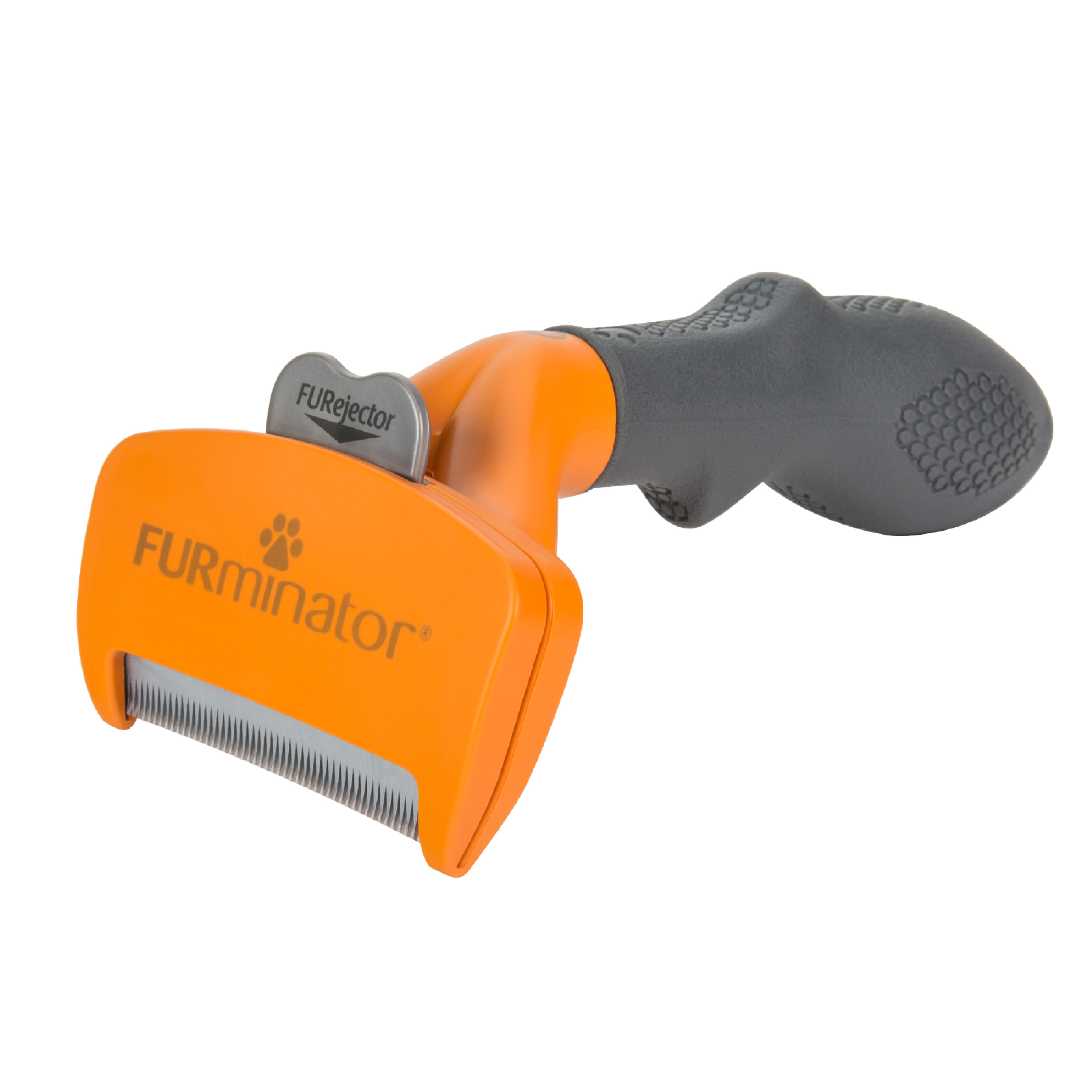
FURminator Undercoat deShedding Tool — Maximum Loose Fur Extraction for Dense Coats
Best for: German Shepherds, Corgis, and Labs with dense, non-matted coats
When your home is buried in fine German Shepherd or Corgi fur, the FURminator Undercoat deShedding Tool pulls out micro-undercoat that wide-toothed rakes leave behind. Its curved stainless steel edge conforms to your dog’s back and hips, while built-in Skin Guard bumpers prevent the corners from digging into bony joints. In our trials, the thumb-activated FURejector button cleared the blade in one second flat. However, you must detangle any knots first and limit use to once weekly; dragging its fine micro-notched teeth through mats or silky feathering will snap healthy guard hairs.
- FURejector plunger clears trapped hair with one thumb press
- Side Skin Guard bumpers prevent edge scraping on hips
- Dedicated short-hair and long-hair tooth depths available
- Can cut outer guard hairs if used daily
- Snags painfully if coat is not detangled first
4.9/5
4.3/5
4.9/5

JW Pet GripSoft Double Row Undercoat Rake — Gentlest Pull-Free Gliding for Tender Dogs
Best for: Brush-shy dogs with sensitive skin and owners with sore wrists
If your dog flinches or runs away the moment a brush touches their hindquarters, the JW Pet GripSoft Double Row Undercoat Rake solves the pulling problem. Its staggered double row of stainless steel teeth rotates 360 degrees independently, spinning past snags rather than yanking at the follicle root. During testing on a senior Shetland Sheepdog, the 90-degree ergonomic handle angle reduced wrist bending while lifting impressive tufts of loose wool. Because the pins roll smoothly around knots instead of cutting them, you will still need a slicker or comb to break up tight mats.
- 360-degree rotating pins reduce hair pulling by 60%
- Staggered double rows trap fine cottony undercoat tufts
- Soft rubber-sheathed handle is gentle on arthritic hands
- Pins can jam with dander if not rinsed monthly
- Rolls over tight mats rather than breaking them
4.5/5
5.0/5
4.6/5

SleekEZ Original Deshedding Grooming Tool — Unbeatable Micro-Tooth Stripper for Labs and Pugs
Best for: Short, flat double coats (Labradors, Pugs, Beagles, Rottweilers)
Long-pinned slickers and rakes slide uselessly over short double-coated breeds like Labrador Retrievers and Pugs, leaving needle-like hairs embedded in your sofa. The SleekEZ Original uses a patented wave-pattern micro-serrated steel blade set into an ergonomic poplar wood block to grab shedding hairs right at the tips without scraping skin. In our Labrador test, hair gathered in neat, cohesive strips along the blade edge and dropped directly to the ground instead of clogging teeth. Do not buy it for long-haired breeds, however, as the shallow teeth only skim the surface of thick ruffs.
- Outperformed every pin brush on short Labrador coats
- Hair falls off in tidy strips with zero clogging
- Doubles as a pet-hair remover for car upholstery
- Cannot penetrate long, fluffy Husky or Collie coats
- Loose short hair drops onto floor during brushing
4.5/5
4.7/5
4.7/5

Hertzko Self-Cleaning Slicker Brush — Fastest One-Click Fur Release for Daily Upkeep
Best for: Quick daily surface brushing and owners who hate picking hair from pins
If digging compacted fur out of wire slicker pins makes you procrastinate on daily brushing, the Hertzko Self-Cleaning Slicker Brush removes that friction completely. Pressing the thumb button retracts the fine angled wire bristles into the plastic faceplate, letting you wipe away a full pad of fur in under two seconds. In our daily maintenance checks on a Pembroke Welsh Corgi and Border Collie, it cleared surface tangles, burrs, and loose topcoat fluff with ease. However, its shorter 15-millimeter pins cannot reach the base of deep, impacted Malamute or Chow Chow coats.
- Retractable pins release full fur pads in two seconds
- Recessed storage mode protects wire pins from bending
- Textured rubber thumb rest prevents hand slippage
- 15mm pins are too short for deep arctic coats
- Spring button requires firm thumb strength to press
4.2/5
4.5/5
4.9/5

Mars Coat King Double Wide Stainless Stripper — Heavy-Duty Rescue for Impacted Wool Coats
Best for: Severely compacted, spay/neuter wool coats (Newfoundlands, Berners, Goldens)
When a double coat becomes so impacted or cottony after spaying that regular slickers bounce right off, professional groomers reach for the German-engineered Mars Coat King. Its curved, tempered high-grade stainless steel hooks strip out massive mats and dead undercoat wool in a single stroke without pulling your dog’s skin. On a neglected Bernese Mountain Dog coat, the 23-tooth double-wide head thinned out three weeks of compacted winter shedding in 12 minutes. Because its inner hooks are sharpened, treat this as a monthly stripping tool rather than a daily brush to avoid over-thinning guard hair.
- Cleared impacted Bernese undercoat in just 12 minutes
- Replaceable German-tempered steel blade head lasts decades
- FSC-certified bubinga hardwood handle feels rock solid
- Will thin topcoat guard hairs if used weekly
- Requires careful finger clearance when wiping blades
5.0/5
4.5/5
4.8/5

Andis Pet 7.5-Inch Steel Grooming Comb — Essential Line-Brushing Verifier and Mat Detector
Best for: Checking down-to-the-skin thoroughness and combing ears, tails, and legs
Every professional groomer follows one rule on double coats: if a steel Greyhound comb cannot glide smoothly from skin to hair tip after brushing, you are not done yet. The Andis Pet 7.5-Inch Steel Grooming Comb combines wide-spaced teeth on one half for loosening dense chest ruffs and fine-spaced teeth on the other for delicate ear and hock feathering. During our tests, its solid nickel-plated steel spine also served as the fastest tool for lifting packed fur out of slicker brushes. Because its flat spine is slim, prolonged heavy dematting can tire your fingers compared to cushioned handles.
- Instantly exposes hidden pin-knots near the skin line
- Coarse and fine tooth spacing on one single spine
- Heavy-duty cast steel resists bending and static buildup
- Thin metal spine lacks cushioned grip for long sessions
- Too slow to use as a standalone primary deshedder
4.5/5
4.9/5
4.7/5

Burt’s Bees Double-Sided Pin & Bristle Brush — Gentle Introductory Grooming and Shine
Best for: Socializing double-coated puppies and distributing natural topcoat oils
When acclimating an 8-week-old Golden Retriever or Aussie puppy to daily handling, aggressive rakes and long wire slickers are far too harsh for their baby fluff. The Burt’s Bees Double-Sided Brush pairs rounded-tip wooden pins on one side for gentle detangling with soft plant-fiber bristles on the reverse to sweep away dander and spread natural skin oils across the outer coat. Crafted from sustainable bamboo, it feels balanced and soothing during table training. Just remember that once your puppy blows their adult coat at 10 months, you will need to upgrade to a dedicated undercoat rake.
- Rounded pins massage delicate puppy skin without scratching
- Soft bristles distribute natural oils for glossy topcoats
- Durable bamboo frame with recycled material construction
- Will not extract heavy adult seasonal undercoat blowouts
- Occasional pin pushes inward under heavy mat pressure
3.9/5
4.9/5
4.5/5
Top 3 Head-to-Head: Chris Christensen Big G vs Safari Rake vs Maxpower Planet
Most double-coat owners narrow their final decision down to our top professional long-pin slicker, our budget single-row pin rake, and our dual-sided dematting rake. Here is how they stack up directly across our three testing benchmarks.
| Feature | #1 Chris Christensen Big G | #2 Safari Single-Row Rake | #3 Maxpower Planet Rake |
|---|---|---|---|
| Undercoat Removal | 5.0/5 (27mm deep pins) — Best | 4.5/5 (21mm tapered pins) | 4.9/5 (9/17 curved hooks) |
| Coat & Skin Safety | 4.9/5 (Zero cutting) — Best | 4.6/5 (Non-bladed tips) | 4.6/5 (Sharpened inner curve) |
| Ergonomics & Cleanup | 4.8/5 (Needs comb to clear) | 4.7/5 (Instant swipe release) | 4.9/5 (Fastest tuft pull) — Best |
| Choose if… | You want salon-grade fluffing and zero guard-hair breakage | You want a simple, budget-friendly rake for tangle-free coats | Your dog gets frequent ear, tail, or pants mats alongside shedding |
Who These Double-Coat Dog Brushes Are NOT For
Even the highest-rated undercoat tools will damage the coat or irritate the skin if used on the wrong breed type or coat condition.
Additionally, if your double-coated dog has pelted, felted mats tight against the skin — or active hot spots, flea dermatitis, or open scabs — do not attempt to rip through them with an undercoat rake. Have a professional groomer or veterinarian safely clip away the pelted sections first, then use these brushes to prevent future compaction.
Common Mistakes to Avoid
How you use a double-coat brush matters just as much as which tool you buy; avoid these four common grooming errors that cause matting and skin burn.
Frequently Asked Questions About Dog Brushes for Double Coats
What type of brush is best for a dog with a double coat?
A combination of a long-pin slicker brush and an undercoat rake is best for most medium-to-long double-coated dogs. The undercoat rake uses wide-spaced 20-millimeter teeth to pull out heavy clumps of detached winter wool, while a long-pin slicker separates fine tangles and lifts residual fluff without breaking outer guard hairs. For short double coats like Labradors, a micro-serrated deshedding blade works best.
Is an undercoat rake or a slicker brush better for double coats?
Neither replaces the other completely because they target different stages of grooming. An undercoat rake is better for rapid bulk removal when your dog is actively blowing their coat in spring and fall, as its wider tooth spacing prevents constant clogging. A slicker brush is better for routine maintenance, detangling feathering behind the ears and legs, and fluffing the coat during line brushing.
Does the FURminator ruin a dog’s double coat?
A FURminator will not ruin a double coat when used properly on an already detangled coat once a week, but aggressive daily use or dragging it through knots can slice and snap outer guard hairs. Because its micro-notched stainless edge grabs tightly, professional groomers recommend avoiding it on long, silky show coats and using it primarily on short-to-medium dense coats like Labs, Corgis, and Shepherds.
How often should you brush a double-coated dog?
You should brush a medium-to-long double-coated dog 2 to 3 times per week during most of the year, and daily during their 3-week spring and fall seasonal coat blowouts. Short double-coated breeds like Labradors and Rottweilers typically need only 1 to 2 ten-minute sessions per week. Regular sessions prevent dead undercoat from compacting against the skin and trapping moisture.
How do you get compacted undercoat out of a dog?
To remove compacted undercoat safely, first mist the dry coat with a leave-in conditioning spray to reduce friction, then use a dual-sided dematting rake or stripper in short strokes to break up the dense wool barrier. Follow up by line brushing down to the skin with a long-pin slicker brush, and verify every section is clear by gliding a steel Greyhound comb from root to tip.
Should I brush my double-coated dog wet or dry?
Always brush your double-coated dog when the coat is dry, lightly misted with a detangling spray, rather than soaking wet. Wet dog hair stretches up to 30% of its length and loses elasticity, meaning brushing a sopping-wet coat snaps healthy hairs and tightens loose undercoat into felt mats. Only brush after a bath once the coat is 80% to 100% blow-dried.
Our Final Verdict
Choosing the right double-coat brush comes down to matching pin depth and blade style to your dog’s coat length. While bladed rakes clear mats fast and micro-serrated edges excel on short Labrador fur, owners of medium-to-long double-coated breeds need deep pin penetration that preserves the protective outer topcoat during weekly sessions.

Thomas Cutter is a lifelong dog owner and the founder of FindOutAboutDogs.com. With over 10 years of hands-on experience owning multiple breeds, Thomas created this site to provide honest, research-based dog advice that real owners can actually trust.
