Long Pins vs Short Pins for Dog Brushes: Which Should You Choose
Quick Answer
Long-pin dog brushes are generally better for reaching through long, flowing, or deeply feathered coats, while short-pin brushes suit shorter coats and shallow grooming tasks. However, coat density, pin spacing, brush stiffness, and the type of brush matter just as much as pin length. For thick or curly coats, a suitable long-pin slicker may work better than a long-pin cushion brush, depending on the grooming task.
How to choose the right pin length
- Short coats: Choose short pins or a rubber or bristle brush designed for smooth coats.
- Medium coats: Match pin length to the depth and density of the hair.
- Long coats: Consider longer pins that can work through the coat instead of brushing only the surface.
- Dense double coats: Select a suitable brush or undercoat rake based on the layer you need to groom.
- Sensitive skin: Prioritize smooth, well-finished pins, a forgiving brush pad, and gentle pressure.
The simplest way to check
- Part the coat and check whether the brush reaches the layer you intend to groom.
- Use a gentle stroke, then check the section with your fingers or an appropriate comb.
- Stop if the brush snags, pulls hair, or leaves the skin irritated.
Choosing between long pins and short pins can feel like a small detail until your brush starts missing tangles or catching on your dog’s coat. The right choice makes regular grooming easier without forcing you to press harder.
In this guide, I’ll explain how pin length affects reach, which coat types benefit from each option, and when another brush design makes more sense. I’ll also cover practical buying considerations so you can choose a tool that suits your dog’s actual coat.


What Is the Difference Between Long Pins and Short Pins on a Dog Brush?
Pin length describes how far the brush’s pins extend from its pad. Longer pins can reach farther into a coat, while shorter pins are generally more suitable for working across shallow coats or specific grooming layers.
However, longer pins are not automatically better. A brush must match the coat’s depth, texture, and grooming needs without scraping the skin or pulling on tangled hair.
How short-pin brushes work
Short-pin brushes have less reach, which can make them practical for shorter coats and areas where you don’t need to penetrate deeply. Their effectiveness depends on the pin design and whether the brush is intended for detangling, smoothing, or collecting loose hair.
- Surface grooming: Suitable short-pin designs can collect loose hair from shallow coats.
- Shorter coat sections: They can be easier to control where long pins would extend beyond the hair.
- Finishing: Some short-pin brushes help smooth accessible hair without reaching deeply into the coat.
- Limitations: They may skim over dense hair or miss tangles hidden beneath a longer outer layer.
A short-pin brush can still be uncomfortable if its pins are stiff, damaged, or pressed too firmly against the skin. Pin length alone doesn’t determine gentleness.
How long-pin brushes work
Long-pin brushes extend farther into the coat, making them useful for longer hair, feathering, and some dense or curly coats. When the brush design matches the coat, the extra reach can help separate hair below the surface.
- Deeper reach: Longer pins can work through a greater depth of hair.
- Long coat maintenance: They can help separate and groom flowing hair without focusing only on the tips.
- Section brushing: They can reach deeper layers when you part the coat and work methodically.
- Limitations: Long pins may catch, bend, or irritate the skin if the brush is unsuitable or used aggressively.
For example, a long-coated dog may need a brush that reaches beneath its visible outer hair. A dog with a short, smooth coat may gain little from that extra reach.
Long Pins vs Short Pins for Dog Brushes: Side-by-Side Comparison
 Save
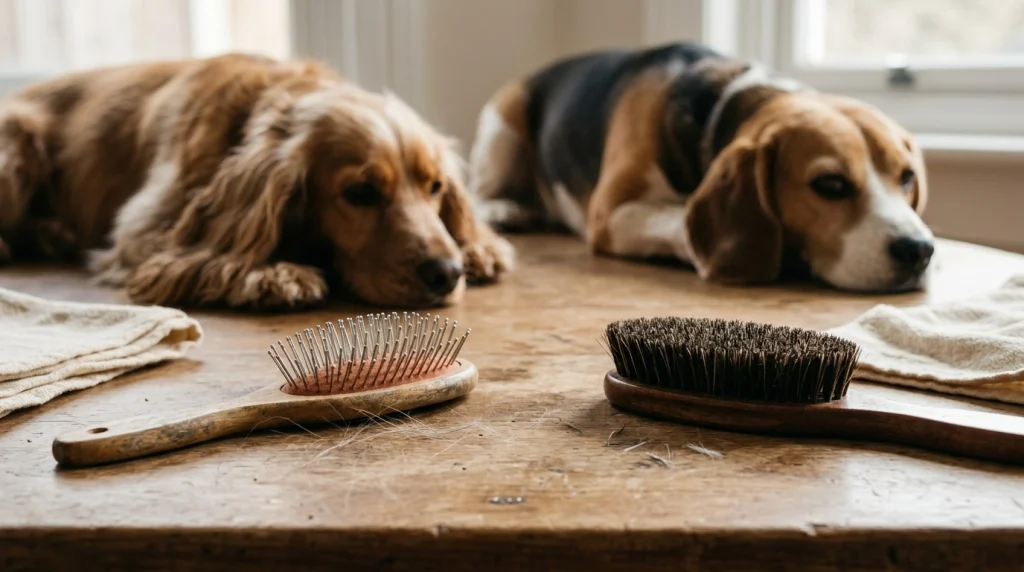
The best option depends on what you need the brush to accomplish. Use this comparison as a starting point rather than a rigid rule for every breed.
| Feature | Short Pins | Long Pins |
|---|---|---|
| Reach | Shallower coat penetration | Greater potential reach |
| Typical coat match | Short or less-deep coats, depending on brush type | Long coats, feathering, and some dense coats |
| Hidden tangles | May miss tangles below the surface | May reach deeper tangles if the design is suitable |
| Ease of control | Often convenient on shallow coat areas | Requires attention to reach and pressure |
| Main limitation | May not reach the required coat layer | Can snag or irritate skin if mismatched |
| Best buying priority | Suitable pin design and comfortable handling | Adequate reach, appropriate flexibility, and smooth tips |
Neither option wins in every category. The useful question is whether the pins reach the coat layer you need to groom while remaining comfortable against your dog’s skin.
Which Dogs Benefit Most From Short-Pin Brushes?
Short-pin brushes can be useful when the coat doesn’t require deep penetration, but the right brush style remains important. For some smooth-coated dogs, a rubber curry brush or soft bristle brush may be more appropriate than a metal pin brush.
Short, smooth-coated dogs
Dogs with short, close-lying hair often need surface grooming rather than a brush that reaches deep into a long coat. A suitable rubber brush or bristle brush can help collect loose hair and surface debris.
Breeds such as Beagles, Boxers, and Greyhounds illustrate the short-coat category, although individual coat condition and sensitivity still matter. A metal pin brush isn’t automatically the best choice simply because its pins are short.
Dogs with shorter body hair and longer feathering
Some dogs have short hair on the body but longer hair around the ears, legs, chest, or tail. In these cases, a single pin length may not work equally well everywhere.
A shorter brush can be useful on suitable shallow areas, while longer feathering may need a longer-pin brush or another coat-appropriate tool. Choose based on the area being groomed rather than the breed name alone.
Dogs that need light finishing
Shorter pins can help with finishing when the brush is designed for that task. They may smooth accessible hair without the unnecessary reach of a longer tool.
Still, don’t confuse short pins with soft pins. Pin stiffness, spacing, tip finish, and the flexibility of the brush pad all affect how the brush feels.
When Should You Choose a Long-Pin Dog Brush?
Long pins are worth considering when your dog’s coat has enough depth to make shorter pins ineffective. The extra reach can be especially useful for long hair, feathering, and coat sections that tend to hide tangles.
Long and flowing coats
Dogs with long, straight, or silky hair may benefit from a pin brush that can move through the length without repeatedly catching the surface. Long pins can help separate the hair, particularly when you work in manageable sections.
However, pin brushes are not the only suitable option. Some long coats need a slicker brush for tangles and a metal comb for checking the finished section.
Feathered coats
Feathering refers to longer hair around areas such as the ears, legs, chest, and tail. These areas can tangle through movement and friction, making adequate pin reach useful.
Work gently from the hair ends toward the roots when loosening tangles. If a knot resists, separate it carefully instead of pulling the brush through it.
Dense or curly coats
Some dense and curly coats require longer pins to reach the hair beneath the visible surface. A suitable long-pin slicker can help separate curls and loosen tangles, but pin length must match the coat and the brush’s design.
Curly coats can mat close to the skin even when the surface looks fluffy. Follow brushing with an appropriate metal comb to check whether the section is genuinely free of tangles.
For more detail, see this guide to what a slicker brush is used for.
Does Pin Length Matter More Than Brush Type?
No. Pin length matters, but brush construction and purpose can be just as important. A pin brush, slicker brush, bristle brush, and undercoat rake are designed to perform different jobs.
Choosing the correct brush category first helps prevent a common mistake: buying longer pins when the real problem is that the tool itself doesn’t suit the coat.
| Brush Type | Primary Purpose | Important Consideration |
|---|---|---|
| Pin brush | Maintaining and separating longer coats | Match pin length and spacing to coat depth |
| Slicker brush | Removing loose hair and addressing small tangles | Fine wires require light pressure |
| Bristle brush | Smoothing short coats and collecting surface debris | Usually cannot reach deeply into dense coats |
| Rubber curry brush | Lifting loose hair from many short, smooth coats | Not a substitute for deep-coat grooming |
| Undercoat rake | Removing loose undercoat from compatible double coats | Choose tooth length and spacing for the coat |
The American Kennel Club’s guide to dog brushes also distinguishes grooming tools by coat type and function. That distinction is more useful than treating all brushes with longer pins as interchangeable.
How Do You Choose the Correct Pin Length for Your Dog?
 Save
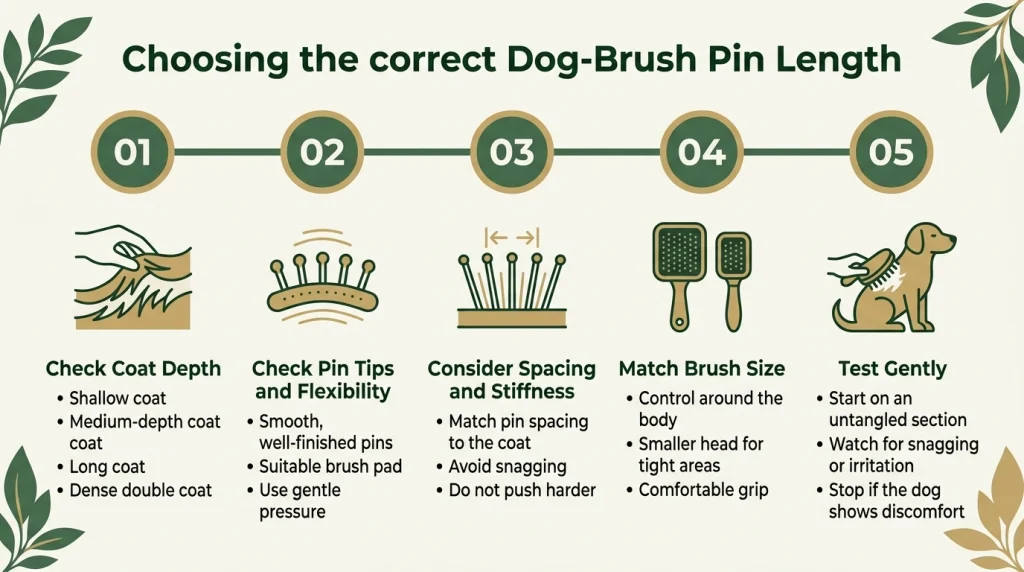
Start with the depth of your dog’s coat, then consider the grooming task and your dog’s comfort. You don’t need the longest available pins; you need pins that reach far enough without forcing the brush against the skin.
1. Check the coat depth
Part the hair with your fingers and examine the coat beneath the surface. If the coat is shallow, long pins may offer little advantage, while a deeper coat may need more reach.
- Shallow coat: Consider a suitable short-pin brush or a rubber or bristle brush.
- Medium-depth coat: Look for pins that can work through the hair without excessive pressure.
- Long coat: Consider longer pins and section-by-section grooming.
- Dense double coat: Evaluate whether a slicker or undercoat rake is the more suitable primary tool.
2. Check the pin tips and flexibility
Look for smooth, well-finished pins without sharp edges or damage. A cushioned or flexible pad may improve how the brush moves through the coat, although construction varies between models.
Rounded tips aren’t a guarantee against irritation. You still need to use a gentle technique and check your dog’s skin during grooming.
3. Consider pin spacing and stiffness
Pin length tells you how far the pins reach, while spacing affects how the brush moves through the hair. Stiffer pins may behave differently from flexible pins even when both brushes have the same length.
Choose a combination that separates the coat without snagging or forcing you to push harder. If the brush repeatedly catches, reassess the tool and the coat before continuing.
4. Match the brush to your dog’s size
A brush head should be easy to maneuver around your dog’s body. A large head may cover broad areas efficiently, while a smaller head can provide better control around legs, ears, and other tight spaces.
Handle comfort matters too. A comfortable grip makes it easier to maintain light pressure throughout a grooming session.
5. Test the brush gently
Try a few strokes on a comfortable, untangled section before brushing the entire coat. The brush should move without persistent snagging, painful pulling, or visible skin irritation.
If your dog flinches, turns away, freezes, or tries to escape, stop and investigate. The cause may be the brush, your technique, a hidden mat, or an underlying painful area.
For more help, read this guide to checking a dog coat for hidden mats.
Can Long Pins or Short Pins Damage a Dog’s Skin?
Either type can cause discomfort if the pins are unsuitable, damaged, or used with excessive pressure. Short pins can still scrape sensitive skin, while long pins can snag hair or reach the skin more forcefully than intended.
The goal is comfortable grooming, not maximum penetration. Never press harder just to make a brush reach the roots.
Common mistakes to avoid
- Brushing too forcefully: Let the brush do the work instead of pushing it into the coat.
- Repeatedly brushing one spot: Too many passes can irritate the skin.
- Pulling through mats: Separate minor tangles gently and seek professional help for tight mats.
- Ignoring damaged pins: Replace a brush when pins become bent, broken, rough, or sharp.
- Using the same tool everywhere: Different coat sections may need different brushes or techniques.
Check your dog’s skin periodically, particularly in areas where hair tangles easily. If you notice persistent redness, sores, bald patches, unusual itching, or pain, stop brushing that area and consult a veterinarian.
The ASPCA’s dog-care resources offer broader guidance on routine care and looking after your dog’s well-being.
Should You Buy One Brush or Both Long-Pin and Short-Pin Brushes?
Most owners should begin with the brush that suits their dog’s main coat and grooming needs. Buying two brushes makes sense when different coat areas need different levels of reach or when a second tool performs a distinct task.
- Short, smooth coat: Start with a suitable rubber or bristle brush.
- Long, silky coat: Consider a pin brush with adequate reach, plus a comb for checking tangles.
- Curly coat: A suitable slicker and metal comb may be more useful than two ordinary pin brushes.
- Dense double coat: Consider an appropriate undercoat rake and a finishing brush.
- Mixed coat lengths: Two tools may offer better control across different areas.
For a long-haired dog, a brush and comb can complement each other rather than compete. The brush loosens and separates hair, while the comb helps identify tangles the brush may have missed.
See also this guide on why using a dog brush and comb together helps.
Dog Brush Recommendations: What Should You Look For?
If you’re ready to choose a brush, focus on its intended use, pin design, and suitability for your dog’s coat. These two established grooming-tool options illustrate different approaches to everyday coat care; confirm the current model details before purchasing.
Long-Coat Option
Chris Christensen Pin Brush
Worth considering for suitable longer coats that need careful separation and finishing. Check the exact pin length, spacing, and brush size against your dog’s coat before ordering.
Short-Coat Option
Safari Dog Bristle Brush
A bristle brush is worth considering for routine surface grooming on suitable short, smooth coats. Confirm the specific brush design and size, and don’t expect it to remove deep undercoat.
These are starting points, not universal recommendations. I would prioritize coat compatibility and comfortable handling over brand recognition or the number of grooming features advertised.
Frequently Asked Questions
Are long-pin dog brushes better for shedding?
Not necessarily. Long pins may reach farther into a coat, but shedding removal depends on the brush design and coat type. A suitable undercoat rake or deshedding tool may work better for loose undercoat, while a pin brush may be more useful for separating and maintaining longer hair.
Can I use a short-pin brush on a long-haired dog?
You can use one for certain surface-grooming tasks, but it may not reach through the entire coat. If tangles develop underneath, consider a brush with more suitable reach and use a comb to check the finished section. Avoid forcing a short brush through hair it cannot penetrate comfortably.
Are long pins safer than short pins?
Neither pin length is inherently safer. Safety depends on the pins’ finish and stiffness, the brush pad, coat compatibility, and your technique. Use light pressure, inspect the skin regularly, and stop if your dog shows discomfort or the brush begins to snag.
How do I know whether my dog’s brush pins are too short?
Part the coat and see whether the brush reaches the layer you intend to groom. If the pins only move across the surface while tangles remain underneath, the brush may lack sufficient reach or may be the wrong type. A suitable comb can help you check for hidden tangles.
Do double-coated dogs need long pins?
Some double-coated dogs benefit from a suitable long-pin slicker or other brush that reaches through their outer coat. However, an undercoat rake may be more appropriate for removing loose undercoat. Choose according to the dog’s coat depth and grooming task, and avoid aggressive repeated passes.
Final Takeaway: Long Pins vs Short Pins for Dog Brushes
Choose long pins when your dog’s coat needs greater reach, particularly for long hair, feathering, and certain dense coats. Choose short pins when they suit the coat depth and the job, but consider a rubber or bristle brush for many short, smooth coats.
Most importantly, don’t judge a dog brush by pin length alone. The right brush should work through the appropriate coat layer comfortably, without snagging, pulling, or irritating the skin.
When you’re unsure, start with your dog’s coat structure, test a suitable brush gently, and use a comb to check your work. That approach is more reliable than assuming the longest pins will always deliver the best grooming results.

Thomas Cutter is a lifelong dog owner and the founder of FindOutAboutDogs.com. With over 10 years of hands-on experience owning multiple breeds, Thomas created this site to provide honest, research-based dog advice that real owners can actually trust.
