How Coat Length Affects Dog Brush Selection
Quick Answer
Coat length affects how deeply a dog brush must reach and what job it needs to perform. Short coats usually suit rubber or bristle tools, while medium and long coats often need pin brushes, slickers, or combs that reach farther into the hair. Dense double coats may also need an undercoat rake, as explained in this guide to choosing a brush for a Husky.
Match the brush to coat length
- Very short coats: Rubber grooming brushes or mitts collect loose surface hair without using unnecessarily long pins.
- Short coats: Bristle brushes work well for loose hair, dander, and finishing.
- Medium coats: Slicker or pin brushes provide more reach while helping separate loose hair.
- Long coats: Longer pins, slickers, and metal combs help reach through feathering and locate tangles.
- Dense double coats: An undercoat rake may be needed even when the visible outer coat looks fairly short.
The key rule
- Choose enough tooth or pin length to work through the coat without scraping the skin.
Dog brush shopping gets confusing because coat length changes what a grooming tool needs to do. A brush that works beautifully on a Boxer can barely touch the undercoat of a long-haired dog.
I use coat length as my starting point, then check density, texture, shedding, and tangles. That second step matters just as much.


Why Does Coat Length Affect Dog Brush Selection?
Coat length affects brush selection because longer hair usually requires more reach, separation, and detangling ability. Short hair often needs surface grooming instead.
A brush has to reach the hair you want to remove without repeatedly scraping the dog’s skin. Pins that are too short may skim over a deep coat.
Pins that are unnecessarily long can also make a simple short-coat grooming job awkward.
Dog coat length describes how far the visible hair extends from the skin, but it does not tell you everything about the coat.
- Length: How long the individual hairs grow.
- Density: How much hair is packed into a given area.
- Texture: Whether the coat feels smooth, silky, wiry, curly, or woolly.
- Layers: Whether the dog has a single coat or both an outer coat and undercoat.
- Condition: Whether the hair is loose, tangled, matted, or clean and free-moving.
This is why two dogs with similar-looking coat lengths may need different tools.
Which Brush Is Best for a Short-Haired Dog?
 Save
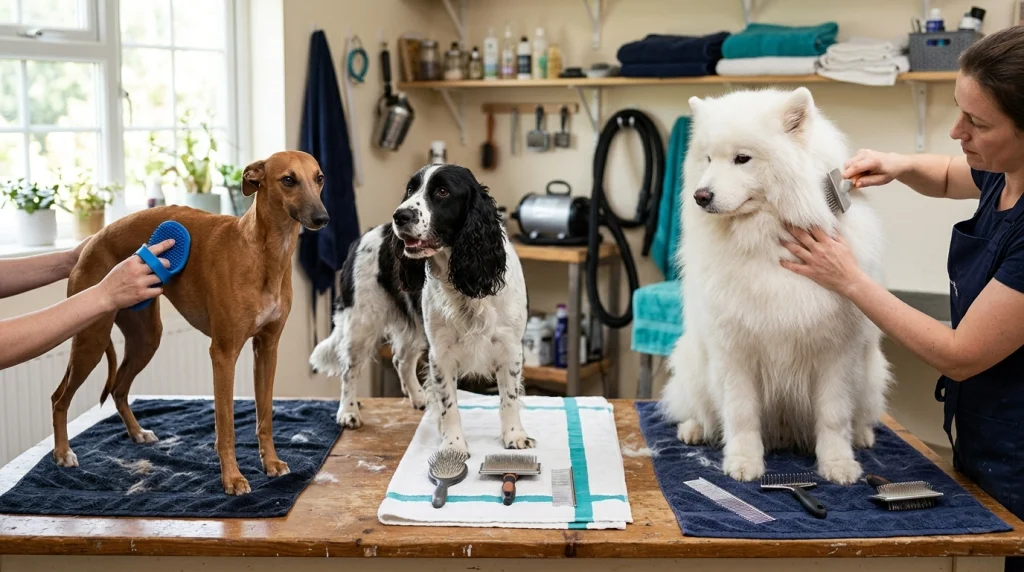
SaveShort-haired dogs usually need a rubber grooming tool or bristle brush rather than a deep-reaching long-pin brush. The main job is removing loose surface hair and debris.
The American Kennel Club lists bristle brushes as particularly useful for short-coated dogs. Rubber brushes and grooming mitts can also lift loose hair from smooth coats.
You can review the AKC guide to dog brush types for a broader explanation of common grooming tools.
Good tools for short coats
- Rubber curry brush: Flexible rubber teeth massage the coat while collecting loose hair.
- Grooming mitt: Useful when a dog is nervous around traditional brushes.
- Bristle brush: Removes loose surface hair and helps smooth the finished coat.
- Soft slicker: Can work on some thicker short coats when used gently.
My practical rule is simple. If I can easily see or feel the skin beneath a smooth coat, I don’t start with a long aggressive tool.
More reach isn’t automatically better.
What Brush Works Best for a Medium-Length Coat?
Medium coats usually benefit from a pin brush or slicker because these tools can move beyond the surface without being excessively long. Coat density determines whether you also need an undercoat tool.
This category includes a wide range of dogs, so there isn’t one universal brush.
- Medium single coat: A pin brush may be enough for routine grooming.
- Medium feathering: A slicker and metal comb help check areas behind the ears and legs.
- Medium double coat: Add an undercoat rake when loose undercoat becomes the main problem.
- Medium wiry coat: Tool choice may depend more on texture than length alone.
A useful test is to separate the hair with your fingers. If your brush touches only the upper layer, its pins may be too short for that dog.
How Does a Long Coat Change the Brush You Need?
Long coats usually need longer pins plus a comb that can verify whether you reached through the entire coat. Surface brushing alone can leave hidden tangles close to the skin.
Long hair also creates more opportunities for friction. Areas behind the ears, under the front legs, around collars, and along feathering deserve extra attention.
PetMD’s brushing and coat-care guidance discusses using slicker and pin brushes on long-haired dogs, followed by a comb.
A practical long-coat setup
- Separate a small section. Avoid dragging a brush across the whole coat at once.
- Use a suitable pin or slicker brush. Work gently through the exposed section.
- Move through the coat gradually. Pay extra attention to friction areas.
- Check with a metal comb. Resistance can reveal a tangle the brush missed.
- Stop instead of pulling. Investigate any snag before applying more force.
I like the comb as a checking tool. It tells me more than simply looking at a freshly brushed surface.
Dog Brush Selection by Coat Length: Quick Comparison
 Save
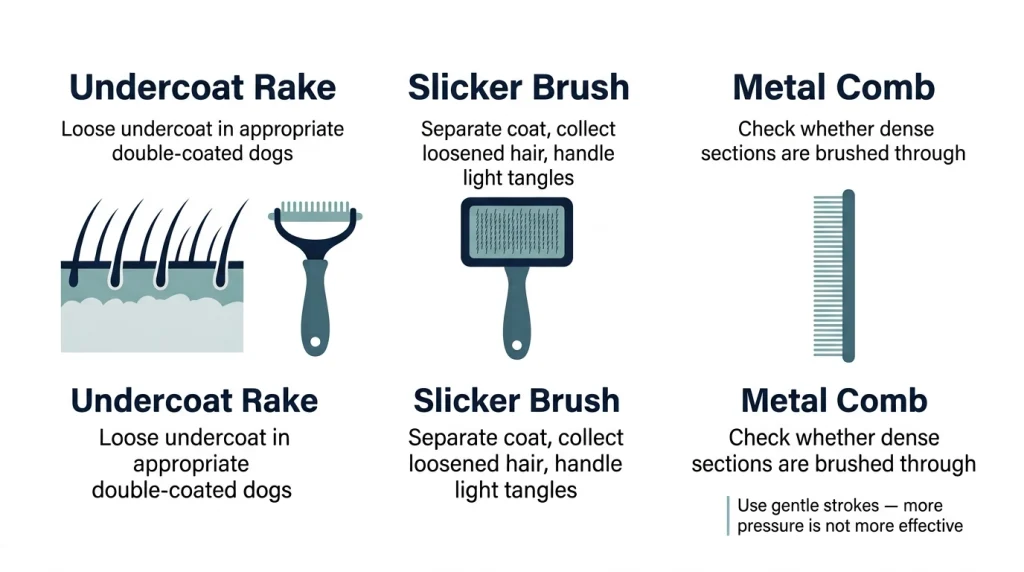
SaveThe longer and denser the coat becomes, the more brush reach usually matters. Density and coat layers can still override this basic pattern.
| Coat Type | Useful Brush Types | Main Grooming Job | Main Caution |
|---|---|---|---|
| Very short / smooth | Rubber brush, grooming mitt | Lift loose surface hair | Avoid unnecessary hard metal pressure |
| Short | Bristle, rubber, soft slicker | Remove loose hair and debris | Don’t choose pins only because they look powerful |
| Medium | Pin brush, slicker, comb | Separate hair and collect loose coat | Check whether pins reach the deeper layer |
| Long | Long-pin brush, slicker, metal comb | Detangle and reach through feathering | Surface brushing can leave hidden tangles |
| Dense double coat | Undercoat rake, long-pin slicker, comb | Remove loose undercoat | Use light pressure and avoid repeated scraping |
Is Coat Length More Important Than Coat Density?
No. Coat length is only the first filter because density determines how difficult it is for a brush to reach deeper hair. A short dense double coat can require more undercoat work than a much longer single coat.
This distinction is easy to miss when buying brushes online.
Consider length and density together
- Short and thin: Start with rubber or bristles.
- Short and dense: Surface tools may need help from a suitable shedding tool.
- Medium and thin: A pin brush may provide enough reach.
- Medium and dense: A slicker or undercoat tool becomes more useful.
- Long and silky: Focus on gentle separation and tangle prevention.
- Long and dense: Use longer pins and work in sections rather than brushing only the surface.
The AKC’s broader dog grooming tools guidance also emphasizes matching grooming frequency and brush type to the dog’s coat.
What About Double-Coated Dogs?
A double coat changes brush selection because loose hair can sit underneath the visible outer coat. The correct tool needs enough reach to remove loose undercoat without relying on excessive pressure.
A Siberian Husky is an obvious example. Its visible coat doesn’t tell you how much soft undercoat sits beneath it.
During heavier shedding, an undercoat rake can do a different job from a slicker. The rake works deeper, while the slicker can collect loosened hair and tidy the surface.
If that is the problem you’re dealing with, see our guide on managing shedding in a Siberian Husky.
Don’t confuse shedding with matting
Loose undercoat should move differently from a tight mat. If a tool catches firmly, stop rather than pulling harder.
Mats can sit close to the skin, making careless cutting or aggressive brushing risky.
- Loose coat: Usually releases gradually through gentle brushing.
- Tangle: May separate with careful finger work, brushing, and combing.
- Tight mat: Can pull on the skin and may require professional attention.
- Skin irritation: Redness, sores, or pain are reasons to stop grooming the area.
How Can You Tell if a Brush Is Too Short?
A brush is probably too short when it repeatedly glides across the surface while deeper loose hair or tangles remain untouched. Parting the coat makes this easier to see.
Don’t judge effectiveness only by the pile of hair in the brush.
- Surface-only movement: Pins disappear into only the top portion of the coat.
- Hidden tangles remain: A comb still catches beneath the brushed surface.
- Loose undercoat stays packed: You can separate the coat and still see obvious loose material underneath.
- Repeated passes are needed: The tool keeps working the same surface hair without reaching farther down.
A longer pin isn’t automatically the fix. The pin design, flexibility, coat texture, and your technique also matter.
How Can You Tell if a Brush Is Too Aggressive?
A grooming tool is too aggressive when comfortable brushing requires pressure that irritates the skin or repeatedly pulls the coat. Grooming should not become a test of how much discomfort your dog will tolerate.
Watch the dog as closely as you watch the brush.
- Skin becomes red after only a few strokes.
- The dog flinches or turns toward the brush repeatedly.
- The tool catches rather than moving through the coat.
- You feel tempted to press harder to make the brush work.
- The coat appears damaged or broken after repeated grooming.
Light pressure is especially important with metal pins, slickers, rakes, and de-shedding tools.
Does Brush Size Matter as Much as Pin Length?
Yes. Brush-head size affects control, while pin length affects reach. Both should suit the dog’s body and coat.
A wide slicker can make the back of a large dog faster to cover. That same head can feel clumsy around a small dog’s legs, ears, and chest.
- Small head: Better control around tight areas and smaller dogs.
- Medium head: Useful as a general-purpose size for many dogs.
- Large head: Covers broad body areas faster on larger dogs.
- Longer pins: Help penetrate longer or denser coats.
- Shorter pins: Often provide enough reach for short surface coats.
As of 2026, there are more coat-specific designs available than most owners need. Matching the basic geometry to the dog matters more than collecting every brush style.
My Simple Way to Choose a Dog Brush
 Save
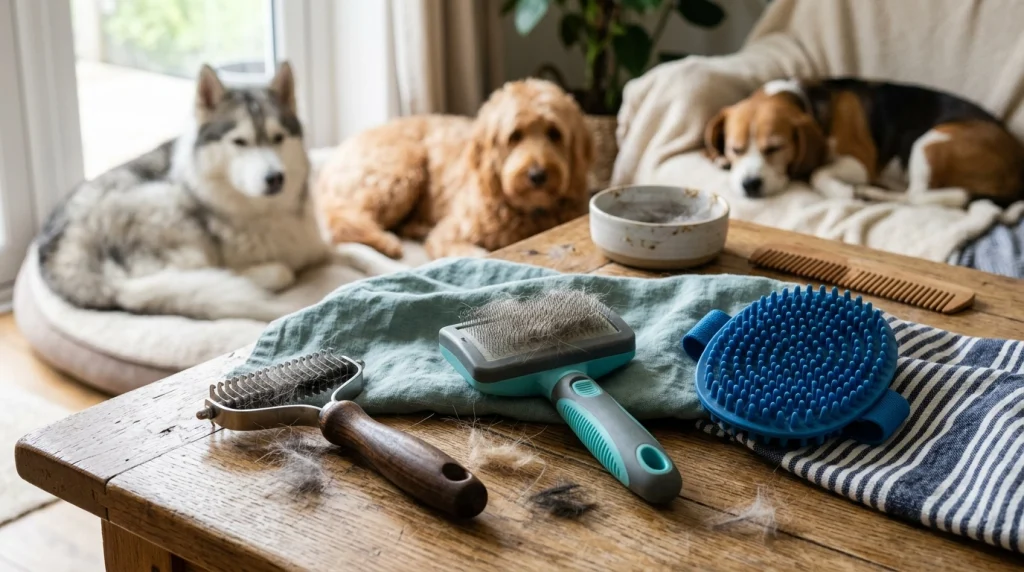
SaveI start with four questions: how long is the coat, how dense is it, what texture does it have, and what problem am I trying to solve? That prevents most mismatched purchases.
- Check coat length. Decide whether you’re dealing with short, medium, or long hair.
- Part the coat. Look at how much hair sits underneath the visible surface.
- Identify the job. Decide whether you need loose-hair removal, detangling, undercoat removal, or finishing.
- Choose enough reach. The tool should work through the target layer without requiring force.
- Test gently. Start with light pressure and watch the dog’s response.
- Use a comb when needed. On longer coats, it helps confirm that you’ve worked through the full depth.
If you’re ready to choose a tool, these are three practical brush styles I would consider for different coat needs:
🐕 Short & Versatile Coats
Safari Pin and Bristle Combo Dog Brush
★★★★☆
This two-sided design combines wire pins with a bristle side for loose hair, debris, and finishing. I like this format when one household needs a simple brush that can handle more than one grooming job.
✨ Dense & Longer Coats
Chris Christensen Big G Slicker Brush
★★★★½
The Big G uses densely packed longer pins designed for substantial coats and undercoat work. I would consider it when ordinary short-pin slickers keep skating over a dense or longer coat.
🧹 General Slicker Option
AKC Self-Cleaning Pet Grooming Slicker Brush
★★★★☆
This slicker is designed to remove loose hair, debris, and tangles while offering an easy-cleaning mechanism. I see it as a practical general slicker when you want a straightforward routine-grooming tool.
Frequently Asked Questions
Do long-haired dogs need a different brush from short-haired dogs?
Usually, yes. Long-haired dogs often need longer pins, slicker brushes, pin brushes, and combs that can reach deeper into the coat. Short-haired dogs usually benefit more from rubber or bristle tools designed to collect loose surface hair without excessive pin length.
Can I use a slicker brush on a short-haired dog?
A soft slicker can work on some short-haired dogs, especially when the coat is dense. Use light pressure because the pins reach the skin quickly. For a smooth, thin coat, a rubber grooming brush or bristle brush is often simpler and more comfortable.
How long should dog brush pins be?
There is no universal ideal pin length. The pins need enough reach to work through the dog’s coat without requiring heavy pressure against the skin. Longer or denser coats generally need more reach than thin, smooth coats.
What brush is best for a long-haired dog that gets tangles?
A long-pin slicker or suitable pin brush can separate and detangle longer hair, while a metal comb helps check whether hidden tangles remain. Work in small sections and stop when you meet resistance rather than pulling forcefully through a knot.
Does a short-haired double-coated dog need an undercoat brush?
It can. Visible hair length doesn’t show how much undercoat sits beneath the surface. If a short-coated dog has a dense double coat and sheds heavily, a suitable undercoat tool may reach loose hair that a basic surface brush misses.
Final Takeaway
Coat length gives you the first clue when choosing a dog brush, but don’t stop there. Density, texture, undercoat, tangles, and the grooming job all influence the final choice.
For short coats, start simple with rubber or bristle tools. Medium and long coats usually benefit from greater pin reach, while dense double coats may need a separate undercoat tool.
Most importantly, don’t judge a brush by how much hair it removes in one dramatic pass. The right brush should reach the necessary layer while keeping grooming controlled and comfortable for your dog.

Thomas Cutter is a lifelong dog owner and the founder of FindOutAboutDogs.com. With over 10 years of hands-on experience owning multiple breeds, Thomas created this site to provide honest, research-based dog advice that real owners can actually trust.
