How Dog Brush Design Affects Grooming Comfort (2026 Guide)
Quick Answer
Dog brush design directly dictates whether a grooming session feels like a soothing massage or a painful chore. The pin geometry, pad flexibility, and handle ergonomics control how much pressure hits your dog’s skin and how much strain hits your wrist. Choosing a well-engineered tool prevents micro-scratches, reduces coat pulling, and supports healthy skin according to American Kennel Club grooming standards.
Key Design Features That Control Comfort
- Pin angle and flex: Bent wires angled at 135 degrees glide over skin instead of stabbing straight down.
- Cushion pad air-flow: Vented rubber pads compress on impact to absorb heavy-handed strokes over bony joints.
- Tip finishing: Polished stainless steel tips slide through dense undercoats without dragging or snagging hair shafts.
- Handle weight balance: Contoured, non-slip grips aligned with the brush head stop groomer wrist fatigue.
- Bristle spacing: Wide pin gaps clear thick tangles safely, while tight clusters smooth out fine topcoats.
Quick Comfort Verification Test
- The forearm test: Drag the brush firmly across your own inner forearm before touching your dog; if it leaves red welts on you, the pin design is too harsh for their skin.
I used to think my old Border Collie, Barnaby, hated being groomed just because he was stubborn. Every time I pulled out my cheap plastic slicker brush, he bolted under the dining table.
Then I ran that exact brush across my own forearm. It felt like dragging twenty tiny sewing needles across my skin.
Most owners blame their dog’s temperament when grooming goes sideways, but the tool’s physical architecture is usually the real culprit. In this guide, I’ll break down the exact mechanical details—from wire gauge to cushion ventilation—that separate a painful torture device from a brush your dog leans into.


What Is Ergonomic Dog Brush Design?
Ergonomic dog brush design is the engineering of a grooming tool’s pins, cushion pad, head curvature, and handle to minimize skin friction for the dog while reducing joint strain for the handler. It balances mechanical tension so tangles release without yanking live hair follicles or scraping the epidermis.
A dog’s skin is much thinner and more sensitive than human skin. Their outermost skin layer is only three to five cells thick, compared to up to fifteen cells in humans.
Bad brush mechanics ignore this biology completely. Here is how poor design physically hurts your dog during a normal brushing session:
- Sharp wire burrs: Machine-cut metal pins often leave microscopic jagged edges at the tip that slice into skin like miniature saws.
- Rigid backing plates: Hard plastic pads refuse to give way when you pass over hip bones, spine ridges, or elbows.
- Friction drag: Cheap synthetic bristles generate static electricity and snag healthy hair, pulling at the root with every stroke.
- Awkward wrist angles: Straight, flat handles force humans to push down harder to get leverage, transferring excess force straight into the dog’s back.
How Do Pin Materials and Shapes Impact Skin Sensitivity?
 Save
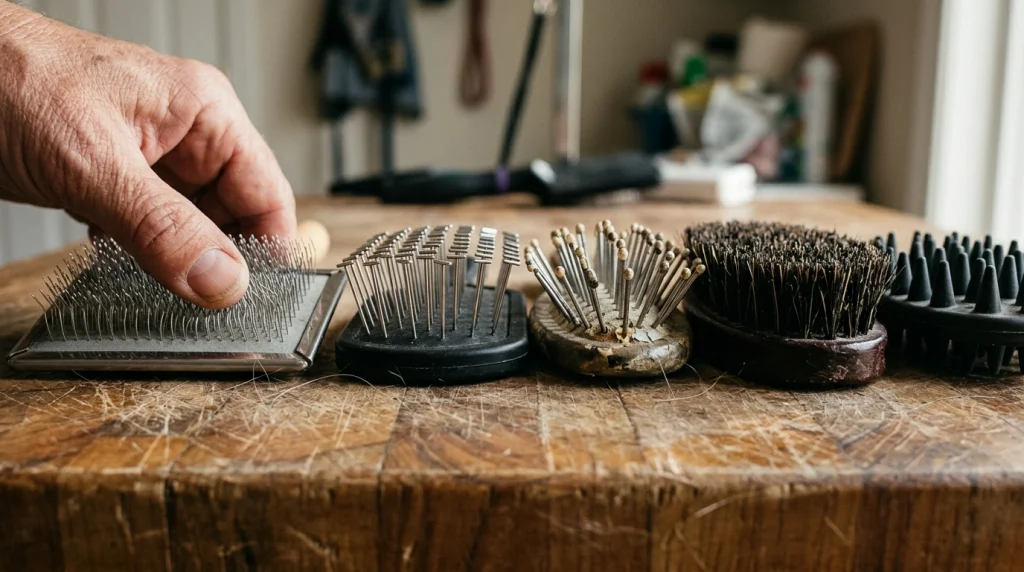
Pin materials and shapes control how smoothly a brush penetrates the coat and how gently it rebounds off the skin. Fine-gauge stainless steel pins flex when they hit a knot, whereas thick, rigid wires yank the entire hair shaft out by the root.
When I started testing professional grooming gear in 2026, the biggest revelation was pin metallurgy. You can’t judge a brush just by looking at the bristle length.
You have to feel the tension of the wires. Different pin configurations create wildly different physical sensations on a dog’s body:
- Angled wire pins (135-degree bend): Found on quality slicker brushes, this bend acts like a leaf spring on a truck. When you press too hard, the elbow of the wire folds slightly so the tip skims parallel to the skin instead of poking straight in.
- Straight T-pins: These pins stand at a 90-degree angle to the pad and have polished rounded ends. They part long, silky hair without creating static, making them ideal for drop-coated breeds.
- Plastic ball-tipped pins: Manufacturers dip wire ends in epoxy to protect skin, which sounds great in theory. In practice, those tiny epoxy balls catch inside dense undercoat mats and rip the hair out on the upstroke.
- Natural boar bristles: Soft, hollow keratin fibers bend instantly upon contact. They don’t detangle, but they distribute natural skin oils (sebum) across short coats with zero skin irritation.
- Rubber curry nubs: Thick, flexible silicone cones grip loose dead fur through high friction while massaging the muscle tissue underneath.
Pro Grooming Tip: Inspect coated pin tips once a month. When epoxy beads chip or fall off, they expose raw, unpolished wire underneath that causes severe brush burn and skin trauma.
Why Does Cushion Pad Flexibility Matter So Much?
 Save
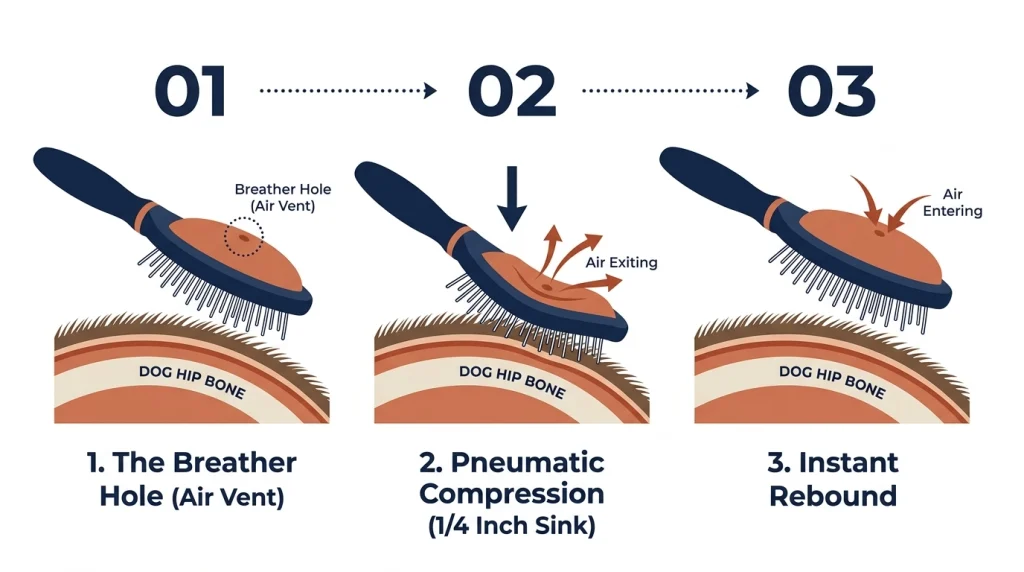
Cushion pad flexibility determines how well a brush adapts to your dog’s three-dimensional skeletal contours. A soft, air-cushioned rubber pad acts as a shock absorber, equalizing pressure so pins don’t gouge bony areas like the spine, hocks, or ribcage.
Think about the shape of your dog’s body. Not a single square inch of a dog is completely flat.
They are a collection of curved ribs, sharp shoulder blades, and tucked waistlines. If your brush pad is stiff, only the center pins touch the coat while the outer pins hang in the air—or worse, the hard edges dig into their joints.
Look closely at the rubber bed holding the pins on a high-end brush. You will notice one specific mechanical feature that cheap brushes fake or skip entirely:
- The breather hole (air vent): A tiny pinhole at the top or bottom of the rubber pad lets air escape when you press the brush against your dog.
- Pneumatic compression: As air pushes out of that vent, the rubber dome collapses inward, softening the blow of your hand.
- Instant rebound: When you lift the brush at the end of your stroke, air rushes back in to pop the pins upright, flicking loose hair out of the coat without tugging.
I once bought a bargain slicker brush that had a breather hole molded into the rubber, but they glued the entire rubber pad directly to the solid plastic backplate. It had zero air space underneath.
My dog flinched the second it touched his hip. Always press the center of a brush pad with your thumb before buying it; it should sink at least a quarter of an inch with a gentle hiss of air.
How Does Brush Head Shape Change Grooming Efficiency?
Brush head shape governs surface coverage, visibility, and maneuverability around tight anatomical pockets like armpits and ears. Curved, contoured heads keep more pins in steady contact with rounded body parts, reducing the total number of strokes needed to clear dead hair.
Fewer strokes equal less skin friction. When you cut a thirty-minute brushing marathon down to ten minutes, your dog stays relaxed from start to finish.
| Brush Head Design | Pressure Distribution | Best Anatomical Zone | Ideal Coat Type |
|---|---|---|---|
| Flat Rectangular | Even across wide planes; harsh on sharp edges | Broad backs, sides, and chest | Medium to long double coats |
| Curved Concave | Wraps around curves; spreads force evenly | Legs, tail, neck, and rounded rumps | Curly, wavy, and plush Poodle mixes |
| Flexible Twin-Head | Hinges in the middle; prevents heavy-handed pressing | Bony hips, spine, and sensitive bellies | Fine hair, prone to tangles or sensitive skin |
| Triangle / Mini | Concentrated on a small point for precision | Armpits, groin, behind ears, and paws | All long-haired breeds with friction knots |
Notice how flexible twin-head brushes work in that table. Instead of a solid plastic back, the brush head is split into two segments connected by a flexible elastomer spine.
If your hand gets heavy while brushing out a tough knot, the brush head literally bends backward. It physically prevents you from digging the pins into your dog’s skin.
How Does Handle Ergonomics Affect Your Dog’s Comfort?
Handle ergonomics directly dictates how calmly and lightly you move the brush through your dog’s fur. When a poorly balanced handle causes human wrist cramping, handlers unconsciously grip tighter and chop downward into the dog’s skin instead of using smooth, sweeping wrist flicks.
Comfort isn’t a one-way street. Your physical comfort holds the steering wheel for your dog’s experience.
Workplace safety researchers at NIOSH have long documented how poorly angled hand tools cause repetitive strain and loss of fine motor control. In dog grooming, losing fine motor control means you stop patting and start hacking at tangles.
Look for these three handle features to keep your hand relaxed and your strokes feather-light:
- Offset neck angle: A handle tilted 15 to 25 degrees upward from the brush face keeps your knuckles from scraping against the dog’s fur while keeps your wrist in a neutral handshake position.
- Thumb rest divots: A sculpted rubber indentation on the throat of the handle lets you guide the brush using fingertip control rather than a white-knuckle fist grip.
- Balanced core weight: Ultra-light hollow plastic brushes force you to supply 100% of the downward pressure; a solid wood or weighted resin core lets gravity do the work gently.
Why Do Self-Cleaning Brushes Sometimes Hurt Dogs?
Self-cleaning brushes often compromise comfort because their retractable plastic plates remove the air cushion required for soft pin suspension. Because the pins must slide through rigid plastic holes to eject hair, they have zero vertical give when pressed against a dog’s body.
Everyone loves pushing a button and watching a mat of fur pop right off the brush. It saves time, and it keeps your hands clean.
However, I rarely use retractable-pin brushes on thin-skinned or bony dogs. Here is the mechanical trade-off happening inside that push-button casing:
- No pneumatic pad: Instead of resting in soft, forgiving rubber, the pins are anchored to a hard internal plastic sled.
- Shortened pin travel: The sliding faceplate covers the bottom half of the wires, leaving only the stiffest top section exposed.
- Rattling pin alignment: Over time, the guide holes wear out, causing individual pins to twist sideways and catch hair unevenly.
If you own a thick-coated Husky or Malamute with an inch of plush insulation, they probably won’t notice the stiffer feel of a self-cleaning slicker. If you have a Yorkie, Greyhound, or short-haired Terrier, skip the push-button gimmick and buy a traditional cushioned pad.
How to Match Brush Design to Your Dog’s Specific Coat
 Save
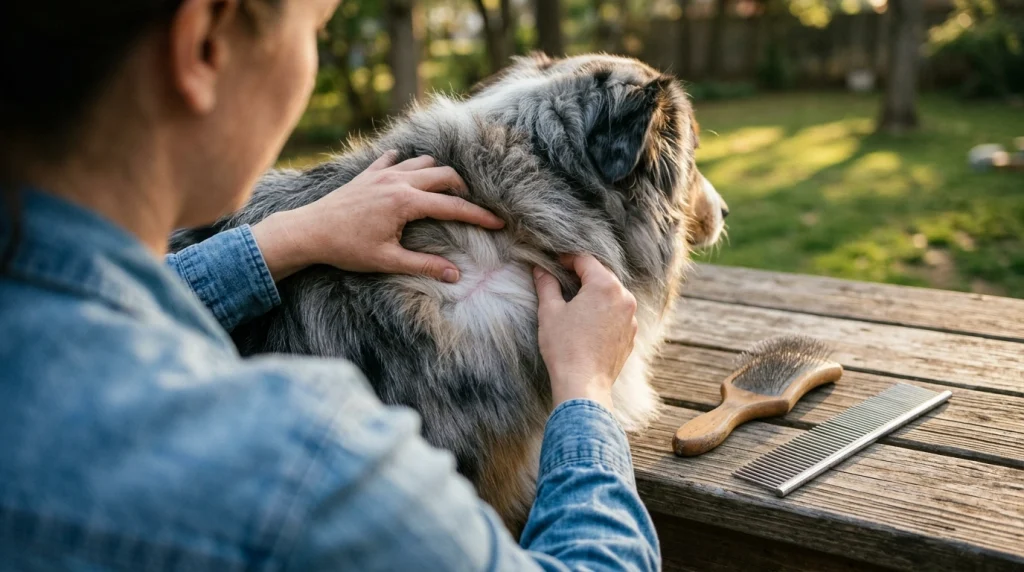
Matching brush design to your dog’s coat requires pairing pin length and stiffness with hair density and skin exposure. Using a long-pinned, stiff slicker on a short-haired dog scrapes bare skin, while a soft bristle brush bounces uselessly off a thick double coat.
Veterinary dermatologists at the Cornell University College of Veterinary Medicine emphasize that routine brushing prevents painful matting that traps moisture and causes skin infections. Still, using the wrong architecture causes micro-abrasions just as fast.
Follow this step-by-step matching system before you touch brush to fur:
- Part the hair to the skin: Measure the depth of your dog’s coat with your fingers; your brush pins should be just slightly longer than the compressed coat depth.
- Check for undercoat density: Double-coated dogs need fine, closely spaced bent wires to lift dead fluff, while single-coated dogs need wider spacing with rounded tips.
- Feel the skin mobility: Loose, wrinkled skin (like on Pugs or Shar-Peis) requires soft rubber curry nubs that won’t catch on skin folds.
- Assess tangle severity: Use a flexible slicker to break up surface knots first, then follow with a wide-toothed stainless steel greyhound comb to verify you reached the skin without tugging.
If you’re ready to upgrade your grooming kit with tools engineered for painless coat care, here are the three brushes I actually keep in my grooming bag:
🏆 Best Overall For Thick & Curly Coats
Chris Christensen Big G Dog Slicker Brush
★★★★★
Features 27mm bent stainless steel pins with ground polished tips, an ultra-soft vented rubber cushion, and a curved head with an extreme offset beechwood handle. I’ve used this on matted Goldendoodles that snap at other brushes, and they fall asleep within five minutes because the cushion absorbs every ounce of excess force.
🛡️ Best For Sensitive Skin & Heavy Hands
Activet Duo Green Medium Flexible Brush
★★★★☆
Built with a dual-hinged flexible elastomer head and staggered stainless pins that bend backward when pressure exceeds a safe threshold. I recommend this to any owner who struggles with wrist control; the flexing head makes it physically impossible to gouge your dog’s hips or spine.
💰 Best For Short Coats & Massage
Kong ZoomGroom Rubber Curry Brush
★★★★★
Molded from single-piece pliable natural rubber with 3/4-inch conical fingers and an indented palm grip. My short-haired dogs treat this like a spa toy—it pulls out buckets of shedding hair through gentle rubber friction without a single piece of metal touching their skin.
Frequently Asked Questions
Are metal pins or plastic tips better for a dog’s skin?
Polished metal pins are safer for thick or tangled coats because they glide smoothly through knots without snagging. Plastic-coated ball tips work fine on short, tangle-free hair, but the balls catch inside dense undercoats and yank hair from the root. Worse, chipped plastic coatings expose sharp wire edges beneath.
How can I tell if my dog’s brush is hurting them?
Watch for subtle physical stress signals like skin twitching along the back, lip licking, whale eye, tucked tails, or sudden sitting when you approach their rear end. After brushing, part the fur to check for pink redness or tiny white dandruff flakes triggered by scraping.
What is the difference between a curved and a flat slicker brush?
A flat slicker brush keeps pins on a single horizontal plane, making it best for line-brushing flat areas like a dog’s sides. A curved slicker angles the outer pins upward, letting you scoop through tangles and wrap smoothly around rounded legs without scratching the skin with the brush corners.
Why does my wrist hurt when brushing my dog?
Wrist pain happens when you use a straight-handled brush that forces your hand into an unnatural downward bend while pressing through thick fur. Switching to a brush with an angled, ergonomic neck and using a quick “pat-and-pull” flicking motion instead of long dragging strokes eliminates joint strain.
Make Grooming Comfort Your First Priority
You don’t need to wrestle your dog across the living room floor just to keep their coat clean and mat-free. Before your next grooming session, grab your current brush, press your thumb into the cushion pad, and run the pins across your own inner arm.
If that brush feels stiff, scratchy, or unbalanced in your hand, retire it immediately. Upgrading to a tool with polished pins, a vented air pad, and an offset handle turns grooming from a weekly battle into fifteen minutes of quiet bonding your dog will genuinely look forward to.

Thomas Cutter is a lifelong dog owner and the founder of FindOutAboutDogs.com. With over 10 years of hands-on experience owning multiple breeds, Thomas created this site to provide honest, research-based dog advice that real owners can actually trust.
