How Does a Pin Brush Work? Dog Grooming Guide
Quick Answer
A pin brush works by sliding long, spaced pins through a dog’s coat to separate hairs, lift loose fur, remove light debris, and loosen small tangles. Its rounded or polished pin ends make it gentler for routine brushing than many aggressive dematting tools, especially on medium and long coats. The American Kennel Club’s dog brush guide also describes pin brushes as useful for smoothing longer coats and working through light tangles.
What Happens When You Brush?
- Pins enter the coat: Long pins reach between individual hairs instead of only brushing the surface.
- Hair separates: The spacing between pins helps loosen light tangles without tightly grabbing the coat.
- Loose fur lifts: Shed hairs that are already detached can be carried out with each stroke.
- Debris comes out: Dust, dried grass, and other loose material can be lifted from the coat.
- Coat gets smoothed: Long finishing strokes help arrange the outer coat and leave it looking neater.
The Important Limitation
- Don’t force mats: A pin brush is best for maintenance and light tangles, not tightly packed mats close to the skin.
If you’ve looked at a pin brush and thought it resembles a human hairbrush, you’re not far off. The simple design is exactly why this grooming tool works so well for everyday coat maintenance.
The important part is knowing what the pins can—and cannot—do. I’ll break down how the brush moves through the coat, which dogs benefit most, and when another grooming tool makes more sense.


What Is a Pin Brush for Dogs?
A pin brush is a dog grooming brush with rows of relatively long, widely spaced pins mounted in a cushioned or fixed brush head. Most pins are metal, although some specialty brushes use wood or brass.
The ends should feel smooth rather than sharp. Quality brushes often use rounded, ground, polished, or coated tips to reduce scratching and snagging.
- Long pins reach into medium or long coats.
- Wide spacing lets hair move between the pins.
- A cushioned pad allows some pins to flex with the dog’s body.
- Smooth pin ends reduce unnecessary pulling and scratching.
- An oval or oblong head provides broad coverage for routine grooming.
This design makes a pin brush primarily a maintenance, detangling, and finishing tool. It isn’t designed to rip through compacted mats.
How Does a Pin Brush Work on a Dog’s Coat?
 Save
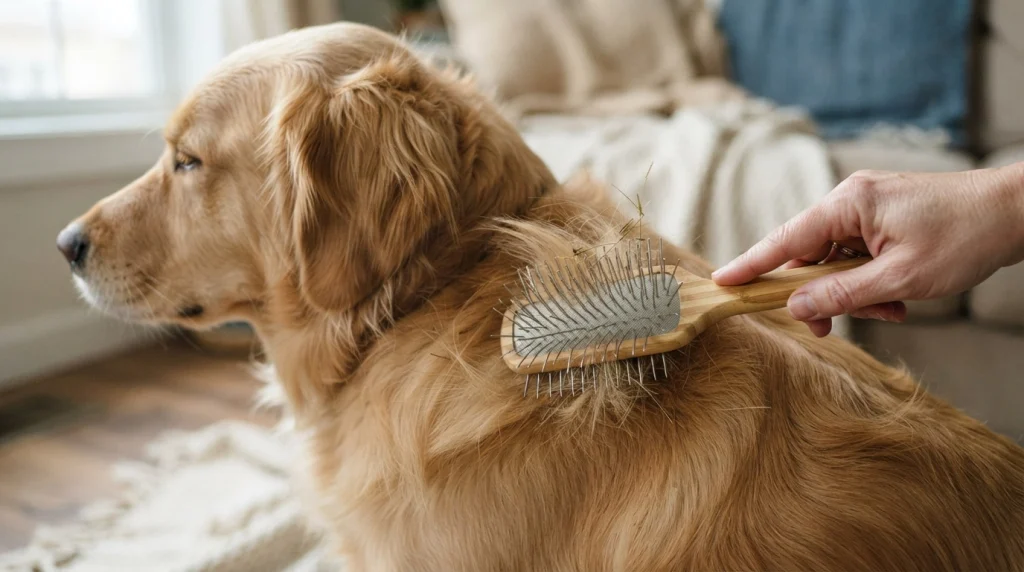
SaveA pin brush works by passing spaced pins between strands of hair. As you move the brush, those pins separate the coat and carry loose material toward the surface.
Think of the action as gentle separation rather than aggressive scraping. That’s the key difference.
1. The Pins Slide Between Individual Hairs
The pins enter the coat as you brush in the direction the hair grows. Their spacing allows many hairs to pass around each pin instead of becoming trapped together.
This reduces resistance when you’re dealing with a properly maintained coat.
2. Small Tangles Begin to Separate
When the pins encounter a loose tangle, they divide it into smaller sections. Repeated light strokes can gradually separate those hairs.
Don’t pull harder when the brush stops. Resistance is useful feedback that you need to slow down or switch tools.
- Hold longer hair near the base when working on a tangle.
- Start near the end of the hair rather than attacking the knot at its base.
- Use short strokes until the area loosens.
- Finish with longer strokes once the brush moves freely.
3. Loose Hair and Surface Debris Get Lifted Out
Detached hair can catch against the pins and move outward with the brush. Light dirt, dried grass, and other debris may come out at the same time.
A pin brush isn’t a dedicated deshedding tool, though. Heavy undercoat removal usually requires a rake, slicker, comb, or another coat-specific tool.
4. The Brush Smooths the Outer Coat
After tangles are removed, long strokes help arrange the coat in its natural direction. This is one reason pin brushes are popular as finishing brushes.
The result should feel loose and smooth rather than flattened or scraped.
Why Does the Cushion Matter on a Pin Brush?
The cushion lets the pins move slightly instead of staying completely rigid. That flexibility helps the brush follow curves across the dog’s body.
It also reduces how much direct pressure transfers from your hand to the skin.
Some cushioned pin brushes have a small opening in the pad. That opening may be intentional because the cushion needs airflow to flex properly.
- Firm cushions give the pins more control in thicker coats.
- Softer cushions conform more easily to body contours.
- Flexible pin movement can make long grooming sessions more comfortable.
A cushion doesn’t make hard brushing safe. You still need a light hand.
What Types of Dogs Are Pin Brushes Best For?
Pin brushes generally work best on dogs with enough coat length for the pins to travel through. Medium, long, flowing, and some double coats are common matches.
They’re also useful when you want to maintain coat shape without aggressively stripping loose undercoat.
| Coat Type | Pin Brush Fit | Main Use | Possible Extra Tool |
|---|---|---|---|
| Long, flowing coat | Excellent | Detangling and finishing | Metal comb |
| Medium-length coat | Very good | Routine maintenance | Slicker brush |
| Double coat | Useful for outer coat | Separating and smoothing | Undercoat rake |
| Curly or dense coat | Situational | Light maintenance | Long-pin slicker and comb |
| Very short, smooth coat | Limited benefit | Light finishing | Rubber curry brush |
A practical example is a long-coated dog with a clean but slightly tangled tail. I’d reach for a pin brush before using an aggressive deshedding tool because the first goal is separating the coat, not removing as much hair as possible.
Pin Brush vs Slicker Brush: What’s the Difference?
A pin brush uses longer, more widely spaced pins for maintenance and finishing. A slicker uses many closely packed angled wires that are better at catching loose hair and working through certain mats and dense coats.
They overlap, but they don’t work exactly the same way.
| Feature | Pin Brush | Slicker Brush |
|---|---|---|
| Pin spacing | Wider | Dense |
| Typical pin shape | Straight | Angled or bent |
| Best role | Maintenance and finishing | Loose-hair removal and mat prevention |
| Coat pulling | Usually lighter | Usually stronger |
| Tight mats | Not ideal | More useful for some mats |
The AKC’s home grooming guidance lists pin brushes among common tools for many long-haired dogs. It separately identifies slicker brushes for mats and dead hair.
How Do You Use a Pin Brush Correctly?
 Save
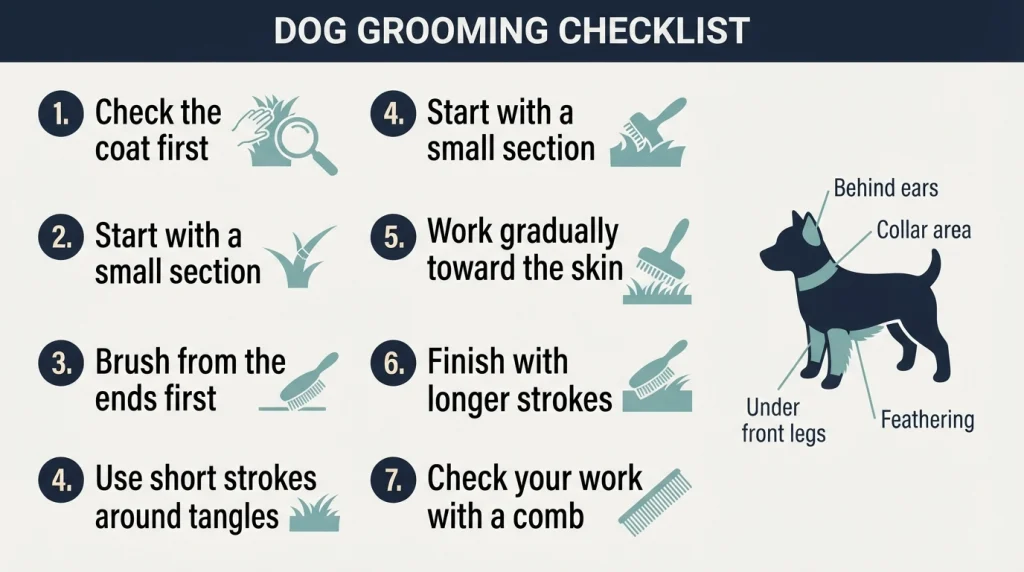
SaveUse a pin brush with light pressure and work in the natural direction of the coat. The brush should move through the hair rather than scrape against the skin.
For long coats, work in manageable sections.
- Check the coat first. Feel for mats, burrs, irritated skin, or anything the brush could catch.
- Start with a small section. Separate the hair so you can see what you’re brushing.
- Brush from the ends first. This prevents you from tightening a tangle by dragging it downward.
- Use short strokes around tangles. Stop if the brush repeatedly catches.
- Work gradually toward the skin. Don’t jab the pin tips into the skin.
- Finish with longer strokes. Follow the coat’s natural direction to smooth it.
- Check your work with a comb. A comb can reveal small tangles the brush passed over.
Pay special attention behind the ears, around the collar, under the front legs, and around feathering. These areas experience more friction and can tangle faster.
Can a Pin Brush Remove Mats?
A pin brush can loosen small, early tangles, but it isn’t my first choice for a tight mat. Dense mats can trap skin, and forceful brushing may pull painfully.
If a knot doesn’t loosen with gentle strokes, stop treating it like an ordinary tangle.
- Don’t repeatedly yank the brush through resistance.
- Don’t press the pins harder against the skin.
- Don’t blindly cut a mat close to the skin with scissors.
- Don’t assume every knot can be brushed out comfortably.
For significant matting, a professional groomer can assess whether careful detangling or clipping is the safer approach.
Does a Pin Brush Remove a Dog’s Undercoat?
A pin brush can pick up some loose undercoat, but it isn’t designed to remove large amounts efficiently. Its spaced pins simply don’t grab undercoat like a dedicated rake or dense slicker.
That’s often an advantage when you want gentle maintenance rather than heavy coat removal.
For thick double-coated dogs, I like to think of the pin brush as one stage in the routine. A rake or appropriate slicker may handle loose undercoat, while the pin brush separates and finishes the outer coat.
How Long Should the Pins Be?
Pin length should roughly match how deeply you need the brush to travel through the coat. Longer hair generally requires longer pins.
For example, Chris Christensen currently offers Original Series pin brushes with different pin lengths and recommends shorter 20 mm pins for shorter coats and 27 mm pins for medium-to-long coats.
- Shorter pins: easier to control on shorter or lighter coats.
- Medium pins: versatile for many everyday grooming jobs.
- Longer pins: reach farther into longer, fuller coats.
You can review the manufacturer’s current pin brush range to see how pin material and length vary between designs.
Can a Pin Brush Hurt a Dog?
Yes, any metal-pin grooming tool can cause discomfort if you press too hard, repeatedly scrape the skin, or force it through mats. Smooth pin tips don’t replace good technique.
Your dog’s response matters too.
- Stop if the dog repeatedly flinches or tries to escape.
- Reduce pressure if you hear or feel pins scraping the skin.
- Inspect irritated, red, sore, or damaged areas before brushing them.
- Keep grooming sessions shorter for puppies and brush-sensitive dogs.
The goal isn’t to make the brush reach the skin at any cost. It’s to work through the coat while keeping the dog comfortable.
What Should You Look for in a Good Pin Brush?
 Save
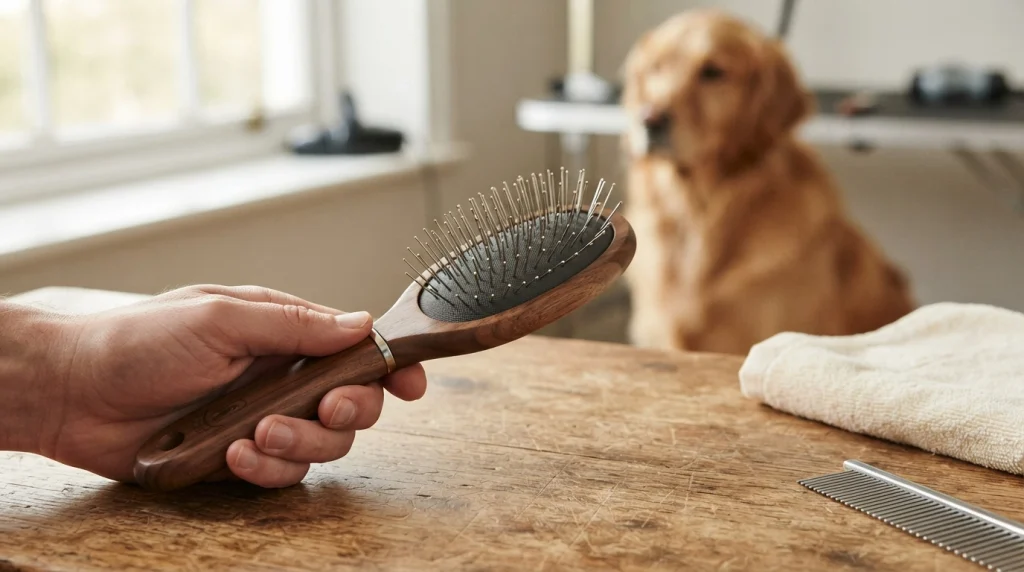
SaveStart with pin quality. Smoothly finished tips matter more to me than decorative handles or complicated marketing claims.
After that, match the brush to your dog’s size and coat.
- Smooth pin tips: Avoid rough edges that catch individual hairs.
- Appropriate pin length: The pins need enough reach for your dog’s coat.
- Secure cushion: Pins shouldn’t wobble excessively or fall out during normal use.
- Comfortable handle: A stable grip improves your control and pressure.
- Suitable head size: Large heads cover bodies faster, while small heads help around legs and tight areas.
The Andis Large Pin Brush, for example, uses a larger brushing surface and long pins for smoothing and finishing larger areas.
Safari by Coastal also offers a wire pin brush with a bamboo handle designed to lift loose hair and debris during everyday grooming.
Pin Brushes I’d Consider for Everyday Grooming
If you’re ready to pick one, these are three practical styles I’d consider based on coat length, budget, and everyday grooming needs.
🏆 Best Overall
Chris Christensen Original Series Pin Brush
★★★★★
This brush uses polished stainless-steel pins, a firm cushion, and a lightweight wooden body. I like this style most for owners who regularly maintain medium or long coats and want smooth pin tips rather than an aggressive detangling tool.
💰 Best Value
Andis Large Pin Brush
★★★★☆
The large brushing surface and long-pin design suit broad areas on medium and large dogs. I’d look at this option when simple everyday coverage matters more than buying a premium wooden grooming brush.
🐕 Best for Everyday Grooming
Safari by Coastal Wire Pin Dog Brush
★★★★☆
Safari’s wire-pin design is intended for lifting loose hair and debris during general grooming. I like the straightforward design for owners who want a basic maintenance brush for frequent short grooming sessions.
Frequently Asked Questions
Do pin brushes remove loose dog hair?
Yes. A pin brush can catch and lift hair that has already loosened from the coat. However, it usually removes less dense undercoat than a slicker brush, shedding tool, or undercoat rake, so it’s better considered a maintenance brush than a heavy deshedding tool.
Are pin brushes good for long-haired dogs?
Yes. Long-haired dogs are one of the main groups that benefit from pin brushes because the long pins can separate and smooth longer strands. Choose a pin length that can reach through the coat without forcing the tips hard against the skin.
Can I use a pin brush every day?
Many dogs can be gently brushed with a pin brush regularly, including daily when their coat requires frequent maintenance. Keep sessions comfortable, avoid repeatedly working irritated skin, and adjust frequency based on coat type, shedding, tangling, and your dog’s tolerance.
Should a pin brush touch my dog’s skin?
The pins can reach through the coat toward the skin, but you shouldn’t scrape or jab the skin. Use light pressure and let the brush follow the body’s shape. If you feel the pins dragging harshly across the skin, reduce pressure immediately.
Is a pin brush or slicker brush better?
Neither brush is universally better. A pin brush is often better for gentle maintenance, separating longer hair, and finishing, while a slicker is usually more effective for catching loose hair and preventing or working through certain tangles in dense coats.
The Bottom Line
A pin brush works through simple mechanical separation. Its long, spaced pins travel between hairs, loosen minor tangles, lift loose fur and debris, and smooth the coat as you brush.
The best results come from using it for the job it was designed to do. Keep your pressure light, stop when you hit serious resistance, and combine the pin brush with a comb, slicker, or undercoat tool when your dog’s coat needs more than routine maintenance.

Thomas Cutter is a lifelong dog owner and the founder of FindOutAboutDogs.com. With over 10 years of hands-on experience owning multiple breeds, Thomas created this site to provide honest, research-based dog advice that real owners can actually trust.
