How to Brush a Curly Coated Dog: A Gentle Step-by-Step Guide
Quick Answer
To brush a curly coated dog, use a gentle slicker brush in small sections, working from near the skin toward the hair tips. Follow each section with a metal comb to find hidden tangles. This technique, called line brushing, works especially well for Poodles and many doodle-type coats. A brush and comb comparison explains why both tools matter.
Six steps for comfortable brushing
- Check the coat: Look for mats, redness, and sensitive areas.
- Prepare the hair: Lightly mist with a dog-safe grooming spray if appropriate.
- Make a part: Lift the coat to expose a narrow section.
- Brush gently: Use short, light strokes without scraping the skin.
- Check with a comb: Confirm that the section is free of snags.
- Repeat and reward: Work systematically, offering breaks and treats.
Important safety rule
- Never force a mat: Tight, painful, or skin-level mats require professional assessment rather than aggressive brushing.
Curly dog hair can look beautifully fluffy while hiding stubborn knots underneath. That’s what makes grooming these coats more challenging than it first appears.
I prefer a simple approach: the right tools, small sections, and a comb check after brushing. Here’s how to make that routine practical without turning grooming into a struggle.


Why Is Curly Dog Hair So Difficult to Brush?
Curly coats can trap loose hairs inside their tight texture. Those hairs twist around neighboring strands, creating knots that become harder to separate over time.
Friction makes matters worse. A harness, collar, or regular movement can encourage tangles in areas that owners rarely inspect.
A mat is a dense clump of tangled hair. Unlike an ordinary loose knot, a mat may pull against the skin and cause discomfort.
Where do curly-coated dogs develop mats?
- Behind the ears: Fine hair tangles with movement and scratching.
- Under the collar: Repeated rubbing compresses the coat.
- Armpits: Friction develops whenever the front legs move.
- Chest and belly: Longer hair collects debris and tangles.
- Legs and feet: Grass, moisture, and dirt complicate grooming.
- Tail base: Dense hair can conceal developing knots.
Don’t judge the coat by appearance alone. A fluffy surface isn’t proof that the hair underneath is clear.
What Tools Do You Need to Brush a Curly Coated Dog?
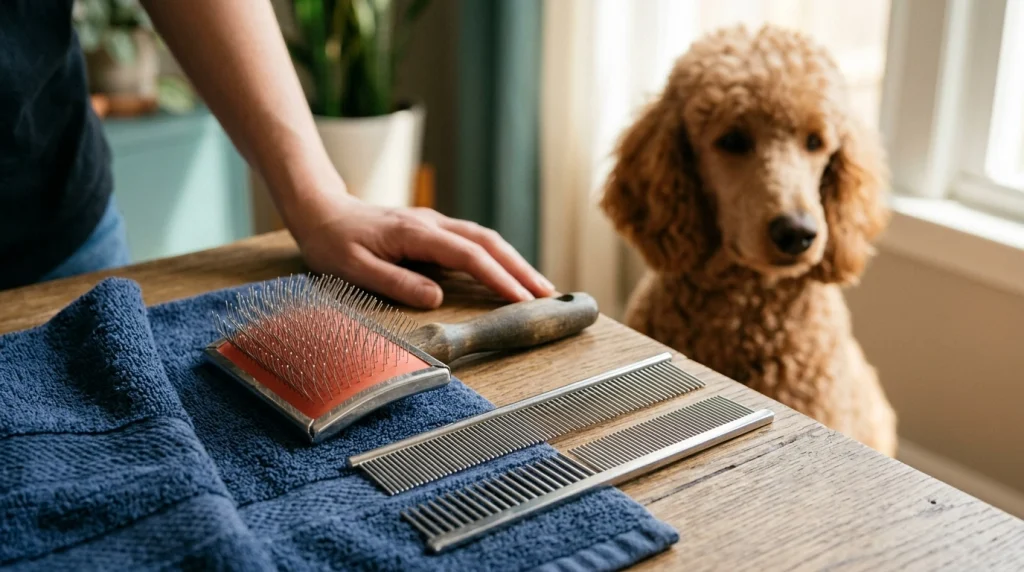
For most mat-prone Poodle-type coats, I recommend starting with two tools: a suitable slicker brush and a metal grooming comb.
A dog-safe conditioning spray is an optional addition. It may help reduce friction while separating longer curls.
Curly dog grooming tools compared
| Tool | Best use | Important limitation |
|---|---|---|
| Long-pin slicker brush | Dense, longer curls | Excess pressure can irritate skin |
| Pin brush | Longer, looser curls | May miss compact knots |
| Metal grooming comb | Checking for hidden tangles | Can pull if forced through knots |
| Conditioning spray | Reducing grooming friction | Cannot safely loosen severe mats |
The American Kennel Club’s brush guide identifies slicker brushes as useful for curly coats. It also stresses choosing tools based on coat type.
Remember that longer pins aren’t automatically better. The brush must match your dog’s coat length, skin sensitivity, and body size.
How Do You Brush a Curly Coated Dog Step by Step?
 Save
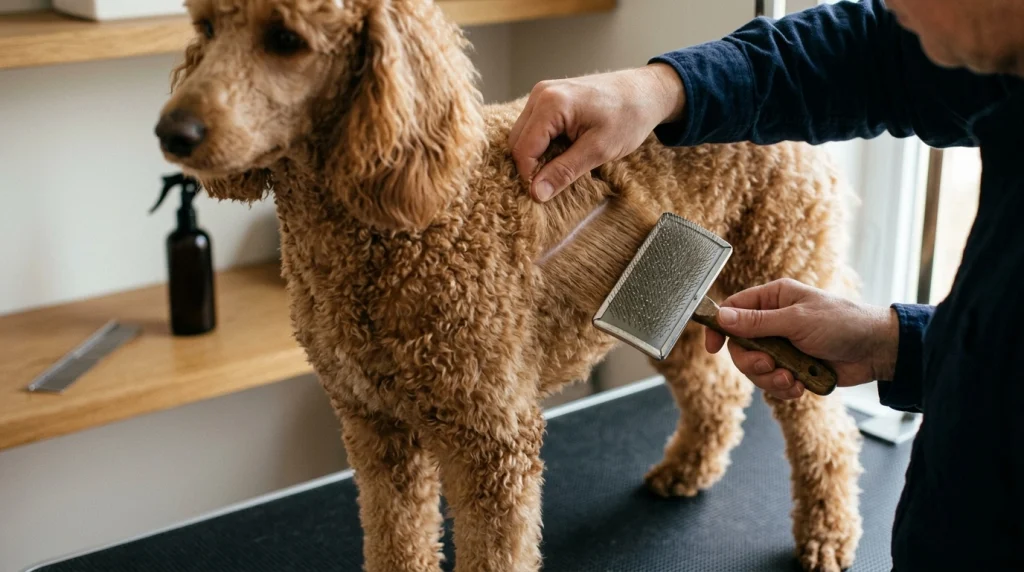
SaveThe most effective general approach for dense Poodle-type hair is line brushing. It means dividing the coat into narrow rows so the brush reaches beyond the fluffy surface.
Here is the method I’d recommend for routine maintenance on an unmatted coat.
Step 1: Prepare a comfortable grooming space
Choose a quiet area with good lighting and a non-slip surface. Keep your brush, comb, and rewards within reach.
Allow your dog to smell the tools before starting. This helps make the routine more predictable.
- Choose a comfortable standing or lying position.
- Remove the collar or harness when appropriate and safe.
- Check for skin irritation, wounds, and firm knots.
- Offer a small reward for relaxed behavior.
Safety tip: Never leave a dog unattended on an elevated grooming surface.
Step 2: Lightly prepare the curls
If the coat feels dry or generates static, lightly mist it with a suitable dog grooming spray. Follow the product’s instructions.
Don’t soak the hair. Wetting an already matted coat can make its condition harder to manage.
For a healthy coat, a little moisture from an appropriate spray may make brushing smoother. Avoid spraying irritated skin without veterinary guidance.
Step 3: Separate the coat into small sections
Start near the bottom of a leg or along the lower body. Gently lift the surrounding hair with one hand.
Create a narrow part that lets you see the skin. Work with only the small section directly below that part.
- Keep the section narrow enough to manage easily.
- Hold the surrounding hair away from your working area.
- Avoid pulling the coat tightly.
- Move systematically so you don’t miss areas.
This sectioning method is more thorough than brushing broadly across the dog’s back.
Step 4: Brush gently from the base outward
Place the slicker lightly into the exposed section, working near the roots without scraping the skin. Use short strokes toward the ends.
For longer hair, you can first loosen the tips and gradually work closer to the base. Never drag the brush through resistance.
My practical rule: If I need extra force, I should change my technique rather than increase pressure.
Step 5: Check every section with a metal comb
After brushing, place the wide-spaced teeth of your comb near the hair roots. Guide the comb gently outward through the section.
It should move without hard snags. If it catches, stop and investigate instead of pulling.
- Comb glides smoothly: Move to the next section.
- Comb catches lightly: Recheck and gently loosen the area.
- Comb meets firm resistance: Don’t force it.
- Dog reacts painfully: Stop and seek professional advice.
This comb check is what distinguishes thorough grooming from surface brushing. For deeper comparisons, see slicker brush vs metal comb.
Step 6: Finish with sensitive areas
Once the main body is comfortable and tangle-free, check the ears, legs, and tail. These places deserve extra patience.
Use a smaller brush where a large head feels awkward. Protect delicate skin by supporting the surrounding hair.
End with praise and a reward. A positive finish makes future grooming sessions easier.
How Often Should You Brush a Curly Haired Dog?
Many long, dense Poodle and doodle coats benefit from daily brushing or brushing every other day. Shorter, less tangle-prone coats may need less frequent sessions.
There isn’t one perfect schedule for every curly-haired dog. Coat texture, length, activity, and friction all influence how quickly mats develop.
| Coat condition | Starting schedule | What to monitor |
|---|---|---|
| Long, dense curls | Daily | Hidden tangles near roots |
| Medium-length curly coat | Every 1–2 days | Harness and ear tangles |
| Short Poodle-style trim | Several times weekly | Snags during comb checks |
| Frequently wet or active coat | Inspect after activity | Moisture, debris, and knots |
These are starting points, not fixed medical or breed standards. Your groomer can help adjust the frequency.
For a longer coat, try dividing grooming across short sessions. Focus on comfort and thoroughness rather than completing everything at once.
Can You Brush Mats Out of Curly Dog Hair?
Small, loose tangles may be manageable with careful brushing. Tight or extensive mats, however, may require professional clipping.
The difference matters because pulling a compact mat can stretch delicate skin. More brushing isn’t always the safest answer.
What should you do with a small tangle?
- Inspect the surrounding skin before touching the knot.
- Support the hair near the base to limit pulling.
- Gently separate loose strands with your fingers.
- Use a suitable grooming spray if appropriate.
- Try light brushing only while the dog remains comfortable.
- Stop if the knot won’t separate easily.
Never use household scissors to cut a tight mat. Folded skin can become trapped inside the hair, making injuries possible.
VCA Animal Hospitals’ grooming guidance recommends gentle tangle removal and warns against attempting unsafe mat removal.
When should you contact a professional?
- A mat feels firmly attached to the skin.
- Multiple knots join into a dense patch.
- Your dog cries, flinches, snaps, or pulls away.
- The skin appears inflamed, wet, or damaged.
- Affected hair prevents normal movement.
A professional groomer can assess coat removal safely. If the skin appears infected, injured, or unusually painful, contact a veterinarian.
Should You Brush Curly Dog Hair Wet or Dry?
 Save
SaveFor everyday maintenance, lightly conditioned or misted hair can be easier to work through than a dry, static-filled coat. However, soaking a tangled coat is not a safe shortcut.
Check for knots before bathing. Clean, completely dried hair is easier to assess than damp hair hiding close-to-skin tangles.
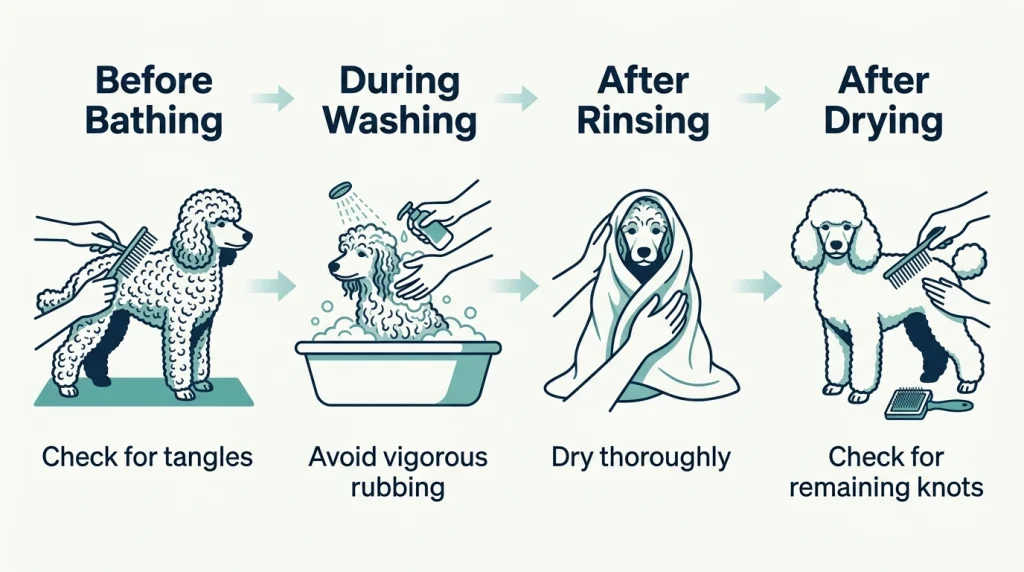
How to handle brushing around bath time
- Before bathing: Inspect the coat and address manageable tangles.
- During washing: Avoid vigorous rubbing that twists hair together.
- After rinsing: Dry thoroughly using coat-appropriate methods.
- After drying: Check the coat gently with your brush and comb.
Professional groomers sometimes brush during controlled drying with appropriate equipment. That doesn’t mean owners should pull through wet, tightly matted hair.
When unsure, ask your groomer to demonstrate a suitable washing and drying routine for your dog’s coat.
What Common Mistakes Should You Avoid?
The biggest mistake is brushing only the outer curls. This creates a tidy appearance while tangles remain closer to the skin.
Several other habits can make grooming uncomfortable or ineffective.
- Using heavy pressure: Slicker pins can scratch sensitive skin.
- Skipping the comb: Hidden knots may remain unnoticed.
- Brushing huge sections: The brush may never reach the roots.
- Ignoring friction areas: Mats often develop beneath collars and behind ears.
- Working through pain: Forcing a knot can cause injury and fear.
- Choosing the wrong tool: Pin length and brush size must suit the coat.
- Delaying grooming: Small tangles can become more difficult over time.
Another mistake is treating every curly breed identically. A full-coated Poodle and a Curly-Coated Retriever don’t necessarily need the same brushing routine.
For example, maintaining the characteristic curls of a Curly-Coated Retriever may involve avoiding routine full-coat brushing. Breed-specific advice should take priority over general Poodle-style instructions.
How Can You Make Brushing Easier for a Nervous Dog?
Start with short, predictable sessions and gentle handling. Your dog’s comfort matters more than finishing the whole coat in one attempt.
For a dog that dislikes brushing, I would begin with one easy area rather than immediately touching tangled ears or legs.
A simple positive grooming routine
- Show the brush and reward calm interest.
- Touch the coat gently without brushing.
- Make one light brush stroke.
- Reward the dog immediately.
- Repeat while the dog stays relaxed.
- Increase the session gradually over time.
Try a few minutes initially and observe your dog’s response. Some dogs will prefer several small sessions rather than a single extended one.
If your dog consistently struggles, ask a qualified groomer or reward-based trainer for help. Sudden sensitivity should also prompt a veterinary check.
Which Curly Coated Dogs Need Extra Grooming Attention?
Poodles, Bichons Frises, and many Goldendoodles and Labradoodles need regular coat checks. Their hair can trap loose strands and develop hidden tangles.
However, curly-coated breeds vary significantly in structure and grooming requirements.
- Poodles: Long clips need thorough section brushing and comb checks.
- Goldendoodles: Coat type varies, but dense fleece coats may mat quickly.
- Labradoodles: Curl density and inherited coat texture affect maintenance.
- Bichons Frises: Dense coats benefit from consistent, gentle grooming.
- Portuguese Water Dogs: Longer coats need appropriate maintenance and professional guidance.
- Curly-Coated Retrievers: Breed-specific curl preservation may require a different approach.
For more product-specific options, see our guide to Goldendoodle grooming brushes.
If your dog has a Labradoodle-type coat, our Labradoodle comb guide can help you compare finishing tools.
Best Grooming Tools for Curly Coated Dogs
 Save
SaveIf you’re building a simple grooming kit, I’d prioritize a slicker brush and a suitable metal comb. Here are three recognizable products worth comparing.
Affiliate disclosure: As an Amazon Associate, we earn from qualifying purchases. The scores below are editorial suitability assessments, not verified customer ratings or hands-on test results.
🏆 Premium Slicker Brush
Chris Christensen Big G Slicker Brush
★★★★½ 4.5/5
A long-pin slicker designed for working through substantial coats. I’d consider this style for dense Poodle-type curls where a short-pin brush only reaches the surface. Choose the correct size and use light pressure.
🔎 Precision Coat Check
Chris Christensen Poodle-Style Buttercomb
★★★★½ 4.5/5
A metal finishing comb suited to checking prepared curly coats. I particularly like this category of tool for identifying missed knots after line brushing. Select the tooth spacing and size that match your dog.
💰 Simple Everyday Comb
Andis Steel Pet Comb
★★★★☆ 4.0/5
A straightforward steel comb with different tooth-spacing sections, depending on the version. I’d start with this kind of tool when the goal is simply to check line-brushed sections without buying multiple specialty combs.
Frequently Asked Questions
What is the best way to brush a curly coated dog?
For most dense, mat-prone Poodle-type coats, use line brushing. Separate the hair into narrow sections, brush gently from near the skin toward the tips, and check each section with a metal comb. Never force a brush through tight mats or painful areas.
Can I use a regular human hairbrush on my curly dog?
A human hairbrush may smooth the outside of the coat, but it often lacks the design needed for thorough curly-coat grooming. A suitable dog slicker brush and metal comb provide better control. Always choose tools based on your dog’s individual coat and skin sensitivity.
How often should I brush my curly coated puppy?
Start with short, gentle grooming sessions while your puppy learns to accept handling. A few calm minutes can be more useful than a stressful full brushing session. As the coat grows, adjust grooming frequency based on curl density and tangles.
Should I brush a curly dog before or after bathing?
Inspect and gently address manageable tangles before bathing. Wetting tight mats may make them harder to handle, and brushing them aggressively afterward can hurt. After washing, dry the coat appropriately and check for remaining tangles without pulling.
Why does my dog’s hair keep matting even though I brush daily?
You may be brushing only the outer curls while knots develop closer to the skin. Try line brushing and checking each finished section with a metal comb. Long hair, collar friction, moisture, and coat texture can also increase matting between sessions.
Final Takeaway: Keep Curly Coat Grooming Gentle and Consistent
Learning how to brush a curly coated dog comes down to technique, patience, and the right tools. Work in narrow sections, brush with a light touch, and use a comb to check your progress.
Make grooming a comfortable habit, not a painful chore. When mats are too tight to separate gently, professional help is the kinder choice.

Thomas Cutter is a lifelong dog owner and the founder of FindOutAboutDogs.com. With over 10 years of hands-on experience owning multiple breeds, Thomas created this site to provide honest, research-based dog advice that real owners can actually trust.
