Brush vs Comb for Curly-Haired Dogs: Which Should You Use?
Quick Answer
For most curly-haired dogs, a brush and comb work best as a team rather than as alternatives. Use a slicker brush to separate curls and loosen tangles, then use a metal comb to check whether you reached all the way through the coat. This is especially important with dense curly breeds such as Poodles, whose coats can mat close to the skin. The American Kennel Club’s dog brush guidance also lists slicker brushes as suitable for curly-coated dogs.
Brush vs comb at a glance
- Slicker brush: Best for separating curls, removing loose hair, and working through light tangles.
- Metal comb: Best for checking whether hidden tangles remain near the skin.
- For mats: Work gently in small sections rather than pulling harder.
- Best routine: Brush first, then comb through each finished section.
- Main goal: Keep the full coat separated without scratching or repeatedly tugging the skin.
One useful test
- If your comb still catches after brushing, that section probably needs more careful work.
Curly coats can look perfectly fluffy on top while hiding tangles underneath. That’s why I don’t consider brushing finished just because the surface looks neat.
I prefer a two-tool check: brush the coat properly, then see whether a comb passes through without resistance. Here’s how that method works and when each tool matters most.


What is the difference between a dog brush and a dog comb?
A dog brush works through a larger area of coat, while a comb gives you a more precise check for tangles and incomplete brushing. On curly coats, the two tools perform different jobs.
A slicker brush has many closely spaced pins. Those pins help separate curls, collect loose hair, and loosen small tangles.
A grooming comb has one row of teeth instead. It covers less coat with each pass, but that narrower contact makes hidden resistance easier to feel.
- Slicker brush: Efficient for routine coat maintenance and line brushing.
- Pin brush: Useful for longer, looser curls where gentle separation matters.
- Metal comb: Useful as a finishing check and for smaller areas.
- Wide-tooth comb: Easier to start with on longer or thicker coat.
- Fine-tooth comb: Better for a closer final check after larger tangles are gone.
Definition: Line brushing means separating the coat into small sections and brushing from near the skin outward instead of skimming across the surface.
I find this technique much more reliable on dense curls because it exposes the coat underneath each section.
Is a brush or comb better for curly-haired dogs?
A brush is usually better for doing the main grooming work, while a comb is better for confirming that the coat is truly tangle-free. For most curly dogs, I would keep both.
The American Kennel Club recommends slicker brushes for curly-coated dogs and specifically discusses their usefulness for removing loose hair and helping prevent mats.
Poodles are a good example. AKC grooming guidance notes that their coats need thorough brushing down toward the skin because matting can develop near the roots.
| Tool | Best Job | Coverage | Main Limitation | When I Use It |
|---|---|---|---|---|
| Slicker brush | Separating curls and light tangles | Wide | Can skim over deeper tangles if technique is poor | Main brushing step |
| Pin brush | Gentle separation of longer coat | Wide | May not handle compact tangles well | Maintenance on looser curls |
| Wide-tooth metal comb | Finding tangles and checking sections | Narrow | Slow for grooming the entire dog | After brushing |
| Fine-tooth metal comb | Detailed final checking | Very narrow | Can pull badly if used on tangled coat | Final pass on prepared coat |
The important distinction isn’t which tool removes more hair. It’s whether the coat is separated comfortably from the outer curl down toward the skin.
Why does curly dog hair mat so easily?
Curly hair can trap loose strands inside the coat instead of letting them fall away easily. Friction then encourages those strands to twist around neighboring hairs and form tangles.
Dense areas can become especially difficult because owners may brush the visible surface without reaching underneath.
- Behind the ears: Movement and scratching create friction.
- Armpits: Leg movement repeatedly rubs the coat together.
- Collar area: Collars and harnesses can compress and rub hair.
- Legs: Longer furnishings collect debris and tangle easily.
- Tail: Dense or longer hair can hide knots beneath the surface.
As of 2026, the principle hasn’t changed: coat type matters more than marketing claims printed on a grooming tool package.
For example, a Curly-Coated Retriever has different coat-care needs from a full-coated Poodle. AKC guidance even notes that many Curly-Coated Retriever owners avoid routine brushing because brushing can alter the breed’s characteristic curls.
So don’t assume every dog with visible curls needs exactly the same routine.
How should you brush and comb a curly-haired dog?
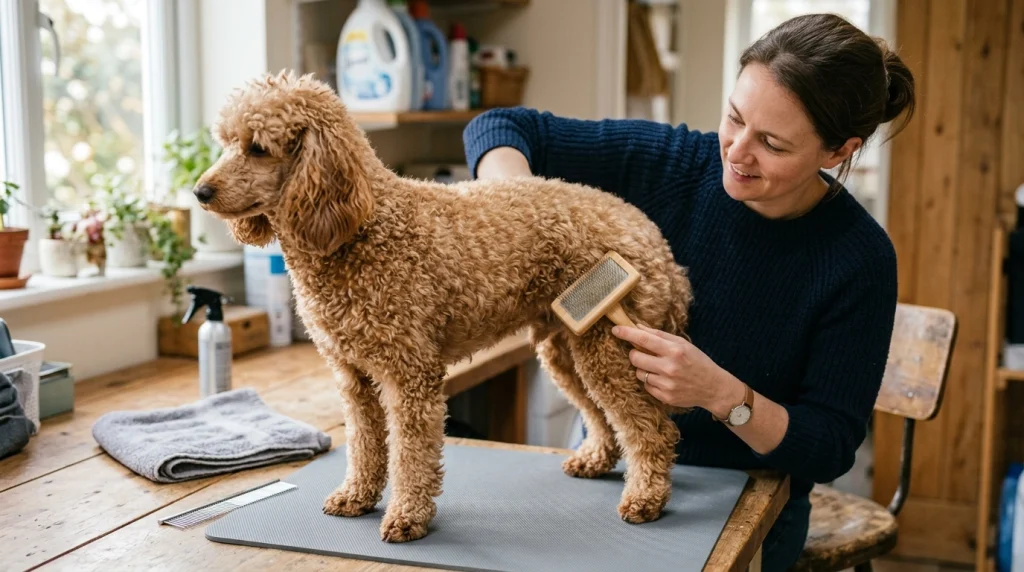 Save
SaveWork in small sections, brush each section from the base outward, and follow with a comb before moving on. The comb becomes your quality-control step.
This is the routine I would use on a typical mat-prone Poodle-type coat.
- Inspect the coat. Feel for tight knots, sore areas, debris, redness, or anything unusual before starting.
- Separate a small section. Lift surrounding hair so you can see closer to the skin.
- Brush gently. Use short, controlled slicker strokes rather than dragging the brush through a large section.
- Hold above a tangle when needed. Supporting the hair can reduce pulling against the skin.
- Check with a comb. Begin with wider-spaced teeth and stop if you meet firm resistance.
- Re-brush resistant areas. Don’t force the comb through a knot.
- Move to the next section. Repeat until the coat has been checked systematically.
I use the comb as a stopping test rather than a detangling weapon. If it catches hard, I go back to careful brushing instead of pulling harder.
That small habit makes grooming calmer.
Should you brush curly dog hair wet or dry?
Don’t make a badly tangled coat your first wet-brushing experiment. Existing tangles should be identified and managed carefully before bathing.
VCA Animal Hospitals advises removing burrs and tangles before bathing because wetting tangled coat can make the problem harder to manage.
Professional grooming routines may use coat-specific sprays, conditioners, and controlled brushing during drying. That’s different from soaking a matted household pet and hoping water loosens everything.
Can a comb remove mats from a curly dog?
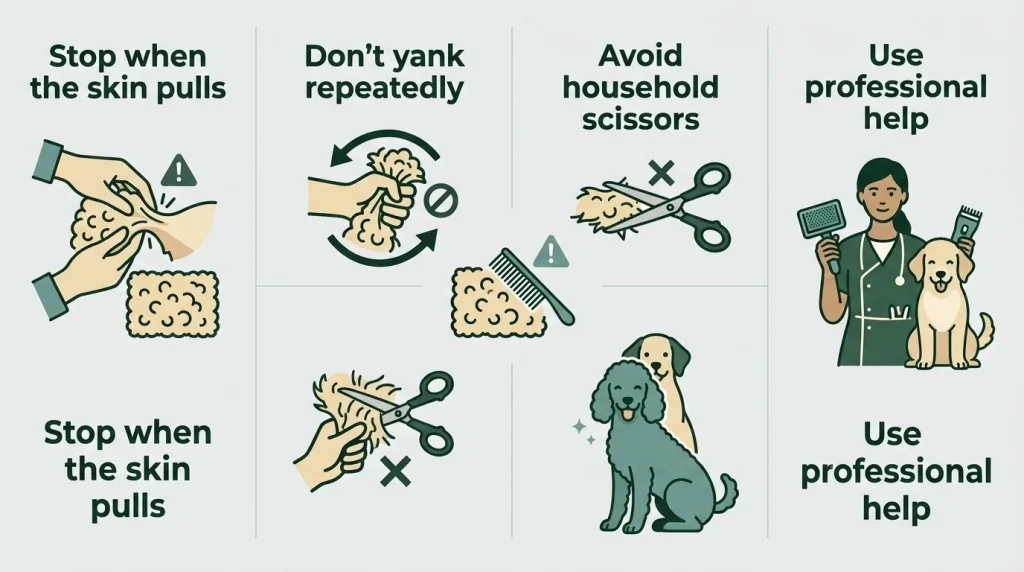 Save
SaveA comb can help with small, loose tangles, but it shouldn’t be forced through a tight mat. Pulling hard can hurt the dog and stress the skin underneath.
VCA recommends gentle handling and professional help when matting becomes severe or extensive.
- Stop when the skin pulls: More force isn’t better grooming.
- Don’t yank repeatedly: Repeated tension can make the session painful.
- Avoid household scissors: Dog skin can be pulled up tightly into a mat.
- Use professional help: Tight, widespread, painful, or skin-level matting may need clipping by someone experienced.
VCA specifically cautions against using scissors to cut mats because of the risk of cutting the skin.
If the skin beneath a mat looks sore, inflamed, wet, smelly, or damaged, a veterinarian should assess it.
What type of brush is best for a Poodle or doodle-type coat?
A long-pin slicker brush paired with a smooth metal comb is one of the most practical setups for many dense Poodle-type coats. Pin length matters because short pins may only groom the outer layer.
AKC’s Standard Poodle grooming guidance recommends a slicker brush and emphasizes reaching through the coat without scratching the skin.
If you’d like a broader explanation of brush designs, see our guide to how different grooming tools reach dense coats. The Husky coat is different, but the guide shows why tool depth matters.
- Choose enough pin length: The pins need to work through the coat instead of skating across it.
- Check the pin finish: Rough metal tips can make grooming uncomfortable.
- Match brush size to the dog: Large heads cover the body quickly, while smaller brushes offer control.
- Keep a comb nearby: Don’t rely on appearance alone to judge whether you’re finished.
For comparison, our guide to managing Siberian Husky shedding explains a different two-tool strategy built around a double coat rather than continuously growing curls.
What mistakes should you avoid with curly coats?
The most common mistake is surface brushing. The coat looks fluffy afterward, but compact tangles can remain underneath.
- Brushing huge sections: Smaller sections make it easier to reach the base of the coat.
- Skipping the comb check: Visual inspection doesn’t reliably reveal hidden resistance.
- Using excessive pressure: Slicker pins shouldn’t scrape repeatedly across skin.
- Pulling through knots: Stop and work the tangle gradually.
- Ignoring friction zones: Check ears, armpits, legs, collar areas, and tail carefully.
- Waiting for severe matting: Maintenance is easier than correcting a compacted coat.
I also wouldn’t copy a grooming routine just because another curly breed uses it. Breed coat structure, haircut length, lifestyle, and individual hair texture can change what works.
The AKC Poodle breed guidance explains how demanding a longer Poodle coat can be and why thorough brushing and combing matter.
How do you know when a curly coat is fully brushed?
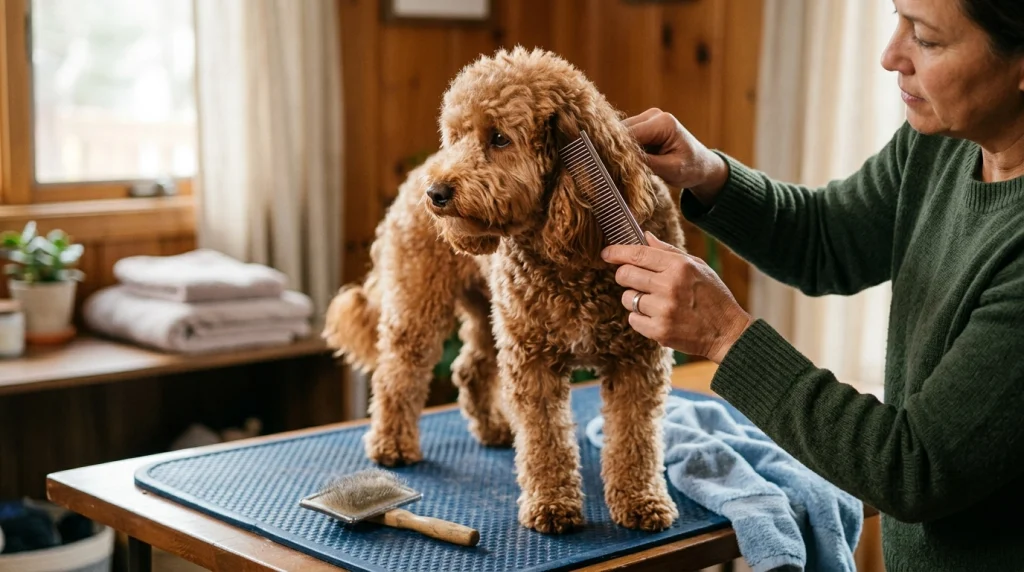 Save
SaveA practical sign is that an appropriate metal comb passes through each section smoothly without hitting hidden knots. Don’t judge only by how fluffy the outside looks.
I like to check the coat systematically so I don’t accidentally miss the same locations every session.
- Behind each ear
- Under the collar or harness area
- Chest
- Both armpits
- Front legs
- Rear legs
- Belly
- Tail and tail base
Move the comb slowly. Resistance is information, not an invitation to pull harder.
Brush vs comb for curly-haired dogs: which one should you buy first?
If I could buy only one tool initially, I would choose a suitable slicker brush for a mat-prone curly coat. But I would add a metal grooming comb as soon as possible.
The brush handles far more coat efficiently. The comb tells you whether the brushing worked.
That combination is much more useful than buying several brushes that all perform nearly the same task.
If you’re ready to build a simple curly-coat grooming kit, these are the kinds of tools I’d consider:
🏆 Best Premium Brush
Chris Christensen Big G Slicker Brush
★★★★½
The Big G is designed for dense coats and uses long pins that can reach beyond the surface. I like this type of brush for section-by-section work on longer Poodle-style coats where a shallow slicker struggles.
🔎 Best Coat Check
Chris Christensen Poodle-Style Buttercomb
★★★★½
This style uses smooth metal teeth designed to move through prepared coat without rough seams catching hair. I would use it after brushing to expose any section that still needs attention.
💰 Best Simple Comb
Andis Steel Pet Comb
★★★★☆
A straightforward steel grooming comb gives you both wider and closer tooth spacing without complicating the kit. I prefer this type for owners who mainly need a reliable post-brushing tangle check.
Frequently Asked Questions
Do curly-haired dogs need both a brush and a comb?
For most mat-prone curly coats, yes. A slicker brush handles the main separation and detangling work, while a metal comb checks whether you reached through the whole coat. Using both helps reveal tangles that surface brushing can miss.
Can I use only a comb on my Poodle?
You can comb a Poodle, but using a comb for the entire grooming session is often slower and can pull badly if the coat contains tangles. A slicker brush usually makes the initial work easier, then the comb can confirm that each section is clear.
Does a slicker brush hurt curly-haired dogs?
A suitable slicker should not hurt when used with light, controlled pressure. Problems can occur when pins repeatedly scrape the skin or when the brush is dragged through tight knots. Stop if your dog flinches, the skin reddens, or the coat pulls sharply.
How often should I brush a curly-haired dog?
The right schedule depends on coat length, density, activity, and grooming style. A long Poodle-type coat may require frequent attention, while a shorter professionally maintained trim may be easier. Check friction areas often rather than waiting until visible mats appear.
What should I do if my dog’s coat is already badly matted?
Don’t force a brush or comb through severe matting. Tight mats can pull painfully against the skin and may hide irritation underneath. A professional groomer can determine whether careful detangling or clipping is safer, while skin sores or inflammation warrant veterinary advice.
Final Takeaway: Brush First, Comb to Check
For most curly-haired dogs, the brush-versus-comb question has a simple answer: use both for different jobs. Brush to separate and maintain the coat, then comb to verify your work.
Keep your pressure light, work in sections, and treat resistance as a reason to slow down. A comfortable grooming routine is far more valuable than trying to pull through every knot in one session.
If you can consistently get a comb through the coat without hidden snags, you’re doing more than making your dog look fluffy. You’re helping prevent small tangles from becoming difficult mats.

Thomas Cutter is a lifelong dog owner and the founder of FindOutAboutDogs.com. With over 10 years of hands-on experience owning multiple breeds, Thomas created this site to provide honest, research-based dog advice that real owners can actually trust.
