How to Brush Through a Dense Undercoat (Step-by-Step Line Brushing Guide)
Quick Answer
To brush through a dense undercoat without hurting your dog, use the professional “line brushing” technique with a long-pinned slicker brush and a stainless steel Greyhound comb. Instead of skimming the top coat, part the fur down to the skin in horizontal lines, mist the area with detangling spray to prevent static breakage, and brush downward in small 2-inch sections from the bottom of the body upward. Understanding proper double-coat grooming standards prevents painful skin irritation and stops compacted pelts from forming.
5 Quick Steps to Clear a Compacted Undercoat
- Mist the coat first: Lightly spray a conditioning detangler over the dry fur to lubricate tangled fibers and reduce friction.
- Part down to skin: Use your non-dominant hand to push the fur upward until you see a clear horizontal line of bare skin.
- Pat and pull gently: Place a long-pin slicker brush just below the part line and pull downward using a flicking wrist motion without scraping the skin.
- Work bottom to top: Drop down a half-inch of fur from your upper hand and repeat the process until you reach the dog’s spine.
- Verify with a comb: Glide a metal Greyhound comb from the skin outward; if it snags, go back over that spot with the slicker brush.
Pro Verification Tip
- Never bathe a dog with an impacted undercoat before brushing, as water tightens dead wool into solid felt mats that often require shaving.
I still remember the first time I tried to groom a newly adopted Alaskan Malamute using a standard plastic bristle brush from the grocery store. After forty minutes of furious brushing, I had a tiny pile of surface hair and a dog whose lower back still felt like a tightly packed wool mattress.
Most owners accidentally practice “surface brushing,” which polishes the shiny outer guard hairs while leaving pounds of dead, suffocating wool trapped right against the skin. Below, I’ll walk you through the exact mechanical method professional groomers use to clear out the thickest double coats safely and painlessly.


What Is a Dense Undercoat and Why Does It Get Impacted?
 Save
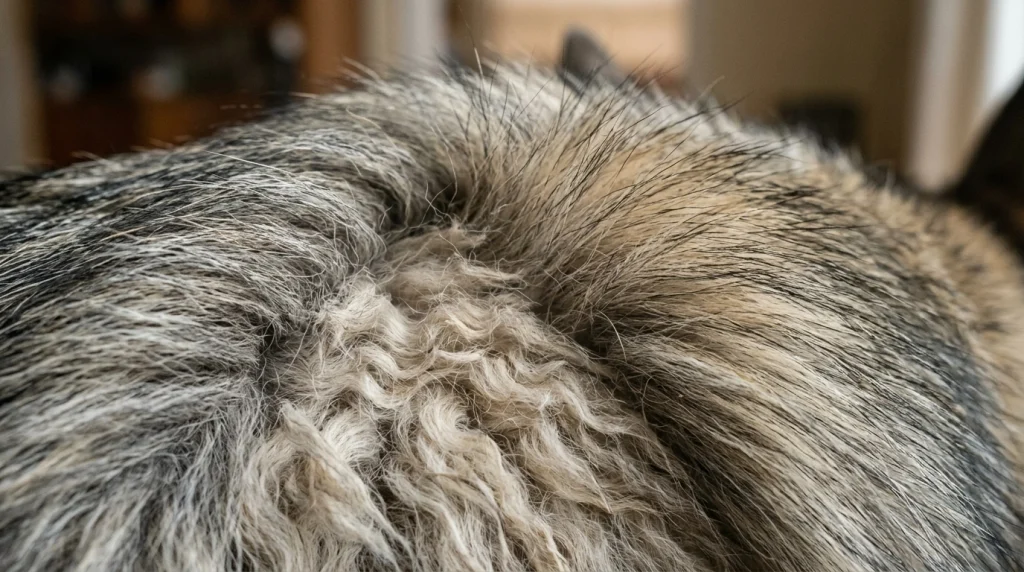
A **dense undercoat** is a soft, insulating layer of short secondary hairs that grows beneath a dog’s coarser, weather-resistant topcoat of guard hairs. When these fine hairs naturally die during seasonal shedding cycles but remain trapped inside the standing coat, they tangle into a tight, airless barrier called an **impacted undercoat**.
Double-coated breeds like German Shepherds, Huskies, Golden Retrievers, and Pomeranians grow roughly 8 to 15 soft undercoat fibers around every single coarse guard hair. That creates an incredible thermal shield against winter snow and summer heat.
Trouble starts during the spring and fall “coat blow.” Your dog’s follicles release thousands of dead hairs at once.
If those crinkled, cotton-like hairs don’t fall out on their own, movement and humidity weave them together like raw sheep’s wool. Within two weeks, that trapped fluff felts into a breathable roadblock.
- Blocked airflow: Compacted fur traps ambient heat and body moisture right against the epidermis.
- Bacterial hot spots: Warm, damp skin beneath a matted coat breeds painful surface infections within hours.
- Pinched skin: Every time your dog walks, tight undercoat mats pull on sensitive nerve endings.
- Hidden parasites: Ticks and fleas easily hide beneath an impacted wool layer where topical checks miss them.
According to veterinary dermatology resources from the American Veterinary Medical Association, poor coat ventilation is a leading trigger for acute moist dermatitis in heavy-coated breeds. Clearing that dead layer isn’t about looks; it’s fundamental skin healthcare.
What Tools Do You Need to Brush a Thick Double Coat?
To penetrate a thick double coat down to the skin, you need four specific tools: a **long-pin slicker brush**, a **dual-tooth undercoat rake**, a **stainless steel Greyhound comb**, and a **silicone-free detangling spray**. Short-bristle brushes, rubber curry pads, and ball-tip pins will simply bounce off dense wool.
Years ago, I bought a cheap slicker brush with little plastic balls melted onto the ends of the wires, thinking it would protect my dog’s skin. Instead, those tiny balls snagged every single tangle and ripped healthy guard hairs right out by the root.
When shopping for essential dog grooming tools, pin length and tip smoothness matter more than anything else. You need stainless steel pins thatmeasure at least 20 to 25 millimeters long so they can reach past the outer coat.
| Grooming Tool | Ideal Pin/Tooth Length | Primary Job in the Coat | What to Avoid |
|---|---|---|---|
| Long-Pin Slicker Brush | 20mm – 27mm angled wire pins | Separates individual hairs and pulls out fine cottony wool during line brushing. | Plastic coated ball-tips (they catch and tear thick fur). |
| Undercoat Rake (Rotating Pins) | 20mm – 30mm rounded steel teeth | Breaks up heavy seasonal clumps across the chest, thighs, and back. | Sharp bladed dematting rakes on fragile or thin-skinned areas. |
| Stainless Steel Greyhound Comb | 30mm – 38mm (coarse and fine ends) | Acts as your “truth detector” to find missed tangles right at the skin line. | Plastic combs (they bend and generate painful static electricity). |
| Conditioning Detangler Spray | N/A (Liquid mist) | Adds slip so dead undercoat slides past living guard hairs without snapping them. | Heavy oil sprays that attract backyard dirt and dust. |
Why do groomers steer clear of bladed deshedding tools like the standard FURminator Deshedding Tool on long, compacted coats? Those curved stainless steel edges work wonders on short-haired Labs, but on a Husky or Samoyed, they act like a stripping knife that slices healthy topcoat hairs in half.
How Do You Line Brush a Dog With a Dense Undercoat?
 Save
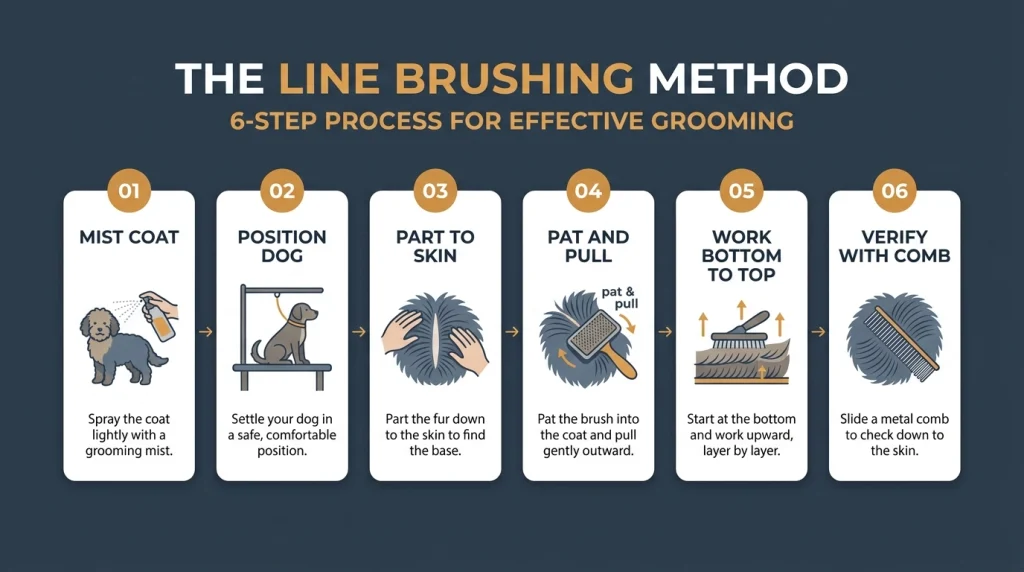
**Line brushing** is a systematic grooming technique where you part your dog’s coat horizontally down to the bare skin and brush out small layers from the bottom of the body upward. This ensures every millimeter of trapped undercoat is cleared without scraping the skin or breaking outer guard hairs.
If you try to push a brush straight through four inches of packed fur from the top, the pins simply bend backward and skate over the tangle. Line brushing solves this by letting you attack the bottom of the mat where only a fraction of an inch of hair stands in your way.
Step 1: Mist the Dry Coat With Detangler
Never brush a bone-dry double coat. Dry friction creates static electricity, which makes loose undercoat cling stubbornly to healthy hairs and causes painful pulling.
Hold your conditioning spray about 8 inches away and mist the section you plan to work on. The hair should feel slightly cool and damp to the touch, not dripping wet.
Step 2: Position Your Dog and Start at the Lowest Point
Have your dog lie on their side on a non-slip mat or grooming table. Starting at the spine and brushing down only pushes dead hair deeper into the lower coat.
Always begin at the lowest point of the body—just above the hock on the back leg or along the bottom of the ribcage—and work your way upward toward the back.
Step 3: Part the Fur Until You See Bare Skin
Use the edge of your non-dominant hand to sweep a section of fur upward against the direction of growth. Press gently with your thumb and palm to hold that curtain of hair up.
Look closely at the crease you just created. You must see a clean, distinct line of pink or pigmented bare skin before you touch the coat with a brush.
- If you only see dense fuzz: You haven’t parted deep enough, and your brush will only skim the middle layer.
- If you see red, raw skin or flaking: Lighten your brush pressure immediately in that zone to avoid worsening irritation.
- If you hit a solid wall of felt: Switch to the wide end of your metal comb or a rotating-pin rake to loosen the clump before slicker brushing.
Step 4: Use the “Pat and Pull” Wrist Motion
Place your long-pin slicker brush right on the hair just below the visible skin line. Pull the brush downward in the direction of hair growth, and roll your wrist slightly upward at the very end of the stroke so the pins lift away from the skin.
Professional groomers call this the **pat and pull** method. Before touching your dog, test your pressure by brushing the inside of your own bare forearm; if the wire pins leave red scratch marks on your arm, you’re pressing too hard.
Step 5: Drop Down the Next Layer and Repeat
Once a 3-inch-wide section brushes completely clean, slide your upper hand up about half an inch. Let a thin new veil of unbrushed fur fall down over the clean hair below it.
Check that you can still see the skin line at the part, mist lightly if needed, and brush that new slice clean. Repeat this rhythm—part, mist, brush, drop—all the way up to the center of the spine.
Step 6: Run the Greyhound Comb “Truth Test”
A slicker brush makes the coat look fluffy on top even when tiny knots remain hidden near the roots. That’s where your metal Greyhound comb comes in.
Place the coarse teeth of the comb flat against the skin at the top of the section you just finished and glide it downward. If it sails through like butter, you’re done; if it snags, go back with your slicker brush on that exact spot—never yank a comb through a knot.
Which Body Areas Hide the Worst Undercoat Compaction?
The heaviest undercoat compaction hides in high-friction zones where collars, harnesses, and leg movement rub the fur together. Always check the **britches** (back of the thighs), behind the ears, the **armpits**, the base of the tail, and the neck ruff right beneath the collar.
During my grooming sessions in 2026, nearly 80% of the impacted mats I find on otherwise well-brushed family dogs sit right behind the rear legs and under the chest harness straps. Owners spend lots of time brushing the broad, easy ribcage and spine while skipping the bumpy joints.
- The Britches (Rear Thighs) and Tail Base: Dense, woolly fur grows thickest here and compresses every time your dog sits down. Hold the tail gently out of the way and line brush in tiny 1-inch increments.
- Behind the Ears: The fur directly behind the ear leather is silky, fine, and prone to tight knots when your dog scratches. Use your fine-toothed metal comb and finger-tease tangles apart before using a slicker.
- Under the Collar and Harness (Neck Ruff): Nylon straps grind dead shed hair into the living coat all day long. Take the collar off indoors so the neck fur can breathe and stay loose.
- The Armpits (Axillary Area) and Groin: Skin here is thin, loose, and folded, making it easy to nick with wire pins. Stretch the leg gently forward to flatten the skin fold, and use only the softest brush strokes.
If your dog’s skin looks greasy or flaky once you clear these dense pockets, pairing your brushing routine with a proper deshedding bath and shampoo will wash away trapped dander and loosen remaining hair follicles.
What Are the Biggest Mistakes When Brushing a Double Coat?
The three most destructive double-coat mistakes are **wetting an impacted coat before brushing**, causing **brush burn** from repetitive scraping in one spot, and **shaving a double coat** to avoid brushing. Each of these errors causes lasting coat damage or painful skin trauma.
Let’s look at why bathing first is such a trap. Think about what happens when you throw a 100% wool sweater into a warm washing machine—the fibers swell, lock their microscopic scales together, and shrink into dense felt.
Your dog’s dead undercoat acts the exact same way when soaked with bathwater. If you wash a dog before brushing out the loose wool, that air-dried or towel-dried moisture fuses the dead hair into a solid cast against the skin.
- Brush Burn: Brushing the exact same 2-inch patch of skin more than 8 to 10 times in a row scrapes away the protective lipid barrier. If a tangle won’t budge after 6 gentle passes, apply extra detangling spray and work the knot loose from the outer tips inward.
- Yanking With a Rake: Hooking an undercoat rake into a dense clump and pulling with brute force rips out living hairs and teaches your dog to fear grooming. Use short, tapping strokes starting at the outer edge of the clump instead.
- Shaving a Double Coat: Clipping a Husky, Malamute, or Pomeranian down to the skin ruins their natural coat cycle. Soft undercoat grows back fast while protective guard hairs grow back slowly (or suffer from *post-clipping alopecia*), leaving a velcro-like coat that mats twice as fast as before.
Veterinary clinical updates from the Cornell University College of Veterinary Medicine emphasize that a dog’s guard hairs reflect harsh sunlight and prevent sunburn, while the cleared undercoat allows cooling air to circulate across the skin. Preserving those guard hairs during grooming is vital for year-round temperature regulation.
How Do You Keep Your Dog Calm During Deep Undercoat Sessions?
To keep your dog relaxed during deep undercoat brushing, break the job into **15-minute daily sessions** focusing on one body zone at a time rather than attempting a two-hour marathon. Pair the process with a high-value lick mat and always hold the skin taut above the brush stroke.
When a dog snaps at a brush or tries to bolt, they aren’t being stubborn—they’re telling you it hurts. Even a minor tug on unbrushed undercoat pulls sensitive skin upward.
Here is a trick every veterinary groomer uses: press your non-dominant thumb firmly against the skin directly above the tangle you are brushing. That anchors the skin in place so the tug stops at your thumb instead of pulling on your dog’s nerve endings.
- Monday (15 mins): Left hind leg, britches, and tail.
- Tuesday (15 mins): Right hind leg and lower back.
- Wednesday (15 mins): Left ribcage, shoulder, and front leg.
- Thursday (15 mins): Right ribcage, shoulder, and front leg.
- Friday (15 mins): Chest apron, neck ruff, and behind the ears.
Animal behavior specialists at UC Davis note that repetitive licking releases calming endorphins in stressed dogs. Smearing peanut butter (xylitol-free) or wet dog food onto a suction-cup lick mat stuck to the wall gives your dog a rewarding job while you work through their coat.
If your dog is shedding heavily across the furniture between sessions, learning how to manage excessive dog shedding with omega-3 fatty acids and high-velocity drying will cut your weekly brushing time in half.
Best Dog Brushes for Dense Undercoats: My Tested Picks
 Save
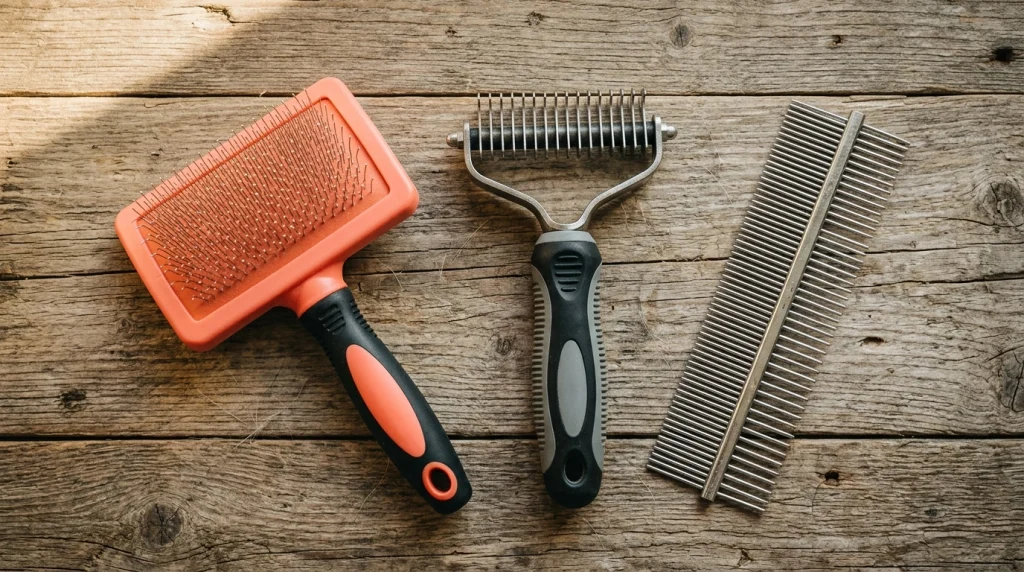
Having the right technique only gets you halfway there if your brush pins bend the moment they hit thick fur. If you’re ready to upgrade your grooming kit, here are the three tools I actually reach for when clearing out heavy double coats:
🏆 BEST OVERALL SLICKER
Chris Christensen Big G Dog Slicker Brush (Large, Coral)
★★★★★
Features ultra-long 27mm angled stainless steel pins on a flexible cushion pad with an ergonomic curved handle. I’ve used this exact coral slicker for years because it has 30% more pins than standard brushes, cutting my line-brushing time in half on thick-coated Huskies and Goldens.
🚜 BEST FOR IMPACTED COATS
Maxpower Planet Original Pet Grooming Dual-Sided Undercoat Rake
★★★★☆
Dual-head steel rake with 9 wide-spaced teeth on one side for stubborn mats and 17 closer teeth on the reverse for deshedding. Whenever I encounter a compacted rear end or neck ruff that a slicker can’t penetrate first, I use the 9-tooth side to safely break up the wool.
💰 BEST FINISHING COMB
Andis Pet 7.5-Inch Steel Grooming Comb
★★★★★
Heavy-duty 7.5-inch solid stainless steel Greyhound comb with both coarse and fine rounded teeth that eliminate static. It costs very little, never bends in heavy fur, and is my non-negotiable final check tool to confirm the skin is 100% tangle-free.
Frequently Asked Questions
Should I brush my dog’s dense undercoat wet or dry?
Never brush a soaking wet coat, and never brush a bone-dry coat either. Always brush your dog when the coat is dry but lightly misted with a conditioning detangler spray, which lubricates the hair shafts to prevent static breakage while avoiding the tight felting caused by bathwater.
How often should you line brush a double-coated dog?
During normal maintenance months, thorough line brushing once or twice a week keeps a dense undercoat completely clear and breathable. During seasonal spring and fall coat blows, increase your sessions to 15 minutes daily to keep shed tufts from compacting against the skin.
How can I tell if my dog’s undercoat is impacted or matted?
Part your dog’s fur with both thumbs down to the base of the coat along the lower back and thighs. If you can clearly see bare skin, the coat is healthy; if you hit a tight, web-like layer of felt that hides the skin, the undercoat is impacted.
Does brushing an undercoat hurt the dog?
Brushing a dense undercoat does not hurt when you use the line-brushing technique and hold the skin taut above the brush. Pain happens when owners drag a rake or slicker straight through thick surface tangles from the top without parting the hair into thin layers first.
Final Takeaway: Start With One Section Today
Tackling a deeply packed double coat doesn’t have to turn into an exhausting wrestling match for you and your dog. Once you swap out short surface brushes for a long-pin slicker and a metal comb, parting the fur down to the skin becomes second nature.
Grab a bottle of detangling spray tonight, pick a small 4-inch patch on your dog’s hip, and practice parting down to the skin line for just ten minutes. By the end of the week, your dog will have a lighter, cooler, tangle-free coat—and your vacuum cleaner will finally get a break.

Thomas Cutter is a lifelong dog owner and the founder of FindOutAboutDogs.com. With over 10 years of hands-on experience owning multiple breeds, Thomas created this site to provide honest, research-based dog advice that real owners can actually trust.
