What Is a Dog Dematting Tool? Uses & Safety Guide
Quick Answer
A dog dematting tool is a grooming tool designed to separate or cut through tangled, clumped, or lightly matted fur with less pulling than an ordinary brush. It usually has curved metal teeth or blades that work through tangles while rounded outer edges help protect the skin. For dense double coats, it can also complement the tools described in my guide to brushes for thick double coats.
What a dematting tool does
- Separates tangles: Wider teeth help break a loose knot into smaller, easier sections.
- Cuts trapped hair: Some designs use sharpened inner edges to slice through tangled hair rather than pulling it out.
- Reduces pulling: Controlled short strokes can be more comfortable than repeatedly tugging with a standard comb.
- Helps dense coats: Certain dual-sided tools can also loosen packed undercoat and shed hair.
- Works before finishing: A slicker brush or metal comb can be used afterward to check and smooth the coat.
Know when to stop
- If a mat is tight against the skin, painful, wet, irritated, or impossible to separate gently, stop and ask a professional groomer or veterinarian for help.
I used to think every dog tangle just needed a stronger brush. That approach usually made the dog less patient and made the knot feel even tighter.
A dematting tool solves a different problem. It works inside tangled hair instead of simply brushing across the top, which is why choosing and using one correctly matters.


What Is a Dog Dematting Tool and How Does It Work?
A dog dematting tool is a specialized grooming tool for loosening tangled hair, small mats, and compacted coat. Most designs use several curved metal teeth rather than ordinary straight brush pins.
The working edges may be sharper on the inside of each tooth while the outside remains smoother or rounded. This lets the tool separate trapped hair with less direct scraping against the skin.
A mat is a compacted mass of tangled hair that has tightened together instead of lying as separate strands. Mats commonly become worse when loose coat, moisture, friction, and debris keep collecting in the same area.
- Wide-spaced teeth: Better for opening larger or looser tangles.
- Closer teeth: Better for refining smaller tangles and collecting loose hair.
- Curved teeth: Help the tool move through hair while giving you more control.
- Rounded tips: Reduce direct scratching when the tool is held correctly.
- Sharpened inner edges: Found on some dematting combs to cut tangled hair instead of yanking it.
One popular example is the GoPets Dematting Comb, which uses a 12-tooth side for tougher tangles and a 23-tooth side for finer detangling and undercoat work.
The Maxpower Planet grooming rake uses a similar two-stage idea. Its 9-tooth side targets tangles, while the 17-tooth side is intended more for loose undercoat and shedding.
What Is the Difference Between a Dematting Tool and a Regular Dog Brush?
A dematting tool works on existing tangles and mats. A regular brush is usually better for routine coat maintenance, loose hair, finishing, and preventing tangles before they tighten.
I don’t treat them as interchangeable. The right tool depends on what I feel when my fingers move through the coat.
| Tool | Best Use | Works on Mats? | Typical Coat Fit | Main Caution |
|---|---|---|---|---|
| Dematting tool | Separating tangles and small mats | Yes, if the mat is manageable | Medium, long, curly, thick coats | Cutting edges require controlled pressure |
| Slicker brush | Loose hair, light tangles, finishing | Only very light tangles | Medium, long, curly, dense coats | Heavy pressure can irritate skin |
| Undercoat rake | Loose undercoat and shedding | Some designs handle light tangles | Dense and double coats | Do not repeatedly scrape one area |
| Metal comb | Checking and finishing | Minor tangles only | Many medium and long coats | Never force it through resistance |
The American Kennel Club describes slicker brushes as useful for removing loose hair and helping prevent mats on medium, long, wire, and curly coats. That makes them useful for prevention, but not a replacement for careful dematting once hair becomes compacted.
When Should You Use a Dematting Tool on a Dog?
Use a dematting tool when you can still identify and gently separate the edges of a tangle. Small, loose mats are much better candidates than hard mats sitting tightly against the skin.
I always check a questionable area with my fingers first. That quick check tells me whether I’m dealing with loose tangled hair or something that needs professional removal.
Good situations for a dematting tool
- Loose knots: The knot moves independently from the skin and can be divided with your fingers.
- Early matting: Hair has started clumping but has not become a solid felted mass.
- Feathering tangles: Longer hair on the legs, tail, chest, or trousers catches and twists together.
- Light undercoat packing: A compatible dual-purpose rake may help loosen compacted dead undercoat.
- Post-tangle cleanup: The tool can remove remaining small snags before a comb or slicker finishes the coat.
Areas where mats commonly hide
Friction makes some places much more likely to tangle. Check these spots regularly instead of waiting until you can see a mat from across the room.
- Behind and underneath the ears
- Under the collar or harness
- Armpits and where the front legs meet the chest
- Inside and behind the rear legs
- Tail and long feathering
- Areas that stay damp after swimming or bathing
Long and dense coats need particular attention. AKC grooming guidance notes that denser and longer coats generally require regular brushing to control tangles and matting.
How Do You Use a Dog Dematting Tool Safely?
 Save
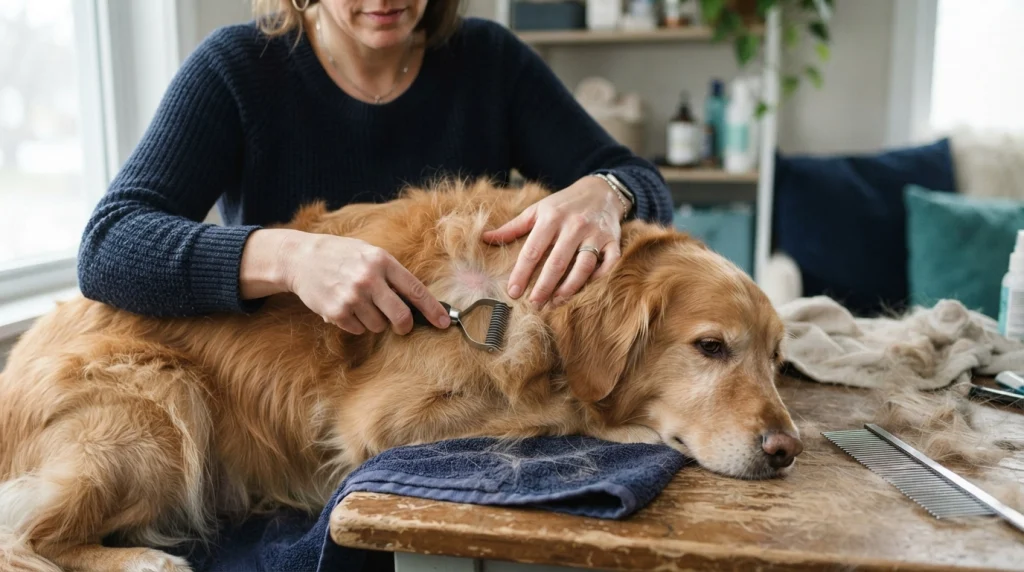
SaveUse a dematting tool with short, controlled movements while keeping tension off the dog’s skin. Never drag hard from the base of a mat straight through to the end.
My goal is always to make the mat smaller gradually. Speed is not worth making grooming painful.
- Inspect the skin first. Look for redness, sores, moisture, swelling, scabs, or anything painful.
- Find the edge of the tangle. Use your fingers to identify where loose hair ends and compacted hair begins.
- Hold hair near the skin. Support the coat gently so pulling on the mat does not tug directly on the skin.
- Start at the outer edge. Work on a small section rather than trying to push through the entire mat.
- Use short strokes. Let the teeth do the work instead of applying heavy pressure.
- Divide the mat gradually. Separate one small section before moving deeper.
- Finish with a comb. A metal comb should move through the completed area comfortably without being forced.
- Stop if your dog hurts. Flinching, crying, repeated turning, snapping, or trying to escape means the session needs to stop.
VCA Animal Hospitals recommends gentle grooming and avoiding excessive pulling when dealing with tangles. It also advises professional help when matting becomes extensive.
My simple pressure test
I would rather make ten gentle passes than one aggressive pass. If I need to brace myself and pull hard, I consider that a sign that the tool is no longer the right solution.
Skin can become trapped surprisingly close to a mat. That is one reason I never slide household scissors underneath a tight clump of hair.
Can a Dematting Tool Hurt a Dog?
Yes. A dematting tool can hurt a dog when it is pressed too hard, pulled repeatedly through a tight mat, or used over irritated skin.
Many tools contain sharpened inner edges. Those edges make the tool effective, but they also mean technique matters.
- Don’t saw repeatedly: Repeated strokes over the same skin can cause irritation.
- Don’t yank: Stop when the tool catches instead of pulling harder.
- Don’t work damaged skin: Red, wet, bleeding, or infected-looking areas need professional attention.
- Don’t chase perfection: Removing every strand in one session is not worth making the dog sore.
- Don’t use scissors on tight mats: Dog skin may be pulled up inside the matted hair.
The ASPCA warns that mats can become more than a cosmetic problem. Severe matting may contribute to skin irritation and can conceal parasites or injuries.
That is why early grooming matters. Removing a small tangle today is much easier than dealing with a painful, tightly compacted mat later.
When Should You Not Demat a Dog at Home?
Do not keep trying to demat when the coat has become tightly felted against the skin. At that stage, professional clipping may be safer and more comfortable than prolonged brushing.
I also stop home grooming when I cannot clearly see or feel the skin around the mat. Guessing is not worth an injury.
- Skin-level mats: You cannot fit fingers between the mat and skin.
- Large felted sections: Several mats have merged into one hard sheet.
- Painful mats: Your dog reacts strongly before the tool even starts moving.
- Wet or smelly mats: Moisture and odor may signal skin trouble underneath.
- Red or broken skin: Grooming over damaged skin can make irritation worse.
- Sensitive locations: Mats close to the eyes, genitals, anus, or other delicate areas deserve extra caution.
- Behavior makes grooming unsafe: Fear, panic, or biting can put both you and your dog at risk.
VCA specifically recommends professional care for severe or extensive tangles. If matting has already irritated the skin, veterinary examination may also be needed.
Dematting Tool vs Undercoat Rake: Are They the Same?
 Save
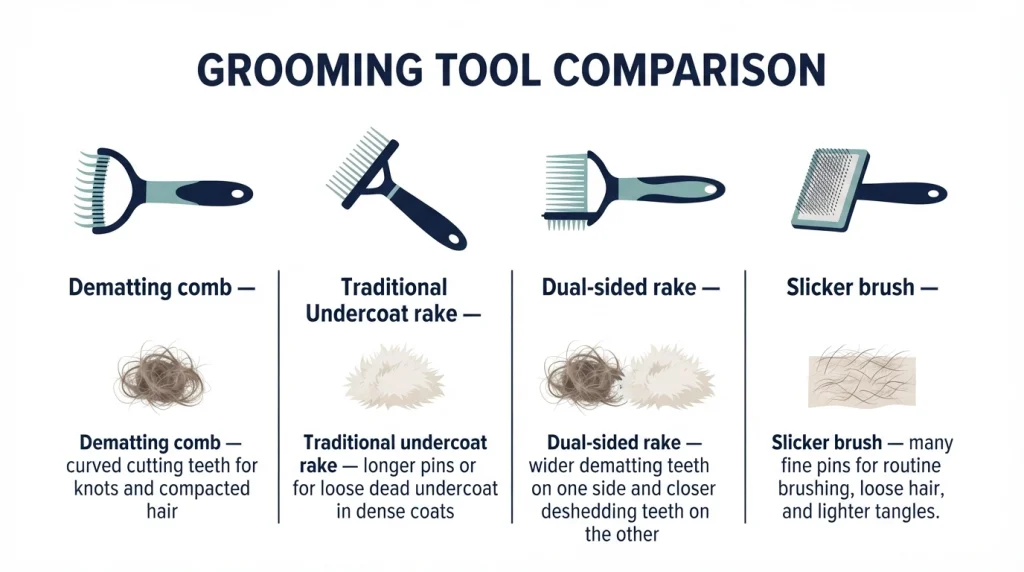
SaveNo. A dematting tool targets tangled or matted hair, while a traditional undercoat rake mainly removes loose dead undercoat from beneath the topcoat.
Some modern tools combine both functions. That can make product names confusing.
- Dematting comb: Usually uses curved cutting teeth for knots and compacted hair.
- Traditional undercoat rake: Uses longer pins or teeth to pull loose undercoat from dense coats.
- Dual-sided rake: Often places wider dematting teeth on one side and closer deshedding teeth on the other.
- Slicker brush: Uses many fine pins for routine brushing, loose hair, and lighter tangles.
If shedding is your main problem rather than actual mats, start with the right shedding tool. My guide to managing heavy double-coat shedding explains why an undercoat rake and finishing brush often work better for that job.
As of 2026, many grooming products use terms such as “dematting,” “deshedding,” and “undercoat rake” together. I look at the tooth design and intended job rather than relying only on the product name.
What Type of Dog Needs a Dematting Tool?
Dogs with medium, long, curly, woolly, or thick coats are more likely to benefit from one. Short, smooth coats rarely need a bladed dematting comb.
The exact tool still depends on coat texture. A heavy double coat behaves differently from a soft curly coat.
- Curly coats: Poodles and many Poodle mixes can tangle close to the skin when brushing misses the coat base.
- Long silky coats: Shih Tzus, Yorkshire Terriers, Maltese, and similar coats can knot around high-friction areas.
- Feathered coats: Spaniels and Golden Retrievers may tangle around ears, legs, tails, and furnishings.
- Heavy double coats: Collies, Huskies, and similar breeds can develop packed undercoat as loose coat accumulates.
- Outdoor dogs: Burrs, wet vegetation, mud, and debris can contribute to tangling regardless of breed.
Not every knot requires a cutting tool. For small surface tangles, fingers, a suitable comb, and careful brushing may be enough.
How Can You Prevent Dog Mats From Coming Back?
 Save
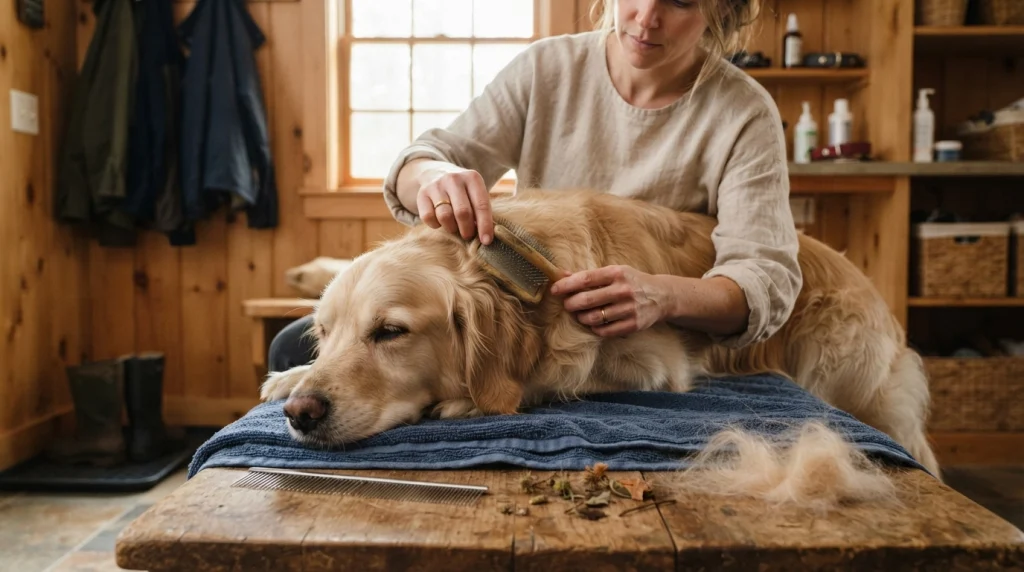
SaveThe easiest mat to remove is the one that never becomes tight. Regular brushing matched to the coat usually saves far more time than occasional aggressive dematting.
I pay extra attention after baths, swimming, rain, harness use, and outdoor adventures. Those are the times when small tangles can tighten quickly.
- Brush consistently: Adjust frequency to coat length, density, and how quickly your dog tangles.
- Brush to the base: Surface brushing can leave hidden tangles underneath longer hair.
- Check friction points: Inspect behind ears, under collars, armpits, legs, and tail feathering.
- Remove debris early: Burrs and plant material are easier to remove before they become tangled into the coat.
- Dry the coat properly: Damp hair can tighten existing tangles.
- Use a finishing comb: A comb helps reveal sections that a brush may have skimmed over.
The AKC recommends choosing grooming tools according to coat type. That matters more than buying the most aggressive tool available.
A comfortable routine also helps your dog accept grooming. Five calm minutes done consistently can be more productive than one long battle every few weeks.
What Should You Look for When Buying a Dog Dematting Tool?
Look for a tool that matches your dog’s coat and gives you control. More blades or sharper teeth do not automatically make a tool better.
I prioritize comfort and predictable handling. If the tool feels awkward in my hand, precise grooming becomes harder.
- Rounded outer tips: These help reduce direct scratching against the skin.
- Appropriate tooth spacing: Wider spacing suits larger tangles, while closer teeth handle finer work.
- Comfortable handle: A non-slip grip improves control when working through resistant hair.
- Strong construction: Thick coats can put significant resistance on a weak grooming head.
- Correct size: A huge head can be awkward around ears, legs, and small dogs.
- Clear purpose: Decide whether you mainly need dematting, deshedding, or a combination tool.
One thing I would avoid is choosing a tool only because advertising shows an enormous pile of removed hair. Coat comfort and skin condition matter more than how dramatic the fur pile looks.
Dog Dematting Tools I Would Consider
If you’re ready to choose one, I would match the tool to the type of coat problem rather than buy three versions that do the same job.
🏆 Best Dedicated Dematting Pick
GoPets Dematting Comb
★★★★½
The dual-sided head uses 12 wider teeth for stubborn tangles and 23 closer teeth for finer detangling and loose undercoat. I like this design when actual mats are the main problem because I can start coarse and finish finer without changing tools.
🐕 Best for Dematting + Shedding
Maxpower Planet Original Pet Grooming Rake
★★★★½
Its dual-sided head has nine wider teeth for mats and tangles plus 17 closer teeth for undercoat work. I would choose this for a thick or double-coated dog when loose undercoat and early tangling are happening together.
💰 Best Simple Dematting Comb
Safari De-Matting Comb
★★★★☆
This straightforward comb uses stainless-steel serrated blades and is intended for tangles on medium-to-long coats. I like the simpler design for owners who need a dedicated mat tool rather than another multi-purpose shedding rake.
Frequently Asked Questions
Does a dematting tool cut a dog’s hair?
Some dematting tools do cut through tangled hair. They often have sharpened inner edges that divide the mat while smoother outer edges face the skin, so some coat loss is expected when tightly tangled strands must be separated.
Can I use a dematting tool every day?
A cutting dematting tool is not usually my choice for everyday brushing. Use it when tangles require it, then maintain the coat with an appropriate brush or comb so you do not repeatedly remove or cut healthy hair.
Should you brush a dog before or after removing mats?
Inspect and lightly brush loose coat first, but do not force a normal brush through a mat. Work on manageable tangles separately, then use a slicker or metal comb afterward to check that the area is free of remaining knots.
Can you bathe a dog that has mats?
Remove manageable tangles before bathing whenever possible. Water and drying can make existing tangles harder to deal with, and severe mats may trap moisture close to the skin, so extensive matting is better handled by a groomer first.
What should I do if a dog mat is too tight to remove?
Stop pulling at it. Tight skin-level mats are safer for a professional groomer or veterinarian to assess and clip with appropriate equipment, especially when you cannot see the skin or the dog shows pain.
Final Takeaway: Use a Dematting Tool Early, Not Aggressively
A dog dematting tool is most useful when a knot is still manageable. It can separate tangled hair with far less pulling than trying to drag an ordinary brush through a stubborn mat.
The important part is knowing its limit. Use gentle short strokes, support the coat near the skin, and stop when a mat becomes tight or painful.
Regular coat checks are still the best strategy. Catch the first small tangle today, and you may never have to fight a large mat tomorrow.

Thomas Cutter is a lifelong dog owner and the founder of FindOutAboutDogs.com. With over 10 years of hands-on experience owning multiple breeds, Thomas created this site to provide honest, research-based dog advice that real owners can actually trust.
