What Is a Dog Grooming Comb Used For? Complete Guide
Quick Answer
A dog grooming comb is used to separate the coat, find hidden tangles, remove loose hair and debris, and check whether brushing has reached all the way through the fur. I especially like a metal comb as a final coat check after brushing, which is also useful when following a double-coat grooming routine.
What a grooming comb helps you do
- Find tangles: A comb catches small knots that a brush may glide over.
- Check brushing: Smooth combing from skin to hair ends shows whether the coat is fully brushed.
- Remove loose hair: Metal teeth can collect loose strands left after brushing.
- Lift debris: A comb can pick out small pieces of dirt, grass, and loose coat material.
- Finish the coat: Combing separates hairs and leaves longer coats looking cleaner and more even.
One important rule
- Never force a comb through resistance. Stop, loosen the tangle with your fingers or an appropriate brush, then try again gently.
A dog grooming comb looks simple, but I consider it one of the best tools for checking my work. Brushes loosen and remove hair, while the comb tells me what I missed.
That difference matters most on long, curly, thick, and double coats. Below, I’ll explain exactly where a comb fits into a grooming routine and where another tool works better.


What Is a Dog Grooming Comb?
A dog grooming comb is a handheld coat-care tool with a row of teeth designed to pass through a dog’s hair. Most grooming combs use metal or plastic teeth in fine, medium, coarse, or mixed spacing.
The classic version is a steel or stainless-steel comb with wider teeth on one end and finer teeth on the other. That combination makes one tool useful for several parts of the coat.
- Coarse teeth: Move through thicker, longer, or less-refined sections of coat.
- Fine teeth: Check smoother sections and help create a neat finish.
- Long teeth: Reach more effectively into longer or denser hair.
- Rounded teeth: Reduce scratching when used with light pressure.
The American Kennel Club notes that metal or plastic combs can be used on many coat types. The exact tool should still match the dog’s coat and grooming job.
What Is a Dog Grooming Comb Used For?
A grooming comb is mainly used for coat checking, detangling small knots, removing loose hair, separating fur, and finishing a grooming session. I don’t treat it as a replacement for every brush.
Instead, I use it as part of a small toolkit. These are the jobs where it earns its place.
1. Finding Hidden Tangles
A dog’s coat can look smooth on top while small tangles remain closer to the skin. A comb often catches those areas immediately.
This is especially useful around friction points where hair rubs against itself.
- Behind the ears
- Under the front legs
- Inside longer leg feathering
- Around the tail
- Under collars or harnesses
If the comb stops, I don’t pull harder. Resistance tells me to inspect the section and deal with the knot first.
2. Checking Whether Brushing Is Complete
This is probably my favorite use for a grooming comb. After brushing, I gently run a metal comb through the coat in small sections.
If it reaches through comfortably without catching, that section is usually in good shape. Groomers sometimes call this kind of finishing check a comb-through.
It’s useful with Poodles, Doodles, long-haired breeds, Spaniel-type coats, and many double-coated dogs.
3. Removing Loose Hair
A comb can pick up loose strands that remain after brushing. This works particularly well on medium and long coats.
For a dog releasing large amounts of undercoat, however, I would not expect a normal comb to do everything. An undercoat rake or suitable brush usually removes bulk more efficiently.
For example, heavy seasonal shedding needs a different approach than a simple finishing comb. My guide to managing Husky shedding shows why several tools may be useful on a dense double coat.
4. Removing Small Pieces of Debris
Longer coats collect bits of dry grass, dirt, loose plant material, and other debris. A wide-tooth comb can help separate the hair so those pieces come free.
Check carefully before pulling anything that seems embedded. Sharp seeds, burrs, or material close to irritated skin may need more careful attention.
5. Fluffing and Finishing the Coat
A grooming comb separates individual hairs and creates a cleaner finish after brushing and drying. This makes it useful before trimming or simply tidying a long coat.
A longer steel comb can also lift hair for a fuller appearance. That’s one reason these simple tools remain common in professional grooming kits.
Dog Grooming Comb vs Brush: What Is the Difference?
 Save
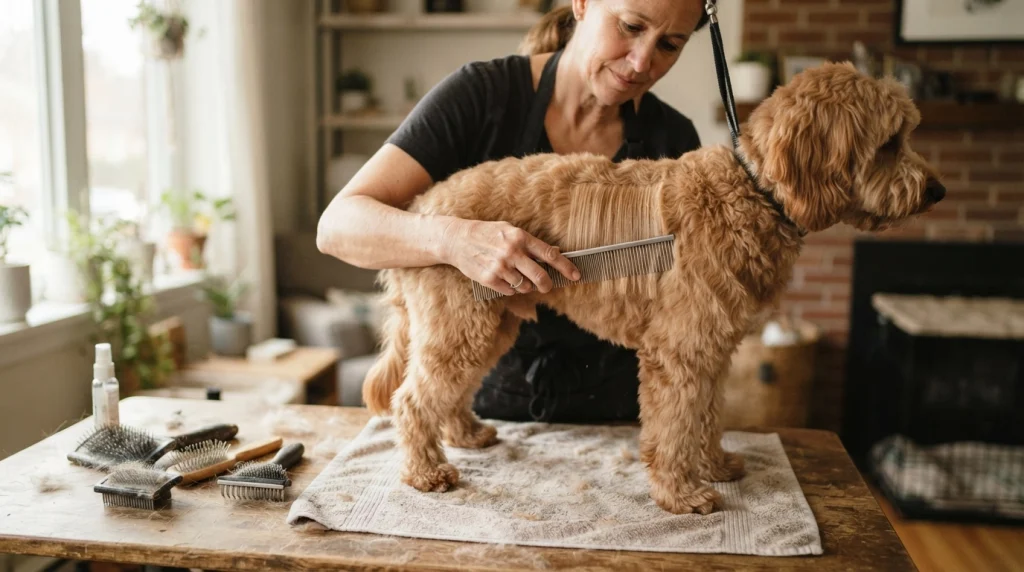
SaveA brush covers more coat quickly, while a comb gives you more precise feedback about individual sections. In many routines, they work better together than separately.
| Tool | Best Use | Coat Coverage | Main Limitation |
|---|---|---|---|
| Steel grooming comb | Checking tangles and finishing | Precise, section by section | Slow for removing large amounts of hair |
| Slicker brush | Loose hair and light tangles | Medium to broad | Can skim the surface if pins are too short |
| Pin brush | Long or flowing coats | Broad | Not ideal for serious mat removal |
| Undercoat rake | Loose undercoat | Deep | Not designed as a fine finishing tool |
| Rubber curry brush | Loose hair on short coats | Surface | Limited reach in long or dense coats |
The American Kennel Club’s grooming guidance also separates tool choice by coat type. Slickers, pin brushes, rubber tools, rakes, and combs each solve different problems.
What Type of Dog Grooming Comb Should You Use?
The right comb depends on hair length, density, and what you’re trying to accomplish. I start with tooth spacing rather than marketing labels.
- Wide-tooth comb: Useful for longer, thicker hair and the first pass through a coat.
- Fine-tooth comb: Better for detailed finishing on hair that is already mostly tangle-free.
- Combination comb: Gives you coarse and fine teeth in one tool.
- Long-tooth comb: Better suited to long or dense coats where short teeth barely reach beneath the surface.
- Flea comb: Has very closely spaced teeth and serves a different, specialized purpose.
For general home grooming, a sturdy combination steel comb is the most versatile starting point. I like being able to begin with the coarse half and finish with the finer section.
How Do You Use a Grooming Comb on a Dog?
 Save
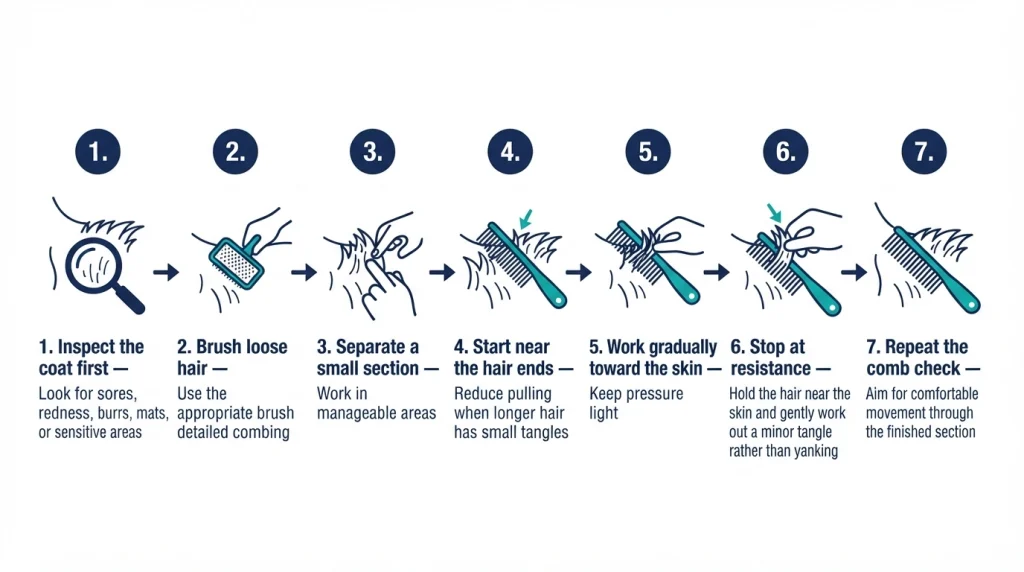
SaveStart with a brushed, manageable section and comb gently in the direction the hair naturally lies. Never use force to drag through a knot.
- Inspect the coat first. Look for sores, redness, burrs, mats, or sensitive areas.
- Brush loose hair. Use the appropriate brush before expecting the comb to do detailed finishing.
- Separate a small section. Work in manageable areas instead of combing the whole side at once.
- Start near the hair ends. This reduces pulling when longer hair contains small tangles.
- Work gradually toward the skin. Keep your pressure light.
- Stop at resistance. Hold the hair near the skin and gently work out a minor tangle rather than yanking.
- Repeat the comb check. The goal is comfortable movement through the finished section.
The veterinary guidance from VCA Animal Hospitals also recommends being gentle and avoiding excessive pulling when working through tangles.
Can a Dog Grooming Comb Remove Mats?
A normal grooming comb can help with small, loose tangles, but it is not the right tool for forcing through a tight mat. Severe matting can sit close to sensitive skin.
I use the comb more as a detector. If it stops firmly, I know that section needs different attention.
- Small loose knot: Separate it gently with your fingers or an appropriate brush.
- Compact mat: Avoid repeatedly pulling it with a comb.
- Mat against the skin: Consider a professional groomer.
- Red or painful skin: Stop grooming the area and seek veterinary advice when appropriate.
VCA specifically cautions against using scissors to cut tight mats because dog skin can be caught easily. Clippers or professional help may be safer when matting is severe.
Which Dogs Benefit Most From a Grooming Comb?
Almost any dog can benefit from occasional combing, but the tool becomes more useful as coat length and density increase. Long and textured coats reveal its value quickly.
- Poodles and Poodle mixes: A comb helps check whether brushing reached through curly hair.
- Spaniels and Setters: Longer feathering can hide small tangles.
- Collies and similar long coats: Longer teeth help check dense sections and feathering.
- Golden Retrievers: A comb can work through longer areas after broader brushing.
- Huskies and other double coats: A comb is useful as a finishing check after undercoat work.
- Long-haired toy breeds: Fine areas around ears and legs often need careful combing.
For smooth, very short coats, I usually reach for a rubber grooming tool or short-bristle brush first. A full-size steel comb may add less value there.
The ASPCA’s dog grooming guidance makes the same broader point: grooming frequency and tool choice should depend on coat type.
How Often Should You Comb Your Dog?
There is no single schedule for every dog. Coat type, hair length, shedding, outdoor activity, and tendency to tangle all change the answer.
- Long or curly coat: Check high-friction areas frequently, sometimes daily.
- Medium coat: Comb after regular brushing or whenever small tangles appear.
- Heavy double coat: Use a comb mainly as a finishing check after the correct shedding tools.
- Short smooth coat: A comb may only be needed occasionally, if at all.
As of 2026, I still prefer consistency over marathon grooming sessions. Five calm minutes spent checking problem areas can prevent a small knot from becoming much harder to handle.
Common Dog Grooming Comb Mistakes
 Save
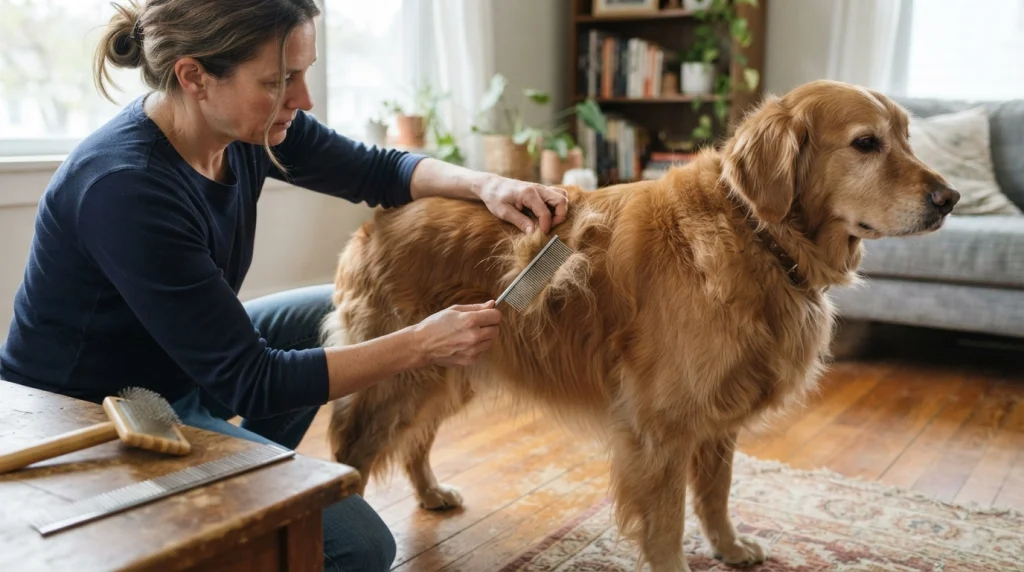
SaveMost comb-related problems come from using too much force or asking the comb to perform a job meant for another tool. A smooth comb-through should not become a wrestling match.
- Pulling through a knot: Stop when you feel resistance instead of yanking harder.
- Starting at the skin: On tangled long hair, begin closer to the ends and work inward gradually.
- Using short teeth on dense fur: The comb may only skim the surface.
- Skipping the brush: A comb is often better as a follow-up tool than the only grooming tool.
- Scraping the skin: Keep pressure light and choose smooth, well-finished teeth.
- Ignoring discomfort: Flinching, turning, sitting, or trying to leave can signal pulling or sensitivity.
One simple habit helps me most: I treat every snag as information. A snag means inspect first, not pull harder.
What Should You Look for When Buying a Dog Grooming Comb?
Choose a comb based on comfort and coat access rather than appearance alone. A plain metal comb with good teeth can outperform a complicated tool.
- Smooth teeth: Look for well-finished surfaces without rough edges.
- Useful spacing: A combination of coarse and fine teeth gives you more flexibility.
- Enough tooth length: Longer hair and dense coats need enough reach.
- Comfortable size: You should be able to control the comb without gripping excessively.
- Strong construction: Teeth should not flex or bend easily during normal use.
For context, Andis currently lists both 7.5-inch and 10-inch steel grooming combs. The 10-inch model uses coarse and fine tooth sections for different parts of the grooming process.
Dog Grooming Combs I Would Consider
If you’re ready to add one to your grooming kit, these are three practical options I’d consider for different priorities.
🏆 Best Everyday Pick
Andis 7-1/2″ Steel Comb
★★★★½
This lightweight steel comb uses professional-style teeth for loose hair, dirt, and everyday finishing. I like the shorter 7.5-inch size when I want easier control around legs, ears, and smaller dogs.
🐕 Best for Larger Coats
Andis 10″ Steel Comb
★★★★☆
This 10-inch steel comb has coarse and fine sections for detangling checks and finishing. I prefer the extra length when working across larger dogs or longer areas of coat where a small comb feels slow.
✨ Premium Finishing Pick
Chris Christensen 7.5″ Buttercomb #000
★★★★½
This fine/coarse Greyhound-style combination comb is designed for everyday maintenance and finishing. I see it as the premium choice for owners who regularly comb longer, styled, or carefully maintained coats.
Frequently Asked Questions
Can I use a human comb on my dog?
A human comb may move through some fine coats, but it is not designed around different canine coat densities and grooming jobs. I prefer a dog grooming comb with smooth teeth, appropriate spacing, and enough tooth length to reach through the coat comfortably.
Should I comb my dog before or after brushing?
For most medium, long, curly, or dense coats, I brush first and comb afterward. The brush removes and loosens hair efficiently, while the comb checks whether small tangles remain and confirms that I reached through the entire section.
Does a grooming comb help with shedding?
Yes, a grooming comb can collect loose hair, especially on medium and long coats. For heavy seasonal undercoat shedding, however, a suitable rake or shedding tool usually handles the bulk removal more efficiently, with the comb serving as a final check.
Why does my dog’s comb keep getting stuck?
The coat may contain a tangle, compacted undercoat, debris, or a mat. Stop rather than pulling harder. Separate the hair, inspect the area, loosen minor tangles gently, and seek professional help when matting is tight, painful, or close to irritated skin.
Are metal combs safe for dogs?
Yes, a well-made metal grooming comb is generally safe when its teeth are smooth and you use light pressure. Avoid scraping the skin or forcing the teeth through resistance. Stop if your dog shows pain, redness, or repeated discomfort.
Final Takeaway: A Grooming Comb Is Your Coat-Checking Tool
A dog grooming comb does more than make fur look neat. It helps uncover hidden tangles, remove leftover loose hair, separate the coat, and confirm that brushing reached where it needed to go.
I think of the comb as the final quality check. Brush for the main job, then comb through the coat gently and let any resistance show you where more attention is needed.
Choose tooth spacing and length that suit your dog’s coat, use light pressure, and never force the tool through a snag. That simple routine makes grooming safer, more comfortable, and much easier to manage.

Thomas Cutter is a lifelong dog owner and the founder of FindOutAboutDogs.com. With over 10 years of hands-on experience owning multiple breeds, Thomas created this site to provide honest, research-based dog advice that real owners can actually trust.
