What Is a Self-Cleaning Dog Brush? 2026 Guide
Quick Answer
A self-cleaning dog brush is usually a slicker-style grooming brush with retractable pins. After the brush collects loose fur, you press a button to pull the pins into the brush head, making the trapped hair much easier to remove. It works like a regular slicker while brushing, so choosing the right brush still depends on your dog’s coat type and grooming needs, as explained in the AKC guide to dog brushes.
What makes it different?
- Retractable pins: A button pulls the metal pins back into the brush head.
- Fast hair removal: Collected fur can usually be lifted away in one clump.
- Slicker design: Most models use fine angled pins for loose fur and light tangles.
- Less cleanup: You spend less time picking hair from between tightly spaced pins.
- Not fully automatic: You still brush your dog normally and may need to wipe the brush head clean.
Best rule to remember
- Choose the brush for your dog’s coat first. Treat the self-cleaning mechanism as a convenience feature, not the main grooming function.
The first time you see the term “self-cleaning dog brush,” it sounds more automatic than it is. The brush doesn’t groom itself or wash its own pins.
What it does is solve one annoying grooming job: pulling a thick wad of dog hair out of a crowded slicker brush. As of 2026, push-button retractable designs are common and simple to use.


What exactly is a self-cleaning dog brush?
A self-cleaning dog brush is a grooming brush with a mechanism that helps release collected hair from its pins or bristles. Most versions are slicker brushes with fine metal pins that retract when you press a button.
A standard slicker can hold loose fur deep between its wires. With a self-cleaning version, retracting the pins leaves that fur sitting on top of the brush head.
- Brush head: Holds the pins and collects loose fur.
- Fine metal pins: Move through the coat and catch loose hair.
- Push button: Activates the release mechanism.
- Retracting plate: Lets the pins disappear beneath the brush surface.
- Handle: Gives you control while brushing and operating the button.
Think of it as a regular slicker brush with an easier eject button. The “self-cleaning” name describes brush cleanup, not the entire grooming process.
How does a self-cleaning dog brush work?
 Save
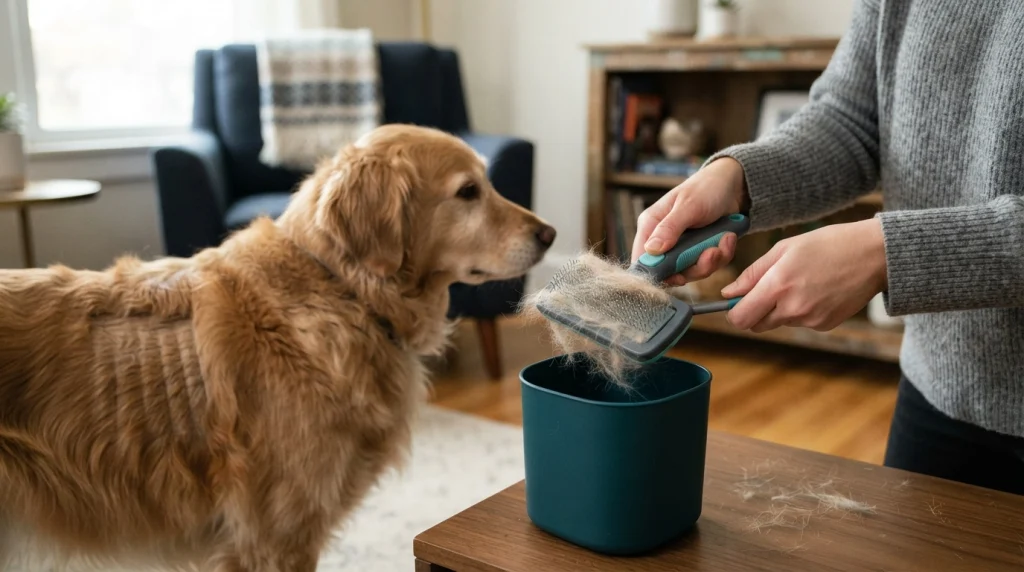
SaveYou brush normally, let loose fur collect between the pins, then press the release button. On common retractable-pin designs, the pins move beneath the surface while the collected hair stays above it.
The process usually looks like this:
- Extend the pins. Make sure the brush is locked into its normal brushing position.
- Brush with light strokes. Work in the direction that suits your dog’s coat and avoid scraping the skin.
- Let loose hair collect. Stop before the brush becomes so packed that the pins cannot move freely.
- Hold the brush over a bin. This keeps released hair off your floor.
- Press the cleaning button. The pins retract or the cleaning plate pushes fur away from them.
- Lift off the fur. Most of it should come away as a pad or clump.
- Extend the pins again. Continue with the next section if needed.
My practical check is simple: the release button should move smoothly before I ever put the brush on a dog. A sticky mechanism can make grooming frustrating once the head fills with hair.
Is a self-cleaning brush the same as a slicker brush?
Most self-cleaning dog brushes are slicker brushes, but not every slicker brush is self-cleaning. The difference is mainly the hair-release mechanism.
A traditional slicker usually requires you to pull hair from the pins by hand. A self-cleaning slicker retracts those pins or pushes collected fur away from them.
| Brush Type | Brush Surface | Best General Use | Hair Removal From Brush |
|---|---|---|---|
| Self-cleaning slicker | Fine metal pins | Loose fur, light tangles, routine coat care | Push-button release |
| Standard slicker | Fine metal pins | Loose fur, mats and tangles depending on coat | Usually removed by hand or comb |
| Pin brush | Longer, widely spaced pins | Longer coats and general finishing | Manual |
| Rubber brush | Flexible rubber nubs | Short coats, massage and surface hair | Usually rinsed or peeled clean |
The important part is the first three columns, not the last one. A quick-release feature is convenient, but it cannot make the wrong brush suitable for the wrong coat.
What are self-cleaning dog brushes good for?
They are particularly useful for routine brushing when your dog’s loose hair quickly fills a slicker brush. The convenience becomes noticeable when you empty the brush several times during one session.
- Regular shedding: They catch loose hair before more of it lands on furniture and clothing.
- Light tangles: Slicker-style pins can help separate manageable tangles when used gently.
- Medium and longer coats: Many slicker designs suit coats where fine pins can move through the hair effectively.
- Curly coats: An appropriate slicker may help maintain coats that need frequent brushing.
- Multi-pet homes: Faster brush cleanup is useful when several animals need grooming.
- Frequent brushing: The more often you brush, the more useful easy hair release becomes.
The ASPCA’s dog grooming guidance also emphasizes matching brushing technique and frequency to the dog’s coat type. That principle matters more than any button on the brush.
Are self-cleaning brushes good for every dog?
No single brush is ideal for every dog. Coat length, density, texture, skin sensitivity and matting determine whether a slicker-style self-cleaning brush makes sense.
Some dogs need another tool either instead of the slicker or alongside it.
- Smooth, short coats: A rubber grooming brush or grooming mitt may be easier and more comfortable.
- Dense double coats: A slicker can help, but an undercoat rake may reach loose undercoat more effectively during heavy shedding.
- Long flowing coats: A pin brush and metal comb may be important for finishing and checking tangles.
- Tightly matted coats: Do not expect a self-cleaning slicker to safely solve severe matting.
- Sensitive or damaged skin: Ask a veterinarian or professional groomer before using wire-pin tools over sore areas.
If your dog has a heavy double coat, brush choice becomes especially important. A slicker may catch loosened hair, while deeper seasonal undercoat can require a separate rake or comb.
Does a self-cleaning brush reduce dog shedding?
It can reduce the amount of loose hair that reaches your home, but it cannot stop normal shedding. Brushing collects hairs that are already loose or ready to come away.
This distinction matters. A brush manages shedding; it doesn’t switch off the dog’s natural hair-growth cycle.
- Before brushing: Loose hair remains in the coat and eventually falls around the house.
- During brushing: The slicker collects some of that loose hair.
- After brushing: New hairs can continue loosening, especially during seasonal shedding.
The AKC’s shedding guidance notes that dogs with heavier shedding may need more frequent grooming during peak periods.
How do you use a self-cleaning dog brush safely?
 Save
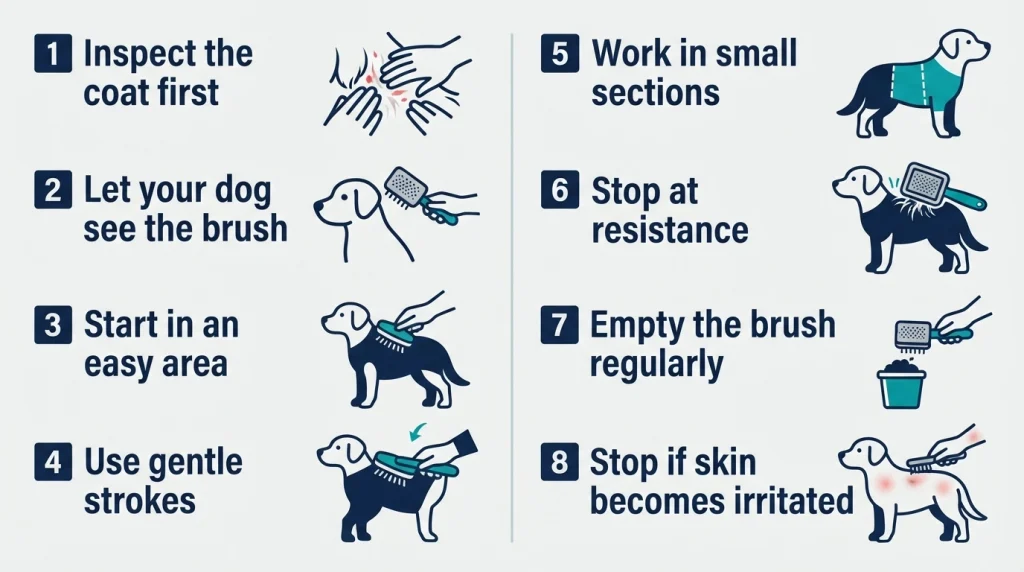
SaveUse light pressure, short controlled strokes and a brush suited to the coat. Fine slicker pins can cause discomfort if you press them hard against the skin.
I pay more attention to the dog’s reaction than to the pile of fur coming off. More hair on the brush doesn’t automatically mean harder brushing is better.
- Inspect the coat first. Look for sores, redness, tight mats, burrs and sensitive areas.
- Let your dog see the brush. Keep the first sessions calm and short if the tool is new.
- Start in an easy area. The shoulder or back is often less sensitive than legs, tail or belly.
- Use gentle strokes. Let the pins move through hair rather than scraping across skin.
- Work in small sections. This gives you more control and helps you notice tangles.
- Stop at resistance. Don’t yank the brush through a tight knot.
- Empty the brush regularly. A packed brush cannot catch loose hair efficiently.
- Stop if skin becomes irritated. Persistent redness, pain or unusual hair loss needs attention.
For broader home-grooming advice, the AKC home grooming guide recommends gentle brushing while checking for mats, debris, cuts and other abnormalities.
Can a self-cleaning slicker remove mats?
It can help with small loose tangles, but it is not a safe answer for every mat. Dense mats close to the skin can pull painfully and may hide irritated skin underneath.
Don’t keep dragging a slicker through a knot that refuses to move. Repeated force can turn a grooming problem into a skin problem.
- Loose tangle: Work slowly from the outer end of the hair.
- Small manageable mat: Support the hair near the skin and use minimal tension.
- Large compacted mat: Consider a professional groomer.
- Mat over sore skin: Seek veterinary or professional guidance.
- Unknown lump beneath a mat: Stop before using scissors or sharp tools.
Self-cleaning dog brush vs regular slicker: which is better?
Neither brushes better simply because of the cleaning mechanism. If pin length, shape, head size and build quality are similar, the self-cleaning version mainly wins on convenience.
I would choose based on these priorities:
- Choose self-cleaning: If you hate pulling fur manually from the brush after every few passes.
- Choose a standard slicker: If you prefer a simpler design with fewer moving parts.
- Choose by pin length: If coat depth is your main challenge.
- Choose by head size: A small dog and a giant breed do not need the same brush width.
- Choose by comfort: The handle should stay controllable during repeated strokes.
One detail gets overlooked: the release mechanism should not wobble or change the angle of the brush in your hand. Cleaning convenience isn’t useful if the tool itself feels awkward.
What should you look for when buying a self-cleaning brush?
Look at grooming performance before the eject button. The best self-cleaning mechanism cannot compensate for unsuitable pins or poor control.
- Appropriate pin length: Pins need to work with your dog’s actual coat depth.
- Smooth construction: Check the pin tips and edges for rough spots.
- Reliable button: The mechanism should extend and retract without sticking.
- Comfortable handle: A non-slip grip helps during longer sessions.
- Suitable head size: Smaller heads offer precision; larger heads cover body areas faster.
- Easy maintenance: Hair, debris and residue should be simple to remove.
- Coat compatibility: Ignore broad “all breeds” claims if the design doesn’t match your dog’s coat.
I also test the button several times before grooming. If it doesn’t move cleanly when the brush is empty, I wouldn’t expect it to improve after fur packs around the head.
How do you clean the brush after grooming?
 Save
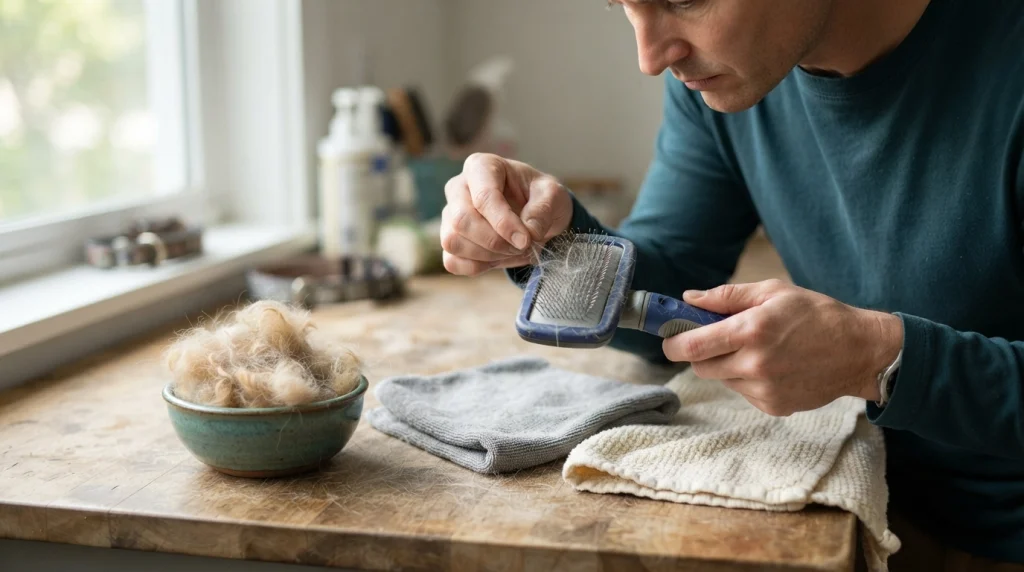
SaveThe eject mechanism removes hair, but the brush still needs basic maintenance. Dirt, skin oils and small hairs can remain around the head and moving parts.
- Retract the pins and remove the collected fur.
- Check between the brush head and moving plate for trapped hairs.
- Wipe the handle and head according to the manufacturer’s care instructions.
- Dry the brush completely if any washable parts become wet.
- Check for bent, damaged or loose pins before the next grooming session.
Don’t assume every self-cleaning brush can be soaked in water. Moving mechanisms and handle construction vary, so follow the manufacturer’s cleaning directions.
Self-cleaning dog brushes I would consider
If you like the retractable-pin idea, these are three common styles I’d compare before choosing. Match the brush to your dog’s coat rather than buying on the self-cleaning feature alone.
🏆 Best All-Around Pick
Hertzko Self-Cleaning Slicker Brush
★★★★½
This popular slicker uses fine angled pins and a push-button retracting mechanism that releases collected fur. I like this style for owners who want a familiar slicker design without manually picking hair from the pins after every section.
💰 Budget-Friendly Option
Depets Self-Cleaning Slicker Brush
★★★★☆
The Depets design uses a one-click cleaning mechanism with bent metal pins and a grip-style handle. I would consider it when easy cleanup matters but you don’t need a premium grooming brush or specialized undercoat tool.
🐾 Best Alternative
Swihauk Self-Cleaning Slicker Brush
★★★★☆
This is another push-button slicker sold for dogs and cats with different coat lengths. I would compare its head size and pin feel with the other options before deciding, especially for a small dog or a pet with sensitive skin.
Frequently Asked Questions
Do self-cleaning dog brushes really work?
Yes, the cleaning mechanism can make removing collected fur much easier. Most designs retract the pins or move a plate around them so hair can be lifted away. The feature improves cleanup, but brushing performance still depends on pin design, coat type and technique.
Can I use a self-cleaning brush every day?
You can brush some dogs frequently, but the correct schedule depends on coat type and skin condition. Daily brushing may suit certain long or shedding coats, while other dogs need less. Always use light pressure and stop if you notice redness, discomfort or excessive pulling.
Are self-cleaning slicker brushes safe for puppies?
They can be appropriate when the brush is gentle, correctly sized and suitable for the puppy’s coat. Start with short sessions and minimal pressure. A softer puppy brush may be a better first tool if the slicker pins feel too firm against delicate skin.
Will a self-cleaning brush remove a dog’s undercoat?
A slicker can collect some loose undercoat, especially on coats it can penetrate properly. However, thick double-coated dogs may need an undercoat rake or another specialized tool during heavy shedding. One brush doesn’t need to perform every grooming job.
Why won’t the hair come off my self-cleaning brush?
The head may be overfilled, small hairs may be wrapped around the mechanism, or the pins may not be retracting fully. Remove trapped fur carefully and check the manufacturer’s cleaning instructions. Stop using the mechanism if the button becomes damaged or repeatedly sticks.
Final Takeaway: Convenience Is the Main Advantage
A self-cleaning dog brush is best understood as a grooming brush with easier hair removal. In most cases, retractable pins let you release trapped fur without digging through a crowded slicker head with your fingers.
That convenience is worthwhile if you brush often, but don’t buy the button before you buy the brush. Match the pin style, size and grooming purpose to your dog’s coat first.
Use gentle pressure, clean the brush regularly and watch your dog’s comfort throughout the session. When those basics are right, the self-cleaning feature can make an ordinary grooming routine noticeably less messy.

Thomas Cutter is a lifelong dog owner and the founder of FindOutAboutDogs.com. With over 10 years of hands-on experience owning multiple breeds, Thomas created this site to provide honest, research-based dog advice that real owners can actually trust.
