Can Grooming Gloves Remove a Dog’s Undercoat?
Quick Answer
No, grooming gloves cannot completely remove a thick, impacted dog undercoat on their own. Their short silicone nubs only reach the topcoat and pull loose surface hair that has already detached. For heavy double-coated breeds, you must pair a glove with a dedicated undercoat rake according to American Kennel Club grooming standards.
How Grooming Gloves Perform by Coat Type
- Short single coats: Removes up to 90% of loose shedding hair while massaging the skin.
- Light double coats: Clears surface fuzz and loose undercoat that has migrated to the top layer.
- Dense double coats: Fails to penetrate down to the skin, leaving trapped dead wool behind.
- Sensitive areas: Works safely on bony legs, tails, and faces where metal blades cause irritation.
- Bath time deshedding: Loosens stubborn undercoat effectively when used to lather deshedding shampoo.
Quick Verification Tip
- Part your dog’s fur with your fingers after using a glove; if you cannot clearly see pink skin, trapped undercoat remains and requires an undercoat rake.
I bought my first pair of silicone grooming gloves hoping they would replace my entire grooming bin. My German Shepherd was blowing his coat, and those viral videos of satisfying hair sheets peeling off a glove sold me instantly.
Ten minutes into brushing him, I realized the truth about how these mitts work. Below, I’ll show you what grooming gloves actually do to an undercoat, when they fail, and how to use them right in 2026.


How Do Dog Grooming Gloves Work on Double Coats?
 Save
Dog grooming gloves use friction and static electricity to grip loose fur sitting near the surface of your dog’s coat. Because the rubber tips measure only 3 to 6 millimeters long, they slide right over dense lower fur layers.
A **double coat** is a two-layer fur system consisting of a coarse, weather-resistant topcoat of guard hairs and a dense, woolly *undercoat* beneath it for insulation. Understanding this structure explains why a rubber mitt struggles with heavy shedders.
When a dog sheds, dead undercoat hairs detach from the follicle. Many of those wavy hairs get trapped underneath the stiff outer guard hairs.
- Guard hairs: Stiff, slick outer hairs that repel water, dirt, and short rubber nubs.
- Undercoat fibers: Soft, crimped, dense hairs that mat together near the skin if left unbrushed.
- Silicone nodules: Flexible rubber pegs that grab stray hairs via friction rather than raking deep.
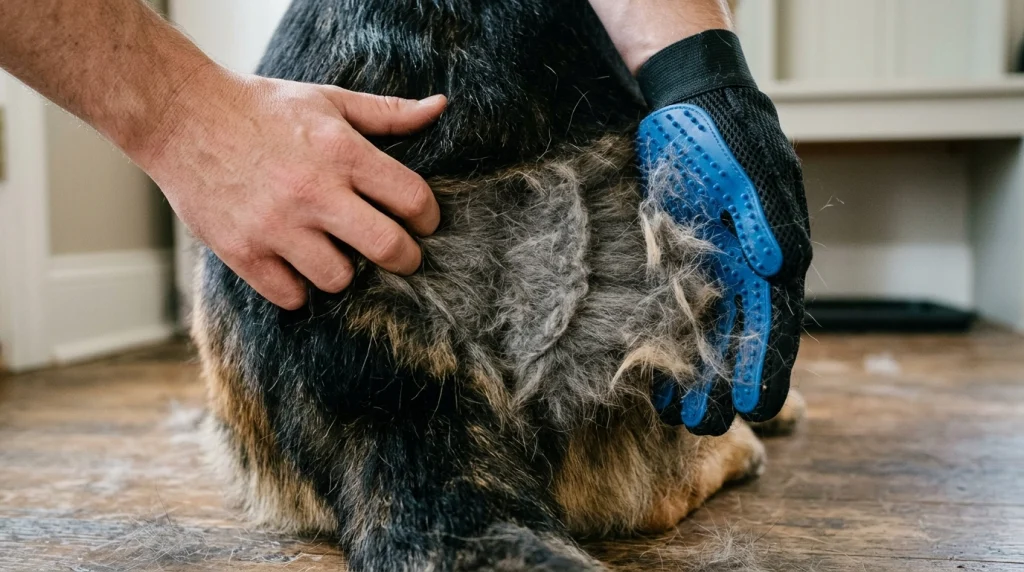
When I tested a standard 259-tip silicone glove on my Shepherd’s hindquarters, I pulled off a full sheet of fur in two minutes. It looked impressive.
Then I parted the hair on his hip to check the skin. A thick, felted layer of dead gray wool was still sitting untouched at the base.
Why Can’t Grooming Gloves Reach Deep Undercoat?
Grooming gloves cannot reach a deep undercoat because soft rubber pegs bend upon hitting stiff outer guard hairs. The pegs lack both the length and rigidity required to part dense fur down to the skin.
Most double-coated breeds have fur depths ranging from 1.5 inches to over 4 inches. A grooming mitt with quarter-inch tips simply cannot reach the bottom layer.
Here is why standard gloves fall short on heavy shedders:
- Insufficient tooth length: Standard glove nodules measure under 0.25 inches, stopping well short of the skin on Huskies, Malamutes, and Golden Retrievers.
- High flexibility: Soft TPR or silicone rubber bends backward when it hits tangled undercoat rather than pulling the knot free.
- Surface compression: Pressing harder with your flat palm only flattens the guard hairs over the undercoat, sealing the dead fur underneath.
Leaving that compressed layer behind causes serious skin issues. According to veterinary guidance from the American Veterinary Medical Association, trapped moisture and dead fur against the skin create hot spots and bacterial infections.
Grooming Gloves vs. Traditional Deshedding Tools
 Save
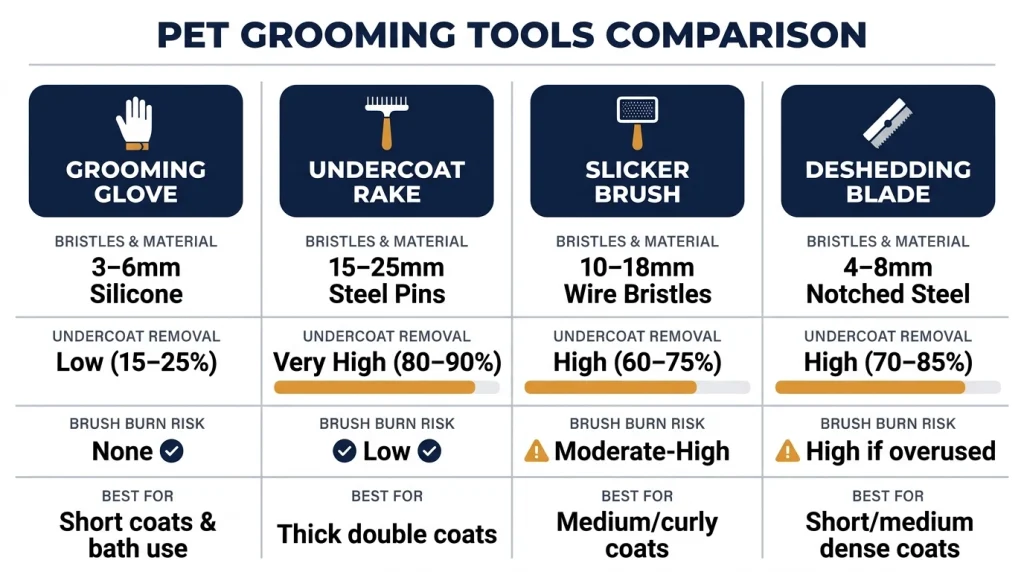
Choosing the right brushing tool depends entirely on coat depth and your dog’s skin sensitivity. While a grooming glove excels at surface cleanup and massage, metal tools handle the heavy lifting for deep coat blowouts.
Compare how grooming gloves stack up against dedicated undercoat tools across my hands-on tests:
| Tool Type | Tooth Length & Material | Undercoat Removal | Brush Burn Risk | Best Coat Type |
|---|---|---|---|---|
| Grooming Glove | 3–6mm soft silicone or TPR rubber | Low (15–25% of loose undercoat) | None | Short single coats, light double coats, bath use |
| Undercoat Rake | 15–25mm rounded stainless steel pins | Very High (80–90% of loose undercoat) | Low | Thick, long double coats (Huskies, Collies, Shepherds) |
| Slicker Brush | 10–18mm angled fine wire bristles | High (60–75% of loose undercoat) | Moderate to High | Medium-to-long coats, curly coats, detangling mats |
| Deshedding Blade | 4–8mm notched stainless steel edge | High (70–85% of loose undercoat) | High if overused | Short-to-medium dense double coats (Labs, Corgis) |
Notice the trade-off between undercoat removal and skin safety. While metal tools extract far more dead wool, they require careful technique to avoid scratching your dog.
A grooming glove never scrapes the skin. That makes it the safest everyday tool in your kit, even if it isn’t the deepest.
When Should You Use a Grooming Glove for Undercoat?
You should use a grooming glove for undercoat during bath time, on bony body parts, and when desensitizing brush-shy dogs. In these specific scenarios, a flexible mitt outperforms rigid metal brushes every time.
I never throw grooming gloves out of my toolkit. Instead, I use them for four specific jobs where metal rakes fail:
- Scrubbing during a deshedding bath: Warm water and deshedding conditioner relax hair follicles, allowing glove nubs to loosen massive amounts of deep undercoat in the tub.
- Grooming bony or sensitive zones: Metal teeth hurt on hocks, tail bones, chests, and cheeks, whereas a glove contours safely over joints.
- Daily topcoat maintenance: Five minutes of evening petting with a glove catches migrating undercoat fibers before they fall onto your sofa.
- Training anxious puppies or rescues: Dogs terrified of brush handles view a grooming mitt as normal petting.
Pro Bathing Tip: Put on a pair of silicone grooming gloves after applying conditioner, not just shampoo. Conditioner coats the hair shafts and lubricates trapped undercoat, letting the rubber nodules slide deeper and pull out twice as much shed fur before you rinse.
Research shared through the Cornell University College of Veterinary Medicine notes that regular mechanical brushing also distributes natural sebaceous oils across the coat. Gloves excel at spreading these healthy skin oils from root to tip.
Which Dog Breeds Benefit Most From Grooming Gloves?
Short-coated single-coat breeds and smooth double-coated breeds benefit most from grooming gloves. Breeds like Labradors, Beagles, and Pugs have shallow fur where rubber tips easily reach the base of the coat.
Not all double coats are built the same. A Labrador Retriever and a Samoyed both have double coats, yet their grooming needs are worlds apart.
Here is how different breed groups respond to glove grooming:
- Smooth double coats (Labradors, Pugs, Rottweilers, Corgis): Fur is under 1.5 inches long, so firm strokes with a high-nodule glove pull out substantial undercoat.
- Single-coated shedders (Boxers, Pit Bulls, Dalmatians, Greyhounds): Zero undercoat exists, making a grooming mitt the only tool you need for 100% of their shedding.
- Medium feathered double coats (Golden Retrievers, Australian Shepherds, Border Collies): Gloves clear the back and sides moderately well but cannot untangle thick trouser feathering or chest ruffs.
- Arctic and plush double coats (Siberian Huskies, Malamutes, Chow Chows, Pomeranians): Gloves only skim the outer guard hairs and will not prevent deep undercoat impaction.
If you own a Lab or Beagle, a pair of HandsOn Pet Grooming Gloves will legitimately handle 80% of your weekly shedding battle. If you own a Malamute, treat the glove strictly as a bath scrubber and finishing polisher.
How Do You Maximize Undercoat Removal With a Grooming Glove?
 Save
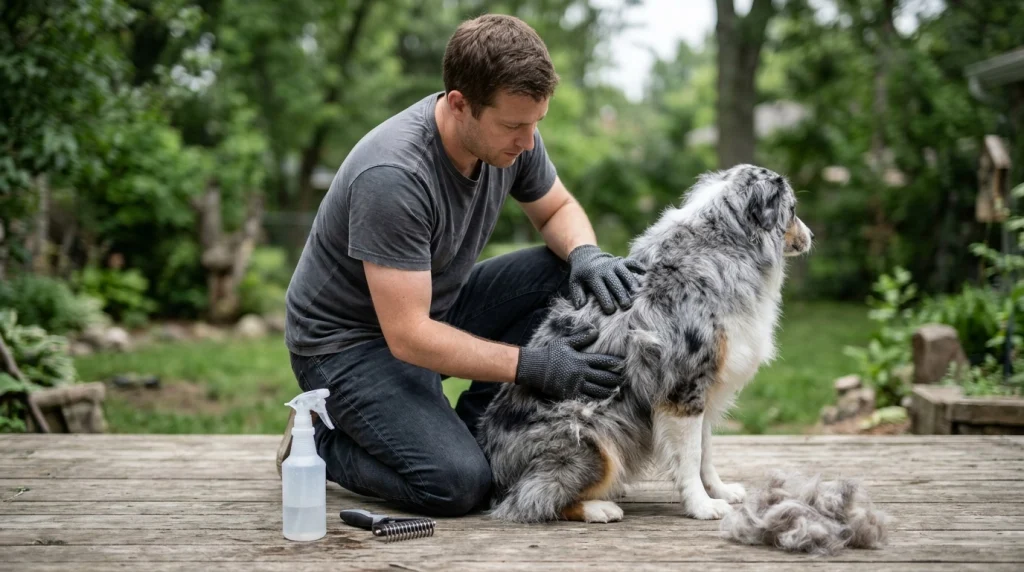
To maximize undercoat removal with a grooming glove, dampen the glove slightly to kill static flyaways and brush in short, firm upward-and-downward strokes. Using a two-tool layering technique extracts deep fur without irritating your dog’s skin.
Most owners just pet their dog lightly from head to tail. That barely scratches the surface.
Follow this 5-step method I use during shedding season to get the deepest clean possible:
- Mist the coat lightly: Spray your dog’s fur with one pump of water or leave-in conditioning spray so dry hairs cling to the silicone tips instead of floating into the air.
- Break up the deep layer first: On heavy double coats, run a long-toothed Maxpower Planet Undercoat Rake gently through the thick areas on the hips, neck, and back.
- Use circular scrub motions: Put on your grooming gloves and rub in small, gentle circles along the flanks and shoulders to lift loosened undercoat to the surface.
- Sweep with long, firm strokes: Pull your gloved hands firmly from neck to tail in the direction of hair growth to gather the lifted wool into a solid mat on your palm.
- Peel and inspect the skin: Peel the fur sheet off the glove once the tips fill up, then part the fur to confirm clean skin underneath.
Never rub a dry double coat vigorously against the grain for too long. While short circular motions loosen trapped tufts, aggressive backward rubbing on long fur can twist guard hairs into knots.
Also remember to clean your grooming mitts with warm soapy water after every couple of uses. Guidelines from the Centers for Disease Control and Prevention remind pet owners that keeping pet equipment sanitized prevents the spread of dander, ringworm spores, and skin bacteria between pets.
What Should You Look for in a Dog Grooming Glove?
Look for a dog grooming glove with long, dense silicone nodules on the fingers and palm, breathable mesh backing, and an adjustable Velcro wrist strap. Cheap gloves have sparse, tiny pegs that slide over fur without gripping anything.
I have tested over a dozen mitts over the years. The cheap $5 bargain bin versions always fail in the exact same ways.
Check these four specs before buying a pair:
- Nodule placement on fingers: Some gloves only put rubber tips on the flat palm, while better designs place independent nodules down every finger so you can curl your hand and rake deeper.
- Nodule count and density: Aim for at least 250+ closely packed tips per glove to create enough friction to trap fine undercoat fuzz.
- Split-finger vs. mitten design: Five-finger gloves let you grip legs, tails, and shampoo bottles naturally, whereas paddle mittens feel clumsy.
- Tear-resistant nitrile or TPR palm: Cheap glue-on rubber pads peel off after three warm baths, so pick gloves with molded or stitched silicone faces.
If you’re ready to pick a grooming glove or pair one with an undercoat tool, here’s what I actually recommend from my own grooming kit:
🏆 BEST OVERALL GLOVE
HandsOn Pet Grooming Gloves
★★★★★
Features firmer round nodules along the fingers and longer scrubbing pegs on the palm, plus five actual sizes from Junior to XL. Because they fit snugly instead of flopping around, I can curl my fingers to dig deeper into wet undercoats during bath time.
💰 BEST BUDGET GLOVE
DELOMO Upgrade Pet Grooming Glove Pair
★★★★☆
Equipped with 259 soft silicone grooming tips per glove and a breathable mesh back in a one-size-fits-most cut. The fur peels off the flat silicone face in one super clean sheet, making it my favorite budget pick for quick daily couch brushing.
🐕 BEST FOR THICK UNDERCOATS
Maxpower Planet Double-Sided Undercoat Rake
★★★★★
Combines a 9-tooth dematting side with a 17-tooth rounded stainless steel deshedding side for heavy double coats. Pair this rake with a grooming glove to pull out the deep impacted wool that rubber pegs can’t reach on Huskies and Shepherds.
Frequently Asked Questions
Are grooming gloves better than slicker brushes for double-coated dogs?
No, grooming gloves are not better than slicker brushes for deep double coats. Slicker brushes have fine angled wires that reach beneath guard hairs to break up small tangles and pull out dense undercoat, whereas gloves only clear loose surface hair and massage the skin.
Can grooming gloves damage a dog’s guard hairs?
No, silicone grooming gloves will not cut or damage healthy guard hairs. Unlike sharp bladed deshedding tools that can slice outer coat hairs if overused, soft rubber nodules only grip hairs that have already detached from the follicle.
Do grooming gloves work better on wet or dry dog fur?
Grooming gloves work well on both, serving different purposes. On dry fur, static and friction trap loose surface hair into peelable mats. On wet soapy fur during a bath, the nodules penetrate deeper to massage the skin and loosen stubborn undercoat.
How often can I use a grooming glove on my dog?
You can safely use a grooming glove on your dog every single day. Because the soft silicone tips have zero sharp edges, daily 5-to-10-minute sessions will never cause brush burn or skin irritation.
Final Verdict on Grooming Gloves and Dog Undercoats
Grooming gloves won’t replace a metal undercoat rake if your dog has thick, plush fur, and any brand claiming otherwise is overselling. They simply don’t have the tooth length to dig down to the skin on heavy double-coated breeds.
However, when used as a bath scrubber, a daily surface catcher, or a gentle brush for sensitive legs and anxious pups, they earn their spot in your grooming drawer. Grab a pair for bath day and daily touch-ups, and team it up with a solid undercoat rake when seasonal coat blowouts hit.

Thomas Cutter is a lifelong dog owner and the founder of FindOutAboutDogs.com. With over 10 years of hands-on experience owning multiple breeds, Thomas created this site to provide honest, research-based dog advice that real owners can actually trust.
