What Is an Undercoat Rake Used For? A Dog Grooming Guide
Quick Answer
An undercoat rake is used to reach through a dog’s outer coat and remove loose, dead hair from the soft undercoat underneath. It is most useful for dogs with thick or double coats, especially when they are shedding heavily. The American Kennel Club’s dog brush guide also notes that undercoat rakes are designed to penetrate to the undercoat and remove loose fur.
What an undercoat rake helps with
- Loose undercoat: Long teeth reach hair that a surface brush may leave behind.
- Seasonal shedding: It helps collect released undercoat before that fur ends up around your home.
- Dense coats: The spaced teeth can move through thick fur more effectively than short bristles.
- Light tangles: Some rakes can loosen minor tangles, although they should not be forced through tight mats.
- Coat maintenance: Removing already-loose undercoat helps keep a double coat easier to brush and inspect.
Before you use one
- Confirm that your dog has enough undercoat for the rake, then use light pressure in the direction of hair growth.
If a normal dog brush keeps gliding over your dog’s coat while fluffy hair remains underneath, an undercoat rake may be the missing tool. Its job is different from simply making the surface look neat.
I find the easiest way to choose grooming tools is to think in layers. A slicker works closer to the surface, while an undercoat rake is meant to reach the softer coat hiding below.


What exactly is an undercoat rake?
An undercoat rake is a grooming tool with relatively long, spaced metal teeth designed to reach loose undercoat beneath a dog’s outer guard hairs. Many versions use rounded tips, rotating teeth, or two rows of pins to reduce pulling.
Simple definition: An undercoat rake is a dog grooming tool used mainly to lift already-loose hair from the dense lower layer of a double coat without having to remove the protective outer coat.
A double-coated dog has a softer undercoat beneath longer or coarser guard hairs. Huskies, German Shepherd Dogs, Golden Retrievers, Corgis, Samoyeds, Pomeranians, and many other breeds have some form of double coat.
The amount and depth of undercoat differ greatly between breeds. Even two dogs of the same breed can have noticeably different coat density.
What is an undercoat rake used for on dogs?
The main purpose is removing loose undercoat, particularly when a double-coated dog is shedding heavily. The longer teeth can reach hair that short surface bristles may miss.
That makes the rake especially handy when tufts of soft fur begin lifting from the coat. I think of those loose clumps as the clearest sign that deeper coat maintenance may be useful.
- Removing released undercoat: The rake catches soft hair that has detached and remains trapped beneath the topcoat.
- Managing seasonal coat changes: Double-coated dogs may release substantially more undercoat during certain periods.
- Reducing loose hair indoors: Hair collected during grooming is hair that is less likely to reach carpets, clothes, and furniture.
- Breaking up mild packed coat: A suitable rake can help separate loose, compacted fur before it becomes harder to manage.
- Preparing for finishing tools: After deeper loose coat is removed, a slicker, pin brush, or comb can tidy the remaining coat.
The goal is not to keep pulling until no hair comes out. A double-coated dog still needs its healthy undercoat and protective guard hairs.
The AKC’s double-coat grooming guidance recommends regular grooming rather than shaving a healthy double coat simply to control shedding.
Which dogs benefit most from an undercoat rake?
Dogs with a noticeable, dense undercoat are the best candidates. Coat structure matters more than the dog’s size alone.
Part the fur with your fingers and look near the skin. A true undercoat usually feels softer, finer, and more wool-like than the outer guard hairs.
| Coat situation | Undercoat rake? | Why |
|---|---|---|
| Thick double coat | Usually useful | Longer teeth can reach loose hair below the guard coat. |
| Heavy seasonal shedding | Often useful | Helps collect released undercoat in controlled grooming sessions. |
| Long, dense coat | Choose longer teeth | Teeth must reach the undercoat without needing excessive pressure. |
| Short double coat | Possibly | A shorter rake may suit the coat better than long pins. |
| Little or no undercoat | Usually unnecessary | Long teeth may simply drag near the skin instead of collecting undercoat. |
Pin length matters. Teeth that are too short may never reach the loose undercoat, while excessively long teeth on a shallow coat make skin contact harder to control.
Undercoat rake vs slicker brush: what is the difference?
 Save
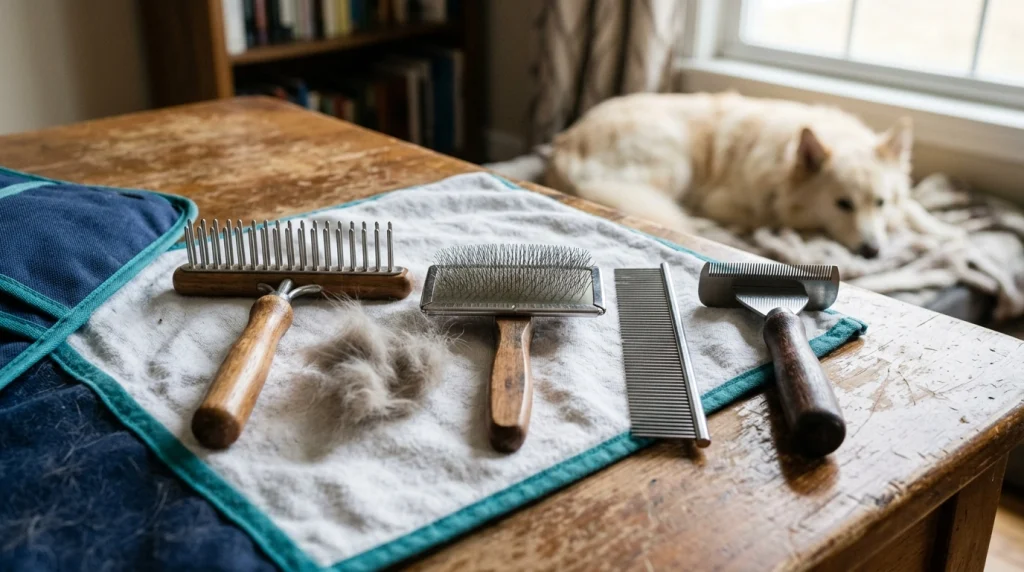
SaveAn undercoat rake targets deeper loose undercoat, while a slicker brush is better suited to surface hair, light tangles, and finishing work. Neither tool completely replaces the other.
A steel comb adds another useful function. It can reveal tangles that a brush has skimmed over and can confirm whether you can move through the coat without hitting hidden resistance.
| Tool | Main job | Best use | Common mistake |
|---|---|---|---|
| Undercoat rake | Lifts loose undercoat | Dense double coats | Pressing too hard or repeatedly raking one area |
| Slicker brush | Surface hair and light tangles | Regular brushing and finishing | Scraping fine pins against the skin |
| Steel comb | Checks for remaining tangles | Final coat inspection | Dragging through a tight mat |
| Blade-style de-shedding tool | Removes loose shedding hair | Specific coat types stated by its manufacturer | Overusing it or assuming every model works like a rake |
I prefer to pick the least aggressive tool that reaches the hair I need to remove. More metal, sharper edges, or stronger pressure do not automatically produce better grooming.
How do you use an undercoat rake safely?
 Save
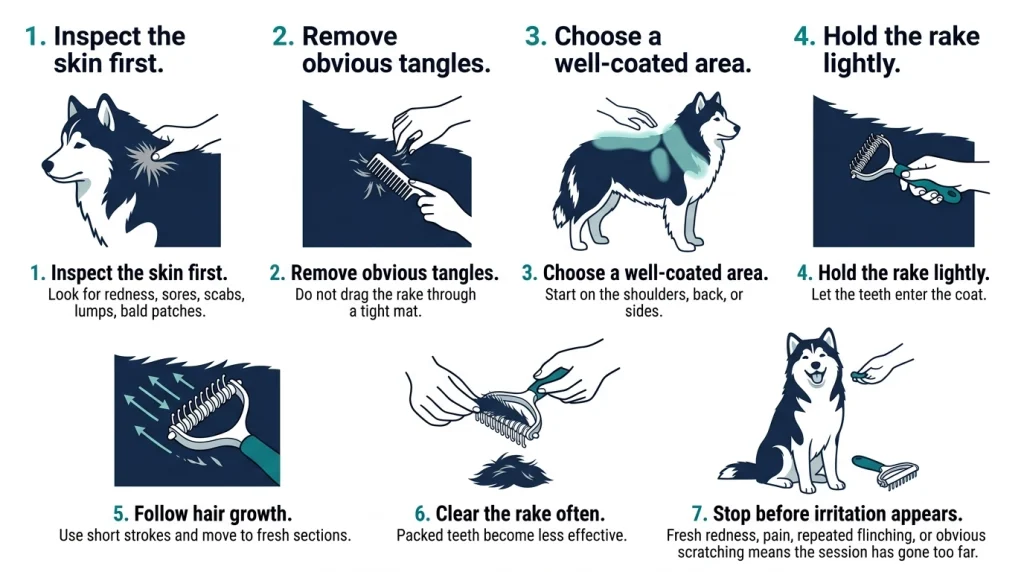
SaveUse an undercoat rake with light pressure, short controlled strokes, and the direction of coat growth. Deal with obvious mats before trying to pull a rake through them.
Texas A&M AgriLife guidance on grooming livestock guardian dogs also recommends addressing mats first and working an undercoat rake in the direction of hair growth.
- Inspect the skin first. Look for redness, sores, scabs, lumps, bald patches, or areas your dog does not want touched.
- Remove obvious tangles. Do not use brute force to drag the rake through a tight mat.
- Choose a well-coated area. Start on the shoulders, back, or sides rather than thin-skinned areas.
- Hold the rake lightly. Let the teeth enter the coat instead of pushing them toward the skin.
- Follow hair growth. Use short strokes and move to fresh sections as loose fur comes free.
- Clear the rake often. Packed teeth become less effective and make it harder to see how much hair you are collecting.
- Stop before irritation appears. Fresh redness, pain, repeated flinching, or obvious scratching means the session has gone too far.
The Texas A&M AgriLife grooming guide specifically advises gentle work around sensitive areas such as ears, tails, armpits, and feet.
How much pressure should you use?
Very little. You are trying to collect hair that is ready to come out, not scrape the skin or forcibly pull healthy hair.
My simple rule is that a useful stroke should feel controlled rather than forceful. If the rake repeatedly stops, investigate the coat instead of pushing harder.
How often should you use an undercoat rake?
There is no single schedule that suits every dog. Coat density, season, climate, health, grooming history, and the specific rake all change how often it should be used.
During a heavy shedding period, short sessions may be useful more often. Outside those periods, a gentler brush may handle most routine coat care.
- Heavy shedding: Check the coat frequently and rake only where loose undercoat is coming away easily.
- Normal shedding: Use the rake as needed rather than automatically reaching for it every day.
- Minimal loose undercoat: Switch to an ordinary brush or comb instead of continuing to rake.
- Sensitive skin: Keep sessions shorter and ask a veterinarian or professional groomer about the safest tool.
Regular brushing itself can be frequent. VCA Animal Hospitals’ grooming guidance notes that double-coated dogs may need particularly frequent brushing during periods of increased shedding.
Can an undercoat rake remove mats?
An ordinary undercoat rake may loosen mild tangles or small amounts of packed coat, but it is not a safe answer for every mat. Dense mats can pull painfully on the skin.
A dematting rake is also not identical to a traditional undercoat rake. Some dematting tools use sharpened or bladed edges, while many basic undercoat rakes use rounded pins.
- Stop if a mat does not loosen with gentle work.
- Never saw repeatedly through a mat close to the skin.
- Avoid pulling sensitive skin around ears, armpits, groin, feet, and tail.
- Ask a professional groomer for help with widespread or tight matting.
- Contact your veterinarian when matting covers sore, infected, injured, or abnormal skin.
Severe matting is one situation where saving every strand of coat should not become the priority. Comfort and skin safety come first.
Can an undercoat rake damage a dog’s coat or skin?
Yes, any metal grooming tool can cause irritation when used with too much pressure, on an unsuitable coat, or repeatedly over the same area. Correct tool choice matters as much as technique.
Do not assume that removing a huge pile of hair proves you are doing a better job. Once loose undercoat stops releasing easily, continuing may provide little benefit.
- Do not dig the teeth toward the skin.
- Do not repeatedly rake one small patch.
- Do not force the tool through resistance.
- Do not use it over sores, irritated skin, or fresh wounds.
- Do not assume every dog needs an undercoat rake.
As of 2026, the basic principle has not changed: match the grooming tool to the dog’s coat rather than choosing the tool that removes the most fur.
What should you look for when buying an undercoat rake?
 Save
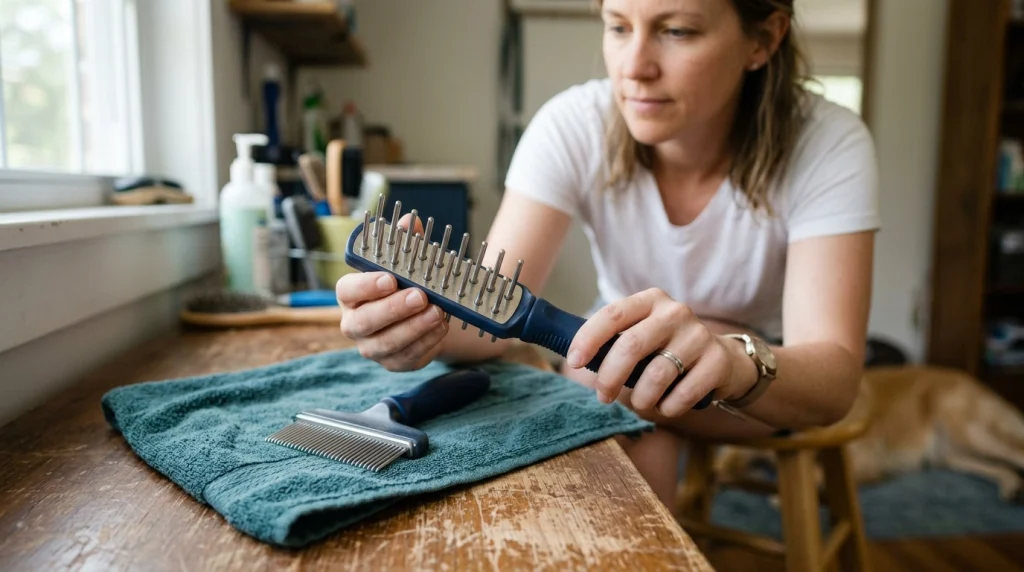
SaveLook for tooth length that matches the coat, smooth or rounded contact points, a comfortable handle, and enough spacing to move through dense fur. A good rake should give you control without requiring heavy pressure.
- Rounded teeth: Smooth tips reduce the chance of sharp contact against the skin.
- Suitable tooth length: Thick, long coats generally need more reach than shallow coats.
- Single or double row: Double rows may collect more loose coat, while a simpler row can offer easier control.
- Rotating pins: Some models use rotating teeth to reduce tugging through dense hair.
- Secure handle: A non-slip grip makes gentle pressure easier to maintain.
If you’re ready to pick one, these are three established styles I would compare first. Ratings below reflect retailer customer ratings checked in 2026, not my own laboratory scores.
🏆 Best for rotating pins
FURminator Grooming Rake
★★★★½ 4.7/5
It uses rounded stainless-steel pins that rotate, helping the tool move through long, dense fur with less tugging. I would look at this style first when smooth movement through a substantial coat matters more than aggressive hair removal.
💰 Best simple double row
JW Pet Gripsoft Double Row Undercoat Rake
★★★★½ 4.6/5
Two rows of round-tipped teeth lift loose undercoat, while the non-slip Gripsoft handle gives useful control. I like this straightforward design for owners who want a dedicated undercoat tool without moving into a blade-style de-shedder.
🐕 Best for thick dense coats
Safari Double Row Undercoat Rake
★★★★½ 4.6/5
Its two rows use varying pin lengths designed to reach into thick or dense coats, with rounded pins for gentler contact. I would compare this model when coat depth is the main problem and a short surface brush simply cannot reach enough loose fur.
Frequently asked questions
Does an undercoat rake cut the dog’s hair?
A traditional rake with smooth, rounded pins is mainly designed to pull out loose undercoat rather than cut healthy hair. However, grooming tools sold under similar names can use different tooth designs. Check the specific product before using it, particularly if the teeth have sharpened edges.
Should I use an undercoat rake before or after a slicker brush?
I usually prefer clearing obvious surface tangles first so the rake does not hit unnecessary resistance. After removing loose undercoat, a slicker or comb can finish the coat and reveal any sections that still need attention.
Can I use an undercoat rake every day?
Some manufacturers allow frequent use, but that does not mean every dog needs daily raking. Use the coat as your guide. When the rake stops collecting loose undercoat easily, switch to gentler routine brushing instead of repeatedly working the same skin.
Is an undercoat rake good for a short-haired dog?
It can be useful if the short-haired dog has a genuine dense undercoat, but the rake must match that shorter coat depth. A long-toothed rake on a shallow coat may contact the skin too easily and offer little advantage over a more suitable brush.
When should I stop using an undercoat rake?
Stop if you see redness, pain, skin scratches, repeated flinching, or resistance caused by a tight mat. You should also stop once loose undercoat is no longer releasing easily. Persistent skin or coat problems deserve advice from a veterinarian or qualified groomer.
Final takeaway
An undercoat rake is used to remove loose, trapped hair from beneath the outer coat of a double-coated dog. Used gently, it can make seasonal shedding and dense coat maintenance far easier.
The important part is restraint. Choose the correct tooth length, follow the direction of hair growth, clear mats first, and stop before the skin becomes irritated.
If you are unsure whether your dog has the right coat for a rake, part the fur and examine the layers before buying another brush. When the coat or skin looks abnormal, let your veterinarian or professional groomer help you choose the safer next step.

Thomas Cutter is a lifelong dog owner and the founder of FindOutAboutDogs.com. With over 10 years of hands-on experience owning multiple breeds, Thomas created this site to provide honest, research-based dog advice that real owners can actually trust.
