Best 10 Dog Breeds for No-Fence Homes — Picked for Low Roaming Risk
Quick Answer
The best dogs for a home with no fence are calm, people-focused breeds with low prey drive and little urge to roam. Top picks include the Bulldog, French Bulldog, Cavalier King Charles Spaniel, Pug, Boston Terrier, Havanese, Bichon Frise, Shih Tzu, Great Dane, and Newfoundland. These breeds bond tightly with their owners, ignore most wildlife, and rarely bolt out an open door. They still need a leash, basic recall training, and supervision outside — no breed is 100% safe off-leash without training.
What you need to know before you pick a breed:
- Low prey drive matters more than size when there’s no fence
- “Stays close to you” is a trained habit, not a fixed trait
- Even calm breeds need a leash near roads or open land
Fast fixes that make any breed safer without a fence:
- Teach a rock-solid recall before any off-leash time
- Use a GPS collar as a backup, not a replacement for training
- Close gaps at doors and gates with a training lead first
You open the front door, and your dog is already halfway down the driveway. No fence, no warning, just gone. That sinking feeling in your chest is one every unfenced-yard owner knows.
I’m a dog writer who has lived in three homes without a fence, and I’ve made every mistake in this article once. Some breeds make that mistake far less likely. Others practically guarantee it.
This guide covers the 10 dog breeds that do best when there’s no fence — plus the training and gear that make any of them safer. Let’s get into what actually keeps a dog close to home.
- Low prey drive and strong attachment to people matter more than breed size
- Hounds, terriers, and sighthounds are the riskiest choices without a fence
- A trained recall cuts escape risk more than any single breed trait
- GPS collars help you find a dog fast, but they don’t stop the wandering
- 2026 vet behaviorists still rank early recall training as the top safety factor


What Makes a Dog Breed Good for a No-Fence Home?
A dog breed suits a no-fence home when it has low prey drive, strong attachment to its owner, and low independence. These traits push a dog to stay near people instead of chasing scents, sounds, or small animals. Breeds built for hunting or herding score worst here, no matter how well-trained they are. Breeds built purely as companions score best.
Here’s the thing. Most escape stories aren’t about a bad dog. They’re about a breed doing exactly what it was bred to do — just in the wrong setting. A Beagle isn’t being naughty when it follows a scent for a mile. It’s doing its job.
Prey drive comes from centuries of selective breeding. The AKC groups breeds by original purpose, and that purpose still shapes behavior today. Hounds track scent. Terriers chase small animals. Herding breeds run circles around anything that moves. Toy and companion breeds were bred to do one thing: stay close to their person.
So what does that mean for you? If you don’t have a fence, skip the hound and terrier groups. Look at the Toy Group, most of the Non-Sporting Group, and a handful of calm Working breeds instead.
Most people assume a big dog needs a big fenced yard. In reality, a calm giant breed like a Great Dane or Newfoundland often roams less than a small terrier with a strong nose.
What Most People Get Wrong About No-Fence Dog Ownership
Most people believe an obedient dog will simply choose to stay in the yard. That’s not quite right. Even the calmest breed can bolt after a squirrel, a jogger, or a slammed car door. Training and breed choice lower the odds. Neither one removes the risk completely.
You might be thinking your dog would never run off because they’re always calm indoors. Here’s why that doesn’t hold up outside: indoor calm and outdoor impulse control are two different skills, and a dog can have one without the other.
Another common mix-up: people confuse “low energy” with “low roaming risk.” A lazy dog can still bolt in three seconds flat if a rabbit crosses its path. Energy level and prey drive are separate traits, and you need to check both.
The 10 Best Dog Breeds for No-Fence Homes — Ranked and Reviewed
Every dog on this list shares three traits: low prey drive, strong owner attachment, and a track record of staying close without constant correction. None of them are escape-proof. All of them make the job much easier than a hound or a husky would.
Bulldog — “The Homebody in a Wrinkly Coat”
 Save
Save| Weight | 40 to 50 lbs |
| Height | 14 to 15 inches |
| Lifespan | 8 to 10 years |
| Energy Level | Low |
| Grooming Need | Low, but check skin folds weekly |
| Shedding | Moderate, short coat |
The Bulldog is a low-energy companion breed known for staying close to home with almost no urge to roam. It weighs 40 to 50 lbs and stands about 14 inches tall. Bulldogs are stubborn but deeply loyal. They make an ideal choice for owners who want a calm dog that won’t bolt.
Their loose, wrinkled skin and stocky, rolling walk make them instantly recognizable. That heavy build is also exactly why they don’t sprint far.
Bulldogs love their people and hate exertion almost equally. A Bulldog will follow you room to room, then flop down the second you stop moving. That’s a “wow” most first-time owners don’t expect from a breed that looks so tough.
- Very low urge to chase or roam
- Content with short walks only
- Rarely reacts to squirrels or birds
- Overheats fast in warm weather
- Snores and drools noticeably
- Needs regular skin fold cleaning
Best for: Low-activity households · Warm-climate owners with shade · First-time dog owners
Calm dog breeds for apartment living, like the Bulldog
French Bulldog — “The Pocket-Sized Shadow”
| Weight | 16 to 28 lbs |
| Height | 11 to 13 inches |
| Lifespan | 10 to 12 years |
| Energy Level | Low to moderate |
| Grooming Need | Low |
| Shedding | Low to moderate |
The French Bulldog is a small companion breed built to stick close to its owner rather than explore alone. Weighing 16 to 28 lbs, it has low prey drive and little interest in chasing wildlife. Frenchies are playful, affectionate, and easily distracted by attention instead of scents.
Their bat ears and squished face give them a comic, expressive look. You’ll see the whole story on their face before they make a sound.
Most people know Frenchies as apartment dogs. What surprises new owners is how rarely they wander even off-leash in a park. Their real weakness isn’t roaming — it’s separation anxiety, which actually keeps them glued to your side.
- Stays within a few feet of owners outside
- Minimal digging or fence-testing behavior
- Great for small no-fence yards
- Poor heat tolerance, needs shade
- Prone to separation anxiety alone
- Higher vet costs for breathing issues
Best for: Apartment dwellers · Owners who work from home · Small-space living
Best dog breeds for small apartments, including the French Bulldog
Cavalier King Charles Spaniel — “The Velcro Dog with a Wagging Tail”
| Weight | 13 to 18 lbs |
| Height | 12 to 13 inches |
| Lifespan | 12 to 15 years |
| Energy Level | Moderate |
| Grooming Need | Moderate, weekly brushing |
| Shedding | Moderate |
The Cavalier King Charles Spaniel is a companion breed bred for centuries to sit beside people, not roam fields. At 13 to 18 lbs, it has a gentle, affectionate temperament and low prey drive. Cavaliers were originally lap dogs for royalty, and that instinct to stay close never left.
Their large, dark eyes and silky, feathered ears give them a soft, storybook look. It’s hard to walk past one without stopping to say hello.
Most spaniels were bred to flush game. Cavaliers are the odd exception — bred purely for companionship. So while the name says “spaniel,” the wandering instinct that word usually implies mostly skipped this breed.
- Bred purely for human companionship
- Friendly with strangers, rarely bolts to greet
- Adapts well to city and rural settings
- Prone to heart issues later in life
- Ears need regular cleaning
- Can develop separation anxiety
Best for: Seniors · Families with gentle kids · Owners wanting a lap companion
Best lap dog breeds for seniors, led by the Cavalier
Pug — “The Comedian Who Never Wanders Far”
| Weight | 14 to 18 lbs |
| Height | 10 to 13 inches |
| Lifespan | 13 to 15 years |
| Energy Level | Low |
| Grooming Need | Low, but face folds need care |
| Shedding | High for a short coat |
The Pug is a small, low-energy companion breed with almost no prey drive and a strong need for closeness. Weighing 14 to 18 lbs, Pugs were bred purely to keep emperors company. They rarely chase or wander, preferring naps and attention to exploring.
Their wrinkled face and curled tail make Pugs one of the most recognizable breeds around. That expressive face shows every emotion in real time.
Everyone expects Pugs to be lazy. What surprises new owners is how food-motivated they are — motivated enough that a treat in your pocket beats any squirrel in the yard.
- Very low prey drive around small animals
- Easily redirected with treats or toys
- Content with a small, unfenced yard
- Struggles badly in hot weather
- Prone to weight gain fast
- Breathing issues in brachycephalic lines
Best for: City living · Owners with mild climates · Families wanting a calm clown
Best dog breeds for city living, including the Pug
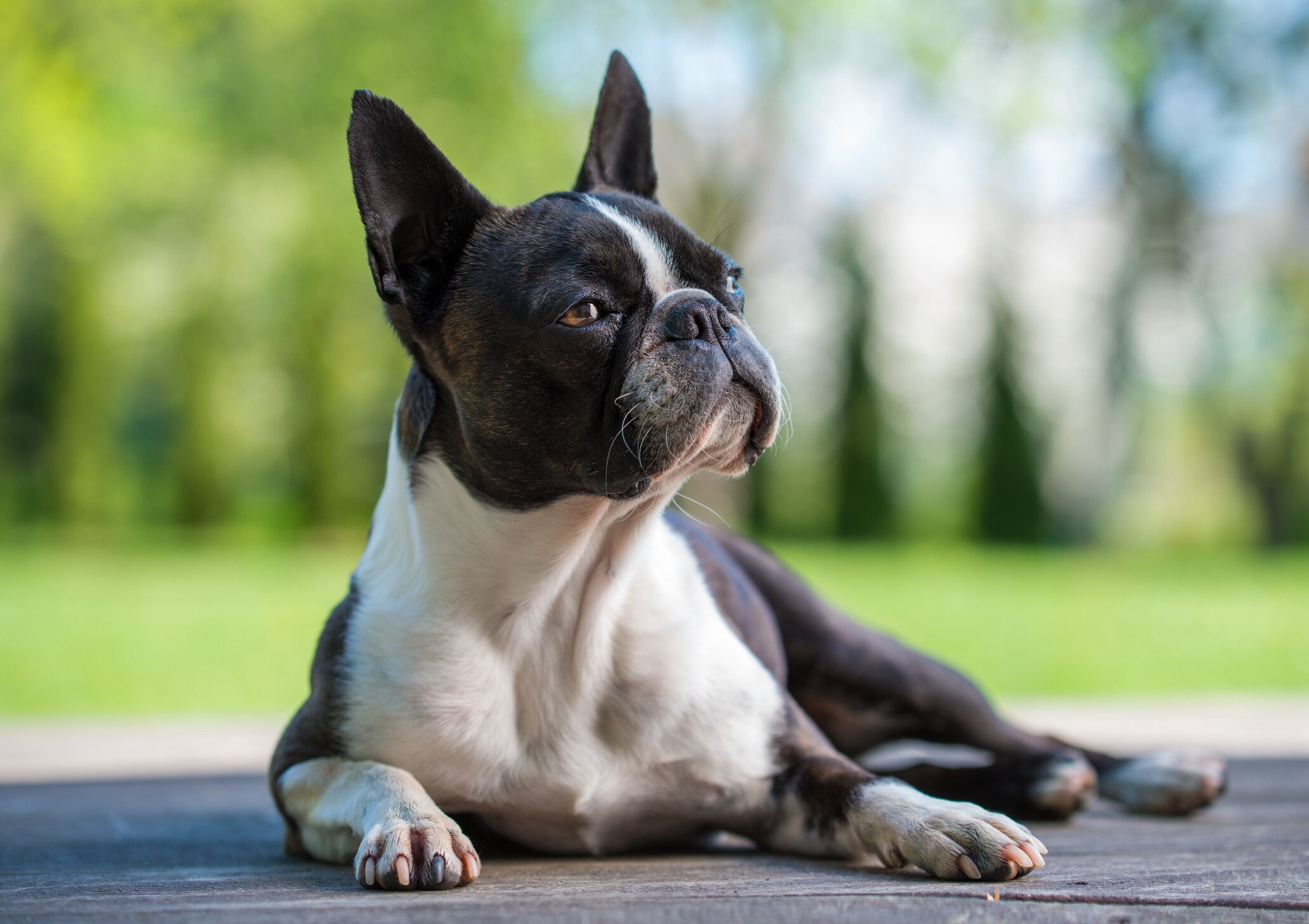
Boston Terrier — “The Tuxedo Dog That Stays on Task”
 Save
Save| Weight | 12 to 25 lbs |
| Height | 15 to 17 inches |
| Lifespan | 11 to 13 years |
| Energy Level | Moderate |
| Grooming Need | Low |
| Shedding | Low |
The Boston Terrier is a small, people-oriented breed with a low prey drive despite its terrier name. Weighing 12 to 25 lbs, it was bred as a companion, not a hunter. Bostons are alert and playful, but they check in with their owner constantly instead of wandering off alone.
Their black-and-white “tuxedo” coat and round, expressive eyes give them a dapper, always-dressed-up look.
Most terriers chase anything that moves. Bostons are the surprising exception, since generations of breeding for companionship, not vermin control, dialed that instinct way down.
- Checks in with owner every few minutes
- Low grooming and shedding needs
- Good recall with basic training
- Sensitive to heat and cold
- Can be gassy after some foods
- Prone to eye injuries and scratches
Best for: Active seniors · First-time owners · Small yards without fencing
Havanese — “The Velcro Dog with Silky Curls”
| Weight | 7 to 13 lbs |
| Height | 8 to 11 inches |
| Lifespan | 14 to 16 years |
| Energy Level | Moderate |
| Grooming Need | High, regular brushing |
| Shedding | Low |
The Havanese is a small companion breed nicknamed the “Velcro dog” for its habit of sticking close to its owner. Weighing 7 to 13 lbs, it has low prey drive and a strong dislike of being left alone. Havanese dogs would rather follow you around than explore on their own.
Their long, silky, wavy coat and springy trot give them a cheerful, bouncy look wherever they go.
People expect a small dog to be nervous outside. Havanese are the opposite — confident, social, and far more interested in people at the fence line than what’s beyond it.
- Rarely wanders more than a few feet away
- Low-shedding, allergy-friendlier coat
- Highly trainable and eager to please
- Coat needs brushing several times a week
- Prone to separation anxiety alone
- Can be vocal when excited
Best for: Allergy-conscious households · Owners home most of the day · Small unfenced yards
Hypoallergenic apartment breeds, including the Havanese
Bichon Frise — “The Cotton Ball with a Calm Heart”
| Weight | 12 to 18 lbs |
| Height | 9 to 11 inches |
| Lifespan | 14 to 15 years |
| Energy Level | Moderate |
| Grooming Need | High, needs regular trims |
| Shedding | Very low |
The Bichon Frise is a small, cheerful companion breed with a low prey drive and a strong bond to its family. Weighing 12 to 18 lbs, it was bred for centuries as a lapdog on sailing ships and in royal courts. Bichons prefer play with people over chasing anything outdoors.
Their fluffy white powder-puff coat curls into a rounded shape that looks almost cartoonish up close.
People assume a fluffy toy breed must be delicate and skittish. Bichons defy that — they’re sturdy, cheerful, and rarely spooked enough to run.
- Very low shedding and low prey drive
- Good-natured with strangers and pets
- Rarely bolts when startled
- Needs professional grooming often
- Prone to tear staining around eyes
- Can bark at doorbells and visitors
Best for: Allergy-sensitive families · Retirees · Multi-pet households
Shih Tzu — “The Ancient Lap Companion”
| Weight | 9 to 16 lbs |
| Height | 9 to 10.5 inches |
| Lifespan | 10 to 16 years |
| Energy Level | Low |
| Grooming Need | High |
| Shedding | Low |
The Shih Tzu is a small, low-energy breed bred in Chinese royal courts purely to be a lap companion. Weighing 9 to 16 lbs, it has almost no prey drive and little desire to explore alone. Shih Tzus prefer short strolls and quiet time close to their owner.
Their long, flowing double coat and round, dark eyes give them a regal, doll-like appearance.
Most owners expect a toy breed to be high-strung. Shih Tzus break that pattern with a laid-back, unbothered attitude toward almost everything outside.
- Very low prey drive and roaming urge
- Happy with short, slow outdoor time
- Calm around new people and pets
- Heavy coat needs daily brushing
- Poor tolerance for heat
- Prone to dental issues
Best for: Seniors · Owners in mild climates · Low-activity homes
Great Dane — “The Gentle Giant Who Won’t Sprint Off”
| Weight | 110 to 175 lbs |
| Height | 28 to 32 inches |
| Lifespan | 7 to 10 years |
| Energy Level | Low to moderate |
| Grooming Need | Low |
| Shedding | Moderate |
The Great Dane is a giant breed with a surprisingly calm, homebody temperament and low prey drive. Weighing 110 to 175 lbs, it prefers lounging near its family over roaming a yard. Great Danes are gentle, affectionate, and rarely motivated to chase wildlife.
Their towering frame and short, sleek coat make them look intimidating, though most act like oversized lap dogs.
People assume a giant breed needs a huge fenced run. In practice, most Danes would rather nap on the porch, which makes them safer without a fence than many small, high-drive dogs.
- Low motivation to chase or roam far
- Gentle and patient with family
- Content with moderate daily exercise
- Short lifespan for a large investment
- Large size means costly food and vet bills
- Not suited to very small homes
Best for: Homes with space indoors · Families wanting a calm giant · Experienced owners
Newfoundland — “The Water-Loving Homebody”
&qlt=85&resMode=sharp2&op_usm=1.75,0.3,2,0) Save
Save| Weight | 100 to 150 lbs |
| Height | 26 to 28 inches |
| Lifespan | 9 to 10 years |
| Energy Level | Low to moderate |
| Grooming Need | High |
| Shedding | High |
The Newfoundland is a calm, gentle giant bred to rescue swimmers, not chase prey. Weighing 100 to 150 lbs, it has one of the lowest prey drives among large breeds. Newfoundlands are famously patient and would rather stay near their family than wander.
Their thick, water-resistant double coat and sweet, drooping expression make them look like a giant, huggable bear.
Most people expect a working breed this size to have strong drive to run. Newfoundlands are the exception, since their job was staying near people in the water, not covering ground alone.
- One of the calmest large breeds outdoors
- Very low interest in chasing small animals
- Extremely patient with children
- Heavy shedding and drooling
- Needs cool spaces in warm weather
- Large size limits small-home living
Best for: Families with kids · Cooler climates · Owners wanting a calm guardian
Compare All 10 No-Fence-Friendly Breeds Side by Side
Comparing these breeds side by side shows a clear pattern: toy and companion breeds carry the lowest roaming risk, while giant breeds rank surprisingly close behind them. Size matters far less than temperament and original breeding purpose when there’s no fence involved.
| Breed | Weight | Prey Drive | Energy |
|---|---|---|---|
| Bulldog | 40 to 50 lbs | Very low | Low |
| French Bulldog | 16 to 28 lbs | Very low | Low to moderate |
| Cavalier King Charles Spaniel | 13 to 18 lbs | Low | Moderate |
| Pug | 14 to 18 lbs | Very low | Low |
| Boston Terrier | 12 to 25 lbs | Low | Moderate |
| Havanese | 7 to 13 lbs | Low | Moderate |
| Bichon Frise | 12 to 18 lbs | Low | Moderate |
| Shih Tzu | 9 to 16 lbs | Very low | Low |
| Great Dane | 110 to 175 lbs | Low | Low to moderate |
| Newfoundland | 100 to 150 lbs | Very low | Low to moderate |
Which of These Breeds Is Right for Your Home?
The right pick depends on your space, climate, and how much time you spend home. A small, low-energy breed suits a tight yard, while a calm giant breed needs more room indoors but rarely tests boundaries outside.
- If you live in a small yard with no fence → a Havanese, Bichon Frise, or Shih Tzu will suit you best.
- If you live somewhere hot and humid → skip flat-faced breeds like the Pug and Bulldog, and pick a Cavalier or Boston Terrier instead.
- If you have a large property and want a calm presence outside → a Great Dane or Newfoundland fits well.
- If you’re gone most of the day → avoid Havanese and French Bulldogs, since both are prone to separation anxiety.
Care Essentials Every New Owner Must Know Without a Fence
Even the calmest breed needs three things to stay safe without a fence: a trained recall, supervised outdoor time, and a backup ID system. Skipping any one of these raises the risk, no matter how low-drive the breed is.
- Start recall training indoors with high-value treats
- Practice in a quiet outdoor space on a long training lead
- Add distractions slowly once recall is reliable
- Fit a well-secured ID tag and microchip your dog
- Add a GPS collar as a backup, not the main safety plan
So what does that mean day to day? Even a Pug that never wanders still needs a leash near a road. A car doesn’t care how calm your dog’s temperament is.
Practice recall at the exact spot your dog is most likely to bolt from, like the front door or car.
Mistakes New No-Fence Owners Make (And How to Avoid Them)
The most common mistake is trusting breed temperament alone to keep a dog contained. Even a low-drive breed can slip out an open door in seconds. Training and supervision matter as much as breed choice.
Never assume a calm breed will stay put during fireworks, storms, or other sudden loud noises.
Other common mistakes include letting a puppy off-leash before recall is solid, skipping microchipping because “my dog never wanders,” and leaving a dog unsupervised near an open gate or driveway. As a result, small gaps in supervision cause far more escapes than breed choice ever does.
Is it ever safe to skip a fence and a leash entirely? Even with the calmest breed on this list, that’s a risk not worth taking. A leash, a trained recall, and basic ID protection matter more than the breed itself once your dog steps outside a controlled space.
Frequently Asked Questions
What is the calmest dog breed for a home with no fence?
The Bulldog and Shih Tzu rank among the calmest choices for no-fence homes. Both have very low energy and little urge to roam. Their biggest risks are heat sensitivity, not wandering off.
Can a dog stay safe outside without any fence at all?
No dog is fully safe outside without supervision, even with low prey drive. A trained recall, a leash near roads, and a securely fitted ID tag lower the risk significantly. Full off-leash freedom still carries some risk for any breed.
Do small dogs need a fence less than large dogs?
Not necessarily. Prey drive and temperament matter far more than size when it comes to roaming risk. A calm giant breed like a Newfoundland can be safer off-leash than a small, high-drive terrier.
Are GPS collars a good replacement for a fence?
GPS collars help you find a dog that has already wandered, but they don’t prevent the wandering itself. They work best alongside training, not as a standalone safety system.
What breeds should I avoid in a no-fence home?
Avoid scent hounds like Beagles, working herders like Border Collies, and high-prey sighthounds like Greyhounds. These breeds were bred to move independently over distance, which raises escape risk without a fence.
Conclusion: Pick the Right Breed, Then Build the Right Habits
Breed choice sets the odds in your favor, but training closes the gap that temperament alone can’t cover. Every dog on this list still needs a leash near roads and a solid recall before any off-leash time. That combination, not the fence, is what actually keeps your dog safe.
One thing to do right now: pick one high-value treat your dog goes wild for, and start a two-minute recall drill in your living room today. That small habit is the real fence your dog will respect.

Thomas Cutter is a lifelong dog owner and the founder of FindOutAboutDogs.com. With over 10 years of hands-on experience owning multiple breeds, Thomas created this site to provide honest, research-based dog advice that real owners can actually trust.
