Best 10 Dog Breeds for Big Families — Chosen by Breed Experts and Real Owners
Quick Answer
The best dog breeds for big families are gentle, patient, and sturdy enough to handle noisy, active kids. Golden Retrievers, Labrador Retrievers, and Bernese Mountain Dogs top the list for their calm temperaments and love of people. The right breed depends on your family’s activity level, home size, and grooming tolerance.
Top 10 dog breeds for big families:
- Golden Retriever — gentle, patient, loves everyone
- Labrador Retriever — playful, loyal, highest child-tolerance score
- Bernese Mountain Dog — calm giant, bonds deeply with all family members
- Beagle — compact, curious, great with kids of all ages
- Collie — loyal, herding instinct keeps kids safe
- Newfoundland — natural “nanny” dog, patient beyond belief
- Boxer — energetic, protective, endlessly playful
- Irish Setter — fast-moving fun, great for outdoor families
- Cavalier King Charles Spaniel — calm lap dog, perfect for quieter big families
- Standard Poodle — allergy-friendly, sharp, thrives in busy homes
Avoid these common mistakes when choosing a family dog:
- Choosing by looks instead of temperament
- Ignoring energy level vs. your family’s lifestyle
- Skipping socialization and early training
Picture six kids, a backyard, and one very patient dog who loves every single minute of the chaos. That dog exists. But it has to be the right breed.
I’m Thomas Cutter, and I’ve spent years researching dog breeds for families — talking to owners, trainers, and vets. Big families need a dog that’s sturdy, calm under pressure, and genuinely good with children. Not every breed fits that bill.
This article covers the 10 best dog breeds for big families in 2026. You’ll get real stats, honest pros and cons, and a clear decision guide so you can pick the right dog for your home.
- Temperament matters more than size or looks when choosing a family dog.
- Labrador Retrievers scored 94 out of 100 for child tolerance in a 2024 Banfield veterinary study — highest of any breed over 50 pounds.
- Most experts agree that early socialization is more important than breed alone.
- Active families need high-energy breeds. Quieter families need calmer dogs.
- Supervision and training are still essential — no breed is 100% bite-proof.


What Makes a Dog Breed Good for Big Families?
A big family is loud, unpredictable, and full of motion. Young kids grab. Toddlers stumble. Teens roughhouse. The right family dog handles all of this without skipping a beat.
According to the American Kennel Club, the most important traits for a family dog are a stable, predictable temperament; energy that matches your household; a size that fits your space; and grooming needs your family can realistically handle.
Here’s why that matters. A dog that gets overwhelmed by noise may snap. A dog with too much energy and no outlet will destroy your furniture. Matching the breed to your actual lifestyle is the single most important decision you’ll make.
Visit the breed in person before you commit. Ask the breeder or shelter to show you the dog around children. Watch how it reacts to noise and sudden movement.
What Most People Get Wrong About Family Dogs
Most people choose a dog based on how it looks in photos. That’s the wrong approach. A fluffy, adorable breed might be anxious around kids. A plain-looking mutt might be the most patient dog on the planet.
The second mistake is assuming any breed labeled “family-friendly” is automatically safe. No dog is. The American Veterinary Medical Association is clear: any dog can bite. It depends on the individual dog, its history, and how it’s raised.
So use this list as a starting point — not a guarantee. Train your dog. Socialize it early. Teach your kids how to interact with animals safely.
The 10 Best Dog Breeds for Big Families — Ranked and Reviewed
Each breed below was chosen based on temperament scores, real owner feedback, veterinary data, and fit for busy, multi-person households. Here they are.
1. Golden Retriever — “The Breed That Was Born for Big Families”
 Save
Save| Weight | 55–75 lbs |
| Height | 21.5–24 inches |
| Lifespan | 10–12 years |
| Energy Level | High |
| Grooming Need | High — brush 3–4x per week |
| Shedding | Heavy, year-round |
The Golden Retriever is a large sporting breed known for its gentle mouth and nearly limitless patience. It weighs 55 to 75 pounds and stands up to 24 inches tall. Golden Retrievers love children of all ages and rarely show stress in noisy environments. They’re highly trainable and eager to please, making them the top family dog recommendation from most veterinary and breed experts in 2026.
Goldens have a dense, water-repellent double coat that ranges from cream to rich gold. Their broad forehead and soft, dark eyes give them a permanently warm expression — like they’re always happy to see you.
Most people know Goldens are friendly. What they don’t know is that Goldens actively seek out children. They don’t just tolerate kids — they follow them around the yard. The surprising part? Goldens are also one of the most emotionally sensitive breeds. They pick up on your mood and adjust their energy to match.
“Our Golden once sat quietly next to our crying 3-year-old for 20 minutes without moving. She just leaned against him. He stopped crying.”
— Rachel M., Golden Retriever owner for 7 years
- Extremely patient with toddlers and babies
- Rarely shows aggression toward children
- Highly trainable — learns fast
- Sheds heavily — daily vacuuming required
- Needs 60+ minutes of daily exercise
- Prone to hip dysplasia and cancer
Best for: Families with young children · Active households · First-time dog owners
—
2. Labrador Retriever — “The World’s Most Trusted Family Dog”
| Weight | 55–80 lbs |
| Height | 21.5–24.5 inches |
| Lifespan | 10–12 years |
| Energy Level | Very high |
| Grooming Need | Low — weekly brushing |
| Shedding | Moderate to heavy |
The Labrador Retriever is a large sporting breed that earned the highest child-tolerance score — 94 out of 100 — in a 2024 Banfield veterinary study of all breeds over 50 pounds. It comes in black, yellow, and chocolate. Labs are endlessly patient, quick to train, and adapt to almost any family routine. Their short, easy-care coat makes them one of the lowest-maintenance large breeds.
Labs have a broad, blocky head and a thick, weather-resistant coat that feels almost velvety. Their “otter tail” — thick at the base and tapered at the tip — wags non-stop. Labs come in three classic colors: black, yellow, and chocolate.
You expect Labs to be friendly. They are. But here’s what surprises people: Labs also have a near-zero stress response to sudden loud noise. Kids screaming, doors slamming, birthday parties — Labs treat all of it as background music. The wow factor? A well-trained Lab will instinctively check on a child who falls down.
“Five kids under 10 in our house. Our Lab has never once growled, snapped, or even looked annoyed. He just wags and moves on.”
— James T., Labrador Retriever owner for 9 years
- Highest child-tolerance score in its size class
- Minimal grooming — short, easy-care coat
- Adapts well to large, noisy households
- Destructive when bored — needs daily exercise
- Prone to obesity without diet control
- Jumps enthusiastically — can knock toddlers over
Best for: Active families · Homes with multiple children · First-time large-breed owners
—
3. Bernese Mountain Dog — “The Gentle Giant Who Loves a Full House”
| Weight | 70–115 lbs |
| Height | 23–27.5 inches |
| Lifespan | 7–10 years |
| Energy Level | Moderate |
| Grooming Need | High — brush 3–5x weekly |
| Shedding | Heavy, especially spring and fall |
The Bernese Mountain Dog is a large working breed from Switzerland with a stunning tri-colored coat of black, white, and rust. It weighs up to 115 pounds but carries itself with surprising calm. Berners bond deeply with every member of a household — including the youngest ones. They’re patient, affectionate, and rarely startle, making them excellent for large, multi-child families.
Their thick, silky coat features a distinct rust-and-white pattern on a black base. Their deep chest and powerful frame hide a surprisingly gentle soul. One look at those soft, dark eyes and you understand why children gravitate toward them instantly.
Everyone expects big dogs to be calm. Berners actually are. What surprises owners is their deep attachment — Berners pick a favorite family and stick with them like glue. The wow factor? Berners have a natural instinct to place themselves between a child and anything that seems threatening. Nobody trained them to do it. It’s just who they are.
“My 2-year-old uses our Berner as a pillow every night. He hasn’t moved an inch to disturb her in 4 years.”
— Diane K., Bernese Mountain Dog owner for 4 years
- Deeply calm — not easily startled
- Bonds with every child in the home
- Moderate energy — no marathon exercise needed
- Shorter lifespan — 7 to 10 years only
- Heavy shedder — coat maintenance is real work
- Heat-sensitive — struggles in hot climates
Best for: Families with young children · Homes with a yard · Cooler climates
—
4. Beagle — “The Small Dog With a Big Family Heart”
| Weight | Under 20 lbs (13″) or 20–30 lbs (15″) |
| Height | 13–15 inches |
| Lifespan | 10–15 years |
| Energy Level | High |
| Grooming Need | Low — weekly brushing only |
| Shedding | Low to moderate |
The Beagle is a compact scent hound weighing up to 30 pounds with a cheerful, pack-oriented personality. Beagles were bred to work in groups — so a big, noisy family feels like home to them. They bounce back quickly from surprises and maintain a happy, upbeat mood. Research consistently shows that Beagles have predictable temperaments and low stress responses to children.
Beagles have a soft, tricolored coat — typically black, tan, and white — and iconic long, droopy ears. Their compact, muscular body is built for stamina. Their tail almost always stands upright, like a little white flag of joy.
People expect Beagles to be playful. They are. But they’re also deeply sociable in a pack-minded way — they want the whole family involved. The surprise? A bored Beagle will use its powerful nose to find trouble fast. Scent-driven escape artists, these dogs need a secure yard.
“Our Beagle sprinted through the house for 30 minutes with four kids chasing her — she loved every second and slept like a log.”
— Mark S., Beagle owner for 6 years
- Perfect size — sturdy but not overwhelming
- Loves being part of a group or “pack”
- Low grooming needs — easy to maintain
- Loud baying — not ideal for thin walls
- Escape artist — needs a secure fence
- Strong nose distracts from training
Best for: Families with school-age kids · Homes with a fenced yard · Owners who enjoy active play
—
5. Collie — “The Loyal Protector Who Keeps a Watchful Eye”
 Save
Save| Weight | 50–75 lbs |
| Height | 22–26 inches |
| Lifespan | 12–14 years |
| Energy Level | Moderate to high |
| Grooming Need | High — brush weekly, more in shedding season |
| Shedding | Moderate to heavy |
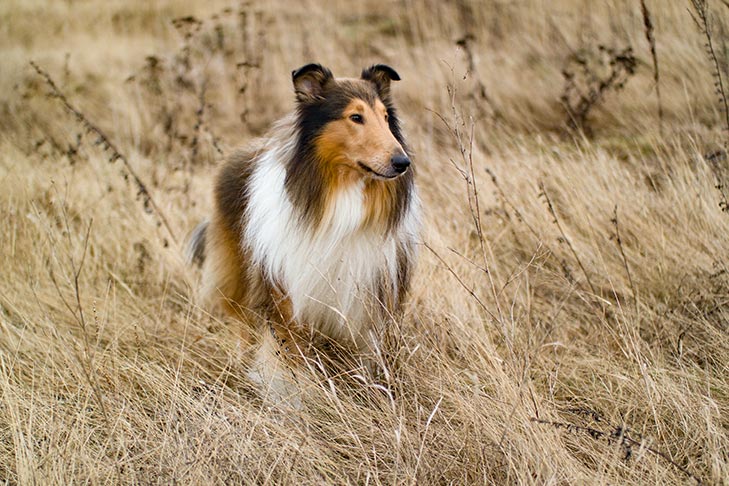
The Rough Collie is a large herding breed known for its loyalty, intelligence, and instinctive protectiveness around children. It weighs up to 75 pounds and lives 12 to 14 years. Collies are well-behaved, highly trainable, and adaptable to busy home environments. In herding tests, about 87% of Collies maintain focus even when children are running nearby — a strong signal of steady temperament.
Rough Collies have a magnificent mane of fur around the neck and chest, tapering to a fine, elegant face. Their sable-and-white or blue merle coloring is instantly recognizable. They carry themselves with a quiet dignity that makes them look almost regal.
Everyone knows Lassie was a Collie. What most don’t know is that the protective instinct is real — not just Hollywood. Collies have been documented alerting parents when children wandered too close to danger. The wow factor is their memory: Collies recall the specific routes and routines of every family member and notice when something is off.
“She once blocked the gate to the pool when my son tried to open it alone. She’d never been trained to do that. She just did it.”
— Linda F., Rough Collie owner for 11 years
- Natural protective instinct around kids
- Long lifespan — 12 to 14 years
- Calm in chaotic environments
- Heavy shedder — coat needs real commitment
- May try to “herd” small running children
- Sensitive to harsh training methods
Best for: Families wanting a natural protector · Homes with older kids · Experienced dog owners
—
6. Newfoundland — “The Original Nanny Dog for Big Families”
| Weight | 100–150 lbs |
| Height | 26–28 inches |
| Lifespan | 9–10 years |
| Energy Level | Low to moderate |
| Grooming Need | High — brush several times per week |
| Shedding | Heavy, constant |
The Newfoundland is a massive working breed weighing up to 150 pounds, widely known as the most patient and gentle dog in the world. The AKC rates Newfoundlands 5 out of 5 for affection with family and 5 out of 5 for being good with young children. Their calm, tolerant nature and instinct to protect children from danger makes them a legendary choice for large families.
Newfoundlands have a thick, water-resistant double coat in black, brown, or Landseer (black and white). Their massive frame — up to 150 pounds — is offset by a face so soft and soulful it could stop a stranger in their tracks. They move slowly and deliberately, which is actually a safety bonus around small kids.
People know Newfoundlands are big and calm. What surprises owners is the instinctive lifesaving behavior. Newfoundlands were bred for water rescue — and that instinct extends to children around pools or rivers. The wow factor? Multiple documented cases exist of Newfoundlands pulling children out of water with no training at all.
“Our Newf weighs 130 lbs and lets our 4-year-old drape herself completely across his back. He just sighs and stays still.”
— Patricia W., Newfoundland owner for 5 years
- Rock-solid patience — rarely startled or stressed
- Natural instinct to protect children
- Low energy — calm indoors
- Drools heavily — not for tidy homes
- Food and vet costs are very high
- Short lifespan — 9 to 10 years
Best for: Families with very young children · Homes near water · Families with space for a large dog
—
7. Boxer — “The Energetic Comedian Every Big Family Deserves”
| Weight | 65–80 lbs |
| Height | 21.5–25 inches |
| Lifespan | 10–12 years |
| Energy Level | Very high |
| Grooming Need | Very low — short coat, minimal brushing |
| Shedding | Low |
The Boxer is a medium-to-large working breed with a muscular build, a flat face, and a personality that’s part clown, part guard dog. It weighs up to 80 pounds and is one of the lowest-shedding large family breeds. Boxers are fiercely loyal, endlessly playful, and naturally protective — a combination that big, active families find unbeatable.
Boxers have a short, shiny coat in fawn or brindle, often with white markings. Their square, pushed-in muzzle gives them a permanently alert, slightly baffled expression. Their powerful hindquarters let them jump higher than their size suggests — something to remember around small children.
Owners expect Boxers to be energetic. They are — but what catches people off guard is their puppy-like behavior well into adulthood. Boxers often “forget” they’re 70-pound dogs and try to sit in laps. The wow factor? Boxers are naturally suspicious of strangers but instantly read a child as “safe.” That distinction happens in seconds.
“Our Boxer went from destroying a chew toy to gently carrying our 2-year-old’s stuffed rabbit to her without being asked. That dog reads our kids.”
— Carlos R., Boxer owner for 8 years
- Very low shedding — easy to clean up
- Naturally protective of family members
- Thrives with active, playful older kids
- Jumps with force — risky near toddlers
- Needs 90+ minutes of daily activity
- Brachycephalic — struggles in heat
Best for: Active families · Families with kids aged 6 and up · Owners wanting low shedding
—
8. Irish Setter — “The Fast, Fun Dog for Outdoor Family Adventures”
| Weight | 60–70 lbs |
| Height | 25–27 inches |
| Lifespan | 12–15 years |
| Energy Level | Very high |
| Grooming Need | Moderate — brush weekly, trim feathering |
| Shedding | Moderate |
The Irish Setter is a large sporting breed from Ireland with a stunning mahogany-red coat and a joyful, high-energy personality. It weighs 60 to 70 pounds and can live up to 15 years — one of the longest lifespans among large family breeds. Irish Setters are outgoing, enthusiastic, and deeply affectionate, making them a standout choice for families who love the outdoors.
Their silky, rich chestnut coat flows along their legs and underbelly in elegant feathering. They move with a fluid, athletic grace — built for open fields, but equally happy in a large backyard. Their long, expressive ears frame a face full of warmth.
Everyone expects Irish Setters to be active — and they’re right. But what owners discover is that this breed thrives emotionally on family chaos. They don’t get overstimulated. They get energized. The surprise? Irish Setters are one of the few breeds that actually improves in behavior the more people are around. Solitude is their enemy.
“She sprints with the kids, sits calmly at dinner, then does it all again. She matches our energy like no dog I’ve ever owned.”
— Anne B., Irish Setter owner for 12 years
- Long lifespan — up to 15 years
- Thrives in large, chaotic households
- Gentle and non-aggressive with children
- Needs 90+ minutes of daily exercise
- Struggles alone — separation anxiety is common
- Slow to mature — acts like a puppy for 3+ years
Best for: Outdoor-loving families · Families who are home most of the day · Active households with teens
—
9. Cavalier King Charles Spaniel — “The Gentle Soul for Calmer Big Families”
| Weight | 12–18 lbs |
| Height | 12–13 inches |
| Lifespan | 12–15 years |
| Energy Level | Low to moderate |
| Grooming Need | Moderate — brush 3x per week |
| Shedding | Moderate |
The Cavalier King Charles Spaniel is a small toy breed weighing 12 to 18 pounds with a naturally calm, affectionate temperament perfectly suited for gentler big families. Cavaliers are patient, cuddly, and non-reactive — they adapt beautifully to home routines. They bond closely with every person in the household and are considered one of the most child-friendly small breeds by veterinary behaviorists.
Cavaliers have silky, flowing coats in Blenheim (chestnut and white), tricolor, ruby, or black and tan. Their large, round, dark eyes give them a permanently sweet, soulful look. At 12 to 13 inches tall, they fit comfortably in a child’s arms without overwhelming them.
People expect Cavaliers to be calm. They are. But what surprises families is how deeply they connect with each individual child. A Cavalier doesn’t just like the family — it assigns itself to certain kids and prioritizes them. The wow factor? Cavaliers are widely used as therapy dogs precisely because they sense emotional distress and respond to it instinctively.
“My son has autism. Our Cavalier goes to him the moment he starts to get overwhelmed. Nobody taught her that. She figured it out herself.”
— Susan L., Cavalier King Charles owner for 3 years
- Gentle and non-reactive — safe near toddlers
- Small size — fits smaller living spaces
- Bonds closely with each family member
- Prone to serious heart conditions after age 5
- Vet costs can be high due to health issues
- Not suited for rough, very active play
Best for: Calmer families · Children with sensory sensitivities · Apartment or smaller-home families
—
10. Standard Poodle — “The Smartest Allergy-Friendly Pick for Busy Families”
 Save
Save| Weight | 40–70 lbs |
| Height | Over 15 inches |
| Lifespan | 10–18 years |
| Energy Level | High |
| Grooming Need | Very high — professional grooming every 6–8 weeks |
| Shedding | Very low — hypoallergenic coat |
The Standard Poodle is a large non-shedding breed and one of the most intelligent dogs in the world. It weighs up to 70 pounds and has a lifespan of up to 18 years. Standard Poodles are gentle, patient, and fast to learn household rules. Their low-shedding coat makes them the top pick for big families where one or more members have dog allergies.
Their dense, curly coat grows continuously rather than shedding — meaning less dander and less mess. Standard Poodles come in a wide range of solid colors: black, white, apricot, red, silver, and more. Their athletic, square build is surprisingly graceful in motion.
Everyone thinks Poodles are fancy, high-maintenance show dogs. They’re not — they’re working dogs with sharp minds and a deeply playful spirit. What surprises families is how quickly Poodles adapt their behavior to each child in the home. The wow factor? Standard Poodles can learn a new command in fewer than five repetitions — faster than almost any other breed.
“My son has severe allergies. Our Poodle changed everything. No sneezing, no reactions, and the dog learned 20 commands in two weeks.”
— Elaine G., Standard Poodle owner for 10 years
- Hypoallergenic — ideal for allergy households
- Learns faster than almost any other breed
- Long lifespan — up to 18 years
- Professional grooming costs add up fast
- Bored Poodles invent mischief quickly
- Needs daily mental stimulation — not just walks
Best for: Families with allergies · Owners who love training · Multi-child households that want a long-lived dog
—
Quick Comparison: All 10 Family Dog Breeds Side by Side
Here’s a fast-scan view of all 10 breeds. Use it to compare at a glance before diving deeper.
| Breed | Size | Energy | Shedding | Lifespan | Best For |
|---|---|---|---|---|---|
| Golden Retriever | Large | High | Heavy | 10–12 yrs | Toddlers, first-time owners |
| Labrador Retriever | Large | Very high | Moderate | 10–12 yrs | Active families, any age kids |
| Bernese Mountain Dog | Large | Moderate | Heavy | 7–10 yrs | Gentle families, young kids |
| Beagle | Small/Med | High | Low/Mod | 10–15 yrs | School-age kids, small homes |
| Collie | Large | Moderate/High | Moderate | 12–14 yrs | Families wanting a protector |
| Newfoundland | Giant | Low/Mod | Heavy | 9–10 yrs | Very young children, large homes |
| Boxer | Large | Very high | Low | 10–12 yrs | Active families, older kids |
| Irish Setter | Large | Very high | Moderate | 12–15 yrs | Outdoor families, teens |
| Cavalier King Charles | Small | Low/Mod | Moderate | 12–15 yrs | Gentler families, smaller homes |
| Standard Poodle | Large | High | Very low | 10–18 yrs | Allergy families, any age kids |
Which Dog Breed Is Right for Your Big Family?
Here’s the honest truth: the “best” family dog is the one that fits your family’s actual lifestyle. Here’s how to match the right breed to your situation.
- If you have kids under 5 and want the safest option → Newfoundland or Golden Retriever
- If you have an active family who hikes and plays outside daily → Labrador Retriever or Irish Setter
- If someone in your home has dog allergies → Standard Poodle
- If you want a natural protector without aggression → Collie or Boxer
- If your family is calmer and prefers indoor life → Cavalier King Charles Spaniel or Bernese Mountain Dog
- If you want a smaller dog that still loves a big family → Beagle
This article covers the top 10 most widely recommended family breeds. If your family has specific needs — a child with a dog phobia, a baby under 12 months, or a dog-reactive household — consult a professional trainer or veterinary behaviorist before choosing your breed. Temperament testing by a professional adds a valuable layer of safety.
Common Mistakes Big Families Make When Choosing a Dog
Here’s something most “best family dog” articles won’t tell you: the breed matters less than the match. Most family dog problems come from avoidable mistakes made before the dog even comes home.
Mistake 1: Choosing by size or looks. A massive Newfoundland might look perfect. But if your family is never home, it will suffer. Appearance has nothing to do with fit.
Mistake 2: Skipping the energy audit. Ask yourself: how much exercise does your family actually get each week — not in theory, but in practice? High-energy breeds like Labs and Irish Setters need daily outlets. If they don’t get them, the couch does.
Mistake 3: Assuming “family-friendly” means “no training needed.” Every dog on this list still needs early socialization, consistent boundaries, and positive reinforcement. Research consistently shows that training during the first 12 to 16 weeks of a dog’s life has the greatest impact on adult behavior.
Before bringing any dog home, have every family member — including kids — meet the dog at least twice in different settings. One meeting is not enough to judge temperament.
What to Do After You Choose Your Family Dog Breed
Choosing the breed is step one. Here’s what most families forget to plan for next.
- Puppy-proof the home — remove hazards at floor level.
- Book a vet appointment within 48 hours of arrival.
- Enroll in a puppy socialization class within the first 2 weeks.
- Teach children the rules: no pulling, no cornering, no disturbing during sleep.
- Set up a quiet “safe zone” where the dog can rest undisturbed.
So what does that mean for your family? If you skip even one of these steps, you risk a stressful first month — for the dog and for your kids. A calm arrival sets the tone for years.
Frequently Asked Questions
What is the best dog breed for a family with young children?
Most experts agree that Golden Retrievers and Labrador Retrievers are the top choices for families with young children. Both breeds have exceptionally patient temperaments, low aggression levels, and a natural affinity for kids. A Newfoundland is also worth serious consideration for toddler-age families due to its instinctive protective behavior.
What dog breeds are good for big families in small homes or apartments?
The Beagle and Cavalier King Charles Spaniel are the best options for big families in smaller living spaces. Both are compact, adapt well to indoor life, and have moderate exercise needs. A Standard Poodle is also a strong choice for allergy-sensitive families, as it sheds very little despite being a larger breed.
Is it safe to have a large dog with young children?
Yes — large, well-trained, socialized dogs are safe around young children. In fact, several large breeds like Newfoundlands and Golden Retrievers consistently rank among the safest family dogs. The key is always supervision, early socialization, and teaching children to respect the dog’s space and signals.
How much daily exercise does a family dog need?
It depends on the breed. High-energy breeds like Labrador Retrievers and Irish Setters need 60 to 90 minutes of exercise per day. Calmer breeds like Cavalier King Charles Spaniels need only 30 to 40 minutes. Matching the breed’s energy level to your family’s lifestyle is one of the most critical decisions you’ll make.
Should a big family get a puppy or an adult dog?
Adult dogs are often the safer and easier choice for big families. Their temperament is already established — you know exactly what you’re getting. Puppies require intensive time and training that busy families may struggle to provide consistently. Adopting a tested adult dog from a reputable rescue is widely recommended by family dog experts.
Picking the right dog for a big family comes down to one thing: honest self-assessment. Know your energy level, your space, your kids’ ages, and your grooming tolerance — then match the breed to those realities. Every breed on this list is wonderful. The question is which one fits your life.
My advice — from everything I’ve researched and heard from real owners — is to start with temperament. Energy and grooming you can manage. Temperament is everything. I’m Thomas Cutter, and I hope this guide helps your family find exactly the right dog for your home in 2026.

Thomas Cutter is a lifelong dog owner and the founder of FindOutAboutDogs.com. With over 10 years of hands-on experience owning multiple breeds, Thomas created this site to provide honest, research-based dog advice that real owners can actually trust.
