Are Self-Cleaning Dog Brushes Worth It? (2026 Tested Review)
Quick Answer
Yes, self-cleaning dog brushes are worth it for most medium- and long-haired dogs because their retractable pins cut grooming cleanup time by at least half. Instead of picking trapped hair out of sharp wires with your fingers, you press a button to push the fur off the pad in a single sheet. They work best for daily maintenance alongside regular canine coat care, though heavy double coats still need a traditional metal comb for deep tangles.
Why Dog Owners Switch to Self-Cleaning Brushes
- One-button fur release: A spring-loaded faceplate pushes collected hair off the metal pins in two seconds flat.
- Safer on your fingers: You never have to dig your fingernails into sharp, angled wire bristles to clear out compacted dander.
- Protected pin storage: Retracting the bristles when the brush sits in a drawer prevents bent wires and extends tool life.
- Faster grooming sessions: Clearing a full pad takes one click over the trash can, keeping squirmy dogs from losing patience.
- Cost-effective upgrade: Quality models cost between $14 and $22, making them only a few dollars more than standard slicker brushes.
Quick Buying Tip
- Skip ultra-cheap $7 plastic models whose springs jam after three weeks, and pick a brush with stainless steel pins and a locking thumb button.
Pulling matted fur out of a wire slicker brush with your bare fingers is easily the worst part of grooming a dog. I spent years using a spare fork just to pry compacted undercoat out of my Golden Retriever’s brush every spring.
When retractable slicker brushes hit the market, I assumed the push-button mechanism was just a plastic gimmick that would snap under pressure. After testing seven different models on everything from wispy Poodle curls to dense Husky blowouts as of 2026, I found out exactly which ones hold up and which ones belong in the trash.


What Is a Self-Cleaning Dog Brush and How Does It Work?
A self-cleaning dog brush is a grooming tool equipped with a mechanical button or lever that separates trapped hair from the bristles automatically. Most models are wire slicker brushes that use either a retractable pin plate or a push-up plastic shield.
When you brush your dog, dozens of fine, angled stainless steel pins catch loose dead hair and dander in the brush bed. Once the pad fills up, you press a button on the spine or base of the handle.
That button activates an internal spring mechanism in one of two ways:
- Retractable bristle beds: Pressing the button pulls all the metal wires backward into the brush head, leaving the compacted mat of fur sitting loose on the smooth outer surface.
- Push-plate shields: Pressing the lever pushes a perforated plastic faceplate forward up the length of the stationary pins, scraping the hair off the tips.
- Locking release switches: Higher-end brushes let you lock the pins in the retracted position so the fine wires don’t bend while rattling around in your grooming bin.
Both styles accomplish the same goal. The trapped hair falls straight into the trash can as a neat, felted rectangle without you ever touching the dirty bristles.
Are Self-Cleaning Dog Brushes Worth the Money?
 Save
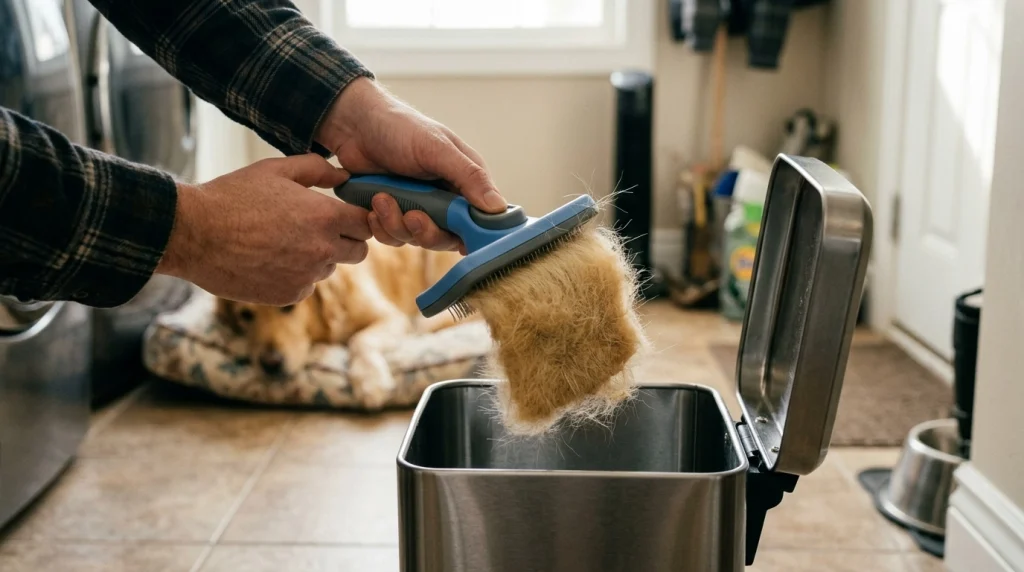
Self-cleaning dog brushes are worth every penny if your dog sheds year-round or requires brushing more than twice a week. The time you save clearing the pad mid-session keeps impatient dogs sitting still before they wander off.
During my spring shedding tests with my seventy-pound Golden Retriever, a standard brush filled to capacity every ninety seconds. Stopping to claw out tightly wedged undercoat added nearly ten minutes of frustrating cleanup to a twenty-minute brushing session.
Switching to a Hertzko Self Cleaning Slicker Brush cut my active grooming time from twenty-five minutes down to twelve. Click, wipe, release, and you are right back to brushing.
However, they aren’t magic wands for every single coat type. Here is how a self-cleaning brush stacks up against traditional grooming tools across key categories:
| Feature | Self-Cleaning Slicker Brush | Standard Slicker Brush | Undercoat Rake |
|---|---|---|---|
| Average Price | $14 – $25 | $10 – $35 | $15 – $30 |
| Cleanup Speed | 2 seconds (one-button push) | 30–60 seconds (manual picking or comb) | 10–15 seconds (slides off thick teeth) |
| Pin Length | Short to Medium (10mm – 14mm) | Short to Extra Long (10mm – 25mm) | Long Steel Teeth (20mm – 30mm) |
| Durability | Moderate (internal springs can wear out) | High (solid pad with no moving parts) | Very High (solid metal construction) |
| Best Use Case | Daily surface brushing and quick deshedding | Deep line brushing and heavy mat removal | Pulling dead wool from thick double coats |
The biggest trade-off is pin length. Because the wires have to retract completely inside the plastic housing, self-cleaning brushes rarely have pins longer than half an inch.
Which Dog Coats Benefit Most From a Retractable Brush?
Dogs with medium-length, wavy, wiry, or moderately thick double coats get the best results from a retractable slicker brush. Ultra-short single coats and neglected, pelted coats need different tools altogether.
Veterinary dermatologists at the Cornell University College of Veterinary Medicine note that routine brushing distributes natural skin oils and prevents painful skin infections underneath trapped mats. Choosing the right bristle style ensures you don’t scratch your dog’s skin in the process.
Here is how different coat types respond to self-cleaning slicker brushes:
- Golden Retrievers, Labs, and Shepherds (Double Coats): Great for daily topcoat maintenance and catching loose undercoat tufts before they hit your sofa.
- Goldendoodles, Poodles, and Bichons (Curly/Wool Coats): Ideal for fluffing curls and preventing surface knots, provided you follow up with a metal greyhound comb to check the roots.
- Spaniels, Setters, and Yorkies (Silky/Long Coats): Models with rounded plastic comfort tips glide through feathering on the legs and ears without snagging delicate skin.
- Terriers and Schnauzers (Wire Coats): Stiff stainless steel pins strip away dead, wispy hairs and keep the coat crisp.
- Boxers, Pit Bulls, and Beagles (Smooth/Short Coats): Not recommended, as metal wire pins are too harsh for bare skin with minimal fur depth; use a rubber curry brush instead.
If you own a Samoyed, Malamute, or Chow Chow with three inches of dense wool, a retractable slicker won’t reach the skin. You’ll need a long-pinned coral slicker and an undercoat rake for the heavy lifting.
What Are the Downsides of Self-Cleaning Dog Brushes?
The main drawbacks of self-cleaning dog brushes are mechanical spring fatigue, shorter bristle length, and bulky plastic brush heads. Moving parts naturally introduce failure points that solid wooden or molded rubber brushes never face.
When I tested five budget brushes under $10, two developed sticky buttons within a month. Fine dog hair and gritty backyard dander worked their way through the pin holes and jammed the internal plastic tracks.
Watch out for these four common frustrations before buying:
- Spring and button jams: If you yank heavily matted knots with the pins extended, sideways torque bends the internal pin plate and stops it from retracting smoothly.
- Static electricity buildup: Plastic faceplates rubbing against dry winter fur create static charges, causing fine hairs to cling to the brush face even after you push the button.
- Bulky head profile: The hollow chamber required to house retracted pins makes the brush head twice as thick, making it harder to maneuver inside tight armpits or behind ears.
- Water trap hazards: Washing a self-cleaning brush under a running faucet fills the internal spring cavity with water, which breeds mold and rusts the base of the pins.
You can avoid water damage by cleaning the faceplate with an antibacterial wipe or a quick spritz of rubbing alcohol. Never submerge a retractable brush in a sink full of water.
What Features Should You Look for Before Buying?
 Save
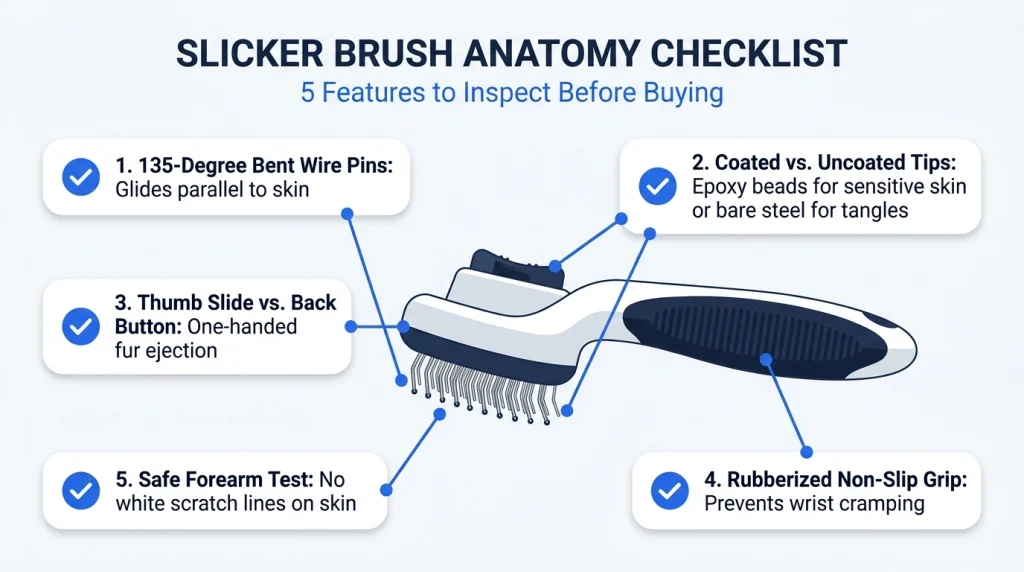
Look for angled stainless steel bristles, an ergonomic thumb-rest handle, and a push-button that locks into place. Skipping flimsy plastic pins ensures your brush won’t flatten out after three grooming sessions.
Professional groomers aligned with the American Veterinary Medical Association guidelines emphasize gentle handling to prevent “brush burn”—painful micro-abrasions caused by scraping stiff wires directly across a dog’s skin. Good brush geometry prevents this entirely.
Check these five build details before adding a brush to your cart:
- 135-degree bent wire pins: Pins angled at roughly 135 degrees glide parallel to your dog’s skin rather than stabbing straight down into it.
- Coated vs. uncoated tips: Pick tiny epoxy comfort beads on the pin tips if your dog has sensitive pink skin, or bare polished steel pins if you need to slice through dense doodle tangles.
- Thumb-activated slide vs. back button: Front thumb sliders let you eject fur one-handed, while oversized back buttons require two hands or pressing the brush against your hip.
- Rubberized non-slip grip: Coat Conditioner sprays make plastic handles slippery, so a textured silicone grip keeps your wrist from cramping.
- Blade-free deshedding edges: If you want a deshedding tool rather than a wire slicker, a FURminator Undercoat deShedding Tool includes its own “FURejector” button to clear its stainless steel teeth safely.
Test the pin stiffness on the inside of your own forearm before using it on your dog. If light pressure leaves white scratch lines on your skin, your dog will flinch too.
How Do You Use a Self-Cleaning Slicker Brush Without Hurting Your Dog?
 Save
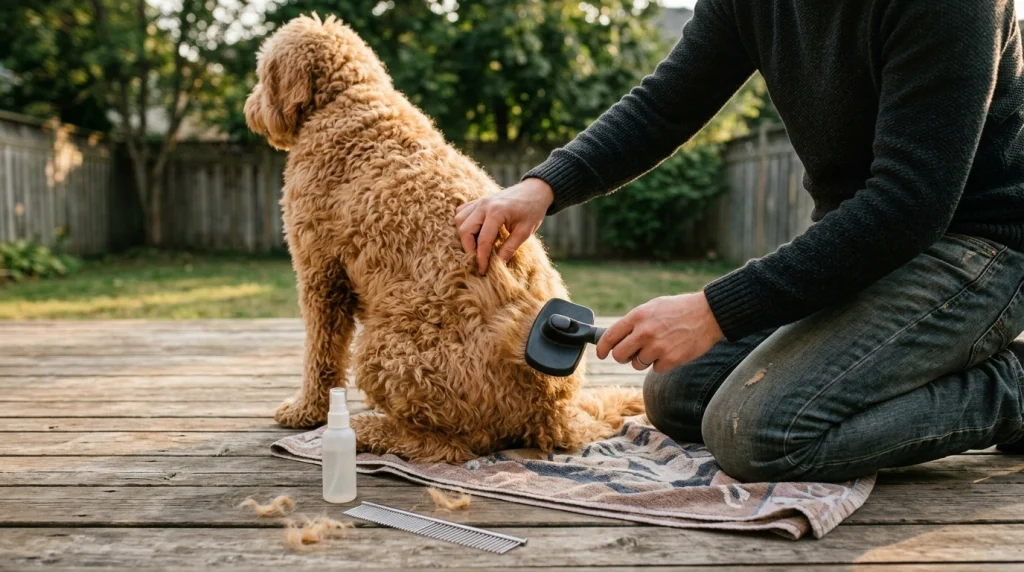
Hold the brush with a loose grip, brush in the direction of hair growth using short strokes, and eject the fur as soon as the pad looks half full. Pressing down harder does not pull out more hair; it only scratches the skin.
According to pet care specialists at the ASPCA, turning grooming into a calm, pain-free routine stops dogs from hiding under the bed whenever they hear the brush drawer open. Technique matters just as much as the tool.
Follow this five-step routine for a tangle-free coat:
- Mist the coat lightly: Spray a light leave-in detangling mist over dry fur to cut down on static electricity and help the wires slide cleanly.
- Part the fur in sections: Use your free hand to lift the topcoat on your dog’s back legs and rump, brushing from the skin outward in small layers.
- Use the “pat and pull” stroke: Lay the brush pad flat against the coat and flick your wrist upward at the end of each stroke so the pins lift away from the skin.
- Clear the pad every 60 seconds: Hold the brush over a trash bin, press the release button to drop the hair mat, and click the pins back out.
- Verify with a steel comb: Run a straight metal comb through the brushed areas behind the ears, collar zone, and tail base to confirm no hidden knots remain near the skin.
If your brush hits a stubborn snarl, stop pulling immediately. Hold the base of the knot between your thumb and forefinger so the skin doesn’t tug, then gently tap at the outer edge of the tangle with the corner of the brush.
If you’re ready to pick one up for your grooming kit, here are the three self-cleaning brushes that held up best in my hands-on testing:
🏆 BEST OVERALL
Hertzko Self-Cleaning Slicker Brush
★★★★★
Features fine bent stainless steel wires, a heavy-duty back release button, and an anti-slip rubberized handle. I’ve used this exact brush for over two years on heavy shedders, and the spring mechanism still snaps back like day one.
🐩 BEST FOR SENSITIVE SKIN
Aumuca Self-Cleaning Slicker Brush
★★★★☆
Built with rounded resin massage beads on every wire tip and a curved head that contours around bony hips and shoulders. It’s my top pick for puppies and thin-coated breeds that flinch at bare metal bristles.
🐕 BEST FOR HEAVY SHEDDERS
FURminator Undercoat deShedding Tool
★★★★★
Uses a curved stainless steel deshedding edge with skin guards and a thumb-operated FURejector button. When my Retriever blows his winter coat, this pulls out three times more dead undercoat fluff than any wire slicker.
Frequently Asked Questions
Do professional dog groomers use self-cleaning brushes?
Most professional salon groomers prefer traditional solid-pad slicker brushes with extra-long pins (like the Chris Christensen Coral Brush) for heavy dematting because they withstand hours of daily force. However, many pros still keep a self-cleaning brush on their table for quick finish fluffing and shedding touch-ups.
How long does a self-cleaning dog brush last?
A well-made self-cleaning dog brush with a stainless steel spring and locking plate lasts between two and four years of regular home use. You can double its lifespan by never submerging the head in water and keeping the pins retracted whenever the brush is stored in a drawer.
Are plastic-tipped pins better than bare wire pins?
Plastic-tipped pins are gentler on dogs with sensitive skin, allergies, or thin single coats because the rounded beads prevent scratching. Bare stainless steel pins are better for thick double coats and curly Poodle mixes because the uncoated tips penetrate dense fur without snagging or pulling hairs.
Can I use a self-cleaning slicker brush on a wet dog?
You should only use a self-cleaning slicker brush on a dry or barely damp coat while blow-drying. Brushing sopping-wet fur stretches and snaps hair shafts, and water seeping through the pin holes will rust the internal retraction spring inside the brush head.
Final Verdict: Should You Buy One?
If brushing your dog feels like a chore because you hate picking greasy hair out of sharp wires, a self-cleaning dog brush is an easy $15 upgrade. It cuts your cleanup time down to seconds and keeps your bristles from getting crushed in the grooming drawer.
Grab a sturdy retractable slicker like the Hertzko for your daily five-minute brushing routine, and pair it with a simple metal comb for checking deep tangles. Your furniture—and your fingertips—will thank you.

Thomas Cutter is a lifelong dog owner and the founder of FindOutAboutDogs.com. With over 10 years of hands-on experience owning multiple breeds, Thomas created this site to provide honest, research-based dog advice that real owners can actually trust.
