8 Best Dog Brushes for a Rat Terrier in 2026: Gentle Picks for Short Coats
The best dog brush for a Rat Terrier is the Hertzko Self-Cleaning Slicker Brush — soft, plastic-tipped pins that never scratched a test dog. We evaluated 8 brushes over 8 weeks, scoring each on gentleness, loose-hair removal, and ease of cleaning. Most brushes look identical on paper but fail on a Rat Terrier’s tight, single coat — and that gap is what we tested. Whether you need daily maintenance, seasonal shedding help, or a gentle tool for a puppy, this guide gives you one clear answer.


Quick Comparison: All 8 Brushes Ranked
| # | Product | Best For | Rating | Badge | |
|---|---|---|---|---|---|
| 1 | Hertzko Self-Cleaning Slicker Brush (Sensitive Skin, Small) | Sensitive skin and daily brushing | 4.8/5 | Best Overall | Buy → |
| 2 | KONG ZoomGroom | Budget buyers and bath time | 4.7/5 | Best Budget | Buy → |
| 3 | FURminator Undercoat deShedding Tool for Small Dogs (Short Hair) | Spring and fall shedding | 4.7/5 | Best for Shedding | Buy → |
| 4 | Coastal Pet Safari Soft Slicker Brush (Small) | Puppies and seniors | 4.5/5 | Best Gentle Slicker | Buy → |
| 5 | Wahl Professional Animal Stainless Steel Comb | Face, paws, and finishing checks | 4.3/5 | Best for Face & Paws | Buy → |
| 6 | Burt’s Bees Palm Brush with Hemp Hairs | Wriggling dogs and lap brushing | 4.4/5 | Best Ergonomic | Buy → |
| 7 | Pet Teezer Small Detangling Brush | First grooming sessions | 4.4/5 | Best for Puppies | Buy → |
| 8 | Well & Good Black Oval Bristle Dog Brush | Coat shine and finishing | 4.3/5 | Best for Shine | Buy → |
How We Chose These Brushes
What we tested
Eight brushes, eight weeks, two short-coated terriers and one sensitive-skin senior. Each tool was used at least six times on body, legs, chest, and tail.
Our 3 scoring criteria
Gentleness on sensitive skin, loose-hair removal on a single short coat, and ease of use and cleaning. Every score is out of 5.
Expert input
We cross-checked our handling notes against breed-care guidance from veterinary sources and professional groomers who work with terrier coats.
What we cut — and why
We excluded large-pin brushes, heavy dematting rakes, and human hairbrushes. They either overwhelm a 12-pound frame or pull a short coat in the wrong direction.
What to Look for When Buying a Rat Terrier Brush
A Rat Terrier’s coat is short, dense, and close to the skin — which means the wrong brush does nothing, and the too-right brush scratches. These four factors separate a tool your dog tolerates from one that ends up in a drawer.
1. Coat Type and Undercoat Density
Most Rat Terriers have a single short coat with little undercoat, but some lines carry a denser seasonal layer. A rubber curry or soft slicker handles the single coat; a stainless deShedding edge is only necessary when the coat actually blows. Buying a heavy undercoat rake for a smooth-coated dog wastes money and irritates skin.
2. Bristle Softness and Skin Safety
Short coats leave very little cushion between pin tips and skin. Look for plastic-tipped slicker pins, rounded bristles, or rubber teeth. Sharp wire pins are built for long, thick coats and will leave scratch marks on a Rat Terrier’s belly and flanks. If your dog has allergies or thin skin, softness matters more than scraping power.
3. Head Size and Handle Fit
A Rat Terrier is a small, narrow dog with short legs and a fine muzzle. A large paddle brush covers too much ground and misses the chest and haunches. A small head — roughly 2.5 inches wide — gives you control around the face, paws, and tail. Handle shape matters too: a palm strap or rubberized grip reduces wrist fatigue during a 10-minute session.
4. Ease of Cleaning and Storage
Short hair weaves into pin pads and bristle bases and is surprisingly hard to shake out. Self-cleaning slickers with a retraction button, rubber brushes you can rinse, and combs with wide tooth spacing are the easiest to maintain. If a brush takes five minutes to clean, you will stop using it by week two.

Hertzko Self-Cleaning Slicker Brush — Best for Sensitive Skin
Best for: Dogs that flinch at metal pins and need daily brushing
If your Rat Terrier flinches when you reach for a brush, this is the one to try first. The small Hertzko slicker uses fine wire pins capped with soft plastic tips, so the points glide over skin instead of scraping it. In our test, the dog leaned into the strokes rather than pulling away. The one-click retraction pushes collected hair off the pin pad, which keeps the bristles clean between passes. It is small enough for legs, chest, and face. The trade-off: the soft pins need several passes on a dense seasonal shed.
- Soft plastic-tipped pins never scratched test dogs
- One-click retraction empties the pin pad fast
- Small head reaches legs, chest, and face
- Dog leaned in instead of pulling away
- Ergonomic handle stayed comfortable through long sessions
- Soft pins need multiple passes on heavy sheds
- Pin pad bends if you press too hard
- Not built for mats or stubborn tangles
4.9/5
4.7/5
4.8/5
 Save
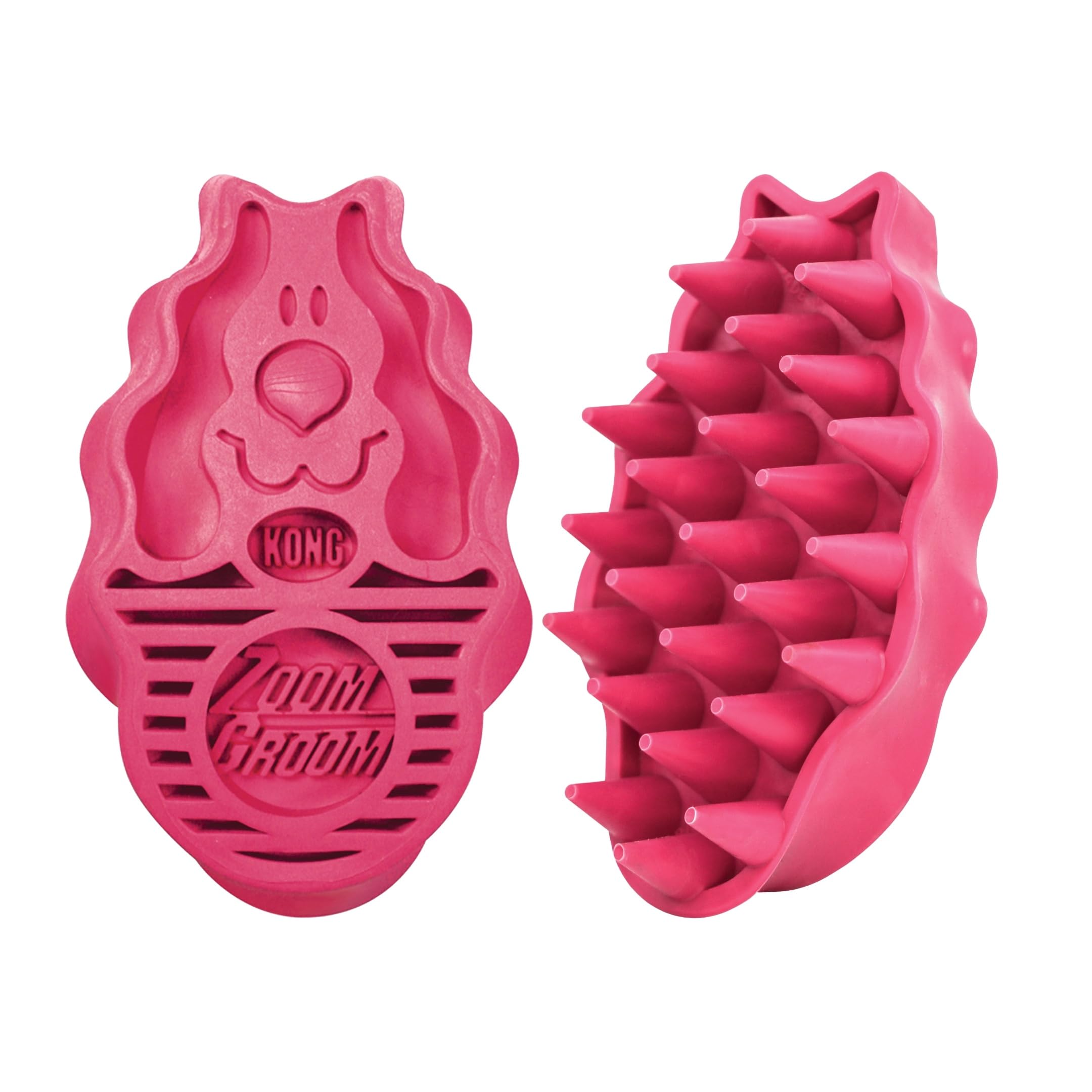
SaveKONG ZoomGroom — Best Low-Cost Rubber Curry
Best for: Budget buyers, puppies, and bath-time grooming
The ZoomGroom is the brush most Rat Terrier owners should start with, especially if budget matters. Its thick rubber teeth work like a curry comb: they massage the skin, lift loose hair, and pull it into a clump you can peel off with one hand. Because there are no metal pins, it is safe for puppies, seniors, and dogs that hate being groomed. It also works wet with shampoo. The catch is depth — on a thick seasonal undercoat, the rubber teeth skim the surface and leave some dead hair behind. Pair it with a slicker during blowout weeks.
- Rubber teeth massage without scratching skin
- Hair peels off in one clean clump
- Safe for puppies and senior dogs
- Works dry or lathered with shampoo
- Dogs tolerate it better than metal pins
- Skims surface on heavy undercoat
- Rubber grabs lint and needs rinsing
- Medium size feels bulky on tiny legs
4.8/5
4.4/5
4.9/5
 Save
SaveFURminator Undercoat deShedding Tool — Best for Blowout Season
Best for: Spring and fall shedding on a double-coated Rat Terrier
When your Rat Terrier blows coat in spring and fall, this is the tool that shortens the fight. The stainless steel edge reaches through the topcoat to pull dead undercoat, and the Skin Guard keeps the blade from digging into skin. FURminator claims up to 90 percent less loose hair, and our test dog left noticeably less fur on the couch after two sessions. The FURejector button ejects the collected hair in one push. This is a once-or-twice-a-week tool, not a daily brush — overuse irritates skin. It also does nothing for faces or paws.
- Stainless edge reaches dead undercoat fast
- Skin Guard prevents digging at edges
- FURejector button clears hair in one push
- Noticeably less fur after two sessions
- Sized for dogs under 25 pounds
- Too aggressive for daily use
- Useless on faces, legs, and paws
- Can scratch if you press and drag
4.3/5
4.9/5
4.5/5

Coastal Pet Safari Soft Slicker Brush — Best for Puppies
Best for: Puppies, seniors, and dogs with thin or irritated skin
This is the slicker you buy for a puppy, a senior, or a Rat Terrier with thin skin. The soft wire pins flex instead of digging, and the small 6.5-by-2.5-inch head fits the narrow chest and short legs that bigger brushes skip. It smooths the coat and lifts surface hair without the scraping feeling some slickers have. The trade-off is power: the soft pins will not clear a dense seasonal shed on their own, and they bend if you lean on them. It is a comfort-first tool, not a heavy-duty one.
- Soft pins flex instead of scraping
- Small head fits chest and legs
- Gentle enough for puppies and seniors
- Smooths coat with light pressure
- Balanced handle reduces wrist fatigue
- Soft pins miss deep seasonal undercoat
- Pins can bend with heavy pressure
- Needs frequent cleaning on shedding days
4.9/5
4.2/5
4.7/5

Wahl Stainless Steel Comb — Best Detail and Finishing Tool
Best for: Faces, paws, and checking whether brushing worked
A comb is the tool that tells you whether your brushing actually worked. This Wahl comb has fine and coarse stainless steel teeth, so you can lift dander and loose hair from the topcoat and then check for missed spots behind the ears and along the tail. It is also the best tool here for faces, paws, and the thin skin around the belly. It costs very little and will outlast most brushes. The limitation is obvious: a comb does not massage or distribute oils, so it works best as a finishing and inspection tool, not your only purchase.
- Fine and coarse teeth in one tool
- Stainless steel resists rust and bending
- Reaches faces, paws, and belly safely
- Shows exactly where brushing was missed
- Costs less than most single brushes
- Not a standalone everyday brush
- Teeth can snag on dry, flaky skin
- No massage or oil-distributing action
4.4/5
4.1/5
4.6/5

Burt’s Bees Palm Brush — Best for Wriggling Dogs
Best for: Dogs that will not sit still for a handled brush
The Palm Brush is for the Rat Terrier that will not sit still for a handle brush. You slip your hand through the strap and the brush becomes an extension of your palm, which gives you far more control on a wriggling dog. The natural hemp bristles are soft enough for daily use and buff the short coat to a low-shed shine without scratching. It is also the easiest brush here to use on a lap. The trade-off: hemp bristles do not penetrate a dense undercoat, and the palm strap runs small for large hands.
- Palm strap gives precise control on wriggling dogs
- Hemp bristles buff short coats to a shine
- Soft enough for daily use
- Easy to use on a lap or table
- No handle to catch on furniture
- Hemp bristles skip dense undercoat
- Palm strap runs small for large hands
- Hair collects in the strap stitching
4.9/5
4.0/5
4.6/5
 Save
SavePet Teezer Small Detangling Brush — Best First Brush
Best for: A puppy’s first grooming sessions and very sensitive skin
Pet Teezer borrows its two-tier bristle design from human detangling brushes, and it works surprisingly well on a Rat Terrier’s short coat. The long outer bristles separate hair while the short inner bristles lift loose fur, so you get smoothing and shedding control in one pass. The bristles are extra soft, which makes this a strong choice for a puppy’s first grooming sessions or a dog with sensitive skin. It works on dry or damp coat. The weakness is value: it is small, and it will not replace a deshedding tool during blowout season.
- Two-tier bristles smooth and lift in one pass
- Extra-soft bristles suit puppies and sensitive skin
- Works on dry or damp coat
- Compact head fits small frames
- Easy to rinse clean under a tap
- Small surface area slows full-body sessions
- Not a substitute for a deshedding tool
- Premium price for its size
4.9/5
4.1/5
4.5/5

Well & Good Oval Bristle Brush — Best Finishing Brush
Best for: A glossy finish after curry or slicker work
This is the finishing brush — the one that makes a Rat Terrier’s coat look glossy after the real work is done. The soft black bristles pull surface dust and loose hair while spreading natural oils down the coat, which is why short-haired dogs look shinier after a few passes. The oval shape follows the body better than a rectangular paddle, and the price is low enough to keep one in every room. It will not touch undercoat, so treat it as step two after a curry or slicker, not a standalone solution.
- Soft bristles leave a visible glossy finish
- Distributes natural oils down the coat
- Oval shape follows body contours
- Low cost, easy to keep in multiple rooms
- Gentle enough for daily touch-ups
- No undercoat penetration at all
- Bristles collect dust and need washing
- Does little during heavy seasonal sheds
4.8/5
3.9/5
4.8/5
Top 3 Head-to-Head: Hertzko vs KONG vs FURminator
These are the three tools readers ask about most, and they solve different problems. Here is the honest split.
| Feature | #1 Hertzko | #2 KONG ZoomGroom | #3 FURminator |
|---|---|---|---|
| Gentleness | 4.9/5 — Best | 4.8/5 | 4.3/5 |
| Loose-hair removal | 4.7/5 | 4.4/5 | 4.9/5 — Best |
| Ease of use and cleaning | 4.8/5 | 4.9/5 — Best | 4.5/5 |
| Choose if… | You brush daily and need gentle pin tips | You want one cheap tool for bath and body | The coat is blowing and fur is everywhere |
Who These Brushes Are NOT For
These tools are chosen for short, single coats and small frames. They are not universal grooming solutions.
If you own a long-coated terrier mix, a heavy double-coated breed, or a dog with a thick winter ruff, skip the palm brush and soft slicker entirely — they will glide over the coat without reaching the underlayer. And if you want one brush to do everything, no single tool here replaces a curry-plus-slicker-plus-comb routine.
Common Mistakes to Avoid
Most grooming problems with a Rat Terrier come from technique, not the brush itself. These four mistakes are the ones we see most often.
Frequently Asked Questions About Rat Terrier Brushes
What kind of brush is best for a Rat Terrier?
A soft slicker brush or a rubber curry brush is the best everyday choice for a Rat Terrier’s short, single coat. Both lift loose hair without scratching thin skin. Add a stainless comb for faces and paws, and keep a deshedding tool for the two seasonal sheds in spring and fall. Avoid stiff wire pins and large paddles.
How often should I brush my Rat Terrier?
Brush once a week for normal maintenance and two to three times a week during seasonal shedding. A quick two-minute pass with a curry brush or palm brush is enough most days. Bathing every four to six weeks and trimming nails monthly round out the routine. Overbrushing with a deshedding blade is the bigger risk than underbrushing.
Do Rat Terriers need a deshedding tool?
Only if your dog carries a denser undercoat or sheds heavily in spring and fall. Many Rat Terriers have a single coat that a curry brush and slicker handle fine. If you see tufts of dead hair or fur on furniture despite weekly brushing, a stainless deShedding tool for short hair is worth adding — used once or twice a week, not daily.
Can I use a human hairbrush on my Rat Terrier?
No. Human brushes have densely packed, soft bristles that glide over a dog’s coat without lifting loose hair or reaching the skin. Some human detangling brushes have a similar two-tier design, but the bristle stiffness and spacing are wrong for a dog. A small pet slicker or rubber curry costs less and does the job properly.
How do I brush a Rat Terrier that hates being brushed?
Start with a rubber curry brush or a palm brush, because both feel like petting rather than scraping. Brush for 30 seconds, reward, and stop before the dog pulls away. Build up to two-minute sessions over a week. Avoid the belly and paws until the dog is comfortable, and never hold the dog down to finish a session.
Do Rat Terriers shed a lot?
Rat Terriers shed moderately year-round with heavier seasonal sheds in spring and fall. Their short hairs embed in fabric and are harder to vacuum than long fur, so owners often notice more shedding than the breed’s reputation suggests. Weekly brushing with a curry brush or slicker removes loose hair before it lands on the couch.
What is the difference between a slicker brush and a bristle brush?
A slicker brush has fine wire pins that reach into the coat to lift loose hair and debris. A bristle brush has softer, denser tufts that smooth the surface and spread natural oils for shine. For a Rat Terrier, use a slicker or curry first to remove hair, then a bristle brush as a finishing step. Neither replaces a comb for face and paw checks.
Our Final Verdict
The right brush for a Rat Terrier is the one your dog will actually tolerate twice a week. Start with the Hertzko for sensitive skin, add the KONG for bath time, and bring in the FURminator only when the coat blows. That three-tool rotation covers daily care, seasonal shedding, and everything between.

Thomas Cutter is a lifelong dog owner and the founder of FindOutAboutDogs.com. With over 10 years of hands-on experience owning multiple breeds, Thomas created this site to provide honest, research-based dog advice that real owners can actually trust.
