Undercoat Rake vs Slicker Brush: Which Is Better for Your Dog?
Quick Answer
An undercoat rake is generally better for removing loose, deep undercoat from suitable double-coated dogs, while a slicker brush excels at separating hair, collecting loose fur, and managing small tangles. Dogs with thick, shedding coats may benefit from both tools. Choose according to your dog’s coat type, skin sensitivity, and grooming needs.
Which grooming tool should you choose?
- Undercoat rake: Best for loosening dead undercoat in suitable double-coated breeds.
- Slicker brush: Best for separating hair, collecting loose fur, and addressing minor tangles.
- Heavy shedding: Start with an appropriate undercoat rake when loose undercoat is the main problem.
- Knots and tangles: Use a suitable slicker for minor tangles and a comb to check your work.
- Short, smooth coats: A rubber grooming brush or soft-bristle brush may be more suitable.
- Skin protection: Use gentle strokes, avoid excessive pressure, and stop if your dog shows discomfort.
One important tip
- Identify your dog’s coat type before buying a tool. A rake designed for a Husky may be unsuitable for a single-coated dog.
Choosing between an undercoat rake and a slicker brush becomes easier when you understand what each tool does. Both can help with grooming, but they handle loose hair and tangles differently.
In this guide, I’ll explain how these tools compare, which coat types benefit most, and how to use each one safely. I’ll also cover practical buying tips to help you choose a brush that suits your dog’s needs.


What Is the Difference Between an Undercoat Rake and a Slicker Brush?
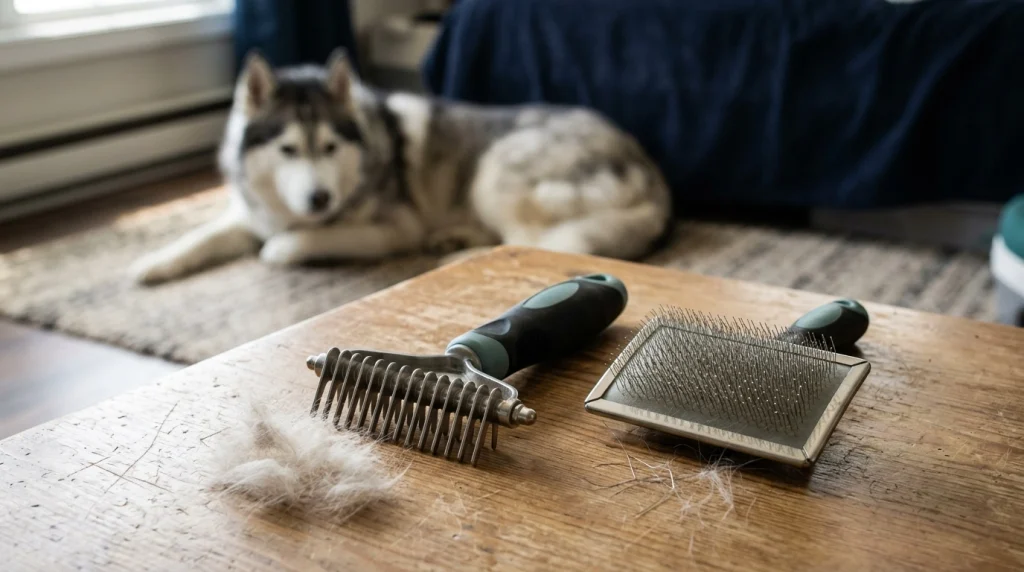
An undercoat rake removes loose hair from beneath the outer coat, while a slicker brush separates hair and collects loose fur with closely spaced wire pins. Their main differences are their construction, reach, and intended grooming tasks.
A double-coated dog has two distinct layers: an outer layer of guard hairs and a softer undercoat. Single-coated dogs lack this same distinct double-layer structure, so their grooming needs can differ considerably.
What Does an Undercoat Rake Do?
An undercoat rake is a grooming tool with metal teeth designed to reach into suitable dense coats and loosen shedding undercoat. Depending on its design, it may have one or two rows of teeth, rotating pins, or different tooth spacings.
Its main purpose is to remove loose undercoat without unnecessarily stripping healthy guard hairs. Smooth teeth and suitable tooth length matter because an aggressive tool can pull hair or irritate the skin.
What Does a Slicker Brush Do?
A slicker brush has many fine wire pins attached to a flat or curved cushion. It helps separate strands, collect loose hair, and work through small tangles in many medium, long, curly, and dense coats.
Some slickers have short pins for shallower coats, while long-pin models reach farther into thicker hair. The pins can scratch the skin if you press too hard, so technique matters as much as brush quality.
Undercoat Rake vs Slicker Brush: Side-by-Side Comparison
 Save
SaveThe better tool depends on the grooming task you need to complete. Use this comparison to narrow your choice before considering individual models.
| Feature | Undercoat Rake | Slicker Brush |
|---|---|---|
| Main purpose | Loosens and removes loose undercoat | Separates hair, collects loose fur, and loosens minor tangles |
| Construction | Longer metal teeth, often arranged in rows | Closely spaced fine wire pins |
| Undercoat removal | Usually the stronger choice for suitable double coats | Can collect loose undercoat depending on pin length and coat density |
| Tangle removal | Not the first choice for ordinary tangles | Useful for small tangles when used gently |
| Typical coat match | Suitable dense double coats | Many medium, long, curly, and dense coats |
| Best grooming stage | Removing loose undercoat | Separating, detangling, and finishing |
| Main risk | Pulling healthy hair or irritating skin | Scratching skin with repeated or forceful strokes |
| Can it replace the other? | Not for every coat or grooming task | Not when deep loose undercoat needs dedicated removal |
My practical rule: Choose the rake when loose undercoat is the main problem, and choose the slicker when tangles and coat separation need more attention. Neither tool should be judged by how much fur it pulls out in one session.
Which Is Better for Double-Coated Dogs?
An undercoat rake is generally the better starting point for a double-coated dog with substantial loose undercoat. A slicker brush can complement it by collecting remaining loose hair and tidying the coat afterward.
Double coats appear in breeds such as Siberian Huskies, German Shepherds, Golden Retrievers, Border Collies, and many other dogs. Their coats vary in length, density, and texture, so the same rake or slicker will not suit every individual dog.
When Should You Choose an Undercoat Rake?
Choose an undercoat rake when you notice loose, fluffy hair accumulating beneath the outer coat, particularly during seasonal shedding. The right design can reach this layer more directly than a brush intended mainly for surface grooming.
- Siberian Huskies: Often benefit from a suitable rake during heavy undercoat shedding.
- German Shepherds: May need undercoat grooming throughout the year, with more attention during heavier shedding periods.
- Golden Retrievers: Can benefit from undercoat removal, but feathered areas may need a slicker or pin brush.
- Australian Shepherds: May benefit from undercoat removal and careful brushing through longer feathering.
These are starting points, not blanket rules for every dog in a breed. Coat length, skin condition, and individual tolerance should guide your final choice.
When Is a Slicker Brush the Better Option?
A slicker is often the better tool when your dog has longer hair that tangles, curls that need separating, or feathering that traps loose hair. It also helps maintain a tidy appearance between more thorough grooming sessions.
- Collies: A slicker can help separate longer coat and feathering after appropriate loose-undercoat removal.
- Poodles: A suitable slicker helps separate curls and prevent tangles in their continuously growing coat.
- Bichon Frises: Often need careful slicker brushing and comb checks to prevent compacted tangles.
- Long-coated mixed breeds: May benefit from a slicker around the ears, legs, and harness area.
For curly or mat-prone coats, a metal comb is also valuable. A brush can leave a coat looking fluffy while small knots remain close to the skin.
Can You Use an Undercoat Rake and Slicker Brush Together?
Yes, using both tools can make sense when a dog has a dense double coat with loose undercoat and areas that also need separating or detangling. Each tool performs a different job, so you don’t have to choose just one.
For a suitable double-coated dog, start with a gentle undercoat rake, follow with a slicker only where needed, and finish by checking the coat with an appropriate comb. This avoids using one tool repeatedly for tasks it wasn’t designed to handle.
A Practical Grooming Sequence
- Inspect the coat: Check for mats, redness, sores, burrs, and sensitive areas before starting.
- Use the rake: Work in small sections with short, gentle strokes in the direction of hair growth.
- Remove collected hair: Clear the rake regularly so loose fur doesn’t interfere with its movement.
- Use the slicker selectively: Brush areas that need light detangling or separation without repeatedly scraping the same patch.
- Check with a comb: On coats that benefit from combing, look for hidden knots and stop if the comb catches.
- Finish when the coat is comfortable: Don’t keep brushing simply because a few loose hairs remain.
Not every dog needs every step. A short-coated dog may need neither a rake nor a slicker, while a curly-coated dog usually needs a different routine from a heavily shedding Husky.
How Do You Choose the Right Undercoat Rake or Slicker Brush?
 Save
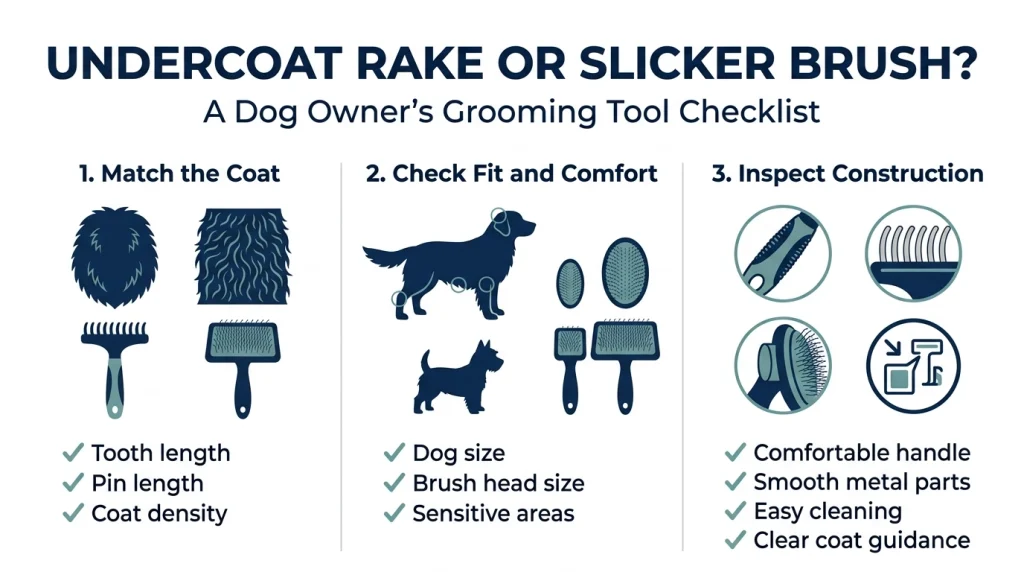
SaveThe best grooming tool fits your dog’s coat and reaches the intended layer without pulling or scratching. Start with coat type, then consider the tool’s design, size, and comfort.
1. Match the Teeth or Pins to the Coat
Longer teeth or pins can reach deeper into some dense coats, but longer doesn’t automatically mean better. Teeth that are too long, sharp, or aggressive can contact the skin unnecessarily.
For a rake, look for smooth, well-finished teeth and spacing that suits the coat. For a slicker, choose pin length and head size that let you work through the hair without forcing the brush.
2. Consider the Dog’s Size and Sensitive Areas
A small brush head gives you more control around the legs, ears, and other narrow areas. A larger head may cover the back and sides more efficiently on a bigger dog.
Always reduce pressure around the belly, armpits, groin, and other sensitive areas. If your dog flinches, pulls away, or repeatedly licks one spot, stop and check the skin.
3. Look for Practical Construction
- Comfortable handle: Helps you maintain a light grip during longer grooming sessions.
- Smooth metal parts: Reduce the risk of rough edges snagging hair or scratching skin.
- Easy cleaning: Makes it simpler to remove collected fur between sections.
- Suitable head size: Improves control without making grooming unnecessarily slow.
- Clear coat guidance: Helps you avoid using a tool intended for a different coat type.
As of 2026, both tool categories include designs marketed for specific coat types. Focus on construction and intended use rather than claims that one tool removes all shedding hair.
What Mistakes Should You Avoid With These Brushes?
The biggest grooming mistake is assuming that more pressure or more passes will remove more hair safely. Both tools can cause discomfort when used aggressively, even if they work well for the dog’s coat.
- Using a rake on every dog: Many single-coated dogs don’t need a dedicated undercoat tool.
- Raking through mats: Tight knots can pull on the skin and shouldn’t be forced through with metal teeth.
- Scraping with a slicker: Excessive pressure can cause skin irritation, sometimes called brush burn.
- Brushing only the surface: Loose hair and tangles may remain hidden beneath longer topcoat.
- Chasing every loose hair: Stop when the coat has been comfortably groomed rather than repeatedly working one area.
- Ignoring skin problems: Redness, sores, unusual bald patches, or persistent itching need attention beyond routine brushing.
If a mat sits tightly against the skin, ask a qualified groomer or veterinarian for help. Trying to cut it out with scissors can accidentally injure the skin hidden beneath the fur.
For general coat-care advice, consult the American Kennel Club’s dog grooming resources and VCA Animal Hospitals’ pet health library. The ASPCA dog-care section is another useful starting point.
How Often Should You Use Each Tool?
An undercoat rake and a slicker brush don’t necessarily need the same schedule. Grooming frequency depends on coat density, shedding, matting risk, and how quickly loose hair accumulates.
Use these schedules as starting points, then adjust according to your dog’s coat condition.
| Coat Type | Suggested Starting Frequency | Tool to Consider |
|---|---|---|
| Short, smooth coat | Once or twice weekly | Rubber or bristle brush |
| Medium double coat | Two or three times weekly | Suitable rake and/or slicker |
| Heavy seasonal shedder | Short, more frequent sessions as needed | Undercoat rake for suitable coats |
| Long or feathered coat | Several times weekly or more often if needed | Slicker or pin brush plus comb |
| Curly, mat-prone coat | Daily or every other day for many dogs | Slicker plus metal comb |
These are general guidelines, not strict rules for every breed. Dogs with skin conditions, unusual shedding, or rapidly developing mats may need a different routine.
Which Grooming Tool Should You Buy First?
If you can buy only one tool, start with the problem you see most often. For a double-coated dog that releases large amounts of loose undercoat, a suitable rake is usually the more useful first purchase.
If your dog develops tangles, has curly hair, or needs regular coat separation, start with a slicker instead. A suitable metal comb can be a useful companion for checking longer coats after brushing.
- Choose a rake first if deep loose undercoat is your main concern.
- Choose a slicker first if tangles and coat maintenance are the priority.
- Choose a gentler alternative if your dog has a short, smooth coat or reacts poorly to wire tools.
- Build a small grooming kit only when each additional tool serves a clear purpose.
Before buying, check the manufacturer’s coat recommendations and select the appropriate size. A well-matched basic tool is more useful than an expensive brush that doesn’t suit your dog.
If you want to compare more grooming options, read this guide to what a slicker brush is used for.
Product Recommendations: Undercoat Rakes and Slicker Brushes
 Save
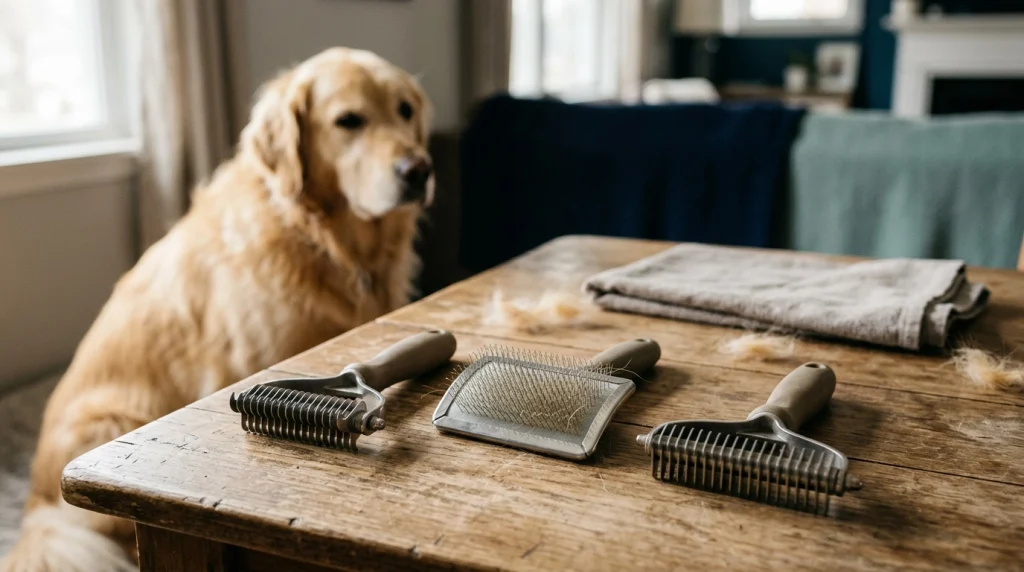
SaveIf you’re ready to choose a tool, these three established options cover different grooming needs. Check current product specifications, available sizes, and coat recommendations before ordering.
🏆 Best for Double Coats
Maxpower Planet Double-Sided Undercoat Rake
★★★★½
Its dual-sided design offers different tooth spacing for grooming dense coats. Consider it for a suitable double-coated dog that needs loose undercoat removed, using gentle strokes without repeatedly working the same area.
✨ Best Premium Slicker
Chris Christensen Big G Slicker Brush
★★★★½
This professional-style slicker is designed for coat separation and grooming longer, fuller hair. Consider it for careful detangling and finishing rather than as a substitute for an appropriate undercoat rake during heavy shedding.
💰 Best Simple Rake
Safari Double Row Undercoat Rake
★★★★☆
Its double-row design targets loose undercoat in appropriate dense coats. Consider this straightforward style if you want a dedicated rake, provided its teeth suit your dog’s coat length and density.
Product note: These star ratings are editorial assessments, not verified current customer ratings or laboratory test results. Prices, availability, and product specifications can change, so review the current listing before purchasing.
Frequently Asked Questions
Is an Undercoat Rake Better Than a Slicker Brush for Shedding?
An undercoat rake is generally better for removing loose undercoat from a suitable double-coated dog. A slicker brush can collect loose hair too, but its main strengths are separating hair and handling small tangles. During heavy shedding, the rake is often the more useful first tool.
Can a Slicker Brush Remove a Dog’s Undercoat?
Yes, a slicker brush can collect loose undercoat when its pins reach the appropriate depth. However, it may be less efficient than a suitable undercoat rake when a dense double coat releases large amounts of loose hair. Choose according to coat type rather than how much fur the brush collects.
Should I Use an Undercoat Rake Before or After a Slicker Brush?
For a suitable double-coated dog with loose undercoat, start with the rake using gentle strokes. Follow with a slicker where you need to separate hair or address minor tangles. A metal comb can then help check the coat, especially in longer or feathered areas.
Can an Undercoat Rake Damage My Dog’s Coat?
Yes, an unsuitable rake or overly aggressive technique can pull healthy hair, damage the coat, or irritate skin. Choose smooth teeth that match the coat, work gently, and stop if your dog shows discomfort. Ask a professional groomer for guidance if you’re unsure which rake suits your dog.
Can I Use a Slicker Brush on a Husky or German Shepherd?
Yes, a suitable slicker can help groom a Husky or German Shepherd, particularly when separating coat or collecting loose hair near the surface. For substantial loose undercoat, an appropriate rake is often more effective. Use light pressure and avoid repeatedly brushing one patch.
Do I Need Both an Undercoat Rake and a Slicker Brush?
No, not every dog needs both. A double-coated dog that sheds heavily may benefit from both tools, while a curly-coated dog may need a slicker and metal comb instead. Base your grooming kit on coat structure, tangling, shedding, and your dog’s comfort.
Final Takeaway: Undercoat Rake vs Slicker Brush
An undercoat rake and a slicker brush are useful for different reasons. The rake is usually the better choice for removing loose undercoat from suitable double coats, while the slicker excels at separating hair and managing minor tangles.
If your dog sheds heavily, start with a properly matched rake and add a slicker when the coat needs extra attention. If tangles are your main concern, a slicker may be the more practical first purchase.
Most importantly, keep grooming gentle and tailored to your dog’s coat. Choose the right tool, work in small sections, and stop if the skin becomes irritated or your dog appears uncomfortable.

Thomas Cutter is a lifelong dog owner and the founder of FindOutAboutDogs.com. With over 10 years of hands-on experience owning multiple breeds, Thomas created this site to provide honest, research-based dog advice that real owners can actually trust.
