Common Double Coat Grooming Mistakes (And How to Fix Them with the Right Dog Brush)
Quick Answer
The most damaging double coat grooming mistakes are shaving the fur, surface brushing without reaching the skin, bathing a matted coat, and scraping the skin with bladed deshedding tools. These habits trap dead undercoat, ruin natural insulation, and cause painful skin infections known as hot spots. You can prevent coat damage by pairing a long-pinned slicker brush with the proper breed coat care line-brushing technique.
Top Double Coat Grooming Mistakes to Avoid
- Surface brushing only: Gliding a brush over the topcoat leaves a dense layer of compacted dead wool trapped against the skin.
- Shaving for summer: Clipping a double coat destroys its heat-blocking barrier and causes permanent, patchy regrowth called clipper alopecia.
- Bathing before brushing: Water tightens existing tangles into rock-hard mats that shrink like wool as they air dry.
- Overusing bladed tools: Metal deshedding blades slice healthy guard hairs and scrape sensitive skin when used more than once a week.
- Skipping the steel comb: Finishing a session without a metal greyhound comb leaves hidden pin-knots behind the ears and under the collar.
How to Verify Your Grooming Technique
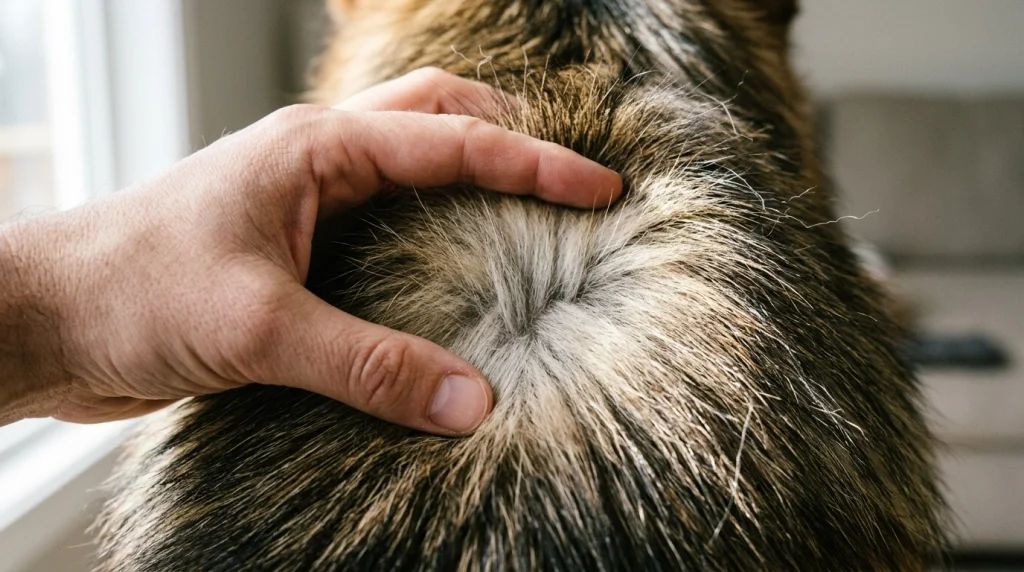
- Part your dog’s fur on the lower back with your fingers; if you cannot see pink or pigmented skin clearly without matted fuzz blocking the view, your brush isn’t reaching deep enough.
I spent my first two years as a Golden Retriever owner brushing my dog every single afternoon, only to have my groomer tell me he was pelted to the skin. I was making the classic rookie error of polishing the shiny topcoat while ignoring the dense wool packing down underneath.
Most grooming guides just tell you to brush more often, which doesn’t help when your technique and tool selection are working against you. Below, I’ll walk you through the exact mistakes that ruin double coats, how to pick the right dog brush for your dog’s hair length, and the step-by-step method professional groomers use as of 2026.


What Is a Double Coat and How Does It Work?
 Save
A double coat is a specialized two-layer fur system consisting of a dense, soft undercoat for insulation and a longer, coarse topcoat of guard hairs that repel water, dirt, and ultraviolet rays. These two layers work together to trap a pocket of air next to your dog’s skin, stabilizing body temperature in both freezing winters and blistering summers.
Think of your dog’s coat like a well-insulated thermos. It keeps warmth in when the snow falls and blocks radiant heat when the sun beats down.
That air pocket only works when air can actually circulate between the hairs. Once dead undercoat sheds and gets trapped under the guard hairs, the thermos turns into a suffocating wool blanket.
- Soft undercoat: Short, crimped, fluffy fibers that grow in thick clusters and shed heavily twice a year during seasonal “coat blows.”
- Harsh guard hairs: Stiff, smooth outer hairs coated in natural oils that shed rainwater and shield pale canine skin from sunburn.
- Follicle ratio: Each hair follicle bundle produces one primary guard hair surrounded by five to twenty secondary undercoat hairs.
What Are the Most Common Double Coat Grooming Mistakes?
 Save
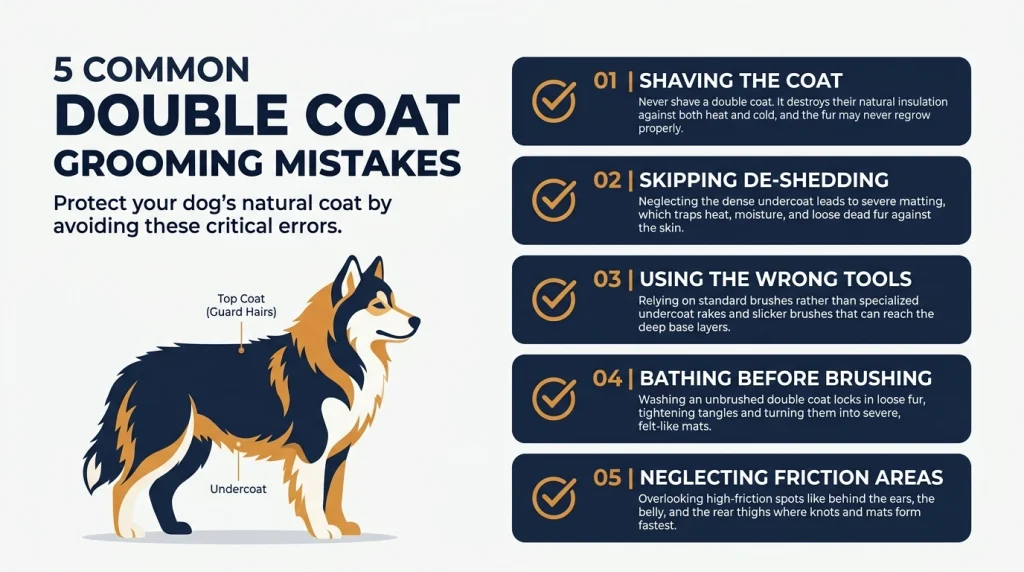
The most common double coat grooming mistakes involve using short-bristled brushes that skim over the fur, bathing dogs while dead undercoat is still trapped inside, and shaving the coat down in hot weather. Avoiding these habits protects your dog from painful skin infections and permanent coat damage.
1. Surface Brushing Without Parting the Coat
Surface brushing happens when you run a dog brush across your pet’s back from neck to tail without lifting the hair to expose the skin. Your dog looks sleek and tidy on the outside, but a solid sheet of tangled wool is quietly forming underneath.
I call this “frosting the cake.” You’re smoothing out the outer guard hairs while pressing the dead undercoat tighter against your dog’s body.
Within a few weeks, that compressed layer weaves itself into a felted mat called a pelt. Once a coat pelts, air can’t reach the skin, and groomers often have no choice but to shave the matted areas out completely.
2. Using the Wrong Dog Brush for Your Coat Type
Grabbing a soft bristle brush or a short-pinned rubber curry for a thick Husky or Samoyed coat is a guaranteed recipe for matting. Short bristles bounce right off dense double coats instead of penetrating through to the base of the hair shafts.
Different double coats demand specific pin lengths and spacing. A short-coated Labrador needs a high-tooth-count undercoat carding tool, while a long-coated Australian Shepherd requires a 20-millimeter long-pin slicker brush and a wide-tooth T-rake.
- Soft boar bristle brushes: Designed strictly for single-coated, short-haired breeds like Greyhounds or Boxers to distribute surface oils.
- Ball-tip pin brushes: The tiny plastic balls on the ends snag and snap dense undercoat fibers rather than sliding through them smoothly.
- Single-row rakes with dull, wide pins: Too wide for short double coats like Corgis, slipping right past the fine shed fur without grabbing it.
3. Overusing Bladed Deshedding Tools
Bladed deshedding tools like the FURminator Undercoat deShedding Tool are designed to grab and strip loose undercoat, not replace your everyday dog brush. Dragging a metal clipper-style blade over the same spot twenty times in a row slices healthy guard hairs and leaves raw, red brush burn on your dog’s skin.
You can spot blade damage easily on dogs with dark guard hairs and light undercoats, like German Shepherds. Their backs start looking frizzy, dull, and strangely light-colored because the glossy outer hairs have been sawed off in the middle.
Limit bladed tools to 10-minute sessions once a week during heavy seasonal shedding. On normal days, rely on a non-bladed slicker brush and a stainless steel comb.
4. Bathing a Dog Before Brushing Out Dead Undercoat
Putting a double-coated dog in the bathtub before removing loose undercoat turns manageable tangles into cement-like mats. Water causes dry, shed hair fibers to swell, interlock, and tighten around healthy hairs as they dry.
Think about throwing a 100% wool sweater into a washing machine. The agitation and moisture shrink the fibers together until you can’t pull them apart.
Damp, compacted fur against warm canine skin also creates a dark greenhouse for bacteria and yeast. According to veterinary dermatology guidance from the American Veterinary Medical Association, trapped moisture is a leading trigger for acute moist dermatitis, commonly known as painful hot spots.
- Brush dry first: Spend 20 minutes line-brushing and combing out 90% of the dead coat before turning on the faucet.
- Dilute your shampoo: Mix one part dog shampoo with ten parts warm water in a squeeze bottle so it penetrates down to the skin and rinses out cleanly.
- Blow dry thoroughly: Use a high-velocity dryer on a cool setting to blast water out of the undercoat rather than letting your dog air dry overnight.
5. Shaving a Double Coat to Keep Your Dog Cool
Shaving a double coat down to the skin does not keep a dog cooler in the summer. Instead, it removes the insulating air barrier and exposes pale, unconditioned skin directly to intense solar radiation and biting insects.
Even worse, shaving permanently alters how the coat grows back. As dogs age, their guard hair follicles enter a slow resting phase while the fuzzy undercoat continues growing rapidly.
When you clip both layers down simultaneously, the fast-growing undercoat crowds out the slow-growing guard hairs. The coat grows back Velcro-like, frizzy, and prone to tangling ten times faster than before—a condition vets at the Cornell University College of Veterinary Medicine refer to as post-clipping alopecia.
Which Dog Brush Should You Use for a Double Coat?
You need three distinct tools to maintain a healthy double coat without damaging the fur: a long-pin slicker brush to separate mats, an undercoat rake to lift dense shed wool, and a stainless steel greyhound comb to verify your work. No single brush can perform all three jobs effectively.
In my own grooming kit, I never reach for an undercoat rake until the slicker brush has cleared the path. Pulling a rake through an unbrushed coat snags knots and makes your dog hate grooming table sessions.
Compare the core tools below to match the right dog brush to your dog’s specific coat length and density.
| Brush Type | Primary Function | Best Double Coat Length | Common Mistake to Avoid |
|---|---|---|---|
| Long-Pin Slicker Brush | Breaks up tangles and pulls out loose tufts during line brushing | Medium to Long (Golden Retrievers, Collies, Pomskies) | Pressing hard down into the skin instead of flicking the wrist upward |
| Rotating-Pin Undercoat Rake | Glides deep to lift heavy, impacted seasonal shed wool | Thick & Plush (Huskies, Malamutes, Bernese Mountain Dogs) | Raking over tangled feathering on the tail, ears, or back of legs |
| De-Matting Coat King Rake | Curved, blunt-end hooks strip thick dead wool quickly | Dense & Coarse (German Shepherds, Akitas, Newfoundlands) | Using over bony areas like hips, hocks, or the spine |
| Rubber Curry Zoom Groom | Massages skin and magnets loose short hairs via friction | Short Double Coats (Labradors, Pugs, Corgis, Beagles) | Using on long-haired coats where rubber cones twist and knot hair |
| Steel Greyhound Comb | Final check tool to locate missed knots down to the skin | All Double Coats (Essential finishing tool for every breed) | Yanking the comb through a snag instead of switching back to a slicker |
How Do You Line Brush a Double Coated Dog Properly?
 Save
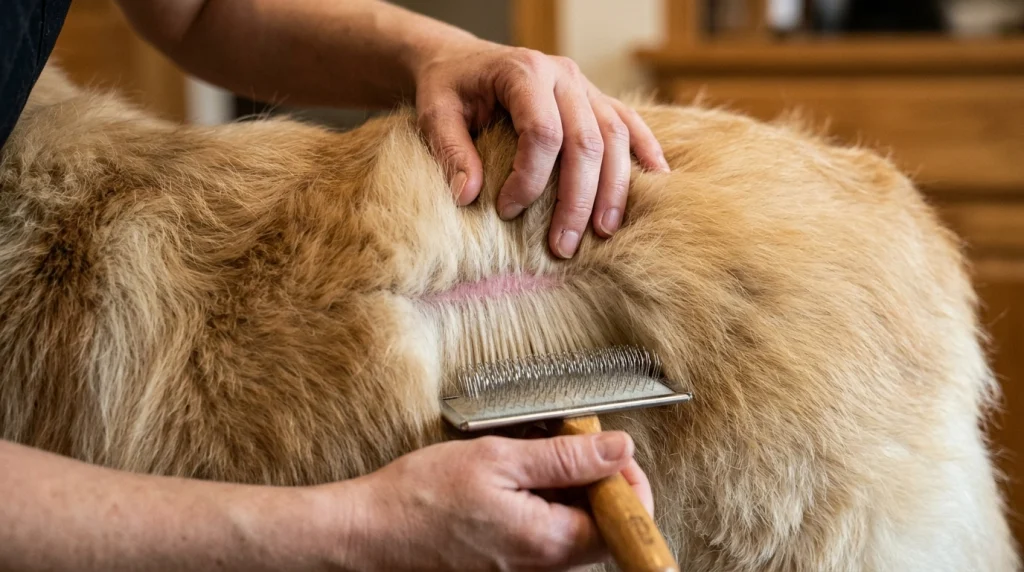
Line brushing is a systematic grooming technique where you part your dog’s fur horizontally to expose a thin line of skin, then brush downward from that part line one tiny section at a time. It is the only method that guarantees your dog brush reaches the bottom millimeter of the undercoat where mats actually start.
When I tested surface brushing versus line brushing on a shedding Australian Shepherd last spring, surface brushing removed one cup of loose hair in fifteen minutes. Line brushing the exact same dog right afterward pulled out an entire kitchen trash bag of compacted undercoat that the first session completely missed.
Follow these exact steps to master line brushing without scratching your dog’s skin:
- Mist the coat lightly: Spray a leave-in conditioning spray over the dry fur to reduce static electricity and prevent brittle hair ends from snapping.
- Start at the lowest point: Have your dog lie on their side and begin at the bottom of the back leg or lower hip, working your way upward toward the spine.
- Part the hair to the skin: Use your non-dominant hand to push the bulk of the coat upward until you see a clear horizontal line of bare skin below your fingers.
- Pat and pull with a slicker: Place your Chris Christensen Big G Slicker Brush just below the exposed skin line, pull downward with the grain of the hair, and flick your wrist away at the end of the stroke.
- Drop down a quarter-inch: Let a thin layer of fur fall down from beneath your upper hand, creating a new part line slightly higher up the body, and repeat the stroke.
- Verify with a steel comb: Once a whole body section is brushed, glide the wide-tooth end of a metal comb from the skin outward; if it glides smoothly with zero resistance, that section is 100% mat-free.
Why Are Friction Zones Always Matted on Double Coated Dogs?
Even owners who brush their dogs faithfully every week often miss the five high-friction zones where skin folds, harnesses, and moisture create rapid matting. Fine, silky hair in these hidden pockets tangles after a single afternoon walk in the rain.
I always check these five trouble spots before touching the wide, easy areas on a dog’s back:
- Behind the ears: The fur right below the ear leather is finer than baby hair and knots tightly every time your dog scratches their neck.
- The collar and harness ring: Nylon webbing rubs back and forth against the shoulders and chest with every step, weaving shed undercoat into thick cords.
- Armpits (axilla): Constant leg movement plus thin, sensitive skin makes this a painful spot where you must use a tiny slicker brush with zero downward pressure.
- Sanitary Pants and Feathering: Long curtain hair on the back of the thighs collects burs, mud, and twigs that quickly felt into solid mats.
- Base of the tail: Dogs often sit and swivel on the top of their tail base, compacting dense shed tufts right above the rump.
Always remove your dog’s collar and harness the moment you walk inside the house. Leaving a nylon harness on a double-coated dog 24/7 is one of the fastest ways to create irreversible chest and armpit mats.
How Does Nutrition and Skin Health Affect Shedding?
Dry, brittle double coats shed excessively and mat twice as fast because dehydrated hair cuticles snag on each other like Velcro. Supporting skin barrier health from the inside out makes your weekly brushing sessions twice as fast.
Research highlighted by the National Center for Biotechnology Information shows that marine-sourced Omega-3 fatty acids (EPA and DHA) strengthen canine hair shafts and calm itchy skin inflammation. When the hair cuticle lies flat and smooth, dead undercoat slides right out during brushing instead of tangling around neighboring guard hairs.
Environmental safety during bath time also plays a major role in coat texture. Always choose dog-specific shampoos formulated around a neutral pH of 6.5 to 7.5, and follow household pet care safety recommendations from the U.S. Environmental Protection Agency when selecting topical flea or grooming treatments.
The 3 Best Dog Brushes for Double Coats
If you’re ready to upgrade your grooming kit and stop fighting stubborn undercoat, here are the three exact tools I rely on for double-coated dogs:
🏆 BEST OVERALL SLICKER
Chris Christensen Big G Dog Slicker Brush (Large, Coral)
★★★★★
Features extra-long, dense angled stainless steel pins on a flexible cushion pad with an ergonomic curved handle. I’ve used my Coral Big G for four years on Golden Retrievers and Huskies—it pulls out twice as much impacted fluff per stroke as drugstore slickers without scratching the skin.
🐕 BEST UNDERCOAT RAKE
Maxpower Planet Pet Grooming Brush (Double-Sided Undercoat Rake)
★★★★☆
Dual-head design offers a 9-tooth side for stubborn mats and a 17-tooth side for thinning and deshedding, with rounded outer edges for skin safety. It’s my go-to tool during spring coat blows when thick tufts are ready to release from the hips and neck.
💰 BEST FINISHING COMB
Andis Pet 7.5-Inch Steel Grooming Comb
★★★★★
Heavy-duty 7.5-inch stainless steel comb featuring both coarse and fine tooth spacing with smooth rounded pin tips. This inexpensive comb is the ultimate truth-teller in my kit—if it can’t glide through the coat after brushing, I know I still have hidden knots to clear.
Frequently Asked Questions About Double Coat Grooming
Will a shaved double coat ever grow back normal?
A shaved double coat can take 12 to 24 months to grow back, and in older dogs or Nordic breeds, it may remain permanently patchy and fuzzy. You can help stimulate sluggish hair follicles by massaging the skin daily with a soft rubber curry brush and supplementing your dog’s diet with marine Omega-3 fatty acids.
How often should I brush a double coated dog?
You should brush a double-coated dog 2 to 3 times per week during normal months and once daily for 15 minutes during heavy spring and fall seasonal coat blows. Consistent 10-minute sessions prevent dead undercoat from compacting against the skin and save you hours of painful de-matting later.
Why is my dog still shedding so much right after brushing?
If your dog is still dropping clumps of fur after a brushing session, your brush pins are too short to penetrate past the outer guard hairs, or you are brushing completely dry, static-filled hair. Switch to the line-brushing method using a long-pin slicker brush and follow up with a high-velocity blow dryer outdoors to loosen remaining dead follicles.
Can I use a human hairbrush on my double coated dog?
Human hairbrushes, including plastic detangling brushes and ball-tipped paddle brushes, should not be used on thick canine double coats. The plastic ball tips catch and tear dense undercoat fibers, while the short, flexible bristles bend backward over heavy fur instead of reaching down to the skin.
Take Control of Your Dog’s Double Coat Today
Fixing your grooming routine doesn’t require spending three hours a day battling flying fur. Swap out short-bristled surface brushes for a long-pin slicker and a steel greyhound comb, stop bathing matted fur, and commit to parting the hair down to the skin.
Grab your comb tonight and do the 10-second part check on your dog’s lower back and behind their ears. Your dog’s skin will breathe easier, your vacuum cleaner will catch a break, and your pup will stay cooler all summer long.

Thomas Cutter is a lifelong dog owner and the founder of FindOutAboutDogs.com. With over 10 years of hands-on experience owning multiple breeds, Thomas created this site to provide honest, research-based dog advice that real owners can actually trust.
