How to Prevent Mats in Double Coats: The Complete Brushing & Line Combing Guide
Quick Answer
To prevent mats in a double coat, use the line combing technique 3 to 4 times a week with a long-pinned slicker brush and a stainless steel greyhound comb. Always spray the coat with a conditioning mist before brushing, part the fur down to the skin, and brush in small sections before bathing so trapped dead undercoat never gets wet and tightens into felt. Proper coat maintenance is recommended by the American Kennel Club to prevent painful skin infections and preserve natural temperature regulation.
5 Core Steps to Prevent Double Coat Mats
- Mist the coat first: Lightly spray a leave-in detangler so dry hair shafts do not snap or generate static electricity.
- Use line combing: Part the fur horizontally so you see bare skin, then brush downward in 1-inch layers from the bottom up.
- Verify with steel: Glide a metal greyhound comb from root to tip after brushing to catch hidden snags near the skin.
- Target friction zones: Check behind the ears, under the collar, in the armpits, and along the back legs daily.
- Brush before bathing: Remove all loose undercoat prior to getting your dog wet, then blow-dry completely with a high-velocity dryer.
The 5-Second Comb Test
- Slide a fine-tooth metal comb vertically against the skin behind your dog’s ears; if it catches, you have compacted undercoat that surface brushing missed.
When I brought home my first Golden Retriever mix ten years ago, I brushed him every single evening. I still found rock-hard knots behind his ears and under his belly by springtime.
I was making the classic rookie mistake of surface brushing the shiny topcoat while completely ignoring the dense wool underneath. In this guide, I will show you the exact tools, brushing methods, and bath-time rules that keep double-coated breeds completely tangle-free.


What Is a Double Coat and Why Does It Mat So Easily?
 Save
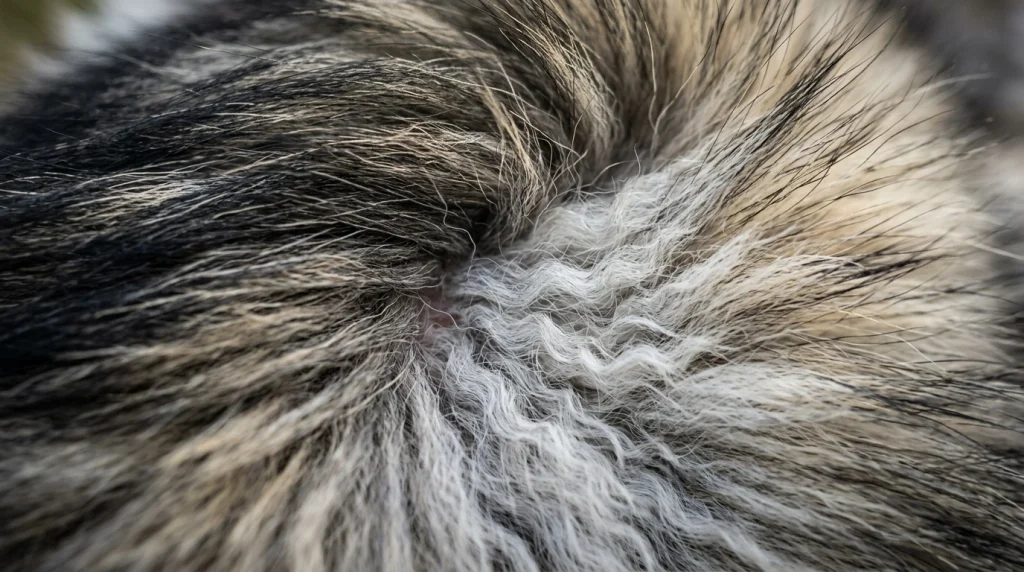
A double coat is a two-layered canine fur system consisting of a dense, soft, insulating undercoat beneath a longer, coarser layer of protective guard hairs. Mats form when shed undercoat hairs become trapped inside the standing guard hairs and tangle together through moisture and friction.
Think of your dog’s undercoat like sheep’s wool. Those short, crimped hairs shed constantly, especially during the spring and fall seasonal coat blows.
If those dead hairs don’t fall to the floor, they stay wedged right against the skin. Every time your dog scratches, rolls on the carpet, or walks in the rain, those loose fibers twist around healthy hairs.
Within a few days, that loose fluff compresses into a tight web called impacted undercoat. Once moisture hits that web, the microscopic scales on the hair shafts lock together like Velcro, creating a solid pelt that pulls painfully on the skin.
- Guard hairs (Topcoat): Long, stiff, water-repellent hairs that shield your dog from dirt, ultraviolet rays, and twigs.
- Undercoat (Secondary hairs): Short, downy fibers that trap air against the body to keep your dog warm in winter and cool in summer.
- Impacted coat: Dense sheets of dead undercoat trapped at the skin level that block airflow and trap moisture.
- Pelt matting: Severe, carpet-like mats that fuse across large body areas and restrict blood flow to the skin.
Why Doesn’t Regular Daily Brushing Stop Mats?
Regular daily brushing fails to stop mats because standard pet store brushes have short bristles that glide across the outer guard hairs without penetrating down to the skin. This leaves the shedding undercoat compacted at the root while making the top layer look deceptively smooth.
I call this “petting your dog with a brush.” When you run a short-pinned brush or a bristle paddle down your dog’s back, the stiff topcoat deflects the pins.
Your dog looks fluffy on top, so you think the job is done. Meanwhile, a quarter-inch layer of dead wool is felting right against their ribs.
As of 2026, professional groomers still report that over half of the matted Australian Shepherds, Huskies, and Goldendoodles they see are brushed regularly at home by well-meaning owners. The difference between a matted dog and a tangle-free coat comes down to pin length and parting the hair.
Groomer’s Rule of Thumb: If you cannot see your dog’s bare pink or pigmented skin while you are brushing, you are only polishing the topcoat.
What Are the High-Friction Matting Zones on a Double-Coated Dog?
The primary high-friction matting zones on a double-coated dog are the skin behind the ears, the neck area under the collar, the armpits, the groin, and the feathering along the back legs. These areas experience constant rubbing from movement and gear, which twists loose hairs into knots within hours.
You don’t always have twenty minutes for a full-body grooming session every Tuesday night. On busy days, spending three minutes checking these specific friction hotspots stops 80% of mats before they start.
- Behind the ears: The fur here is silky and fine. Whenever your dog shakes their head or scratches an ear, those fine hairs twist into tight little dreadlocks right at the base of the skull.
- Under the collar and harness: Nylon and leather straps rub back and forth with every step. Take your dog’s collar and harness off the moment you get inside the house.
- The armpits (axilla): Front legs pump thousands of times on a single walk. That constant skin-on-skin friction turns fine belly fur into tight knots that pinch when your dog stretches.
- The trousers and tail base: The long feathering on the backs of the hind legs catches burrs, mud, and urine splash, gluing the undercoat together.
- The chest bib: Dogs dip their chests into water bowls and chew on toys between their paws, soaking the bib fur in saliva that dries into stiff tangles.
Which Dog Brush Works Best for Preventing Double Coat Mats?
 Save
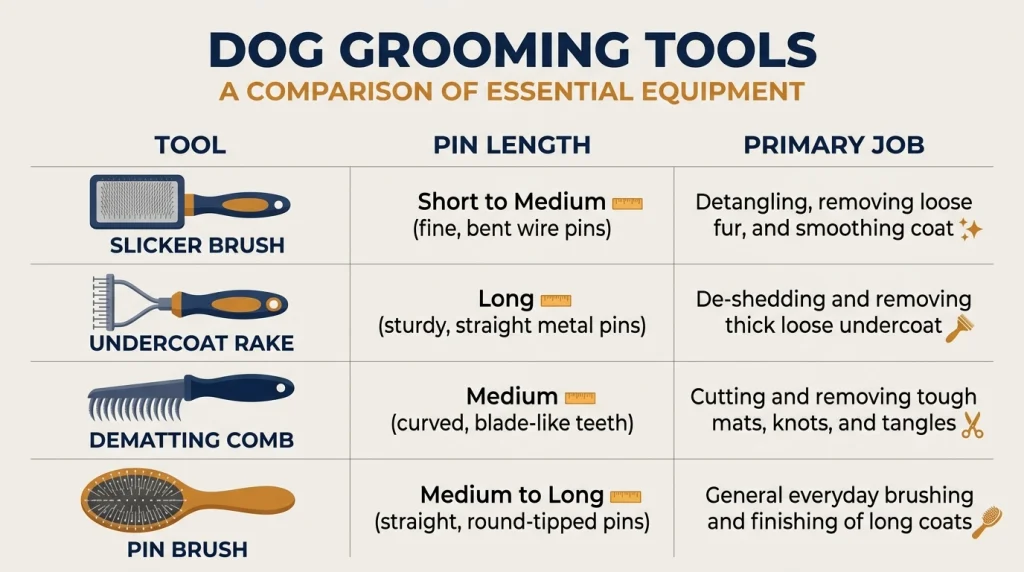
The best dog brush setup for preventing double coat mats combines a long-pinned slicker brush (with 20mm to 27mm bent wire pins), an undercoat rake with rotating rounded teeth, and a stainless steel greyhound comb. No single brush can both detangle deep mats and clear heavy seasonal shedding alone.
When I audited my grooming toolkit a few years back, I tossed out three gimmick brushes with plastic balls on the tips. Those little plastic beads catch on tangles, rip out healthy guard hairs, and stop the pins from reaching the skin.
You need smooth, polished stainless steel pins that slide through dense fur without snagging. Check out the table below to match the exact tool to your dog’s coat length and shedding stage.
| Grooming Tool | Ideal Pin/Tooth Length | Primary Job | Best Breeds | Coat Damage Risk |
|---|---|---|---|---|
| Long-Pin Slicker Brush | 20mm – 27mm angled wire | Separating hairs and lifting deep tangles | Collies, Samoyeds, Goldens, Bernese | Low (if used with light pressure) |
| Undercoat Rake | 15mm – 25mm single row | Pulling out thick clumps of dead seasonal wool | Huskies, Malamutes, German Shepherds, Newfoundlands | Low (use rounded pins only, not bladed) |
| Steel Greyhound Comb | 25mm – 38mm dual-spaced | Checking your work and combing delicate ears/legs | All double-coated breeds | None (never yank through a tight knot) |
| Long-Pin Pin Brush | 27mm – 35mm straight pins | Daily maintenance on very long, flowing coats | Pomeranians, Keeshonds, Chow Chows | Very Low (must have tip-free polished pins) |
| Bladed Deshedding Tool | Short stainless trimmer edge | Skimming short coats (Avoid on long double coats) | Short-coated Labs or Corgis (sparingly) | High (slices guard hairs and causes frizz) |
Notice the last row in that table. Many owners grab a bladed deshedding tool like a FURminator because it pulls out gratifying piles of fur on the first pass.
On a long double coat like a Golden Retriever, Sheltie, or Australian Shepherd, those sharp inner edges act like a stripping knife. They slice right through healthy guard hairs, leaving the coat dull, frizzy, and even more prone to matting next month.
Instead, reach for a Chris Christensen Big G Slicker Brush when working through thick fluff. Its cushioned pad and extra-long angled pins flex when they hit a snag instead of scratching your dog’s skin.
How Do You Line Comb a Double-Coated Dog Step by Step?
Line combing (and line brushing) is a systematic grooming technique where you part the dog’s coat horizontally down to the skin and brush small, quarter-inch layers from the bottom of the body upward. This guarantees every millimeter of undercoat is detangled from the root to the tip.
The first time I tried line brushing my dog, it took me forty-five minutes because he wouldn’t sit still. Once I taught him to lie on his side on a non-slip yoga mat with a frozen peanut butter lick mat, I cut the time down to fifteen minutes.
Follow these exact steps to master the technique at home.
- Mist the section with conditioning spray: Never brush a bone-dry coat. Dry brushing creates static electricity and snaps delicate hair ends, which creates Velcro-like split ends that mat twice as fast tomorrow.
- Start at the lowest point of the body: Have your dog lie on their side and begin at the bottom of a back leg or the lower belly line.
- Part the hair horizontally to the skin: Use your non-dominant hand to push the bulk of the coat upward toward your dog’s spine. You should see a clean horizontal line of bare skin beneath your fingers.
- Brush downward with a “pat and pull” motion: Place your slicker brush just below your parted line and stroke downward away from the skin, flicking your wrist slightly at the end so the pins don’t scrape the skin.
- Drop down a quarter-inch of hair: Let a thin curtain of fur slip out from under your top hand, reveal a new line of skin, and brush that layer clean.
- Verify the section with your metal comb: Before moving to the next body part, take your stainless steel greyhound comb and glide it through the brushed area from skin to tip. If the comb glides smoothly using the wide teeth, switch to the fine teeth; if it snags, go back with your slicker brush.
Watch your wrist angle while you work. If you press the flat face of a slicker brush straight down and drag it along the skin, you will cause painful friction burns known as brush burn.
Test your pressure by brushing the inside of your own bare forearm first. If the wire pins leave red scratch marks on your skin, lighten your touch and flick your wrist upward at the end of every stroke.
How Do Baths and Water Cause Severe Matting in Double Coats?
Bathing a double-coated dog before brushing out all loose undercoat causes severe matting because warm water opens the hair cuticles and soap friction agitates the fibers. As the wet fur air-dries, those tangled fibers shrink and fuse into a tight sheet of felt against the skin.
Think about what happens when you accidentally toss a 100% wool sweater into a warm washing machine. It comes out half its original size and stiff as cardboard.
Your dog’s undercoat reacts the exact same way when you give them a bath or let them swim in a lake without brushing them first. Even worse, thick mats hold damp water against the skin for days.
According to veterinary dermatologists at the Cornell University College of Veterinary Medicine, trapped moisture underneath a dense coat creates a warm, dark breeding ground for bacteria, leading to painful acute moist dermatitis (commonly called hot spots). Follow this bath protocol to prevent post-bath pelting:
- Complete a 100% comb-out before water touches the coat: If a metal comb cannot pass through every inch of your dog’s dry fur, do not turn on the faucet.
- Dilute your shampoo and massage in one direction: Mix your dog shampoo with water in a squeeze bottle and squeeze it through the coat gently rather than scrubbing in circles with your fingernails.
- Always apply a silicone-free dog conditioner: Conditioner closes the microscopic cuticles along each hair shaft, making the hairs slippery so shed undercoat slides right out during blow-drying.
- Blast the coat dry with a high-velocity dryer: Towel-drying and air-drying leave the base of the coat damp for up to 24 hours. A canine force dryer blows the water out of the roots while straightening the hair shafts and blasting out leftover dead wool.
How Should You Remove an Existing Mat Without Hurting Your Dog?
 Save
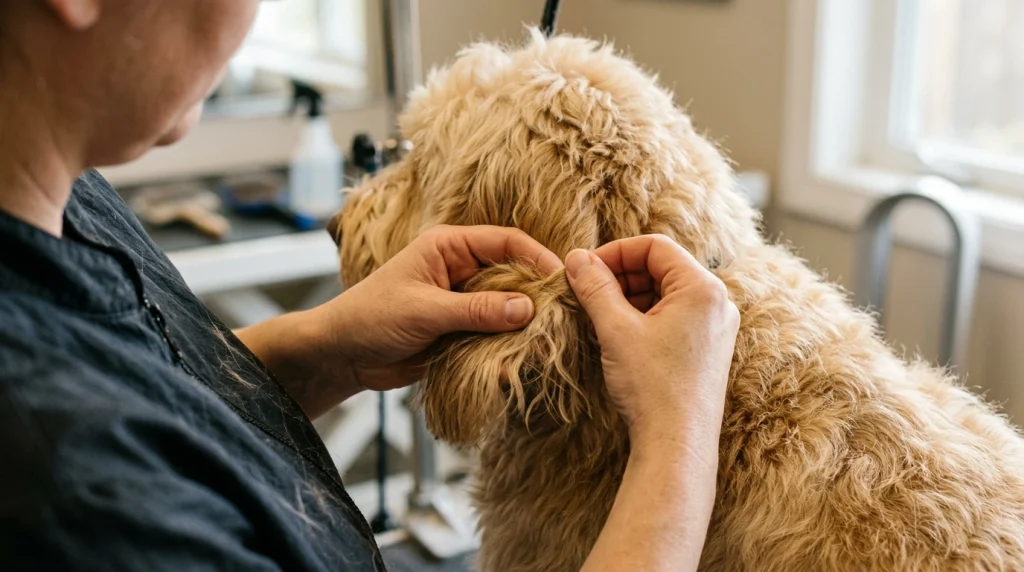
To remove a small, loose mat without hurting your dog, saturate the knot with detangling spray or cornstarch, hold the base of the hair right against the skin to prevent pulling, and pick the tangle apart from the outer tip inward using your fingers and a slicker brush.
Never take a pair of household scissors to a mat that sits tight against your dog’s skin. According to the ASPCA, a dog’s skin is thin and loose, meaning a tight mat pulls a tent of skin up into the center of the knot where scissors can easily slice right through it.
When I find a stubborn walnut-sized knot behind my dog’s ear, I follow a gentle three-step rescue process.
- Step 1 — Lubricate the fibers: Drench the knot in a silicone detangling serum, coconut oil, or dry cornstarch powder. Rub the powder or oil into the center of the knot with your thumb and forefinger so the hairs can slide past each other.
- Step 2 — Split the mat vertically by hand: Pinch both sides of the mat and gently pull it apart horizontally—like pulling apart a cotton ball—while holding the hair roots firmly against the skin so your dog doesn’t feel the tug.
- Step 3 — Tap and brush from the outside edge: Tap the edge of your slicker brush against the outer tip of the loosened knot and pull downward in tiny strokes, working from the ends of the hair back toward the skin.
If a mat feels hard like a piece of felt and sits flush against the skin with zero wiggle room, put the brush down. Attempting to brush out a pelt-level mat causes bruising, skin tears, and lifelong grooming anxiety.
At that stage, the safest choice is booking a professional groomer or veterinarian to safely shave underneath the mat with a #10 surgical clipper blade. While the American Veterinary Medical Association notes that routine shaving of healthy double coats should be avoided so the coat can insulate properly, shaving a severely pelted coat is a medical necessity to restore circulation and stop skin infections.
If you want to build a reliable home grooming kit that makes line combing effortless, here are the three exact tools I keep in my grooming caddy:
🏆 BEST OVERALL SLICKER
Chris Christensen Big G Dog Slicker Brush (Large, Coral)
★★★★★
Features dense, 27mm angled stainless steel pins on a flexible cushion pad with an ergonomic curved handle. It costs more than pet store brushes, but it cut my weekly line-brushing time in half because the long pins actually reach the skin on the first stroke.
🪮 BEST FOR SEASONAL SHEDDING
JW Pet GripSoft Rotating-Pin Undercoat Rake
★★★★☆
Built with a single row of rounded, 360-degree rotating stainless steel teeth and a non-slip rubberized handle. I grab this every spring during coat blow because the spinning teeth lift out thick tufts of dead wool without slicing healthy guard hairs.
💰 BEST FINISHING COMB
Andis Steel Pet Comb (7.5-Inch Dual Tooth)
★★★★★
Heavy-duty, static-free stainless steel comb featuring half coarse teeth and half fine teeth with smooth rounded tips. This under-$10 tool is my non-negotiable “truth detector” after every brushing session to verify zero hidden snags remain near the skin.
Frequently Asked Questions About Double Coat Matting
How often should I brush a double-coated dog to prevent mats?
You should brush a double-coated dog 3 to 4 times per week during most of the year using the line-brushing technique. During spring and fall seasonal coat blows, increase brushing to once daily for 10 to 15 minutes so dead undercoat cannot compact against the skin.
Can I shave my double-coated dog so it stops matting?
You should only shave a double-coated dog if the coat is severely pelted and causing skin pain or infection. Shaving a healthy double coat permanently alters its texture, causes the woolly undercoat to grow back faster than the protective guard hairs, and makes the regrown coat mat even more easily.
Does cornstarch really help get mats out of dog hair?
Yes, plain kitchen cornstarch works remarkably well on dry, greasy mats behind the ears and in the armpits. Dusting cornstarch deep into the knot absorbs oils and reduces friction between hair shafts, allowing you to gently pull the tangle apart with your fingers and a slicker brush.
Why is my dog matting worse around 8 to 12 months old?
Puppies go through a “coat change” between 8 and 14 months of age where they shed their soft puppy fluff and grow in their thicker adult double coat. The fine puppy hairs get trapped inside the incoming adult guard hairs, requiring daily line combing until the adult coat finishes coming in.
Keep Your Dog’s Double Coat Healthy and Tangle-Free
Preventing mats doesn’t require hours of exhausting struggle on the living room floor. Once you swap out short-pinned surface brushes for a long-pinned slicker brush and a metal greyhound comb, ten minutes of line combing a few times a week keeps your dog’s skin breathing comfortably.
Tonight, grab a metal comb and run the 5-second test behind your dog’s ears and under their collar. If you feel a snag, mist the fur, part it down to the skin, and clear out that trapped fluff before it turns into a knot.

Thomas Cutter is a lifelong dog owner and the founder of FindOutAboutDogs.com. With over 10 years of hands-on experience owning multiple breeds, Thomas created this site to provide honest, research-based dog advice that real owners can actually trust.
