How to Brush a Dog With a Thick Undercoat: A Safe Step-by-Step Guide
Quick Answer
To brush a dog with a thick undercoat, work in small sections and reach through the outer coat without scraping the skin. Start with a slicker or pin brush, remove loose undercoat gently with a rake, then finish with a comb to check your work. This approach follows the basic principles used for grooming double-coated dogs.
Quick brushing steps
- Check the coat: Feel for mats, sore areas, burrs, and skin irritation before you start.
- Part the fur: Separate the coat into small sections so you can see where the undercoat begins.
- Brush lightly: Use a slicker or suitable pin brush in the direction the hair naturally grows.
- Rake gently: Use an undercoat rake only on loose coat, without pressing the teeth against the skin.
- Comb-check: Run a steel comb through the section to find hidden tangles or packed fur.
- Stop if needed: End the session if the skin becomes red or your dog shows pain or increasing stress.
One useful rule
- If the comb cannot pass through without force, that area needs more gentle section-by-section work.
A thick undercoat can make a dog look deceptively easy to brush. The top may appear smooth while loose fur and small tangles stay packed underneath.
I prefer to judge the job by what a comb finds after brushing, not by how much fur lands on the floor. That simple check makes it much harder to leave packed undercoat hidden near the skin.


What Is a Thick Undercoat on a Dog?
 Save
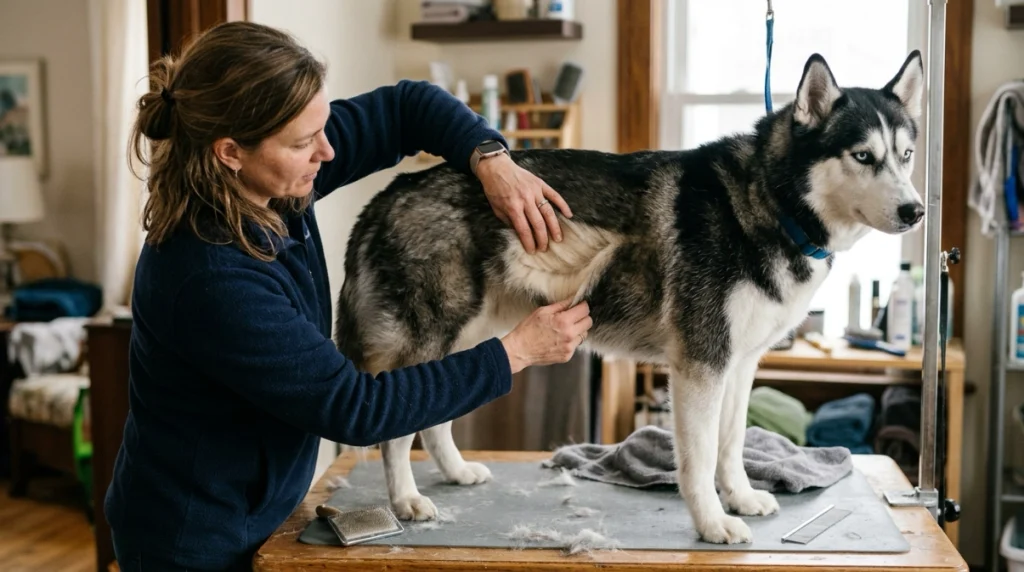
SaveA thick undercoat is a dense layer of short, soft hair growing beneath the longer outer coat. Together, these layers are commonly described as a double coat.
The outer guard hairs help repel moisture and protect the skin. The softer undercoat provides insulation and can shed heavily as seasons and living conditions change.
- Common examples: Siberian Huskies, German Shepherds, Golden Retrievers, Border Collies, Samoyeds, Malamutes, and many similar breeds.
- What you can feel: Soft, woolly hair beneath longer or coarser guard hairs.
- What causes trouble: Loose undercoat can remain trapped rather than falling away cleanly.
- Why brushing matters: Regular grooming removes loose hair and helps you detect tangles, debris, sores, and skin changes.
The American Kennel Club explains that double coats vary from short to medium, long, and very dense Arctic-style coats. You can see its broader explanation of double-coated dog breeds and coat types.
What Brush Should You Use for a Dog With a Thick Undercoat?
Most thick-coated dogs benefit from more than one grooming tool. One brush rarely does every part of the job equally well.
I like a simple three-stage setup: loosen the coat, remove loose undercoat, then verify with a comb. The dog’s coat length and density determine which tool should do most of the work.
| Tool | Best Job | Thick-Coat Use | Main Caution |
|---|---|---|---|
| Slicker brush | Separating coat and lifting loose hair | Excellent for medium and long dense coats; long-pin models such as the Big G use 27 mm pins | Don’t repeatedly scrape one skin area |
| Undercoat rake | Removing loose, packed undercoat | Especially useful during heavy shedding; some double-row models use two tooth lengths | Use minimal pressure |
| Steel comb | Finding remaining tangles | Ideal as the final check after brushing each section | Never force it through a mat |
| Pin brush | Finishing and working longer outer hair | Useful on long coats after much of the loose undercoat is removed | May not reach deeply enough alone |
| De-shedding tool | Removing loose shedding undercoat efficiently | Useful for compatible shedding coats when used exactly as directed | Avoid excessive repeated passes |
The AKC guide to dog brush types also distinguishes slickers, undercoat rakes, bristle brushes, pin brushes, and other grooming tools by coat type.
How Do You Brush a Dog With a Thick Undercoat Step by Step?
The safest approach is to work methodically instead of dragging a brush across the entire back. Small sections let you reach loose undercoat while keeping pressure under control.
1. Start with a calm dog and inspect the coat
Run your hands over the neck, shoulders, chest, back, sides, legs, tail, and behind the ears. Look for tender spots before a brush reaches them.
- Check for mats or hard clumps.
- Look for burrs, twigs, or other debris.
- Notice redness, bumps, sores, or bald areas.
- Pause if touching an area causes pain.
The ASPCA recommends using grooming sessions to check for skin problems, fleas, tangles, and other changes. Its dog grooming guidance also emphasizes choosing brushing methods according to coat type.
2. Work on a dry coat unless your tool says otherwise
For routine brushing, a clean, dry coat is easy to inspect and control. Some grooming tools permit wet-coat use, so always follow that specific manufacturer’s instructions.
Never assume every rake or de-shedding edge works the same way. The tooth shape, spacing, and intended coat type matter.
3. Use line brushing on dense areas
Line brushing means lifting a small layer of hair and brushing the exposed section beneath it. You then move gradually through the coat instead of skimming across the surface.
- Use one hand to lift a narrow section of coat.
- Place the brush into the exposed hair below that section.
- Brush outward in the direction of hair growth.
- Use short, controlled strokes instead of force.
- Move the lifted hair slightly and repeat.
This method is especially useful around the shoulders, hindquarters, chest, and other places where loose undercoat can hide.
4. Bring in the undercoat rake only where needed
An undercoat rake should pull loose hair through the outer coat without scraping the skin. If you need strong pressure, stop and reassess the section.
- Keep the rake aligned with normal hair growth.
- Use a light hand and controlled strokes.
- Remove collected fur from the tool frequently.
- Don’t keep raking an area just because hair still comes out.
Heavy seasonal shedding can produce surprising amounts of loose fur. More fur does not automatically mean more pressure is appropriate.
5. Check your progress with a steel comb
A finishing comb is one of my favorite quality-control steps. It quickly shows whether the coat is genuinely separated or merely smooth on top.
Start near the hair ends and work inward if you find resistance. A finished section should comb through with little force.
Where Should You Be Most Careful When Brushing?
 Save
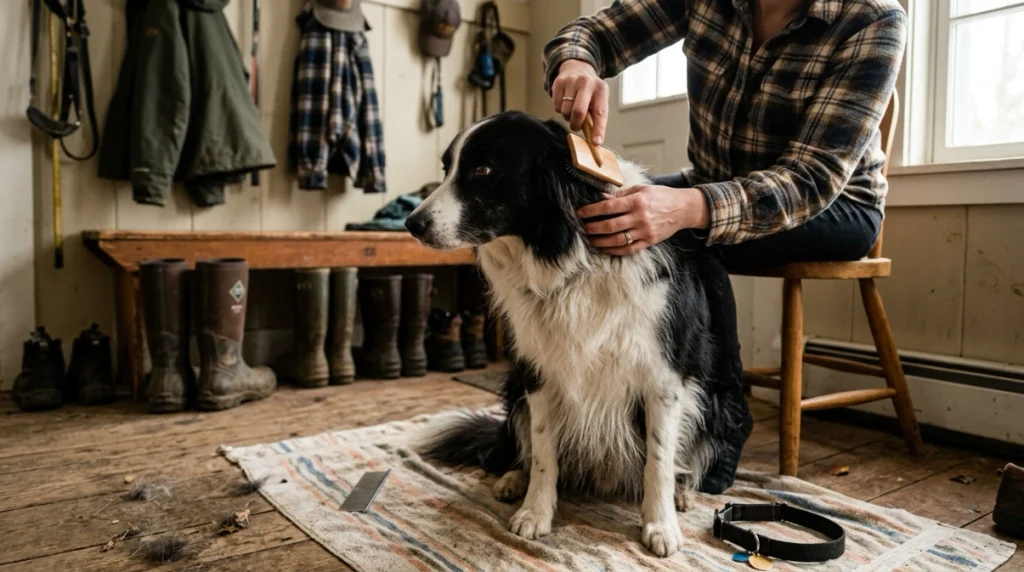
SaveDense coats are not equally difficult everywhere. Friction points and feathered areas often tangle faster than the flat coat across the back.
- Behind the ears: Fine hair can knot close to the skin.
- Under the collar: Constant rubbing can compact loose hair.
- Armpits: Movement and friction make this a common tangle zone.
- Chest: Long feathering can hide small knots.
- Rear legs: Dense furnishings often hold shed undercoat.
- Tail: Long hair needs section-by-section brushing rather than hard pulling.
Use smaller tools and shorter strokes around sensitive areas. A large rake that works well on the back may be awkward behind the ears or near the legs.
How Often Should You Brush a Dog With a Thick Undercoat?
A good baseline for many double-coated dogs is at least one thorough brushing each week. Dogs actively shedding their undercoat may need several shorter sessions during the week.
Coat length, climate, indoor living, activity, and the dog’s individual shedding pattern all affect the schedule. Long coats that tangle easily often need more attention than short double coats.
- Normal maintenance: Check and brush the complete coat at least weekly.
- Heavy shedding: Increase the frequency and shorten each session if needed.
- Long feathering: Check high-friction areas more often.
- After outdoor activity: Look for seeds, burrs, mud, and debris before tangles tighten.
I would rather do three calm 10-minute sessions than one frustrating marathon. Short sessions also make it easier to notice when your dog’s patience is fading.
Can You Brush Mats Out of a Thick Undercoat?
Small, loose tangles can often be teased apart carefully. Tight mats close to the skin are different and can be painful to manipulate.
Don’t attack a dense mat with hard brushing. Never put scissors against the skin beneath a mat because folded skin can be pulled up inside the knot.
- Hold the hair gently between the mat and skin to reduce pulling.
- Work from the outer edge of the tangle instead of the tight center.
- Use small sections rather than trying to remove the whole knot at once.
- Stop if your dog reacts painfully.
- Use a professional groomer for severe, skin-tight, or widespread matting.
Professional help is also sensible when packed undercoat prevents you from seeing or feeling the skin properly. Comfort matters more than saving every strand of hair.
Should You Shave a Dog With a Thick Undercoat?
Routine shaving is generally not the solution for a healthy double coat. Regular removal of loose undercoat is usually the better maintenance strategy.
The topcoat and undercoat perform different protective functions and may regrow differently. The AKC specifically warns against routine shaving of double-coated dogs except in limited circumstances such as severe coat neglect or veterinary necessity.
Instead, concentrate on regular brushing, bathing when appropriate, thorough drying, and professional grooming when the coat becomes too difficult to manage at home.
What Signs Mean You Should Stop Brushing?
Brushing should not become a battle between the tool and the dog’s skin. Stop when the coat or your dog’s behavior suggests the session is becoming uncomfortable.
- Skin turns noticeably red.
- Your dog repeatedly flinches or turns toward the brush.
- You find an open sore or inflamed patch.
- Hair is breaking rather than loose undercoat coming free.
- A tool keeps catching in one spot.
- Your dog starts growling, snapping, panicking, or trying urgently to escape.
Bald patches, persistent itching, sores, unusual odor, or major changes in shedding deserve veterinary attention rather than more brushing.
A Simple Thick-Undercoat Grooming Routine
If the number of tools feels confusing, keep the routine simple. You can get most home maintenance done with a three-tool sequence.
- Slicker or suitable pin brush: Separate the outer coat and loosen hair.
- Undercoat rake: Remove loose dense undercoat where it is genuinely needed.
- Steel comb: Check each finished area for hidden resistance.
The comb is what tells you whether you’re finished. If it catches, return to that small area rather than brushing the whole dog again.
Brushes I Would Consider for a Thick Undercoat
 Save
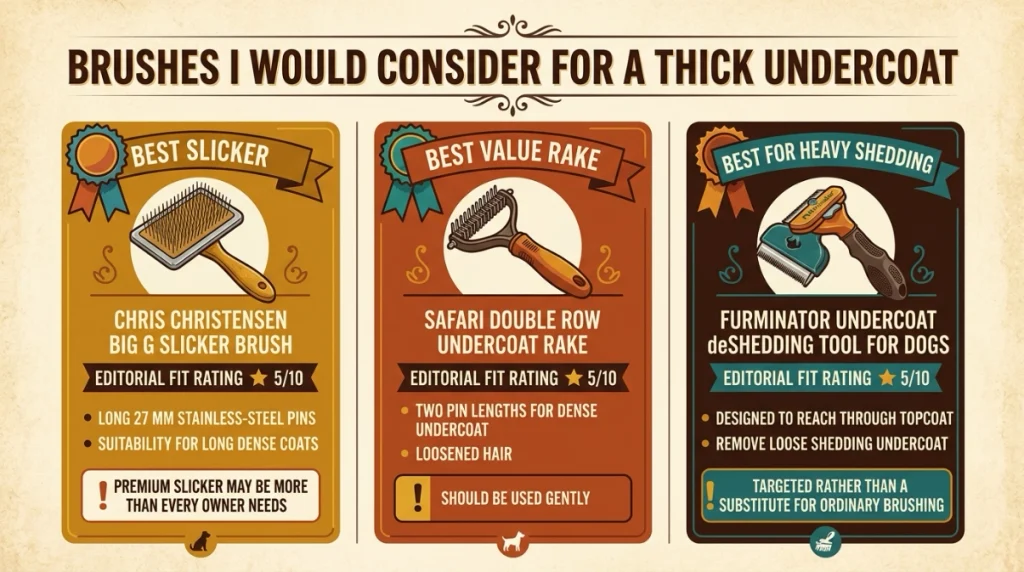
SaveIf you’re ready to choose your grooming tools, these are three established options that match different parts of a thick-coat routine. My ratings below are editorial fit ratings, not retailer customer-review scores.
🏆 Best Slicker
Chris Christensen Big G Slicker Brush
★★★★½ Editorial fit
The Big G uses long 27 mm stainless-steel pins and is designed for long, dense coats. I like this style when the priority is separating a deep coat before the final comb-through, though the premium price makes it more tool than every owner needs.
💰 Best Value Rake
Safari Double Row Undercoat Rake
★★★★☆ Editorial fit
Its double-row design uses two pin lengths to reach dense undercoat and collect loosened hair. I would choose it for straightforward undercoat removal when you want a simple rake rather than an aggressive cutting-style tool.
🐕 Best for Heavy Shedding
FURminator Undercoat deShedding Tool for Dogs
★★★★☆ Editorial fit
This tool is designed to reach through the topcoat and remove loose shedding undercoat. I see it as a targeted shedding tool rather than a substitute for ordinary brushing, so careful, limited use matters.
Frequently Asked Questions
Should I brush a thick undercoat against the direction of hair growth?
For routine home grooming, use controlled strokes mainly in the direction the coat naturally grows. You can lift and separate sections to reach underneath, but repeatedly dragging a rake backward through dense fur can increase pulling and skin irritation.
How do I know when I have removed enough undercoat?
Don’t judge the session by the size of the fur pile. Finish when a steel comb moves through the section easily, the coat feels separated rather than packed, and further brushing is no longer finding significant tangles or resistance.
Is an undercoat rake better than a slicker brush?
Neither is automatically better because they perform different jobs. A slicker is useful for separating hair and removing loose fur, while a rake is designed to reach dense undercoat. Using both carefully can be more effective than forcing one tool to do everything.
Can I brush my double-coated dog every day?
Gentle daily coat checks or light brushing can be useful for dogs that tangle or shed heavily. Deep raking or aggressive de-shedding does not need to happen every day, so adjust the tool and intensity to the dog’s coat condition.
What should I do if my dog’s undercoat is severely matted?
Stop trying to pull severe mats out with repeated brushing. Tight mats can be painful and may sit close to delicate skin, so a professional groomer or veterinarian is the safer choice when the coat is heavily compacted or the skin cannot be inspected.
Final Takeaway
The best way to brush a dog with a thick undercoat is to work in small sections, keep pressure light, and check your progress with a comb. Your goal is a comfortable, separated coat—not the biggest possible pile of shed fur.
Make grooming routine before the coat becomes packed or matted. A few calm, consistent sessions are easier on both you and your dog than waiting until shedding gets out of control.

Thomas Cutter is a lifelong dog owner and the founder of FindOutAboutDogs.com. With over 10 years of hands-on experience owning multiple breeds, Thomas created this site to provide honest, research-based dog advice that real owners can actually trust.
