Dog Brush vs Human Hair Brush: Can You Use Your Brush on Your Dog?
Quick Answer
You should avoid using a human hair brush on your dog for regular grooming, though a soft paddle brush works in a one-time pinch for surface dirt. Human brushes are designed for single-strand hair follicles and acidic scalps, whereas proper canine coat care requires angled pins and specific bristle spacing to penetrate dense, multi-hair follicles without scratching a dog’s thin skin.
Key Differences at a Glance
- Follicle structure: Human follicles grow one hair strand, while dog compound follicles grow up to 15 strands that trap dead fur.
- Skin thickness: A dog’s epidermis is three times thinner than human skin and tears easily under stiff human nylon bristles.
- Pin geometry: Dog slicker brushes use 45-degree angled wires to lift tangles upward rather than pulling straight against the hide.
- Undercoat reach: Human paddle brushes slide right over a dog’s dense secondary coat, leaving painful mats buried against the skin.
- Static and hygiene: Plastic human bristles create uncomfortable static shocks on dry dog fur and transfer human styling products to pets.
Quick Verification Tip
- Part your dog’s coat down to the skin after brushing; if you still see clumped fuzz at the base, your brush is only skimming the surface.
We have all been there on a muddy Sunday evening when the dog brush goes missing and your own paddle brush is sitting right on the bathroom counter. Years ago, I tried using my own vented hair brush on my Golden Retriever, Barnaby, thinking hair is just hair.
That mistake cost us a painful ear mat and a pricey trip to the groomer. Below, I will break down the exact structural differences in a dog brush vs human hair brush so you can protect your dog’s skin and pick the right tool.


What Is the Difference Between a Dog Brush and a Human Hair Brush?
 Save
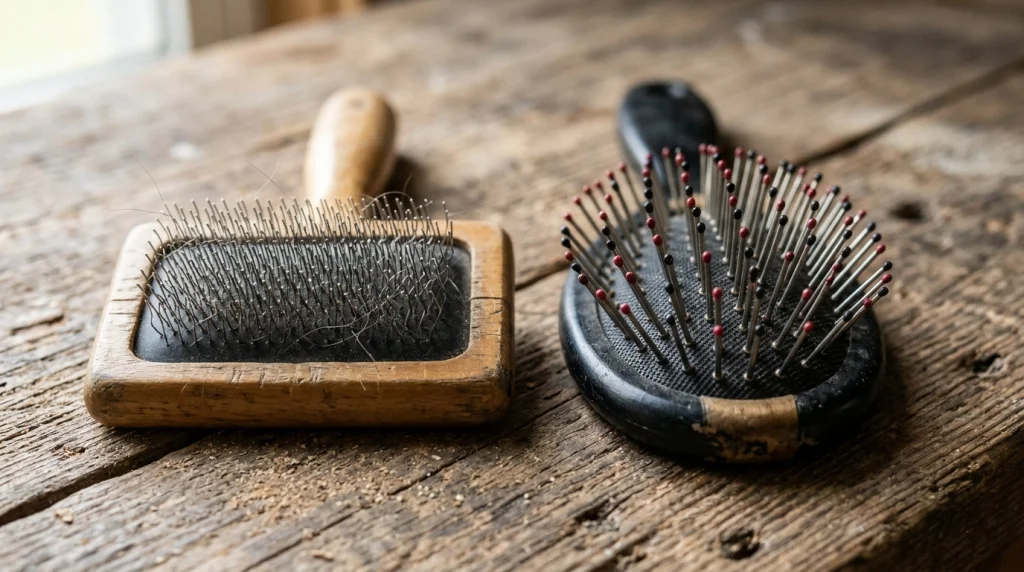
A dog brush is a specialized grooming tool built with angled steel pins, flexible rakes, or tightly packed boar bristles to penetrate compound canine hair follicles and protect thin animal skin. A human hair brush is built for single-strand terminal hair and a thicker, oilier human scalp.
When you put them side by side, the engineering differences jump right out. Manufacturers design each tool around completely different biological rules.
| Feature | Dog Brush | Human Hair Brush |
|---|---|---|
| Target Follicle Type | Compound follicles (5 to 15 hairs per pore) | Simple follicles (1 to 3 hairs per pore) |
| Target Epidermis Thickness | 3 to 5 cell layers thick (delicate) | 10 to 15 cell layers thick (tough) |
| Pin Angle & Shape | 45-degree bent wires or tapered stainless steel | 90-degree straight nylon or plastic pins |
| Pin Tip Protection | Polished round steel tips or recessed flex pads | Epoxy ball tips (often snag dog undercoats) |
| Primary Goal | Undercoat extraction, de-shedding, mat prevention | Detangling single strands, styling, sebum smoothing |
| Static Control | Anti-static grounded metal or natural boar bristle | Often molded plastic or nylon (high static on fur) |
Look closely at the epoxy ball tips on a standard human paddle brush. Those tiny plastic balls feel great massaging your own head.
On a dog, those exact same ball tips act like miniature grappling hooks. They catch the microscopic loops of a dog’s wooly undercoat and rip healthy hair straight out by the root.
Why Does Canine Skin and Coat Anatomy Require a Different Brush?
 Save
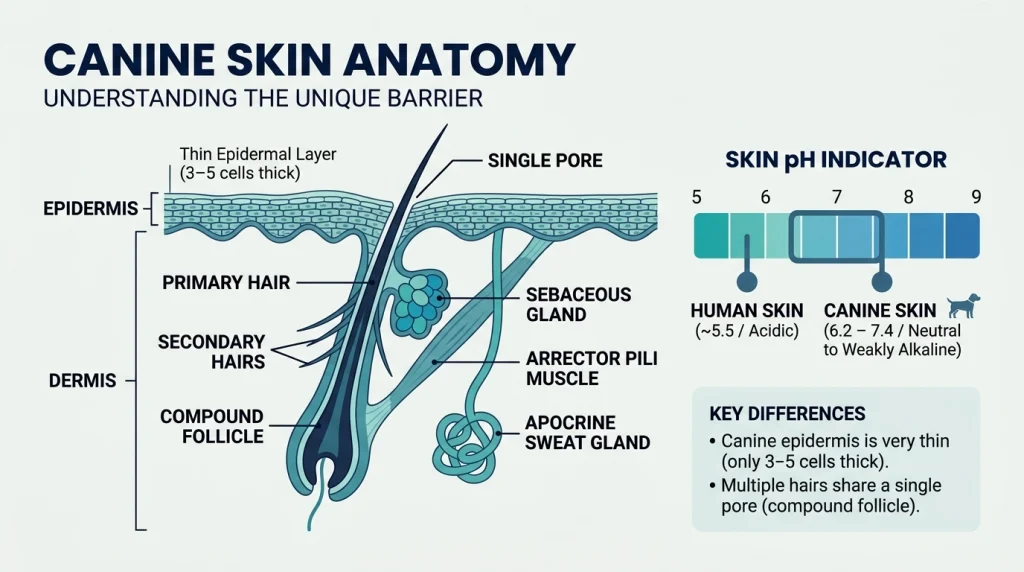
Canine skin is significantly thinner, less acidic, and far more densely packed with hair than the human scalp. Using tools built for human anatomy ignores three major biological traits that define how dogs grow and shed their coats.
When I started testing grooming gear across different breeds, I realized most coat damage comes from owners treating dog fur like human head hair. Here is what is happening beneath your dog’s coat.
1. Compound Hair Follicles vs. Simple Follicles
If you look at your own scalp under a magnifying glass, you will see individual hairs emerging from individual pores. Dogs do not grow hair that way.
Dogs have compound hair follicles. According to veterinary dermatology references in the Merck Veterinary Manual, a single canine pore pushes out one stiff primary guard hair surrounded by five to fifteen soft secondary undercoat hairs.
All of those hairs exit through the exact same skin opening. When your dog sheds, those fluffy secondary hairs detach at the root but get wedged inside the bundle of neighboring hairs.
A human brush lacks the pin tension and spacing required to reach into that dense bundle. Instead, it presses the loose fur flat against the skin, compacting it into a tight felt blanket.
2. Epidermal Thickness and Scratch Sensitivity
Most people assume dogs have tough hides because they roll in gravel and crash through brushwood. That is a myth.
A dog’s dense coat provides their physical armor, so their actual skin does not need to be thick. A human scalp has an epidermis (outer skin layer) that is 10 to 15 cell layers thick.
Your dog’s epidermis is only 3 to 5 cell layers thick. It is the biological equivalent of delicate tissue paper.
- Stiff human nylon bristles: Do not bend when they hit a dog’s bony hips, spine, or shoulder blades, leaving microscopic scratches.
- Broken epoxy tips: Human brushes frequently lose the tiny plastic beads on their pin tips, exposing jagged wire that slices thin dog skin.
- Air cushion tension: The rubber air pad on a human brush is calibrated for human hand pressure against a thick skull, not a dog’s sensitive ribcage.
3. Skin pH and Sebum Distribution
Human skin is naturally acidic, sitting at a pH around 5.5. Canine skin is almost completely neutral, ranging between 6.5 and 7.5.
Because dog skin is less acidic, bacteria and yeast multiply much faster whenever the skin barrier gets scraped. If you use a stiff human brush that causes tiny surface abrasions, you open the door to brush burn and secondary staph infections.
Sharing your brush also transfers human conditioner, dry shampoo, and hairspray residue onto your dog. Those human products disrupt their skin barrier and cause flaking.
How Does Pin and Bristle Engineering Compare?
Dog brushes use specialized wire geometries, flex cushions, and tapered pins to lift dead fur out of the coat without scraping the hide. Human brushes rely on straight vertical pins designed to part long, continuous strands of hair.
During a grooming workshop in early 2026, I watched a professional groomer demonstrate the “balloon test” to show how pin angles work. She blew up a party balloon and dragged a stiff human nylon brush across it with medium pressure, and the balloon popped instantly.
Next, she took a professional dog slicker brush with 135-degree bent steel wires and stroked the second balloon using the exact same hand weight. The angled wires flexed backward on contact, gliding smoothly without popping the rubber.
Here is how the four main types of dog brush bristles outperform human brushes on canine fur:
- Angled Slicker Wires: Fine stainless steel pins bent at roughly 45 degrees (creating a 135-degree working angle). When you pull the brush, the knees of the pins absorb shock while the tips lift tangles up and away from the skin.
- Undercoat Rake Teeth: Long, smooth, heavy-gauge steel posts that sometimes rotate 360 degrees in the handle. They part the topcoat and sink 1 to 2 inches deep to hook shedding wool without cutting the top guard hairs.
- Polished Pin Brushes: Similar in look to a human oval brush, but engineered with longer, wider-spaced stainless steel pins set into a highly compressible air pad. They lack the snag-prone epoxy balls found on cheap drugstore brushes.
- Canine Boar Bristles: Packed in staggered clusters of varying heights to grab fine dander from short-haired breeds like Boxers and Pit Bulls.
Can You Ever Use a Human Hair Brush on a Dog?
Yes, you can occasionally use specific types of human hair brushes on certain dogs, provided the brush matches your dog’s coat texture and you clean it thoroughly first. However, it should only serve as a temporary backup or finishing tool rather than your primary shed remover.
I am a realist, and I know people will still reach for a human brush when an unexpected burr shows up on a camping trip. If you are going to do it, you need to know which human brushes are safe and which ones cause harm.
When a Human Brush Is Safe to Use
I tested three popular human brushes on my own dogs to see which ones actually hold up without causing discomfort. Two specific styles passed the test for light duty.
- 100% Natural Boar Bristle Brushes: If you own a short-coated, single-coated dog like a Chihuahua, Greyhound, or Doberman, a soft human boar bristle brush works wonderfully. It buffs their coat to a high shine and spreads natural oils without scratching.
- Soft Flexible Detangling Brushes (Wet Brush or Tangle Teezer): Human detanglers with ultra-soft, bendable teeth work well on silky, single-coated toy breeds like Yorkshire Terriers, Maltese, and Shih Tzus. In fact, several major pet brands sell licensed dog versions that use the exact same flexible plastic teeth.
- Wide-Tooth Shower Combs: A sturdy, seamless wide-tooth human comb is handy for working dog conditioner through a long coat while your pet is soaking in the tub.
When a Human Brush Is Dangerous to Use
Never use a human hair brush on a heavy double-coated breed or a tightly curled breed. The wrong tool here leads directly to medical issues.
I calls this the “iceberg mat” trap. When you brush a Golden Retriever, Husky, German Shepherd, or Goldendoodle with a human paddle brush, the top layer of fur looks glossy and neat.
Underneath that smooth top layer, the brush has pushed weeks of dead undercoat down against the warm skin. When your dog gets wet in the rain or goes for a swim, that compacted layer shrinks and tightens like wool in a hot dryer.
The American Veterinary Medical Association (AVMA) notes that severe matting cuts off blood circulation to the skin, traps moisture, and hides painful hot spots or parasites. Once a pelt forms against the skin, no brush can save it—a groomer has to shave your dog down with a surgical blade.
Can Humans Use a Dog Brush on Their Own Hair?
No, humans should never use a dog slicker brush or de-shedding tool on their own hair because the fine wire pins and sharp edges will shred human hair cuticles and scratch your scalp. Only a natural boar bristle dog brush is gentle enough for human hair, though sharing brushes between species is unhygienic.
It sounds funny, but people ask this question all the time when their own brush disappears. Let’s look at why grabbing Fido’s brush is a terrible idea for your morning routine.
A dog slicker brush uses dozens of raw steel wires designed to grab and pull out dead, detached undercoat fluff. Human head hair stays in its growth phase (the anagen phase) for two to seven years.
If you drag a wire slicker brush or an undercoat blade through your own hair, it acts like a cheese grater on your hair shafts. It strips the protective outer cuticle, creates instant split ends, and rips healthy anchored hair right out of your head.
There is also the hygiene factor. According to the CDC Healthy Pets guidelines, dogs can carry fungal spores like ringworm, microscopic mites, flea dirt, and outdoor bacteria on their coats without showing stark symptoms.
Keep a strict wall between your vanity tools and your pet’s grooming kit. Your scalp will thank you.
How to Choose the Right Dog Brush by Coat Type
 Save
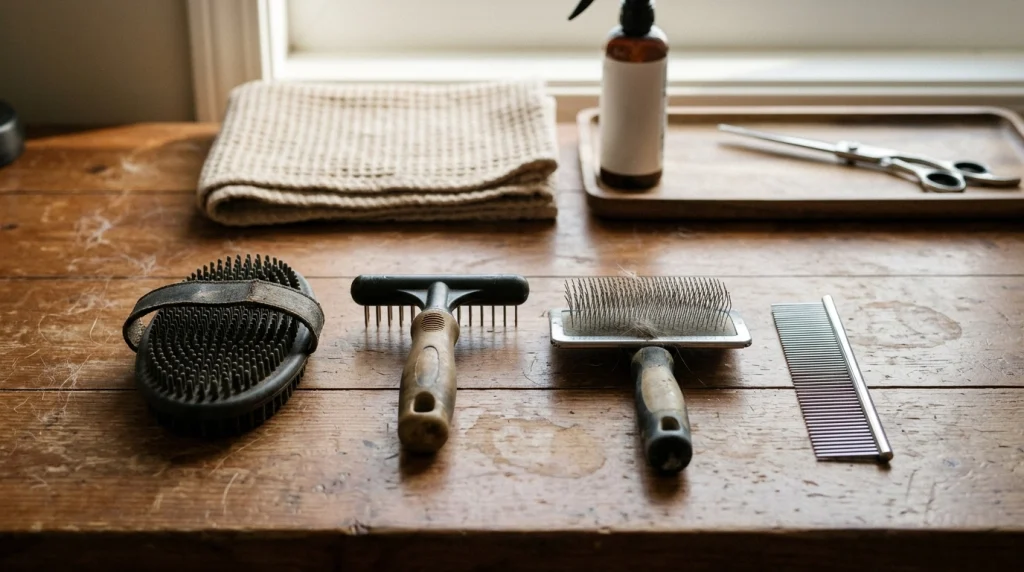
Matching your brush to your dog’s specific coat type is the secret to cutting shedding by up to 80 percent while keeping grooming sessions painless. Instead of reaching for a human paddle brush, match your dog’s fur to one of the four main canine coat categories below.
| Dog Coat Type | Example Breeds | Best Dog Brush Style | Why Human Brushes Fail Here |
|---|---|---|---|
| Smooth & Short | Beagle, Boxer, French Bulldog, Greyhound | Rubber curry brush or boar bristle brush | Hard plastic pins scratch skin with zero fur cushion |
| Double Coat (Medium/Long) | Golden Retriever, Husky, German Shepherd, Corgi | Undercoat rake + long-pin slicker brush | Cannot penetrate dense secondary wool; compacts mats |
| Curly & Poodle-Mix | Poodle, Goldendoodle, Bichon Frise, Labradoodle | Long curved-pin slicker + steel greyhound comb | Ball tips snag curls and cause severe pain |
| Silky & Drop Coat | Yorkie, Maltese, Shih Tzu, Afghan Hound | Tipless polished steel pin brush | Creates static electricity that knots fine strands |
If you own a Doodle or a double-coated breed, learn the professional technique called line brushing. Part your dog’s fur horizontally with one hand so you can see a clean line of pink skin.
Brush just below that part line, pulling the fur downward, then drop down half an inch and repeat. Always finish by sliding a stainless steel greyhound comb through the coat from root to tip to verify no hidden knots remain.
If you are ready to retire that old bathroom brush and pick a tool engineered for canine anatomy, here are the three dog brushes I keep in my personal grooming bag:
🏆 BEST OVERALL SLICKER
Chris Christensen Big G Slicker Brush
★★★★★
Features extra-long 27mm angled stainless steel pins with ground, polished tips and an ultra-forgiving cushioned pad. It is pricey, but it glides through my Golden Retriever’s feathers and thick Doodle curls in half the time of standard slickers without scratching skin.
💰 BEST DUAL-SIDED EVERYDAY
Safari Combo Pin and Bristle Dog Brush
★★★★☆
Combines wide-spaced stainless steel pins on one side with soft coat-polishing bristles on the reverse in a durable wooden handle. If you like the familiar feel of a human paddle brush, this budget-friendly upgrade gives you that exact motion with dog-safe pin spacing.
🐕 BEST FOR SHORT & SENSITIVE COATS
KONG ZoomGroom Rubber Grooming Brush
★★★★★
Built from soft, flexible 3/4-inch rubber fingers that act like a magnet for loose short hairs while massaging the skin. I use this in circular motions during bath time on short-haired hounds and sensitive rescues who flinch at metal bristles.
Frequently Asked Questions
Can I use a human Wet Brush on my dog?
Yes, you can use a human Wet Brush on dogs with thin, single-layered, silky hair like Yorkies or Maltese because its flexible IntelliFlex bristles bend before scratching thin skin. However, it is ineffective on thick double-coated breeds like Huskies or Golden Retrievers because the soft bristles cannot reach the dense undercoat.
Why do dog brushes not have little balls on the bristles?
High-quality dog pin and slicker brushes omit the little epoxy balls found on human brushes because those plastic tips catch and tear wooly undercoat hairs. Instead, good dog brushes use precision-polished rounded steel tips or 45-degree angled pins that slide cleanly through multi-hair follicles without snagging knots.
Can using the wrong brush hurt my dog’s skin?
Yes, using a stiff human brush or dragging a wire brush with heavy pressure causes a painful condition called brush burn. Because a dog’s outer skin layer is only 3 to 5 cells thick, stiff vertical bristles easily leave microscopic scrapes that become inflamed, itchy, and prone to bacterial infection.
What can I use if I do not have a dog brush right now?
If you lack a dog brush in an emergency, use a clean wide-tooth human comb for long-haired dogs or a damp microfiber washcloth for short-haired breeds. Stroke gently in the direction of hair growth to remove surface debris until you can pick up a proper canine slicker or curry brush.
Final Takeaway on Choosing the Right Brush
Your own hair brush does a great job detangling single-strand human hair, but your dog’s compound follicles and delicate epidermis play by a different set of rules. Swapping out that spare bathroom paddle brush for a coat-matched dog brush takes the tug-of-war out of grooming night.
Check your dog’s coat down to the skin before your next brushing session. Grab a tool built for their specific coat type, use light wrist pressure, and turn grooming into the relaxing massage your dog deserves.

Thomas Cutter is a lifelong dog owner and the founder of FindOutAboutDogs.com. With over 10 years of hands-on experience owning multiple breeds, Thomas created this site to provide honest, research-based dog advice that real owners can actually trust.
