What Are the Different Types of Dog Brushes? Complete Guide
Quick Answer
The main types of dog brushes are slicker brushes, bristle brushes, pin brushes, rubber curry brushes or grooming mitts, and undercoat rakes. Combs and de-shedding tools also play important roles in a complete grooming kit. The right choice depends mainly on your dog’s coat length, density, texture, and shedding level, which is why the American Kennel Club’s dog-brush guide recommends matching the tool to the coat rather than buying one brush for every dog.
The main dog brush types
- Slicker brush: Removes loose hair, small tangles, and early mats from many medium, long, curly, and dense coats.
- Bristle brush: Smooths short coats, removes surface debris, and helps distribute natural coat oils.
- Pin brush: Gently works through longer flowing coats and is useful for finishing after detangling.
- Rubber brush: Loosens dead hair from short, smooth coats and works well during bathing.
- Undercoat rake: Reaches loose undercoat in double-coated dogs, especially during seasonal shedding.
- De-shedding tool: Targets loose undercoat but requires careful, limited use on suitable coat types.
Walk into a grooming aisle and the choices can look almost identical at first. In reality, a slicker, pin brush, rubber curry, and undercoat rake do completely different jobs.
I find it easier to choose a brush by starting with the dog’s coat rather than the package claims. Once you know what each design does, the decision becomes much simpler.
Definition: A dog brush is a grooming tool designed to remove loose hair, debris, tangles, or surface dander while helping maintain the coat. Different brush designs reach different layers of hair, so no single brush is ideal for every coat.


What Are the Main Types of Dog Brushes?
 Save
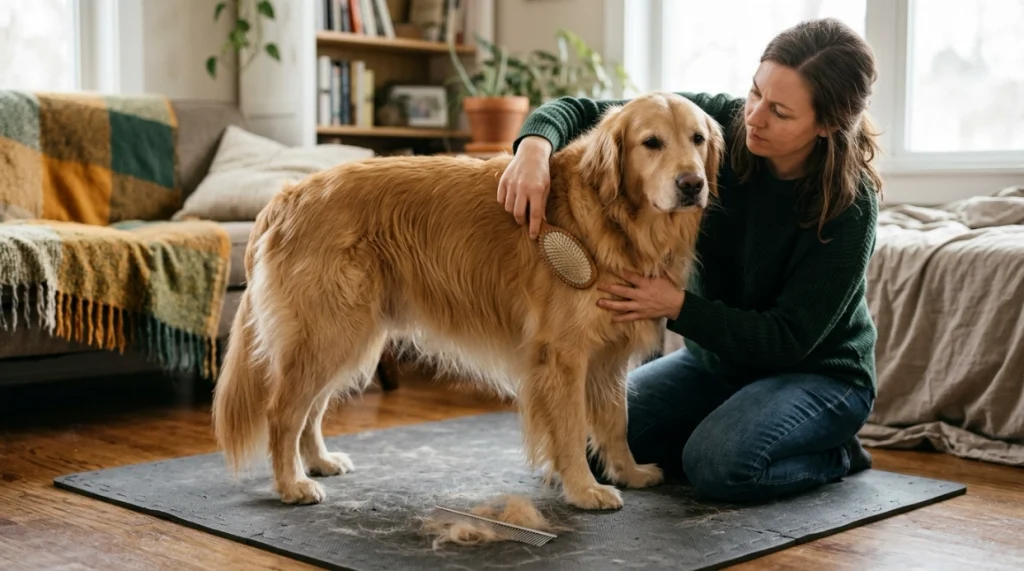
SaveThe five core brush styles are slicker, bristle, pin, rubber, and undercoat brushes. Combs and specialized de-shedding tools are useful companions rather than true replacements for everyday brushing.
| Brush type | Best use | Best coat types | Main caution |
|---|---|---|---|
| Slicker | Loose hair and tangles | Medium, long, curly, dense | Wire pins can irritate skin with heavy pressure |
| Bristle | Finishing and surface hair | Short and smooth | Does not reach thick undercoat well |
| Pin | Gentle detangling and finishing | Medium and long flowing coats | May miss compact undercoat |
| Rubber curry | Loose surface hair and bathing | Short and smooth | Usually ineffective on long thick coats |
| Undercoat rake | Loose undercoat | Double coats | Pin length must suit coat depth |
| De-shedding tool | Heavy seasonal shedding | Suitable shedding coats with undercoat | Overuse can irritate the skin |
Slicker Brushes
A slicker brush has many fine wire pins set close together, usually with each pin bent slightly near the end. It is one of the most useful choices for removing loose hair and separating tangles.
Slickers suit many Poodles, Bichons, Spaniels, long-coated dogs, and dense-coated breeds. The American Kennel Club also advises using a light touch because pressing the wire pins hard against the skin can cause discomfort.
- Best for: Tangles, loose hair, curly coats, longer coats, and coat fluffing.
- Choose softer pins when: Your dog has a fine coat or sensitive skin.
- Choose longer pins when: The coat is long or dense enough that short pins cannot reach through it.
Bristle Brushes
Bristle brushes use clusters of natural or synthetic bristles instead of wire pins. They work mainly at the surface of the coat.
I like them most as a finishing tool on smooth-coated dogs. They lift light debris, collect loose surface hairs, and leave the coat lying neatly after deeper grooming.
- Best for: Boxers, Beagles, short-haired hounds, and other smooth-coated dogs.
- Strong point: Gentle everyday finishing.
- Weak point: Limited ability to reach dense undercoat or serious tangles.
Pin Brushes
A pin brush resembles a human hairbrush, with widely spaced metal pins mounted in a cushioned base. Many pins have polished or rounded ends to reduce scratching.
Pin brushes are useful on silky, flowing, medium-to-long coats. They separate hair without the dense pulling action of a slicker, which makes them helpful for finishing and routine maintenance.
For a long-coated dog, I often think of the pin brush as the gentle second step. Deal with real knots first, then use the pin brush to straighten and finish the coat.
Rubber Curry Brushes and Grooming Mitts
Rubber curry brushes use soft flexible teeth that grip loose hair while massaging the surface of the skin. Grooming mitts work on the same basic principle.
These tools shine on short, smooth coats because the flexible teeth can grab shedding hair without needing to penetrate several inches of fur. The ASPCA’s grooming guidance also recommends rubber brushes for smooth, short coats.
- Dry use: Massage gently to loosen dead hair and surface dirt.
- Bath use: Work dog shampoo through a wet short coat.
- Best feature: Soft contact makes many dogs more comfortable with grooming.
Undercoat Rakes
An undercoat rake uses one or two rows of longer metal teeth to reach beneath the outer coat. Its job is to pull out loose undercoat rather than polish the visible topcoat.
This makes it especially useful for breeds with true double coats. Retrievers, German Shepherds, Huskies, Malamutes, Corgis, and similar dogs can build up large amounts of loose undercoat during shedding periods.
The tooth length matters. A rake that is too short may skim the surface, while an unsuitable long tool can make grooming awkward or uncomfortable.
De-Shedding Tools
A de-shedding tool is designed specifically to collect loose undercoat during periods of heavy shedding. It should not automatically replace a normal brush.
Manufacturer instructions for tools such as the FURminator Undercoat deShedding Tool stress using them on suitable shedding coats, with light pressure and limited repeated strokes. They are not recommended for every non-shedding or sensitive coat.
- Use it for: Loose dead undercoat.
- Do not use it for: Cutting through mats or forcing knots apart.
- Stop immediately if: You see fresh redness, irritation, or discomfort.
Combs and Dematting Tools
Metal grooming combs are not technically brushes, but they belong in the same kit. A comb helps detect tangles that a brush may glide over, especially behind ears, under legs, and in feathered areas.
Dematting tools are more specialized. Severe mats close to the skin deserve extra caution because pulling hard can hurt and cutting near folded skin can cause injury.
The VCA grooming and coat-care guide recommends professional help when tangles are extensive and warns against casually using scissors near tightly matted skin.
Which Dog Brush Should I Use for My Dog’s Coat?
Choose by coat structure first, not breed name alone. Two dogs of the same general size can need completely different tools if one has a smooth single coat and the other has a thick double coat.
| Coat type | Good starting tool | Useful second tool |
|---|---|---|
| Short and smooth | Rubber curry or grooming mitt | Soft bristle brush |
| Short and dense | Slicker or rubber brush | Bristle brush |
| Long and silky | Pin brush | Metal comb |
| Curly | Slicker brush | Metal comb |
| Double coat | Slicker or undercoat rake | Appropriate de-shedding tool |
As of 2026, the basic rule has not changed: match the tool to both hair length and coat density. A brush that works beautifully on a Labrador can be almost useless on a long Poodle coat.
What Is the Difference Between a Slicker, Pin, and Bristle Brush?
A slicker works deeper on loose hair and tangles, a pin brush separates longer hair more gently, and a bristle brush finishes the surface. Many long-coated dogs benefit from more than one of them.
- Slicker brush: Best when detangling and loose-hair removal are the priority.
- Pin brush: Best when you want gentle separation without densely packed wires.
- Bristle brush: Best when you want surface cleaning, smoothing, and finishing.
That distinction matters because owners often expect a finishing brush to remove deep undercoat. It cannot reach hair that its bristles never touch.
What Type of Dog Brush Is Best for Shedding?
For a smooth-coated shedder, start with a rubber curry or grooming mitt. For a double-coated dog, an undercoat rake or correctly chosen de-shedding tool can reach loose hair beneath the topcoat.
Heavy shedding does not mean you should brush harder. The goal is to collect hair that is already loose, not scrape the same skin area until no more fur appears.
- Light everyday shedding: Rubber brush or bristle brush.
- Dense double-coat shedding: Undercoat rake.
- Seasonal coat blow: Undercoat rake plus carefully used de-shedding tool.
- Curly low-shedding coat: Slicker and comb for tangle prevention rather than aggressive de-shedding.
How Do You Brush a Dog Without Hurting Its Skin?
 Save
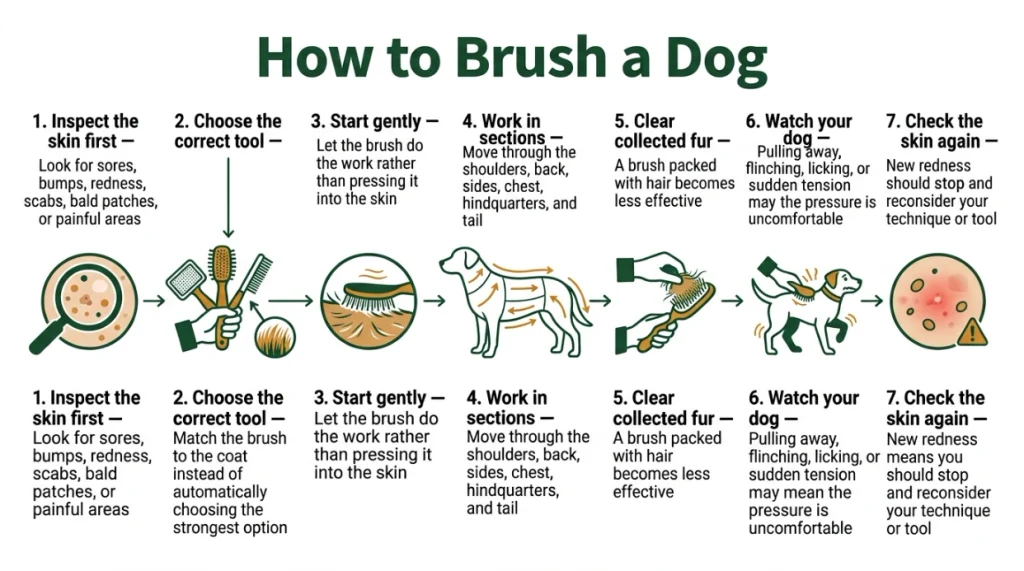
SaveUse gentle pressure, work in manageable sections, and stop if the skin becomes red or your dog shows discomfort. Brushing should remove loose material without repeatedly scraping one small area.
- Inspect the skin first. Look for sores, bumps, redness, scabs, bald patches, or painful areas.
- Choose the correct tool. Match the brush to the coat instead of automatically choosing the strongest option.
- Start gently. Let the brush do the work rather than pressing it into the skin.
- Work in sections. Move through the shoulders, back, sides, chest, hindquarters, and tail.
- Clear collected fur. A brush packed with hair becomes less effective.
- Watch your dog. Pulling away, flinching, licking, or sudden tension may mean the pressure is uncomfortable.
- Check the skin again. New redness means you should stop and reconsider your technique or tool.
Regular brushing also gives you a chance to notice skin changes hidden by the coat. If you find unexplained sores, bald areas, painful skin, or persistent irritation, grooming should pause until your veterinarian can assess the problem.
Do You Need More Than One Dog Brush?
 Save
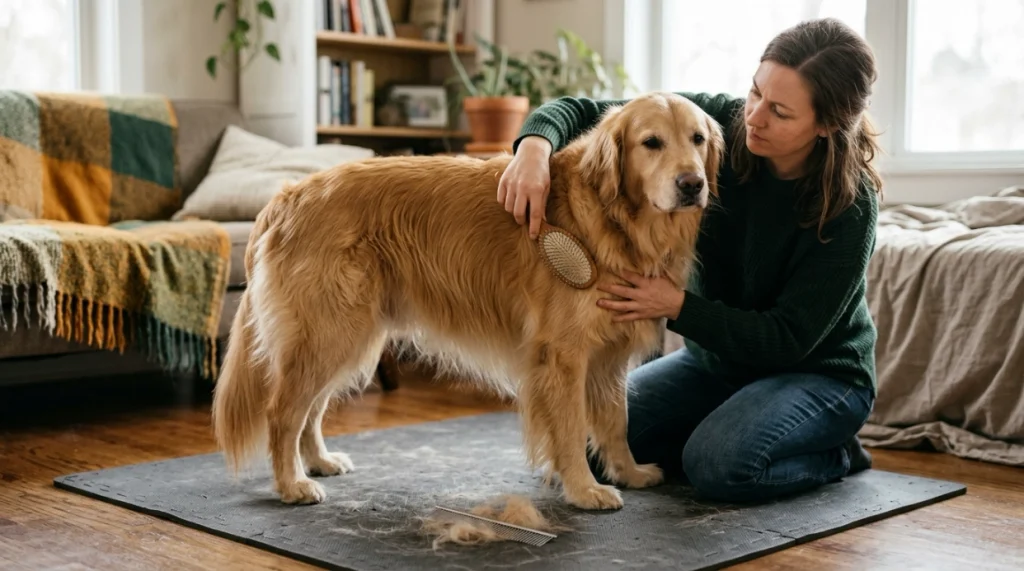
SaveMany dogs benefit from two complementary tools because cleaning, detangling, undercoat removal, and finishing are different jobs. You do not need a drawer full of equipment.
A simple two-tool setup is often enough. I would rather own two brushes that match the coat than six aggressive tools that all do roughly the same thing.
- Short smooth coat: Rubber curry plus soft bristle brush.
- Long silky coat: Pin brush plus metal comb.
- Curly coat: Slicker plus metal comb.
- Double coat: Slicker plus undercoat rake.
- Heavy seasonal shedder: Routine brush plus a suitable de-shedding tool used only when needed.
If you’re ready to choose grooming tools, these are three practical options I would compare first:
🏆 Best for dense coats
Chris Christensen Big G Slicker Brush
★★★★½ 4.5/5 editor fit
Its long 27 mm pins are designed for long and dense coats, including curly and cottony textures. I would consider it when an ordinary short-pin slicker simply cannot reach through the coat effectively.
🐕 Best for short coats
KONG ZoomGroom Dog Brush
★★★★½ 4.5/5 editor fit
Flexible rubber fingers make this useful for dry brushing and shampooing short-coated dogs. I like this style for dogs that dislike sharper-feeling metal tools and mainly need loose surface hair removed.
🍂 Best for heavy shedding
FURminator Undercoat deShedding Tool
★★★★☆ 4.2/5 editor fit
The stainless de-shedding edge is designed to reach loose undercoat beneath the topcoat. I would reserve it for suitable shedding dogs and follow the size, hair-length, pressure, and frequency instructions carefully.
Frequently Asked Questions
What is the most versatile type of dog brush?
A slicker brush is one of the most versatile choices for medium, long, curly, and many dense coats. However, it is not ideal for every dog. Short smooth coats often respond better to a rubber curry or bristle brush, while double coats may also need an undercoat rake.
Can I use a human hairbrush on my dog?
A human brush may smooth the surface of some soft coats, but it is not designed around canine coat density or undercoat structure. A dog-specific brush gives you better control and makes it easier to choose the right pin length, bristle firmness, and grooming purpose.
What brush is best for a short-haired dog?
A rubber curry brush, grooming mitt, or short-bristle brush is usually a good starting point for short-haired dogs. Rubber tools are especially useful for loosening dead surface hair, while a bristle brush can collect remaining hair and leave the coat smooth.
What brush is best for a double-coated dog?
A slicker brush and correctly sized undercoat rake make a useful combination for many double-coated dogs. During heavy seasonal shedding, a suitable de-shedding tool may also help, but it should be used gently and according to its instructions rather than as an everyday aggressive brush.
How often should I brush my dog?
Frequency depends on coat type and shedding. Smooth short coats may need weekly brushing, while long, silky, curly, or mat-prone coats can require much more frequent care. During seasonal shedding, double-coated dogs may also benefit from extra sessions.
Choose the Brush That Matches the Coat
The best dog brush is not the strongest or most expensive one. It is the tool that reaches the right layer of your dog’s coat without causing unnecessary pulling or skin irritation.
Start with coat length, density, texture, and shedding level. Then choose one or two tools that solve those specific grooming jobs, use light pressure, and let your dog’s skin tell you when enough is enough.

Thomas Cutter is a lifelong dog owner and the founder of FindOutAboutDogs.com. With over 10 years of hands-on experience owning multiple breeds, Thomas created this site to provide honest, research-based dog advice that real owners can actually trust.
