How to Brush a Poodle Coat: Step-by-Step Grooming Guide
Quick Answer
To brush a Poodle coat, use a long-pin slicker brush and a stainless-steel comb. Divide the curly hair into small sections, gently brush from near the skin toward the ends, and check each section with the comb. This technique, called line brushing, prevents hidden tangles and mats. The American Kennel Club grooming guide also recommends careful brushing through the coat without scraping the skin.
Six Steps to Brush a Poodle Coat
- Prepare your tools: Get a slicker brush, steel comb, and dog-safe detangling spray.
- Check the coat: Find knots, irritated skin, and sensitive areas before brushing.
- Part the hair: Separate the curls into small, manageable sections.
- Brush each section: Use gentle, short strokes from near the roots outward.
- Check with a comb: Make sure the teeth pass through comfortably without snagging.
- Finish sensitive areas: Carefully check behind the ears, under the legs, and around the collar.
My Recommended Routine
- Long or dense coats: Brush daily or nearly daily.
- Shorter coats: Brush several times weekly and check friction areas daily.
- Tight, painful mats: Stop brushing and arrange professional grooming.
A Poodle can look perfectly fluffy while developing tight knots underneath those beautiful curls. That’s why learning how to brush a Poodle coat properly matters more than simply brushing more often.
I’ll explain the line-brushing method, the tools worth using, and the common mistakes that make grooming uncomfortable. You’ll also learn how to recognize tangles that need professional attention.


Why Does a Poodle Coat Need Special Brushing?
Poodles have dense, curly hair that catches loose strands rather than releasing them easily. Without regular grooming, those strands twist together and form mats close to the skin.
This happens even when the coat looks clean. The visible curls can hide tangles underneath.
A mat is a tightly tangled collection of hair that cannot be separated easily with normal brushing. Larger mats can pull against the skin and cause discomfort.
What Makes Poodle Hair Different?
- Curly texture: Hair strands wrap around neighboring strands and form knots.
- Continuous growth: The coat needs regular trimming and ongoing maintenance.
- Low visible shedding: Loose hair often stays trapped within the curls.
- Dense coverage: Tangles can develop near the skin without being obvious.
- Friction: Collars, harnesses, and ordinary movement encourage matting in specific areas.
These coat characteristics explain why a quick surface brushing isn’t enough. You need to work through the hair in layers.
Poodles also differ significantly from double-coated breeds such as Huskies. Our Husky brush guide explains why double coats often require different grooming tools.
What Tools Do You Need to Brush a Poodle?
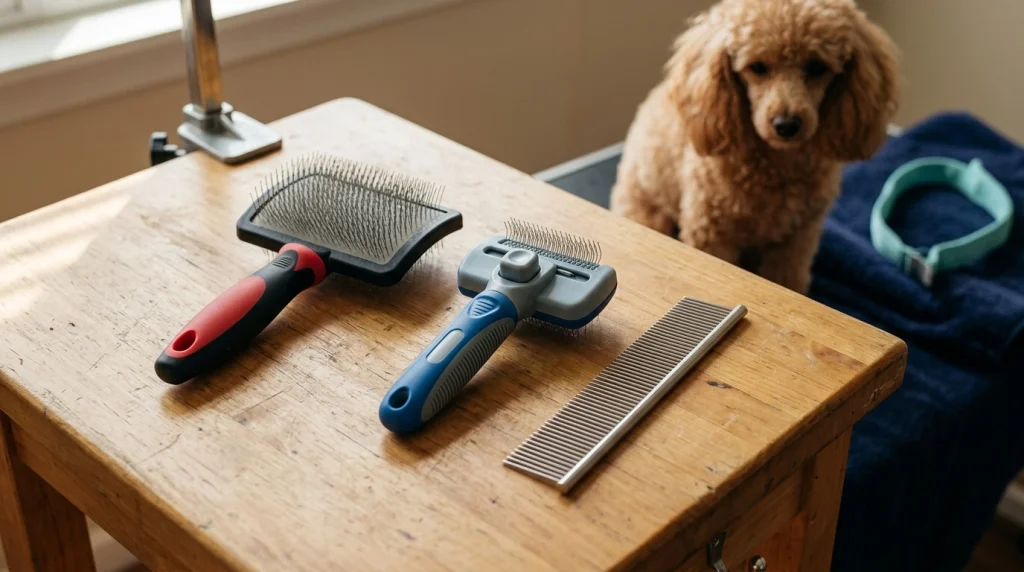
A slicker brush and a stainless-steel comb are the two essentials. Adding a gentle detangling spray can make longer grooming sessions easier.
I would start with this simple kit rather than buying several brushes that perform the same job.
- Long-pin slicker brush: Separates dense curls and lifts loose hair.
- Stainless-steel grooming comb: Checks for hidden tangles after brushing.
- Dog-safe detangling spray: Adds slip when hair is dry or difficult to separate.
- Grooming mat: Provides a stable, nonslip surface during brushing.
- Small rewards: Help puppies and nervous dogs associate grooming with something pleasant.
Poodle Grooming Tools Compared
Different grooming tools solve different problems. This comparison helps you choose the right tool for each task.
| Grooming Tool | Best Use | Main Advantage | Caution |
|---|---|---|---|
| Long-pin slicker | Routine line brushing | Reaches dense curls | Avoid scraping skin |
| Steel comb | Checking for tangles | Finds hidden knots | Never force through mats |
| Pin brush | Light finishing | Gentle surface grooming | May miss deep tangles |
| Detangling spray | Reducing friction | Helps strands separate | Use dog-safe formulas |
The slicker brush does most of the work. However, the comb tells you whether you’ve actually finished each section.
How Do You Brush a Poodle Coat Step by Step?
 Save
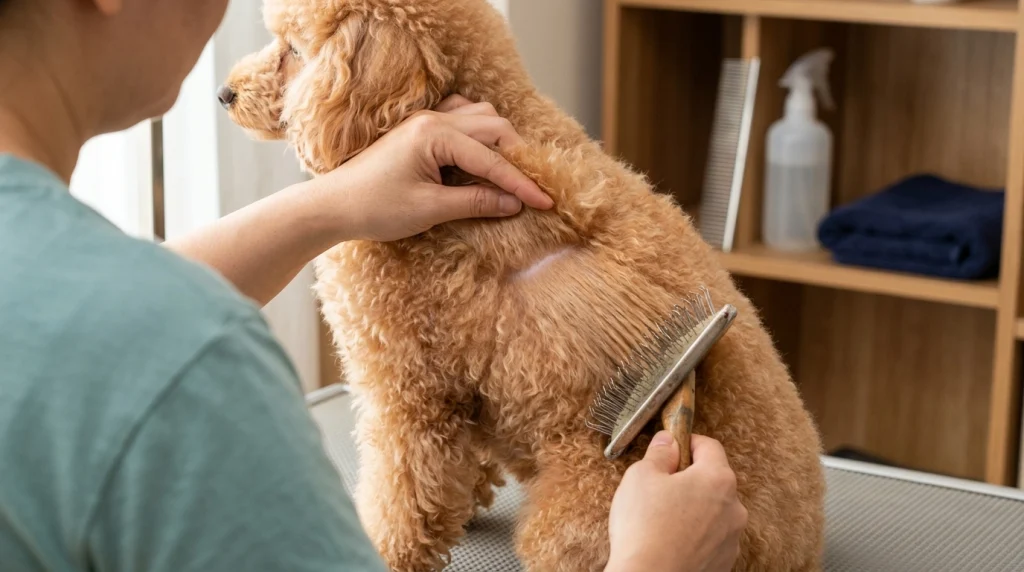
SaveThe most effective method is line brushing, which separates the coat into layers before brushing. This technique helps you reach the roots without dragging a tool aggressively across the skin.
Step 1: Prepare Your Poodle for Brushing
Choose a quiet location with stable footing. Keep your brush, comb, spray, and rewards within easy reach.
Before starting, gently examine the coat with your hands.
- Look for visible knots or compacted areas.
- Check for redness, scabs, or sensitive skin.
- Remove loose debris that comes away easily.
- Notice whether your dog reacts when certain areas are touched.
Don’t immediately brush through a suspicious lump of hair. First, determine whether it’s a small tangle or a tight mat.
Step 2: Lightly Mist the Coat When Needed
A light coating of dog-safe grooming spray can reduce friction between individual hairs. This is particularly useful for longer coats that feel dry or catch easily.
Avoid soaking the coat. You want slightly conditioned hair, not wet curls.
Follow the spray manufacturer’s directions and avoid your dog’s eyes and ears. Skip products that irritate the skin.
Step 3: Divide the Coat Into Small Sections
Start along the lower side of your Poodle’s body. Lift the upper coat and create a narrow horizontal part.
The part should allow you to see the hair close to the skin. This is where surface brushing frequently misses knots.
- Lift a manageable layer of curls with one hand.
- Hold the upper hair away from the section you’re brushing.
- Expose a narrow strip of coat underneath.
- Work through that strip before releasing another layer.
Smaller sections give you better control. They also make it easier to notice when the brush starts catching.
Step 4: Brush Gently From the Roots Outward
Use the slicker brush with short, controlled strokes. Start close enough to the roots to reach the full coat without digging the pins into the skin.
Work outward through the hair while supporting the section with your free hand. Keep the movement gentle.
- Use light pressure: Let the pins separate hair rather than scrape skin.
- Follow hair growth: Avoid repeatedly pulling against tightly curled sections.
- Support tangled hair: Hold it near the roots to reduce uncomfortable pulling.
- Stop at resistance: Investigate a snag instead of increasing force.
If the dog flinches, turns away, or tries to escape, pause and reassess your technique. Comfortable grooming matters more than finishing quickly.
Step 5: Check Each Section With a Steel Comb
After using the slicker, pass a steel comb gently through the same section. Start near the roots and move outward without forcing the teeth.
If the comb glides through comfortably, that section is ready. If it catches, look for the remaining tangle.
This is the step I would never skip. A fluffy surface doesn’t prove that the roots are free of mats.
Step 6: Repeat Across the Entire Body
Continue lifting thin layers and brushing toward the upper body. Then move to the chest, legs, shoulders, neck, and tail.
Work at your dog’s pace, especially around sensitive spots.
- Brush the sides and lower body.
- Move across the shoulders, back, and chest.
- Separate the curls on each leg.
- Carefully check behind the ears and under the collar area.
- Finish the tail and any remaining longer coat.
- Run the steel comb through completed sections.
The entire coat should feel easier to separate when you’re finished. Your Poodle should also remain comfortable during the process.
How Often Should You Brush a Poodle?
Most Poodles benefit from brushing several times per week, while longer coats often need daily attention. The exact schedule depends on coat length, density, activity, and how quickly tangles form.
For a practical 2026 grooming routine, I’d prioritize consistent checking rather than following a rigid calendar.
Suggested Brushing Schedule by Coat Condition
| Coat Condition | Suggested Frequency | Main Priority |
|---|---|---|
| Short, freshly trimmed coat | Several times weekly | Check friction points |
| Medium-length curly coat | Daily or every other day | Line brushing and combing |
| Long or dense coat | Daily | Prevent deeper matting |
| Puppy coat changing | Daily checks and frequent brushing | Catch new tangles early |
These are starting points, not strict veterinary schedules. Increase or reduce brushing according to what the steel comb reveals.
Professional grooming remains important even with regular home care. The American Kennel Club provides broader breed-care resources for understanding coat maintenance and grooming needs.
Where Do Poodles Get Matted Most Often?
Poodles commonly develop tangles where the coat rubs against skin, clothing, or equipment. These locations deserve extra attention during every grooming session.
- Behind the ears: Movement and longer hair encourage hidden knots.
- Under the collar: Constant rubbing can compact the curls.
- Armpits: Walking and running create repeated friction.
- Between the hind legs: Dense hair can knot in difficult-to-see areas.
- Tail base: Curls may become compressed or tangled.
- Around the harness: Straps can repeatedly rub the same coat sections.
Spend an extra moment parting the hair in these areas. Don’t rely on how smooth the outside looks.
For sensitive areas, use your fingers to separate loose tangles before introducing the comb. Stop if your dog shows pain.
How Do You Remove Tangles From a Poodle Without Hurting Them?
 Save
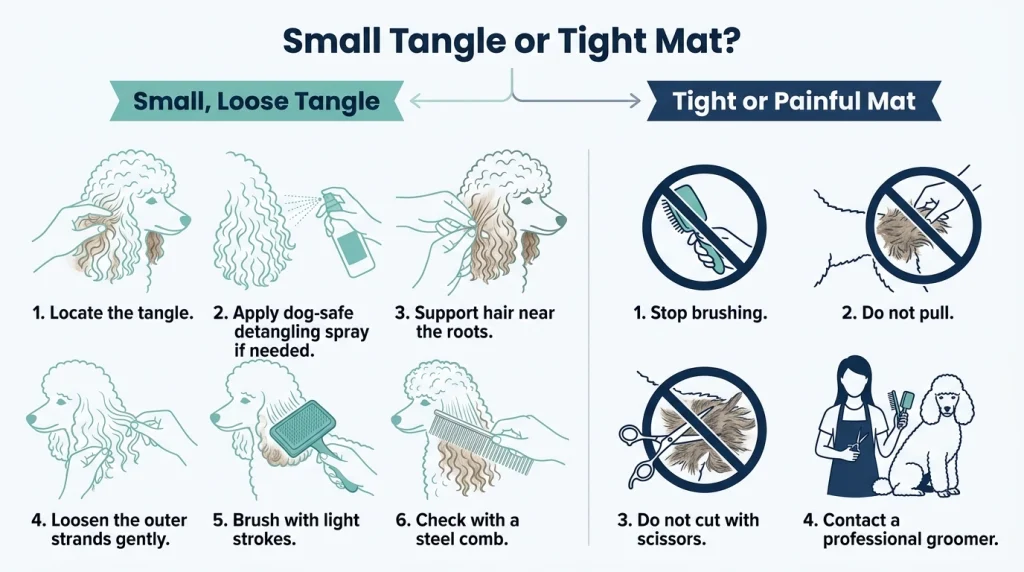
SaveSmall, loose tangles may be separated gently with your fingers, a detangling product, and a suitable brush. Tight mats against the skin should be handled by a professional groomer.
The important distinction is whether the hair moves freely away from the skin. A firmly attached mat can cause significant discomfort.
For Small, Loose Tangles
- Locate the tangled section without pulling it.
- Apply a small amount of dog-safe detangling spray if appropriate.
- Support the hair near its base with your fingers.
- Gently loosen the outer strands without yanking.
- Use a suitable slicker brush with light strokes.
- Finish with a steel comb to check for remaining knots.
If the tangle resists or your Poodle becomes uncomfortable, stop. Repeated pulling may irritate the skin and damage hair.
When Should You Stop and Call a Groomer?
Seek professional help when mats feel tight, widespread, or painful. Don’t try cutting them out with household scissors.
Skin can become trapped inside a mat, making accidental cuts possible. A qualified groomer has safer equipment for assessing and removing compacted hair.
Important Safety Tip
Never force a brush through hard mats or cut close to the skin with scissors. If you notice sores, swelling, discharge, or significant pain, contact your veterinarian before attempting further grooming.
For more general advice about dog hygiene and coat care, visit the ASPCA pet care resources.
Should You Brush a Poodle Before or After a Bath?
Brush and comb out existing tangles before bathing your Poodle. Washing a tangled coat can make existing knots tighter and more difficult to manage.
Once the coat is clean, dry it thoroughly using appropriate grooming methods. Then brush and comb the dry or lightly conditioned coat as needed.
A Safer Bathing Routine
- Check the entire coat for tangles before bathing.
- Gently remove manageable knots.
- Use a shampoo formulated for dogs.
- Rinse thoroughly to remove product residue.
- Dry the coat carefully, avoiding excessive heat.
- Finish with gentle brushing and a comb check.
Don’t leave a dense Poodle coat damp for extended periods. Trapped moisture and existing tangles can make coat maintenance more difficult.
What Brushing Mistakes Should Poodle Owners Avoid?
The biggest mistake is brushing only the outside of the curls. It creates a neat appearance without addressing tangles hidden closer to the skin.
Several other habits can make grooming less effective or uncomfortable.
- Using too much pressure: Metal pins can irritate the skin when pressed or dragged aggressively.
- Skipping the comb: Hidden mats can remain after surface brushing.
- Ignoring friction areas: Ears, armpits, and collar lines can mat quickly.
- Forcing through knots: Strong pulling hurts and may damage the coat.
- Brushing for too long: Exhausted or anxious dogs may become resistant to grooming.
- Bathing a tangled coat: Existing knots may tighten during washing.
- Using unsuitable tools: A short brush may not reach through dense curls.
My preferred approach is to make grooming predictable and manageable. A calm session that thoroughly covers a few sections is more useful than rushing across the entire coat.
How Can You Teach a Poodle Puppy to Enjoy Brushing?
Begin with short, gentle grooming sessions and reward calm behavior. Puppies learn more easily when brushing feels safe and predictable.
Don’t expect a young puppy to remain still for an entire grooming session immediately. Build tolerance gradually.
A Simple Puppy Brushing Routine
- Let the puppy see and sniff the brush.
- Reward calm behavior around the grooming tools.
- Touch the coat gently with your hand first.
- Brush a small, comfortable section.
- Offer praise or a small reward.
- End the session before the puppy becomes frustrated.
Gradually increase the amount of coat you brush as your puppy becomes comfortable. Pay special attention during the transition from the softer puppy coat to the denser adult coat.
For nervous dogs, a veterinarian or qualified reward-based trainer can help address persistent grooming anxiety. The American Veterinary Society of Animal Behavior offers resources on humane behavior training.
Best Brushes and Grooming Tools for a Poodle Coat
 Save
SaveFor home maintenance, I would prioritize tools that work together rather than purchasing several similar brushes. A capable slicker brush and a reliable metal comb make a practical starting combination.
The following are real grooming products worth comparing by your Poodle’s size, coat density, and your budget. These are editorial suitability assessments, not hands-on test scores.
🏆 Best for dense curly coats
Chris Christensen Big G Slicker Brush
★★★★½ 4.5/5
This premium slicker uses long, angled pins designed to work through dense coats. It’s the option I’d consider for longer Poodle trims where shorter brushes struggle to reach the roots.
💰 Best basic slicker option
Safari Self-Cleaning Slicker Brush
★★★★☆ 4/5
This slicker offers a push-button cleaning mechanism for removing collected hair. I’d consider it for routine maintenance on shorter trims, while checking that its pins reach the full coat.
✨ Best finishing tool
Andis Steel Pet Comb
★★★★½ 4.5/5
This metal grooming comb helps locate small knots after slicker brushing. It’s the complementary tool I’d put in every Poodle grooming kit for checking whether sections are truly tangle-free.
Frequently Asked Questions About Brushing a Poodle Coat
Can I brush my Poodle every day?
Yes. Gentle daily brushing is useful for Poodles with longer or denser coats, especially when tangles develop quickly. Use light pressure, work in sections, and stop if the skin becomes irritated. Shorter trims may need less frequent full-body brushing, but daily checks of friction areas remain helpful.
What is the best brush for a Poodle’s curly hair?
A long-pin slicker brush is a practical choice for dense Poodle curls. It helps separate hair and remove loose strands when used correctly. Pair it with a stainless-steel comb to check for hidden knots near the roots. Choose an appropriate brush size and avoid harsh pressure.
Should I brush my Poodle when the coat is wet?
For normal maintenance, brush the dry or lightly conditioned coat rather than pulling through wet tangles. Check for mats before bathing. During professional-style bathing and blow-drying, groomers may brush damp, conditioned hair using specialized techniques, but this requires care to avoid breakage and irritation.
Why does my Poodle get matted even after brushing?
Surface brushing often misses tangles developing near the skin. Loose hair can remain trapped inside the curls, particularly around the ears, legs, and collar. Try line brushing in smaller sections and finish each section with a metal comb to confirm that the full coat is clear.
How do I know when my Poodle needs professional grooming?
Arrange professional grooming when the coat becomes difficult to manage, needs trimming, or develops tight mats. Many owners schedule appointments every four to eight weeks, depending on their preferred clip and coat growth. Painful matting, irritated skin, or significant grooming distress calls for professional assessment sooner.
Final Takeaway: Keep Your Poodle’s Coat Comfortable
Learning how to brush a Poodle coat starts with one essential skill: brushing in sections rather than skimming the surface. A suitable slicker brush, steel comb, and consistent routine help prevent painful tangles.
Focus on gentle line brushing, daily checks of mat-prone areas, and professional help whenever knots become difficult or painful. Your goal isn’t just a fluffy coat; it’s a comfortable Poodle with healthy skin and manageable hair.

Thomas Cutter is a lifelong dog owner and the founder of FindOutAboutDogs.com. With over 10 years of hands-on experience owning multiple breeds, Thomas created this site to provide honest, research-based dog advice that real owners can actually trust.
