What Type of Coat Does a Poodle Have? Guide 2026
Quick Answer
A Poodle has a dense, curly, single coat that grows continuously and sheds much less loose hair than a typical double-coated dog. The official Poodle breed standard recognizes both naturally curly coats and properly maintained corded coats.
What makes the Poodle coat different?
- Single coat: Poodles do not have the typical outer coat and soft seasonal undercoat combination seen in many double-coated breeds.
- Curly texture: The coat naturally forms dense curls that can trap loose hairs close to the body.
- Continuous growth: Poodle hair keeps growing, so regular clipping and trimming are part of normal coat care.
- Low loose-hair shedding: Less hair usually lands on furniture, but loose strands can remain caught inside the curls.
- High matting risk: Missed tangles can tighten quickly, especially around friction areas such as ears, legs, armpits, and the collar line.
The practical takeaway
- Use a slicker brush to separate curls, then check your work with a metal comb that can reach from the tips toward the skin.
If you have ever run your hand over a freshly groomed Poodle, you already know this coat feels different. It is springy, dense, and capable of hiding a surprising amount of tangled hair underneath a perfectly fluffy surface.
That is why I never describe the Poodle as simply a “non-shedding dog.” Understanding how the coat grows tells you much more about the brushing, clipping, and mat prevention it needs.


What Type of Coat Does a Poodle Have?
A Poodle has a single, curly, continuously growing coat. The American Kennel Club also places Poodles in its curly-coat category rather than its double-coat category.
The easiest definition is this: a Poodle coat is dense hair that stands away from the body, forms curls, grows for a long period, and does not follow the heavy seasonal shedding pattern typical of many double-coated dogs.
- Coat structure: Single coat
- Normal texture: Dense and naturally curly
- Alternative presentation: Corded
- Growth pattern: Continuously growing
- Loose-hair shedding: Relatively low
- Matting tendency: High when brushing is skipped
The AKC grooming coat classifications specifically describe curly coats as single, stand-away coats that continue growing. Poodles are listed as an example.
This matters because grooming advice designed for a Labrador, Husky, or Golden Retriever does not automatically fit a Poodle.
Is a Poodle Single-Coated or Double-Coated?
Poodles are generally classified as single-coated dogs. They do not have the distinct coarse outer coat plus softer seasonal undercoat associated with classic double-coated breeds.
A Labrador is a useful contrast. Its undercoat can release large amounts of hair during shedding periods, while a Poodle’s loose hairs often remain trapped among neighboring curls.
| Feature | Poodle Coat | Typical Double Coat |
|---|---|---|
| Layers | Single coat | Outer coat plus undercoat |
| Growth | Continues growing and needs trimming | More defined growth and shedding cycles |
| Loose hair | Often caught inside curls | Often falls freely from the body |
| Main grooming problem | Tangles and mats | Loose undercoat and seasonal shedding |
| Common tool focus | Slicker brush plus metal comb | Brush plus coat-specific shedding tools |
This difference is one reason I am cautious with aggressive de-shedding tools on Poodles. The goal is usually to separate curls and remove tangles, not strip an undercoat that is not there.
Why Does a Poodle Shed So Little but Mat So Easily?
 Save
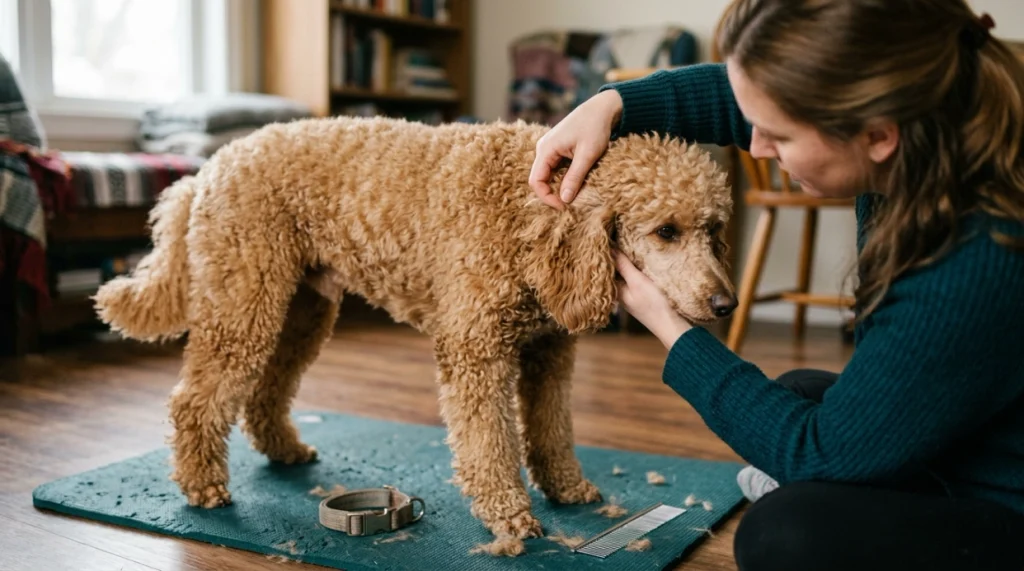
SavePoodles still lose hair, but much of that loose hair becomes caught inside their dense curls instead of dropping immediately onto the floor. That trapped hair can combine with friction and moisture to form tangles.
This is the trade-off many new owners miss. Less loose hair around the house does not mean less coat maintenance.
- Behind the ears: Movement and rubbing create small knots quickly.
- Armpits: Leg movement repeatedly compresses the coat.
- Collar area: Collars and harnesses rub against curls.
- Legs: Longer furnishings collect moisture, dirt, and friction.
- Tail and rear: Dense coat can tangle where hair moves against itself.
My simple rule is to inspect the high-friction areas before admiring the fluffy body coat. Those hidden places tell you whether the grooming routine is working.
If you are still deciding whether the breed fits your household, this guide to friendly dog breeds for families also covers the Poodle’s grooming trade-offs.
Can Poodles Have a Corded Coat?
Yes, a Poodle can have a corded coat. The official breed standard recognizes both curly and corded coat presentations.
A corded coat consists of carefully maintained rope-like cords rather than brushed-out curls. This is controlled coat management, not simply allowing a Poodle to become badly matted.
- Cords need deliberate separation.
- Roots must be kept from joining neighboring cords.
- Bathing requires thorough rinsing.
- Drying must be especially complete.
- Routine brushed-coat techniques do not apply in the same way.
For the average companion Poodle, a brushed and clipped curly coat is much easier to maintain. Cording is a specialized grooming choice that requires patience and consistent care.
Do Toy, Miniature, and Standard Poodles Have Different Coat Types?
Toy, Miniature, and Standard Poodles share the same basic coat type. Size changes how much dog you need to groom, but it does not create three separate coat structures.
Individual texture can still vary. One Poodle may have a tighter, firmer curl while another feels softer or more cottony.
- Toy Poodle: Same curly coat on a smaller body, with small areas that need precise brushing.
- Miniature Poodle: Same maintenance principles with a manageable amount of coat.
- Standard Poodle: More surface area makes sectioning and efficient tools especially useful.
The AKC Poodle breed profile treats the varieties as one breed separated principally by size. Coat care remains an important part of all three varieties.
For a smaller Poodle specifically, our guide to dog breeds for first-time owners includes the Miniature Poodle and its grooming demands.
How Should You Brush a Poodle Coat?
 Save
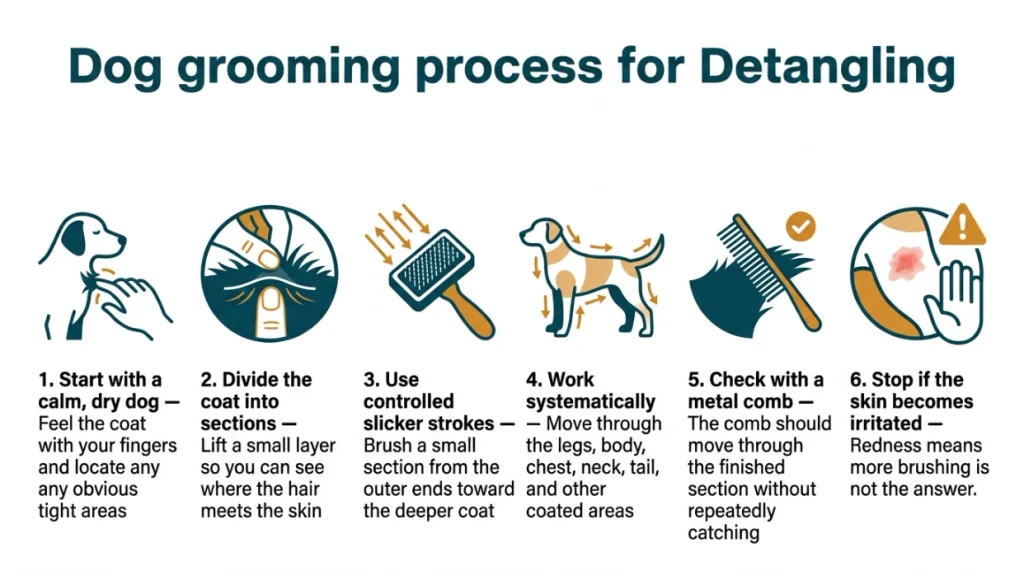
SaveThe best method is to work in small sections instead of brushing only the visible surface. Your goal is to separate the coat from near the skin outward without scraping the skin.
- Start with a calm, dry dog. Feel the coat with your fingers and locate any obvious tight areas.
- Divide the coat into sections. Lift a small layer so you can see where the hair meets the skin.
- Use controlled slicker strokes. Brush a small section from the outer ends toward the deeper coat.
- Work systematically. Move through the legs, body, chest, neck, tail, and other coated areas.
- Check with a metal comb. The comb should move through the finished section without repeatedly catching.
- Stop if the skin becomes irritated. Redness means more brushing is not the answer.
The AKC Standard Poodle grooming guide also recommends brushing down through the coat while taking care not to scrape the skin.
I treat the comb as the final quality check. A coat can look beautifully brushed on top while still hiding a knot underneath.
What Brush Is Best for a Poodle Coat?
A good slicker brush is the most useful everyday brush for many Poodles. Pair it with a stainless-steel comb instead of expecting one brush to perform every grooming job.
| Tool | Best Use | Main Limitation |
|---|---|---|
| Long-pin slicker | Separating longer curls and reaching dense coat | Poor technique can irritate skin |
| Medium slicker | Routine brushing on shorter pet trims | May not reach through a long dense coat |
| Steel comb | Finding remaining tangles and finishing | Not ideal for forcing through established mats |
| Pin brush | Gentle finishing on prepared coat | Can glide over deeper tangles |
| De-shedding tool | Usually not my first choice for routine Poodle care | Designed around a different coat-management goal |
Brush size matters too. A large Standard Poodle body benefits from efficient coverage, while a Toy Poodle needs a head that can move safely around small legs and tight areas.
Does a Short Poodle Haircut Remove the Need for Brushing?
No, but a short pet clip can make coat care much easier. Shorter curls usually tangle less quickly and are easier to inspect down to the skin.
A Poodle kept in a long fluffy style needs more frequent and detailed brushing. Skipping sessions allows small tangles to tighten before the next grooming appointment.
- Short pet clip: Easier home maintenance and faster coat checks.
- Medium-length coat: Needs regular section-by-section brushing.
- Long coat: Requires careful, frequent maintenance to stay mat-free.
- Corded coat: Requires specialized separation and drying rather than ordinary brushing.
If low shedding is one reason you are considering a Poodle, you can also compare other indoor-friendly coats in our guide to indoor dog breeds for families.
What Poodle Coat-Care Mistakes Should You Avoid?
The biggest mistake is assuming a fluffy surface means the entire coat is tangle-free. Mats often begin close to the skin where casual brushing never reaches.
- Surface brushing only: Separate the coat so your tool reaches through the curls.
- Pulling hard on knots: Work gently or stop before causing discomfort and skin irritation.
- Ignoring friction areas: Check ears, armpits, collar zones, legs, and tail carefully.
- Bathing over serious mats: Tight tangles need proper assessment instead of being ignored.
- Using one aggressive tool everywhere: Match the tool to coat length, condition, and body area.
- Skipping the comb check: A finishing comb often finds tangles the slicker missed.
When matting is tight against the skin, forcing a brush through it can hurt. A professional groomer can often choose a safer solution than prolonged pulling at home.
Poodle Grooming Tools I Would Actually Keep on Hand
 Save
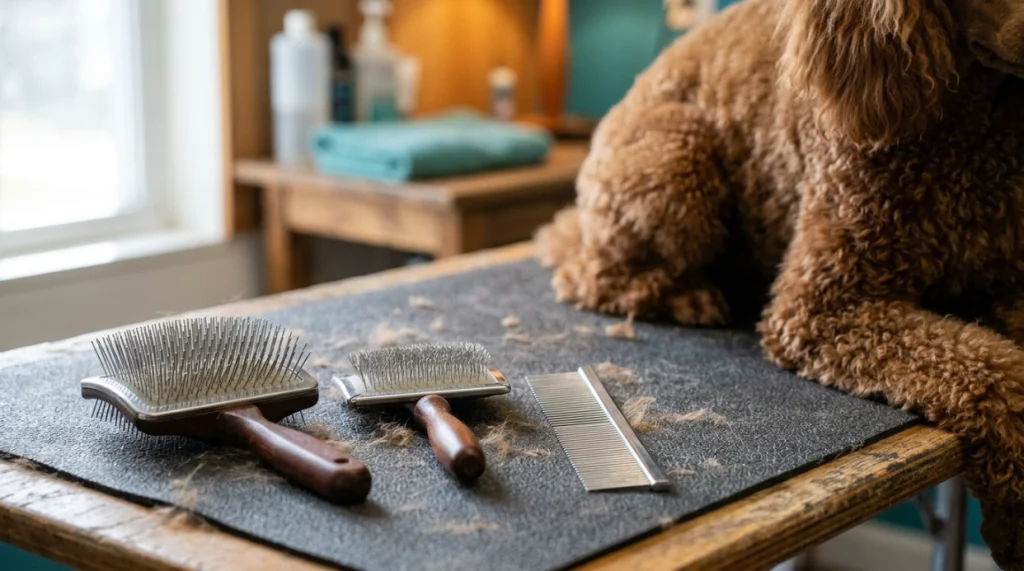
SaveIf you are building a simple Poodle grooming kit, I would start with one effective slicker and one dependable steel comb. Those two tools cover far more useful work than a drawer full of specialized gadgets.
🏆 Best for dense coats
Chris Christensen Big G Slicker Brush
★★★★★
Its long 27 mm pins and curved head are designed for dense, longer coats and fluffing curly hair. I like this style when coat depth makes a shorter slicker feel as though it is only polishing the surface.
💰 Budget-friendly slicker
Andis Medium Firm Slicker Brush
★★★★☆
This medium-firm slicker is designed to remove loose hair and moderate tangles with controlled brushing. I see it as a practical option for shorter pet clips when you do not need an extra-long professional slicker.
🔎 Best finishing check
Andis 7-1/2-Inch Steel Comb
★★★★☆
The dual-tooth steel design gives you coarse and fine spacing for checking finished sections. This is the tool I would use after slicker brushing to find small tangles before they become real mats.
Frequently Asked Questions
Do Poodles have hair or fur?
People commonly describe a Poodle as having hair because its coat has a long growth cycle and keeps growing until it is cut. Hair and fur are both made from keratin, so the practical difference for owners is the Poodle’s growth pattern, curl, low loose-hair shedding, and grooming needs.
Are Poodles truly non-shedding?
No dog is literally incapable of losing hair. Poodles usually release much less loose hair around the home because shed strands can stay trapped within the surrounding curls until brushing removes them.
Do Poodles have an undercoat?
Poodles are classified as single-coated rather than traditional double-coated dogs. They do not have the separate seasonal undercoat found in breeds such as Huskies, Golden Retrievers, or Labradors.
How often should I brush a Poodle?
The correct frequency depends strongly on coat length and condition. Long Poodle coats may need daily attention to prevent matting, while shorter pet clips are easier to maintain but should still be checked regularly for knots near the skin.
What is the best brush for a Poodle?
A well-made slicker brush is usually the most useful primary brush for a curly Poodle coat. Follow it with a metal comb so you can detect tangles that the brush may have passed over.
Does a Poodle puppy have the same coat as an adult?
Poodle puppies begin with a softer puppy coat, and coat texture changes as the adult coat develops. The transition can make tangling more noticeable, so consistent brushing habits established early are especially helpful.
Final Takeaway
A Poodle has a dense, curly, single coat that grows continuously, sheds relatively little loose hair, and mats readily when neglected. Curly and corded presentations are both recognized, but most pet Poodles live in regularly brushed and clipped curly coats.
The grooming lesson is simple: low shedding does not mean low maintenance. Use a slicker to open the curls, let a metal comb confirm your work, and keep the coat short enough for the amount of grooming you can realistically maintain.
If your comb reaches through the coat comfortably without repeatedly catching, you are doing far more than making your Poodle look fluffy. You are preventing the tight tangles that turn an easy grooming session into a difficult one.

Thomas Cutter is a lifelong dog owner and the founder of FindOutAboutDogs.com. With over 10 years of hands-on experience owning multiple breeds, Thomas created this site to provide honest, research-based dog advice that real owners can actually trust.
