What Brush Is Best for a Poodle? 2026 Grooming Guide
Quick Answer
The best brush for most Poodles is a long-pin slicker brush that can reach through the curly coat without needing heavy pressure. Pair it with a sturdy metal comb so you can check for hidden tangles near the skin; VCA’s dog coat-care guidance also recommends slicker brushes for curly Poodle-type coats.
What to look for in a Poodle brush
- Long pins: They reach farther through dense curls than shallow pins.
- Flexible cushion: Some movement in the brush head makes controlled strokes easier.
- Angled wires: Fine bent pins help separate curls and small tangles.
- Correct size: Large heads suit the body, while smaller heads give better control on legs.
- Comfortable grip: Poodle grooming can take time, so hand comfort matters.
- Comb backup: A metal comb confirms whether the coat is clear beneath the surface.
Simple buying rule
- Choose a long-pin slicker for medium or long curls, then use a metal comb as your final mat check.
Poodle curls look soft and easy to manage, but the coat can hide surprisingly stubborn tangles. A brush that only smooths the surface can leave knots untouched underneath.
That is why I focus on reach, control, and the final comb check. This guide explains which brush works best, what features matter, and how to use it without scraping your dog’s skin.


Why Is a Slicker Brush Best for Most Poodles?
A slicker brush is usually the best primary brush for a Poodle because fine wire pins can separate dense curls and catch developing tangles. It works especially well when the pins are long enough for the coat you are maintaining.
The American Kennel Club’s Standard Poodle grooming guidance specifically recommends a slicker brush and stresses reaching through the coat without scratching the skin.
Definition: A slicker brush is a grooming brush covered with closely spaced fine wire pins, usually bent or angled, designed to separate hair and work through loose tangles.
Poodles have dense, curly coats that can trap shed or broken hairs rather than dropping them around the house. That trapped hair can become part of a knot if it is not removed regularly.
VCA notes that curly coats require frequent brushing and specifically lists slicker brushes as suitable for Poodles. A slicker therefore matches the coat’s structure better than a basic bristle brush.
What Should You Look for in a Poodle Slicker Brush?
Choose a Poodle brush according to coat length and density first. Features such as self-cleaning buttons are convenient, but they matter less than whether the pins can reach the coat properly.
- Pin length: Longer pins are useful on fuller Poodle coats because they reach through more hair.
- Pin finish: Smooth, well-made pins should move through hair without rough edges catching strands.
- Flexible pad: A cushioned head can provide more give than a rigid brush.
- Curved head: A curved slicker can follow the shape of the body and improve contact across broad areas.
- Head size: Large brushes save time on Standard Poodle bodies, while smaller heads improve control on Miniatures, Toys, legs, and tighter areas.
- Handle comfort: A secure ergonomic grip matters during longer grooming sessions.
A useful example is the Chris Christensen Big G. Its current manufacturer specification lists 27 mm stainless-steel pins, a flexible cushion, a curved back, and large, medium, and smaller head options.
Those specifications make sense for a Poodle carrying a fuller coat. A short maintenance clip usually does not require such an aggressive depth of brush.
Slicker Brush vs Pin Brush vs Bristle Brush for Poodles
A slicker, pin brush, and bristle brush are not interchangeable. Each reaches and handles a Poodle coat differently.
| Brush Type | Main Job | Poodle Fit | Best Use |
|---|---|---|---|
| Long-pin slicker | Separates curls and works through small tangles | Excellent | Primary brush for medium-to-long coats |
| Pin brush | Moves through longer hair with rounded pins | Useful secondary tool | Finishing and lightly tangled coat |
| Bristle brush | Smooths the surface and lifts light debris | Limited | Surface finishing on very short clips |
| Steel comb | Finds remaining resistance near the roots | Essential companion tool | Checking every brushed section |
My practical rule is simple: I do not consider a longer Poodle coat completely brushed just because the slicker glides across it. I want an appropriate steel comb to pass through afterward without repeatedly catching.
This brush-and-comb grooming guide explains why the two tools perform different jobs.
How Do You Brush a Poodle Without Hurting the Skin?
 Save
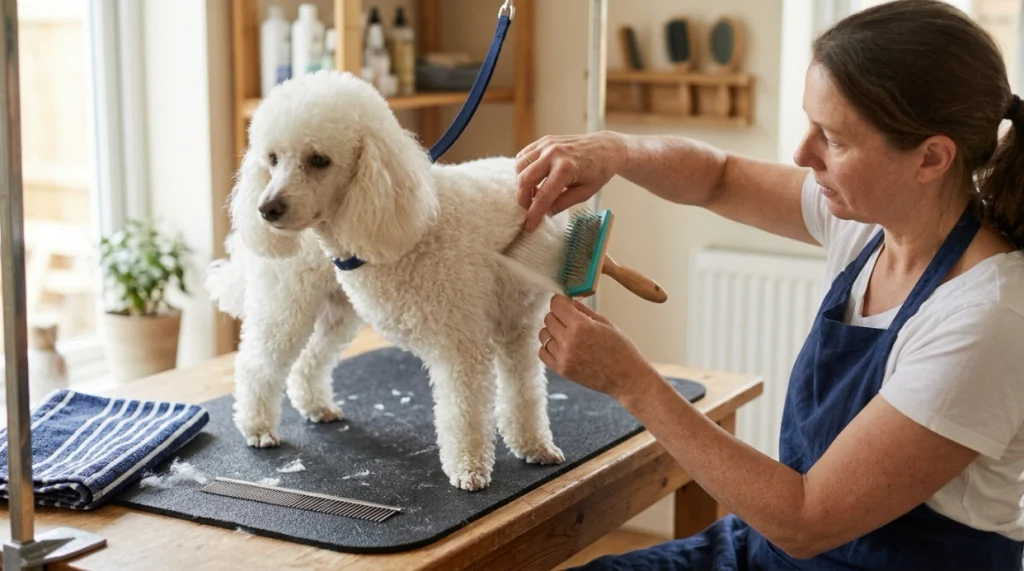
SaveBrush a Poodle in small sections with light, controlled strokes. Reaching near the roots does not mean scraping the pins across the skin.
- Start with a dry, comfortable dog. Use a stable nonslip surface and good lighting.
- Check the coat first. Look and feel for firm mats, sore skin, or areas that cause discomfort.
- Lift a small section. Separate enough coat to see where the hair begins near the skin.
- Brush the ends first. Loosen any minor resistance before gradually working closer to the roots.
- Use short strokes. Let the pins separate the coat instead of forcing them through it.
- Check with a metal comb. Stop if the comb catches rather than dragging it through.
- Move to the next section. Continue until the areas you intended to groom are comfortable and clear.
This section-by-section technique is often called line brushing. It helps prevent the common mistake of repeatedly brushing only the fluffy surface.
For a more detailed inspection method, see this guide to checking a dog coat for hidden mats.
AKC also advises using a light touch with slicker brushes because pushing wire pins hard against the body can cause discomfort. Technique matters as much as the brush itself.
Where Do Poodles Mat Most Often?
Poodle mats often develop where hair experiences friction, movement, or moisture. These areas deserve more attention than the easy-to-brush middle of the back.
- Behind the ears: Fine hair can twist together as the ears move.
- Armpits: Constant leg movement creates friction.
- Collar area: Collars repeatedly rub the same curls.
- Harness areas: Chest and shoulder straps can encourage tangles.
- Legs: Longer leg coat needs smaller brushing sections.
- Groin and belly: Soft hair and sensitive skin require gentle handling.
- Tail: Dense hair near the tail base can hide knots.
VCA recommends checking areas such as the ears, armpits, and backs of the legs frequently on curly-coated dogs. Regular checks can catch a small knot before it becomes a tight mat.
Never increase pressure simply because a tangle refuses to move. A compact mat close to the skin may need professional clipping instead.
How Often Should You Brush a Poodle?
A Poodle with a long or full coat may need brushing or at least a careful coat check every day. A short professionally maintained clip can usually be easier to manage.
VCA’s current coat-care guidance recommends daily brushing for long, silky, or curly coats. The Poodle Club of America also describes regular clipping and grooming as a basic part of Poodle ownership.
| Poodle Coat | Practical Starting Routine | Watch Closely |
|---|---|---|
| Long, full curls | Daily section brushing and comb checks | Ears, legs, armpits, collar areas |
| Medium maintenance coat | Frequent brushing with daily friction-area checks | Areas where the comb repeatedly catches |
| Short sporting or pet clip | Several checks each week, adjusted to growth | Longer ears, topknot, tail, and leg hair |
Your individual dog matters more than the calendar. Swimming, rain, clothing, collars, coat length, and outdoor activity can all change how quickly tangles appear.
For broader scheduling guidance, compare your routine with this dog brushing schedule by coat type.
Can You Use a Regular Dog Brush on a Poodle?
You can use some ordinary dog brushes on a Poodle, but many generic brushes are too shallow for a longer curly coat. A tool that never reaches beneath the surface cannot reliably prevent deeper tangles.
A bristle brush may make a short coat look neat. It is not my first choice for managing a dense, growing Poodle coat.
A pin brush can be useful for finishing or maintaining certain longer styles. However, I would still keep a slicker and steel comb available wherever mat prevention is the main goal.
The ASPCA’s dog grooming guidance also emphasizes matching the brush to coat type instead of treating one brush as suitable for every dog.
Should You Brush a Poodle Before or After a Bath?
 Save
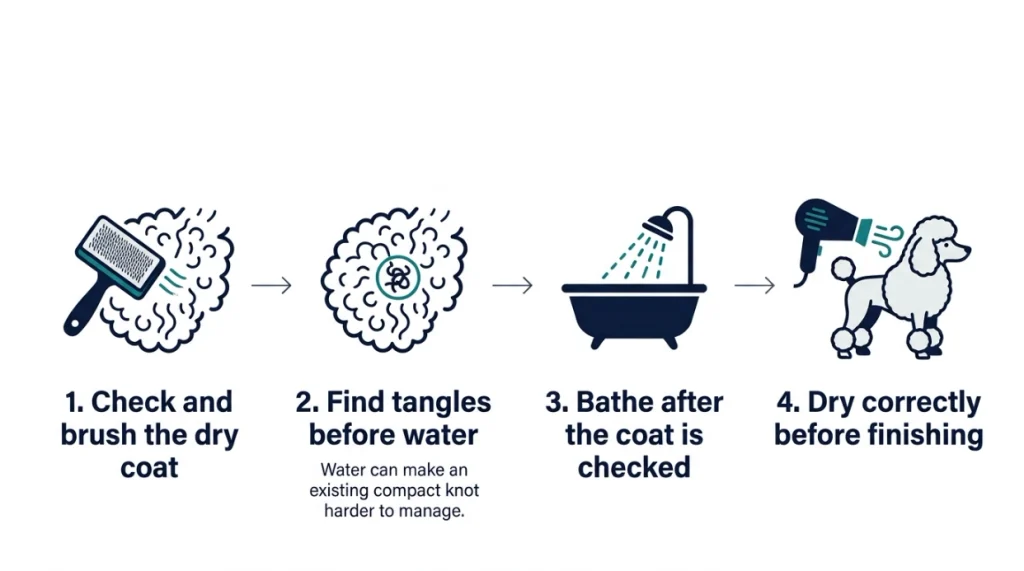
SaveCheck and brush the coat before bathing so you know whether significant tangles are already present. Water can make an existing compact knot harder to manage.
The ASPCA recommends giving a dog a thorough brushing before bathing to remove dead hair and mats. That is especially sensible with a Poodle’s curl pattern.
After bathing, dry the coat correctly before doing detailed finishing work. Ask a professional groomer to demonstrate drying and coat preparation if you maintain a longer Poodle style at home.
What Should You Do When a Poodle Has Tight Mats?
Stop brushing if the mat feels hard, sits tightly against the skin, or pulls the skin when moved. Persistent brushing can turn a grooming problem into a painful experience.
The ASPCA warns against cutting tight mats with scissors because skin can be caught within the tangled hair. A professional groomer is usually safer for firm matting, while irritated or injured skin deserves veterinary attention.
- Loose knot: Work slowly with fingers, slicker, and comb.
- Firm mat: Stop if the skin moves or your dog shows discomfort.
- Skin-tight mat: Ask a professional groomer about safe clipping.
- Red or sore skin: Contact your veterinarian.
Prevention is much easier than removing established mats. Short, regular grooming sessions usually beat a long rescue session after several weeks of coat growth.
Does Poodle Size Change Which Brush You Need?
The same basic brush type works for Standard, Miniature, and Toy Poodles, but head size should match the dog and grooming area. A huge slicker can make detail work awkward on a Toy Poodle.
- Standard Poodle: A large slicker speeds up body work, with a medium brush for legs and tighter areas.
- Miniature Poodle: A medium head often balances coverage and control.
- Toy Poodle: A smaller brush gives better control around narrow body areas.
The Poodle Club of America recognizes three Poodle size varieties, but all require regular clipping and grooming. Coat length still matters more than the label on the brush package.
Poodle mixes can have similar needs when they inherit a dense curly coat. This guide to the best brush for a Goldendoodle shows how the same slicker-and-comb principle applies to another curl-heavy coat.
Which Poodle Brushes Are Worth Considering in 2026?
 Save
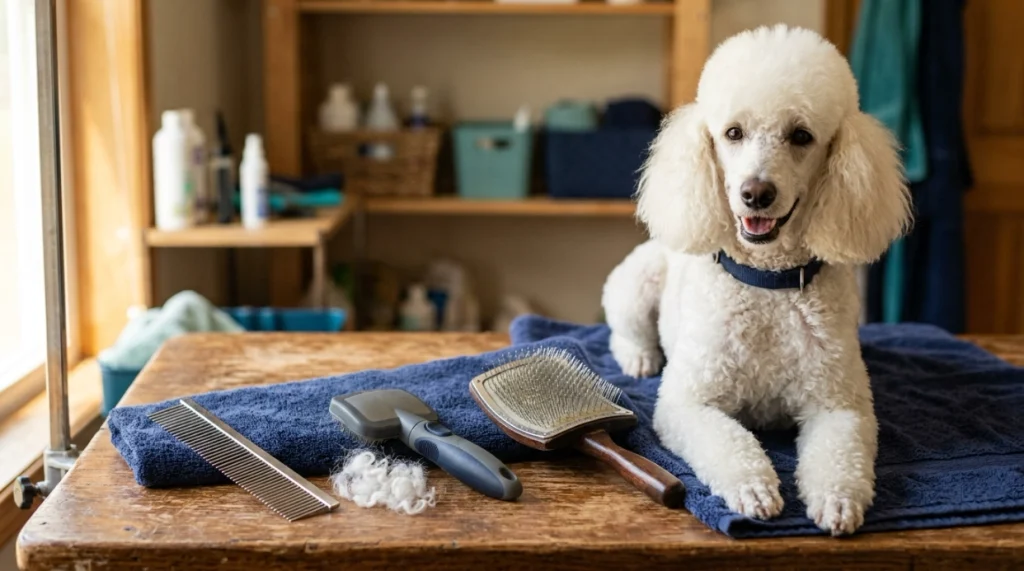
SaveIf you are ready to choose your tools, I would prioritize one capable slicker and one dependable comb instead of buying a large grooming kit. The products below cover premium brushing, simpler self-cleaning, and the final coat check.
Retailer ratings can change over time, so the ratings shown below are current 2026 snapshots rather than permanent scores.
🏆 Best Overall
Chris Christensen Big G Slicker Brush
★★★★½ 4.6/5
The Big G uses 27 mm stainless-steel pins, a flexible cushion, curved back, and multiple head sizes for dense longer coats. I pick it for owners maintaining a fuller Poodle coat who need more reach than a shallow everyday slicker.
💰 Best Easy-Clean Value
Safari Self-Cleaning Slicker Brush
★★★★☆ 4.4/5
Safari uses stainless-steel pins and a push-button system that releases collected hair from the brush. I like this option for routine grooming when easy cleanup matters more than having extra-long professional-style pins.
🔎 Best Final Coat Check
Andis 7.5-Inch Steel Comb
★★★★½ 4.7/5
This 7.5-inch steel comb provides a simple way to check whether the slicker reached through each section. I consider the comb the quality-control tool because hidden resistance becomes much easier to feel.
Frequently Asked Questions
What brush is best for a Standard Poodle?
A long-pin slicker brush is the best starting choice for most Standard Poodles carrying medium or long coat. Use a large head for broad body areas, then follow with a steel comb to confirm the pins reached through the curls.
What brush is best for a Toy Poodle?
A small or medium slicker brush usually gives better control on a Toy Poodle than a large professional head. Match the pin length to the actual coat length, use light pressure, and verify the finished section with a small metal comb.
Should I use a slicker brush every day on my Poodle?
A long or mat-prone Poodle coat may benefit from daily attention, but that does not mean repeatedly scraping every area. Use gentle section brushing where needed, inspect friction zones, and adjust frequency according to coat length and advice from your groomer.
Can a slicker brush remove Poodle mats?
A slicker can loosen small tangles and help prevent mats from forming, but it should not be forced through a hard skin-tight mat. If the skin pulls with the knot or your dog shows pain, stop and ask a professional groomer for help.
Do Poodles need a comb as well as a brush?
Yes, a metal comb is highly useful for Poodles because it checks whether the slicker reached through the deeper coat. If the comb repeatedly catches near the roots, that section still contains resistance that surface brushing may have missed.
The Bottom Line
For most Poodles, the best brush is a quality long-pin slicker brush paired with a steel comb. The slicker does the main coat work, while the comb tells you whether that work reached beneath the fluffy surface.
Choose pin depth and head size according to your dog’s coat, not marketing claims alone. Use light pressure, check mat-prone areas often, and get professional help when a knot becomes tight or painful.
For your next grooming session, start with one small section and finish it completely before moving on. That simple habit is more useful than rushing a brush over the entire coat.

Thomas Cutter is a lifelong dog owner and the founder of FindOutAboutDogs.com. With over 10 years of hands-on experience owning multiple breeds, Thomas created this site to provide honest, research-based dog advice that real owners can actually trust.
