How to Brush a Dog Without Forcing the Process
Quick Answer
To brush a dog without forcing the process, start below the dog’s stress threshold, pair the brush with rewards, and stop when the dog asks for a break. If brushing already causes fear, first learn how to desensitize a dog to brushing before trying to complete a full grooming session.
Quick steps for force-free brushing
- Pick a calm moment: Start when your dog is relaxed rather than excited, cornered, or overtired.
- Show the brush: Let your dog notice or sniff it, then reward calm behavior.
- Touch before brushing: Briefly touch the brush to an easy area such as the shoulder.
- Use one stroke: Make one gentle stroke, reward, and pause.
- Watch body language: Stop for freezing, repeated turning away, escape attempts, or growling.
- Build gradually: Add strokes only while your dog remains comfortable.
The most important rule
- A short session that ends calmly is more useful than finishing the whole coat through restraint.
Brushing becomes difficult when the goal changes from coat care to simply “getting it done.” A worried dog usually becomes more resistant when pressure keeps increasing.
I prefer a different rule: protect the dog’s comfort first, then build grooming skill. That approach takes patience, but it gives you a routine you can repeat without turning the brush into a warning sign.


What Does Brushing a Dog Without Force Actually Mean?
 Save
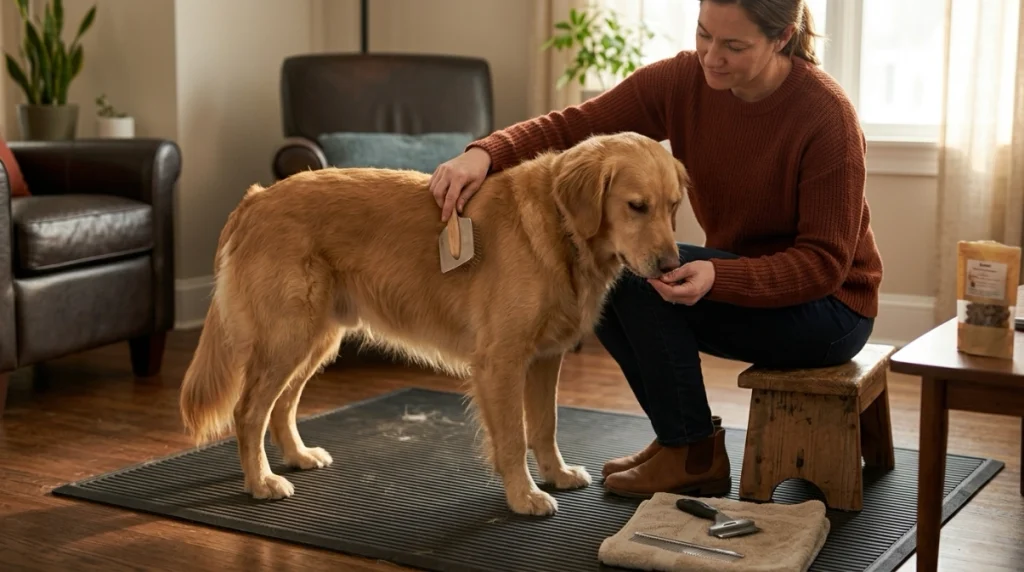
SaveForce-free brushing means keeping the dog below a level of fear where learning and cooperation fall apart. You use gradual exposure, rewards, predictable pauses, and suitable grooming tools instead of pinning the dog down until the coat is finished.
Cooperative care is an approach that teaches an animal to participate voluntarily in grooming, handling, and veterinary procedures when practical. Cornell’s veterinary cooperative-care guidance emphasizes gradual exposure, positive reinforcement, choice, and working at the dog’s pace.
You can read that guidance through Cornell University’s cooperative grooming resource.
- Force: Holding, cornering, chasing, or overpowering the dog so brushing can continue.
- Pressure: Continuing after the dog repeatedly signals discomfort.
- Cooperation: Teaching the dog what will happen and rewarding calm participation.
- Choice: Allowing reasonable breaks or a trained start-and-stop signal.
This doesn’t mean every grooming task can be optional forever. Mats, skin problems, and hygiene needs sometimes require professional help when home training cannot solve the immediate problem safely.
How Do You Start Brushing a Dog That Keeps Trying to Leave?
Start with a version of brushing so easy that your dog doesn’t need to escape. For some dogs, the first successful session contains no actual brushing.
VCA describes desensitization as exposing a fearful pet to a stimulus at a low enough intensity to avoid triggering the full fear response. Counterconditioning pairs that exposure with something the animal enjoys.
The same concepts can be applied to grooming, as explained in VCA’s desensitization and counterconditioning guide.
- Set up stable footing. Use a rug, mat, or another non-slip surface where your dog already relaxes.
- Bring out the brush. Keep it far enough away that your dog notices it without retreating.
- Reward calm behavior. Use a small treat, praise, or another reward your dog genuinely values.
- Move the brush closer. Stop advancing if your dog stiffens, retreats, or refuses food.
- Touch an easy area. Briefly place the brush against the shoulder or side without making a stroke.
- Try one gentle stroke. Follow it immediately with a reward and a short pause.
- End early. Finish while your dog can still succeed rather than waiting for resistance.
Don’t jump from one successful stroke to twenty. Add difficulty in small pieces.
You might progress from one stroke to three, then five. Another dog may need several sessions just to become comfortable with the brush touching the coat.
How Can You Tell When Your Dog Wants You to Stop?
A dog doesn’t need to bite before you recognize discomfort. Early stress signals are much easier to work with than a full defensive reaction.
Watch for changes that appear specifically when you reach for the brush or touch a certain body area. The site’s guide to signs that a brush is causing discomfort can help you separate ordinary movement from a grooming problem.
- Turning away: The head repeatedly moves away from your hand or brush.
- Moving off: Your dog steps away whenever brushing begins.
- Freezing: The body suddenly becomes unusually still or tense.
- Lip licking: Repeated licking appears without food being present.
- Lower posture: The body crouches or the tail tucks.
- Looking at the brush: Your dog repeatedly turns toward the tool during each stroke.
- Growling: Treat the warning seriously rather than correcting it.
- Snapping: Stop the home session and consider professional behavioral or veterinary guidance.
A growl gives you useful information. Punishing the warning can suppress communication without removing the discomfort underneath it.
If your dog suddenly dislikes brushing after previously tolerating it, consider pain as well as behavior. Tender skin, an injury, arthritis, an ear problem, or a tight mat can make ordinary handling uncomfortable.
How Hard Should You Press When Brushing a Dog?
Use enough pressure to work through the coat, but not enough to scrape the skin or repeatedly pull hair. A better tool usually solves more than extra force.
The American Kennel Club notes that brush selection should match coat length and texture. Its guide to choosing dog brushes also warns that slicker brushes should be used with a light touch.
| Tool | Best Starting Use | Comfort Consideration | Avoid |
|---|---|---|---|
| Rubber curry or grooming mitt | Smooth, short coats | Flexible contact may feel less intimidating | Hard scrubbing over irritated skin |
| Bristle brush | Short coats and finishing | Useful for light surface grooming | Expecting it to remove deep mats |
| Slicker brush | Medium, long, curly, or tangle-prone coats | Use light pressure and small sections | Pressing pins firmly against skin |
| Undercoat rake | Suitable thick and double coats | Let the teeth move through loose undercoat | Dragging through tight resistance |
| Metal comb | Checking long or curly coats after brushing | Good for finding hidden tangles | Ripping the comb through a knot |
One simple pressure check is to brush your own forearm gently with the tool first. It won’t perfectly mimic canine skin, but it can reveal sharp pins or excessive hand pressure.
How Long Should a Brushing Session Last for a Nervous Dog?
A nervous dog doesn’t need a long session to make progress. At first, measuring success by calm repetitions is more useful than measuring minutes.
Try counting strokes rather than deciding you must finish an entire side. Three relaxed strokes can be a better training session than fifteen increasingly tense ones.
- Very worried dog: Practice seeing, approaching, or briefly touching the brush.
- Mildly worried dog: Try one to three strokes, reward, then release.
- Improving dog: Brush one small body area before taking a break.
- Comfortable dog: Gradually combine small sections into a normal grooming routine.
Increase only one challenge at a time. Don’t simultaneously add more strokes, a sensitive body area, a new room, and a different grooming tool.
As of 2026, my preferred rule for this process is simple: stop while the dog is still coping well. Ending on a calm repetition gives you a better starting point next time.
What Should You Do If Your Dog Walks Away During Brushing?
If the environment is safe, treat walking away as information instead of a battle. Give the dog a brief break and make the next repetition easier.
Repeatedly following a dog around the room with the brush usually turns grooming into a chase. Cornering the dog can create even more pressure.
- Pause the brushing.
- Put the brush down or move it farther away.
- Let your dog settle.
- Restart with an easier step if your dog voluntarily returns.
- End the session if stress returns quickly.
A mat or medically necessary procedure can create a different situation. If the task cannot safely wait for training, professional help is usually safer than escalating restraint at home.
How Do You Brush Tangles Without Holding the Dog Down?
 Save
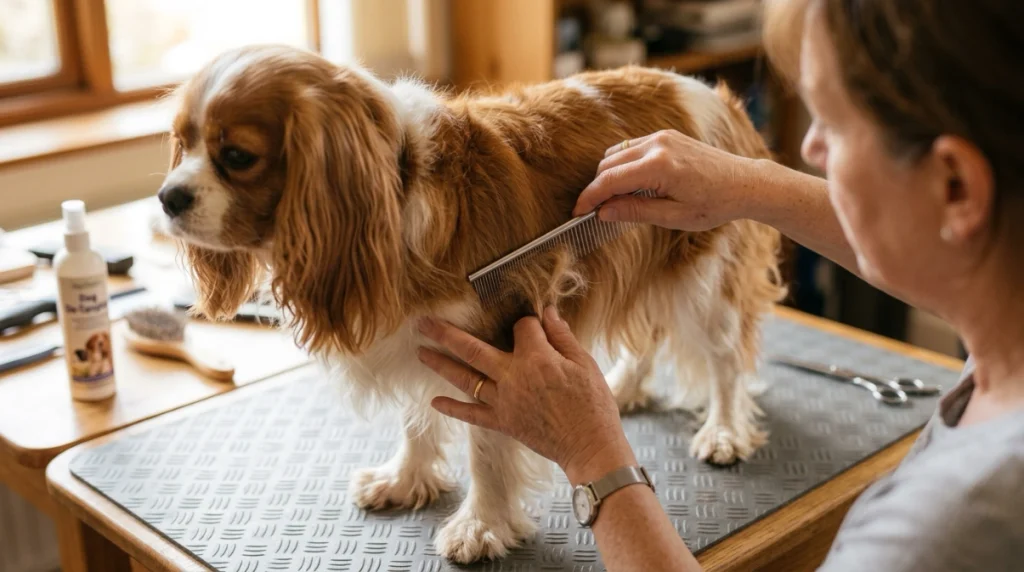
SaveSmall loose tangles can often be handled by working slowly in tiny sections. Tight mats should not become a test of how much pulling your dog will tolerate.
The ASPCA recommends regular brushing to prevent tangles and keep the coat and skin in good condition. Its dog grooming guidance also notes that brushing technique and frequency depend on coat type.
- Find the edge. Start with loose hair around the tangle instead of pulling through its center.
- Support the hair. Hold the coat between the skin and tangle when practical to reduce pulling.
- Use short movements. Work from the ends toward the base rather than dragging through the whole knot.
- Reward pauses. Let your dog reset after a few comfortable repetitions.
- Stop at tight mats. Seek professional help when the mat is close to skin, widespread, painful, or difficult to separate.
Don’t cut a tight mat with ordinary scissors near the skin. Skin can become pulled upward into the mat, making an accidental cut easier than it appears.
How Often Should You Brush Without Making Your Dog Dread It?
Brush often enough that routine sessions stay easy. Waiting until the coat is heavily tangled can turn a simple maintenance task into uncomfortable detangling.
Your dog’s coat type matters, so use the site’s dog brushing schedule by coat type when deciding how often routine coat care is needed.
- Smooth coats: Short maintenance sessions may be enough once or twice weekly for many dogs.
- Double coats: Several weekly sessions can help prevent loose undercoat from packing together.
- Long coats: Frequent brushing helps stop small tangles from becoming painful mats.
- Curly coats: Daily or near-daily checking may be needed when the coat is kept longer.
Frequency alone isn’t the goal. The best routine is frequent enough to prevent coat problems but gentle enough that your dog remains comfortable.
When Should You Stop Training and Call a Professional?
Home practice is appropriate for mild reluctance when the dog can stay under threshold. Strong defensive behavior, painful matting, or sudden sensitivity deserves a different approach.
Review the site’s guide on when a dog needs professional grooming if the coat itself has become too difficult to manage safely at home.
- Tight mats: Especially when they sit directly against the skin.
- Repeated snapping: A qualified trainer, veterinary behavior professional, or veterinarian can help assess the cause.
- Sudden pain: New sensitivity may need veterinary investigation.
- Skin problems: Redness, open sores, odor, swelling, or unexplained hair loss should not be brushed repeatedly.
- Severe fear: Professional behavior support can help build a safer desensitization plan.
Don’t interpret professional help as failure. Sometimes the kindest choice is preventing one difficult grooming problem from becoming a long-term fear pattern.
Dog Brushes I’d Consider for Gentler Grooming
 Save
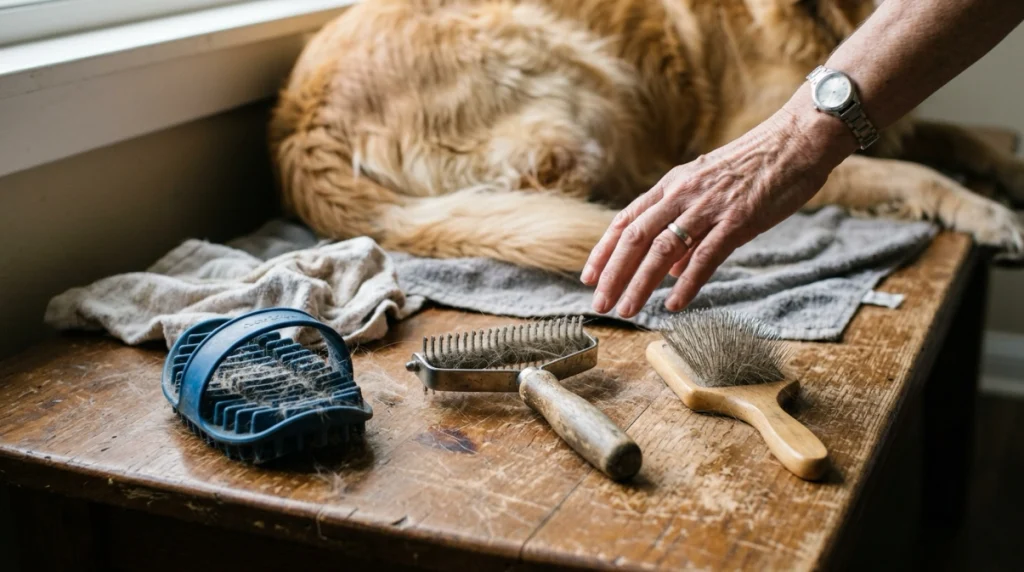
SaveIf you’re ready to choose a tool, I’d match it to the coat and the dog’s current comfort level. A gentler experience comes from the right tool, light pressure, and short sessions working together.
🐕 Best Gentle Starter
KONG ZoomGroom Dog Brush
★★★★★
This flexible rubber grooming tool removes loose hair while providing a massage-like feel on suitable short coats. I like this style as a lower-intensity starting point when a dog dislikes the feel or appearance of metal pins.
🍂 Best for Thick Undercoat
FURminator Grooming Rake
★★★★☆
The Grooming Rake uses rotating metal teeth and is intended for thick fur and dense double coats. I would choose it for controlled undercoat work rather than using extra pressure with a shallow brush that cannot move through the coat.
✨ Best for Long Coats
Chris Christensen Big A Slicker Brush
★★★★☆
The Big A uses 27 mm pins and is designed as a gentler slicker option for long coats, including delicate coats. I would consider it when coat depth requires long pins but you still want controlled section-by-section brushing.
Frequently Asked Questions
Should I hold my dog still while brushing?
Gentle positioning is different from overpowering a frightened dog. If your dog repeatedly struggles, freezes, growls, or tries to escape, reduce the difficulty instead of increasing restraint. For urgent coat problems that cannot wait for training, ask a veterinarian or professional groomer for help.
What should I do if my dog tries to bite the brush?
Stop moving the brush toward the dog and create more distance. Biting at the tool can signal fear, frustration, play, or discomfort, so don’t simply push through it. Reintroduce the brush gradually with rewards, and seek professional help if snapping is intense or directed toward people.
Can treats make a dog accept brushing?
Treats can help change how a dog feels about brushing when they are paired with small, manageable exposures. Food should not be used to lure a terrified dog into tolerating overwhelming handling. Keep the grooming intensity low enough that the dog can remain relaxed and take rewards normally.
Why does my dog hate being brushed in one particular spot?
A specific area may contain a tangle, sensitive skin, an injury, or another source of discomfort. Stop repeatedly brushing that location and inspect it gently. If the sensitivity is new, severe, or accompanied by redness, swelling, sores, or pain, contact your veterinarian.
How do I make my dog enjoy brushing?
Start with short sessions, an appropriate brush, easy body areas, and rewards your dog values. Increase strokes and grooming difficulty only after the current step becomes comfortable. Some dogs may learn to enjoy brushing, while others simply become calm and cooperative, which is also a successful outcome.
Final Takeaway: Cooperation Matters More Than Finishing Fast
Learning how to brush a dog without forcing the process means changing the goal. Instead of trying to finish the entire coat at any cost, build a routine your dog can successfully repeat.
Start small, reward calm participation, use a coat-appropriate tool, and respect early signs of discomfort. When pain, severe matting, or defensive behavior makes home grooming unsafe, bring in the right professional rather than turning brushing into a wrestling match.

Thomas Cutter is a lifelong dog owner and the founder of FindOutAboutDogs.com. With over 10 years of hands-on experience owning multiple breeds, Thomas created this site to provide honest, research-based dog advice that real owners can actually trust.
