How to Detangle Doodle Hair Without Hurting Your Dog
Quick Answer
To detangle doodle hair safely, loosen small knots with your fingers and a dog-safe detangling spray, then work gently through the coat with a slicker brush. Finish with a stainless-steel comb to find hidden tangles. Never force a brush through tight mats or cut them out with household scissors. Choosing the right tool matters, as explained in our curly dog brush guide.
How to detangle doodle hair in 6 steps
- Check the coat: Identify loose knots, tight mats, and sensitive skin before starting.
- Prepare your tools: Gather a slicker brush, metal comb, and dog-safe detangling spray.
- Separate small knots: Support the hair near the skin and loosen the ends with your fingers.
- Brush in sections: Use short, gentle strokes without scraping the skin.
- Check with a comb: Stop whenever the teeth catch or pull.
- Know when to stop: Leave painful, tightly packed, or widespread mats to a professional.
Important safety rule
- Never pull: Resistance means you should pause and inspect the knot.
- Never force detangling: Tight mats can pull painfully against your dog’s skin.
A Goldendoodle or Labradoodle can look beautifully fluffy while hiding stubborn knots beneath the surface. Those tangles can quickly become painful when brushing only reaches the outer coat.
My approach is simple: protect the dog’s comfort first, then work on the coat. I’ll explain the tools, brushing technique, and warning signs that tell you when home detangling is no longer appropriate.


Why Does Doodle Hair Get Tangled So Easily?
Doodle coats often trap loose hair among surrounding waves or curls. Friction and moisture can turn those trapped strands into increasingly tight knots.
A doodle’s coat texture depends on its genetics, coat length, and individual hair characteristics. Some dogs have loose waves, while others develop dense curls that require more frequent grooming.
What is the difference between a tangle and a mat?
A tangle is a small group of intertwined hairs that may separate with gentle finger work. A mat is a tighter collection of tangled hair that can become compacted near the skin.
Severe matting sometimes forms a connected layer across a large area of the body. This condition is often called pelting and generally requires professional removal.
- Loose tangle: Hair separates easily without pulling the skin.
- Small mat: A compact knot resists ordinary brushing but may still move away from the skin.
- Tight mat: Hair feels dense and sits close against the skin.
- Pelted coat: Large sections of hair become connected into a tight layer.
The most important difference is your dog’s comfort. According to PetMD’s veterinary guidance on matting, tight mats can cause pain, irritation, and hidden skin problems.
Can You Detangle Matted Doodle Hair at Home?
Yes, you can usually address small, loose tangles at home when your dog remains comfortable. Tight, painful, widespread, or skin-level mats need professional attention.
Before reaching for a brush, gently lift the surrounding hair and inspect the area. Use this comparison to decide whether home grooming is reasonable.
| Coat condition | What to do | Safety priority |
|---|---|---|
| Loose surface tangles | Use fingers and gentle brushing. | Avoid tugging. |
| Small, movable knots | Try short, gentle sessions. | Stop if the skin pulls. |
| Tight mats near skin | Contact a professional groomer. | Do not cut or force apart. |
| Widespread mats or damaged skin | Arrange veterinary assessment. | Prioritize pain and skin health. |
My rule is to judge a grooming session by comfort, not the amount of hair removed. A smooth-looking coat means little if brushing has left the dog distressed.
What Tools Do You Need to Detangle Doodle Hair?
A slicker brush, stainless-steel comb, and dog-safe detangling spray cover most routine doodle grooming needs. Choose tools according to coat density, hair length, and sensitivity.
- Long-pin slicker brush: Separates longer curls and removes loose hair when used with light pressure.
- Stainless-steel comb: Finds knots hidden beneath the surface and checks whether brushing was thorough.
- Dog-safe detangling spray: Adds slip to help ease small knots without aggressive pulling.
- Small grooming brush: Offers better control around legs and other narrow areas.
- Small treats: Reward calm behavior and support positive grooming experiences.
The American Kennel Club’s brush selection guide explains why slicker brushes suit many curly-coated dogs. It also emphasizes choosing the correct brush size and using gentle pressure.
For a closer look at how these tools work together, see our brush versus comb comparison.
How to Detangle Doodle Hair Step by Step
 Save
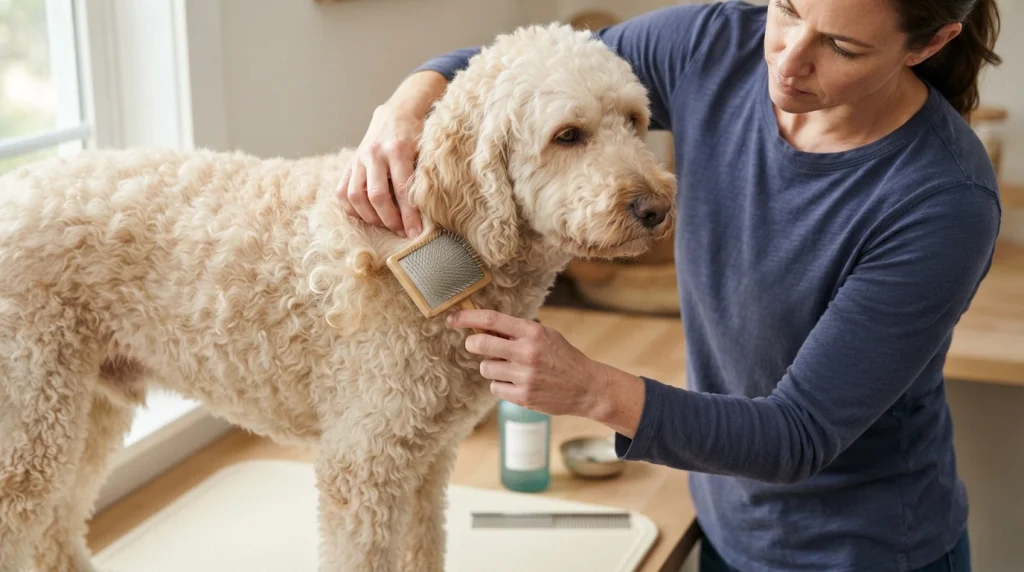
SaveStart with loose, manageable hair and gradually work toward small knots. Detangling should feel controlled rather than becoming a contest between the brush and your dog.
Step 1: Choose a comfortable grooming location
Use a stable, nonslip surface where your dog can stand or lie comfortably. Keep grooming tools within easy reach so you aren’t repeatedly interrupting the session.
Start when your dog is relaxed rather than excited or exhausted. A calm environment makes it easier to notice discomfort early.
Step 2: Inspect the coat with your fingers
Gently separate the hair and feel for knots near the skin. Inspect the collar area, chest, legs, and behind the ears.
Look for redness, swelling, moisture, or unusual odor while checking the coat. Stop and consult a veterinarian if you discover painful or damaged skin.
Step 3: Apply a suitable detangling spray
A light application of dog-specific detangler may reduce friction while you work through small knots. Follow the product directions and avoid the eyes, nose, and mouth.
You don’t need to soak the entire coat. A heavily wet or matted coat can become harder to manage.
Step 4: Loosen the knot with your fingers
Support the hair close to the skin so your movements don’t pull directly against it. Gently tease the outer strands apart, beginning at the ends of the knot.
Don’t twist, yank, or pull the entire clump. If the knot doesn’t loosen comfortably, leave it for a professional.
Step 5: Brush gently through small sections
Lift a small layer of hair and brush the exposed coat with short, controlled strokes. Work from near the skin outward without pressing metal pins into the skin.
Let the brush move through free hair instead of dragging it through resistance. Adjust your hand position whenever the coat pulls.
Step 6: Check your work with a metal comb
Pass a stainless-steel comb gently through the brushed section. Begin with wider-spaced teeth and move toward finer teeth only when the coat allows it.
A comb that catches reveals a remaining knot or dense area. Stop immediately rather than pulling harder.
Step 7: Reward your dog and finish gently
Give your dog a short break, praise, or treat after a comfortable session. Stop before grooming becomes frustrating or stressful.
Check the coat for remaining tangles and skin irritation. Schedule professional help if any stubborn mats remain.
What Is Line Brushing, and Why Does It Work for Doodles?
Line brushing is a grooming technique that separates the coat into narrow sections, allowing you to brush closer to the roots. It helps uncover tangles that ordinary surface brushing can miss.
Rather than repeatedly brushing over fluffy outer hair, you expose one small section at a time. This method is especially useful for longer, curly doodle coats.
How to line brush a doodle coat
- Start near a lower body section. Lift the hair above it with one hand.
- Create a narrow part. Expose a manageable layer of hair underneath.
- Brush the exposed section. Use short strokes with light pressure.
- Check with your comb. Ensure the section moves freely without snagging.
- Move upward gradually. Repeat until you’ve covered the area comfortably.
The comb check is particularly important. I consider it more useful than judging whether a coat looks fluffy from a distance.
Poodle-dominant coats may need similar care. Our Poodle brushing tutorial explains this technique in more detail.
Where Do Doodles Get the Most Mats?
Doodles commonly develop mats in areas where hair repeatedly rubs against skin, collars, or harnesses. These spots deserve extra attention during routine checks.
- Behind the ears: Fine hair tangles easily when the head moves or rubs against bedding.
- Under the armpits: Walking and running create friction between the legs and body.
- Around the collar: Constant contact can compress longer hair.
- Under the harness: Straps may encourage knots around the chest and shoulders.
- Between the legs: Repeated movement can twist nearby strands together.
- Around the tail: Longer hair may collect moisture and debris.
- Between the toes: Hair can become compacted and difficult to manage.
Check these areas with your fingertips rather than relying only on what you can see. A smooth outer coat can conceal tight knots underneath.
Use extra caution around the ears, eyes, groin, and paws. Mats in sensitive areas should be handled by an experienced professional when they don’t separate easily.
Should You Wash a Matted Doodle Before Detangling?
No, avoid bathing a doodle with tight or significant mats before addressing the problem. Wetting tangled hair can make existing knots more compact as the coat dries.
For routine coat maintenance, inspect and gently brush manageable tangles before bathing. If your dog already has painful mats, arrange professional care first.
Can you brush doodle hair when it’s wet?
A dog-specific conditioning spray may be used on dry or damp hair according to its directions. However, soaking a tangled coat is not a substitute for proper detangling.
After an ordinary bath, dry the coat thoroughly and inspect it for knots. The AKC’s home grooming advice also recommends using suitable canine grooming tools and avoiding unsafe cutting techniques.
When Should a Matted Doodle Be Shaved Instead of Brushed?
 Save
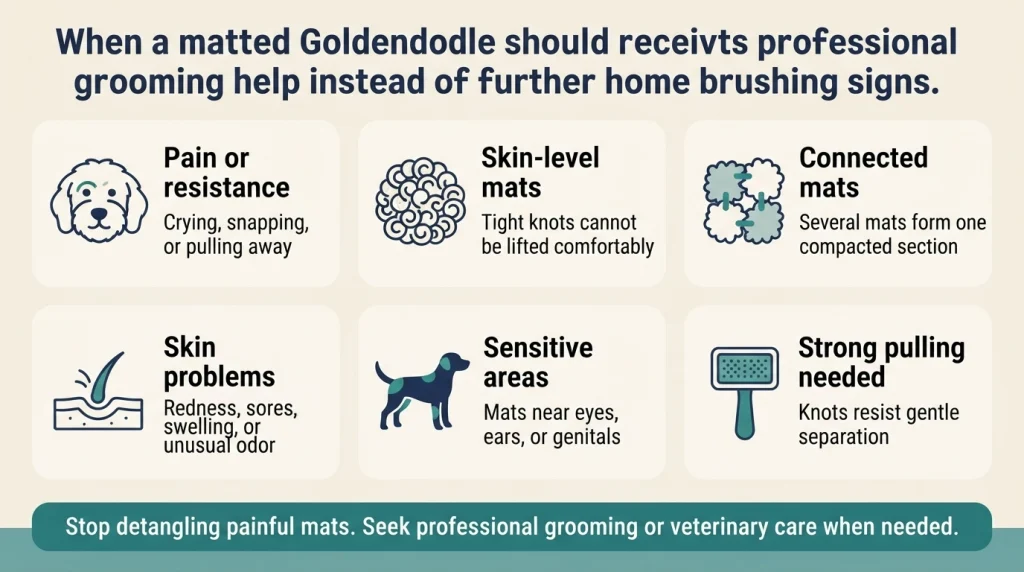
SaveProfessional clipping may be the safest choice when mats are tight, widespread, or painful. Preserving coat length should never take priority over your dog’s comfort.
Severe matting can pull against the skin and conceal irritation or wounds. Excessive brushing may increase discomfort without successfully separating the hair.
Signs you need professional help
- Your dog cries, snaps, or repeatedly pulls away during gentle grooming.
- The mat sits firmly against the skin and cannot be lifted comfortably.
- Several mats have joined into one large, compacted section.
- You notice redness, sores, swelling, discharge, or an unusual smell.
- The mat is close to the eyes, ears, genitals, or another sensitive area.
- You cannot loosen a knot without significant pulling.
Never attempt to cut skin-level mats using household scissors. A dog’s thin skin can become trapped within a knot, creating a serious injury risk.
Professional groomers have specialized equipment for removing difficult mats. The PetMD discussion of matted dog hair explains why clipping may be kinder than prolonged detangling.
If the coat hides injured or infected skin, consult a veterinarian. Medical assessment matters more than achieving a particular haircut.
How Often Should You Brush a Goldendoodle or Labradoodle?
Many long-coated or tightly curled doodles benefit from daily brushing. Shorter, well-maintained coats may need less intensive sessions, although regular checks remain important.
There is no universal schedule for every doodle. Hair texture, coat length, outdoor activity, and the dog’s tolerance should guide your routine.
A practical grooming schedule
- Long, dense curls: Check daily and brush thoroughly, often every day.
- Medium-length waves: Check friction areas daily and brush frequently.
- Short, maintained trims: Inspect regularly and brush several times weekly as needed.
- After swimming or rainy walks: Check for knots and dry the coat carefully.
- During coat changes: Increase inspections when loose puppy hair begins catching in the developing adult coat.
Regular professional grooming can help maintain a manageable coat length. Ask your groomer how frequently appointments should occur for your dog’s specific coat.
If brushing repeatedly becomes difficult, consider a shorter haircut. A comfortable, manageable coat is often preferable to a long coat that continually develops mats.
Do Doodle Puppies Need a Different Detangling Routine?
Yes, doodle puppies benefit from shorter, gentler grooming sessions that build confidence. Their developing coats may also change texture as they mature.
Start by introducing the brush gradually, even before significant tangling appears. Reward relaxed behavior and stop while the experience remains positive.
How to introduce grooming to a puppy
- Let your puppy investigate the brush without forcing contact.
- Touch the coat gently and reward calm behavior.
- Brush a small, easy section with light pressure.
- Introduce the metal comb gradually.
- Extend grooming sessions only as your puppy becomes comfortable.
Never hold a frightened puppy down to complete a brushing session. Repeated uncomfortable experiences can make future grooming more difficult.
A patient groomer can also help introduce professional handling. Early positive experiences make ongoing coat maintenance easier.
What Common Mistakes Make Doodle Matting Worse?
The biggest mistake is brushing only the outer layer while hidden knots remain close to the skin. Other habits can also make small tangles harder to manage.
- Using excessive pressure: Hard brushing can irritate the skin and make dogs resist grooming.
- Pulling through knots: This creates pain and may break surrounding hair.
- Skipping the comb check: Surface brushing may leave deeper tangles untouched.
- Bathing before addressing mats: Moisture may make existing knots tighter.
- Using human scissors: Cutting close to the skin creates a serious injury risk.
- Ignoring friction areas: Small knots around harnesses and ears can worsen unnoticed.
- Waiting too long between sessions: Loose hair can accumulate and form dense mats.
- Forcing lengthy grooming sessions: Dogs may become fearful or increasingly resistant.
Instead, make coat inspections part of your regular routine. Catching a loose knot early is easier than addressing a compacted mat later.
Best Grooming Tools for Detangling Doodle Hair
 Save
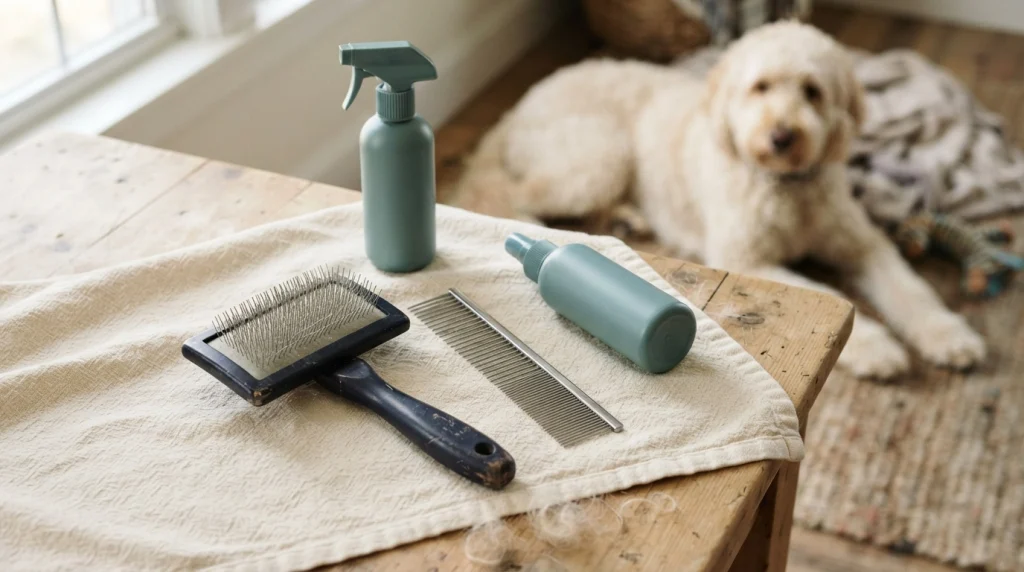
SaveYou don’t need a large collection of expensive tools to maintain most doodle coats. I’d prioritize a suitable slicker brush, dependable steel comb, and optional detangler.
These three products address different stages of routine grooming. The suitability ratings below are editorial feature assessments, not customer review averages or hands-on test results.
Affiliate disclosure: As an Amazon Associate, this site may earn from qualifying purchases.
🏆 Best for Dense Curls
Chris Christensen Big G Slicker Brush
★★★★½ 4.5/5 editorial fit
Designed for longer, dense coats, this slicker features 27 mm stainless-steel pins and an ergonomic handle. I’d choose it for maintaining substantial doodle coats when the brush size matches the dog. It should still be used gently and never forced through tight mats.
🐾 Essential Comb Check
Andis 7.5-Inch Steel Comb
★★★★★ 4.7/5 editorial fit
This 7.5-inch grooming comb has coarse and fine tooth spacing for checking and finishing coats. I’d keep it alongside a slicker brush because its teeth can reveal hidden tangles. It isn’t intended for forcing apart painful mats.
💧 Best Detangling Support
TropiClean Island Bloom Tangle Remover Spray
★★★★☆ 4.2/5 editorial fit
This 8-ounce, no-rinse detangling spray is formulated for dogs and cats. I’d consider it for adding slip during gentle grooming of minor knots. Its fragrance may not suit every sensitive dog, and it cannot safely resolve severe matting.
Frequently Asked Questions
1. What is the easiest way to detangle doodle hair?
The easiest safe approach is to loosen small knots with your fingers, then use a suitable slicker brush in narrow sections. Follow with a steel comb to check for hidden tangles. If a knot resists gentle handling or pulls the skin, stop and seek professional help.
2. Can I use coconut oil to detangle my doodle’s hair?
Coconut oil can make hair feel slippery, but it isn’t my preferred detangling product. It may leave the coat greasy, collect debris, or encourage licking. A dog-specific detangling spray used according to its instructions is generally a more practical choice for routine grooming.
3. Is it better to brush doodle hair wet or dry?
For routine maintenance, work with a dry or lightly misted coat using appropriate grooming products. Avoid soaking a coat that already contains tight mats, since moisture can worsen tangling. After a normal bath, dry the coat thoroughly and check it with a comb.
4. How do groomers remove severely matted doodle hair?
Professional groomers assess how tight the mats are and whether removal would cause discomfort. When detangling isn’t humane or practical, they may use professional clippers to remove the affected coat. If the skin is injured or infected, veterinary care may be necessary.
5. How do I prevent my Goldendoodle from getting matted again?
Use a consistent brushing routine, check high-friction areas daily, and finish sessions with a steel comb. Keep the coat at a length you can realistically maintain. Regular professional appointments and extra attention after swimming, bathing, or outdoor activity also help limit future tangles.
Final Takeaway: Keep Doodle Detangling Gentle
Learning how to detangle doodle hair begins with recognizing what can safely be brushed and what needs professional care. Small knots often respond to patient finger work, a suitable slicker brush, and a careful comb check.
Long-term success comes from consistent grooming rather than occasional aggressive detangling. Make comfort your priority, keep the coat manageable, and never force a brush through a painful mat.
Start with gentle coat checks today. Your doodle’s skin and comfort matter far more than maintaining a perfectly fluffy haircut.

Thomas Cutter is a lifelong dog owner and the founder of FindOutAboutDogs.com. With over 10 years of hands-on experience owning multiple breeds, Thomas created this site to provide honest, research-based dog advice that real owners can actually trust.
