Retractable Pins vs Fixed Pins: Which Dog Brush Is Better?
Quick Answer
Retractable-pin dog brushes are usually more convenient to clean because a button or slider withdraws the pins and releases trapped fur. Fixed-pin brushes have permanently exposed pins, often providing a straightforward, durable design with fewer moving parts. Choose retractable pins for easier cleanup and fixed pins for simplicity, but prioritize pin length, flexibility, spacing, and comfort for your dog’s coat.
Key differences at a glance
- Cleaning: Retractable pins can release collected hair without as much manual picking.
- Construction: Fixed-pin brushes generally have fewer mechanical parts that can fail.
- Grooming results: Both can work well when their pin design matches the dog’s coat.
- Comfort: Pin tips, pressure, length, and flexibility matter more than the retracting mechanism.
- Best fit: Consider retractable pins for frequent cleanup and fixed pins for a simple, conventional brush.
Before choosing
- Match the brush to your dog’s coat length, density, and tendency to tangle.
- Use light pressure and stop if your dog shows discomfort or the skin becomes irritated.
Choosing between retractable pins and fixed pins might seem like a small detail, but it can change how convenient your regular grooming routine feels. I would look beyond the cleaning button and consider how the brush moves through the coat, how comfortably it handles tangles, and how easy it is to maintain.
In this guide, I’ll explain how each design works, where the differences matter, and which features deserve your attention before buying a dog brush in 2026.


What Are Retractable Pins and Fixed Pins on a Dog Brush?
Retractable pins are brush pins that move back into or behind the brush head when you activate a release mechanism. Fixed pins remain in their normal exposed position because the brush does not have a pin-retraction mechanism.
Both designs can appear on brushes with metal pins, including some slicker-style grooming brushes. The main difference is how the pins are stored and how you remove hair from the brush after grooming.
- Retractable-pin brush: A button, slider, or similar mechanism changes the position of the pin pad to help release collected hair.
- Fixed-pin brush: The pins stay exposed, so you remove trapped hair by hand or with a suitable cleaning tool.
- Pin brush: Usually has longer, more widely spaced pins intended for maintaining longer coats and separating hair.
- Slicker brush: Usually has many closely spaced, fine pins for separating coat, collecting loose hair, and addressing small tangles.
These terms describe different features, not interchangeable brush categories. A retractable-pin brush can still be a slicker brush, and a fixed-pin brush can use either widely spaced pins or a dense pin arrangement.
Important distinction: Retractable describes the pin mechanism, while slicker and pin brush describe brush designs and their typical uses. Compare the actual pin arrangement before judging two brushes by their labels.
Retractable Pins vs Fixed Pins: What Is the Difference?
 Save
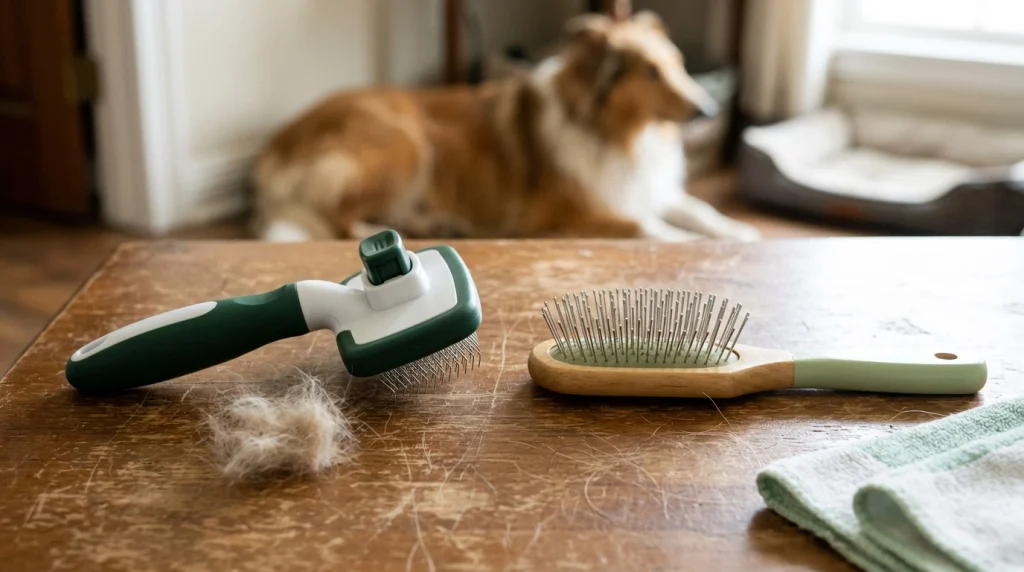
Retractable pins mainly improve cleanup convenience, while fixed pins offer a simpler construction. Neither design automatically removes more hair or works better on every dog.
The following comparison focuses on practical ownership differences rather than unverified performance claims.
| Feature | Retractable Pins | Fixed Pins |
|---|---|---|
| Hair removal | Mechanism may release collected hair in a sheet or clump. | Usually requires pulling hair from around the exposed pins. |
| Moving parts | Includes a release mechanism and movable pin assembly. | Typically has a simpler, stationary pin assembly. |
| Cleaning effort | Often lower for routine removal of loose hair. | Can require more manual picking between pins. |
| Maintenance | The mechanism may need extra attention if hair or debris collects around it. | Fewer moving parts generally mean fewer mechanism-related concerns. |
| Coat compatibility | Depends on pin spacing, length, shape, and brush-head design. | Depends on the same coat-matching features. |
| Potential drawback | The release mechanism can stick or wear out. | Trapped fur can take longer to remove. |
| Best reason to choose | Convenient cleanup after frequent brushing. | Simple construction and straightforward maintenance. |
One point matters more than the table might suggest: the pin mechanism does not determine the brush’s grooming ability by itself. A well-designed fixed-pin brush can outperform a poorly matched retractable model on a particular coat.
Are Retractable-Pin Dog Brushes Easier to Clean?
Yes, generally. A retractable-pin brush can make routine cleanup easier by withdrawing the pins so collected fur separates from the brush head.
That convenience becomes noticeable when you brush a dog regularly and the head fills with loose hair. Instead of working individual strands out from between many pins, you activate the mechanism and remove the released fur.
- Less manual picking: You may spend less time pulling fur from around individual pins.
- Quicker between-session cleanup: Removing collected hair after each use helps keep the brush ready for the next session.
- Less contact with exposed pins: Depending on the design, withdrawing the pins can make handling the collected hair easier.
There is a trade-off. Hair, dust, and grooming debris can collect around the moving parts, and a poorly maintained release mechanism may stop working smoothly.
Don’t assume every retractable brush cleans itself completely. You may still need to remove hair around the edges, clean the pin pad according to the manufacturer’s instructions, and check that the mechanism operates properly.
How does a retractable-pin mechanism work?
Many self-cleaning brushes use a button that moves a plate or changes the position of the pins relative to the brush head. This helps push collected fur away from the pins so you can lift it off.
Designs vary, so the release method and cleaning instructions are not identical across brands. Check the manufacturer’s instructions before disassembling a brush or rinsing its head.
Are Fixed-Pin Dog Brushes More Durable?
Fixed-pin brushes have a potential durability advantage because they generally lack the moving mechanism found in retractable designs. Fewer mechanical parts mean fewer opportunities for a release button, slider, or internal assembly to malfunction.
However, fixed pins are not automatically stronger. Durability also depends on the materials, how the pins attach to the pad, handle construction, and how carefully you use and store the brush.
- Pin security: Check for loose, bent, or missing pins before grooming.
- Pad quality: Look for a securely attached pad without visible damage.
- Handle strength: A comfortable handle should feel stable without cracking or flexing excessively.
- Build quality: Inspect seams and connections that might loosen with repeated use.
For someone who wants a basic brush with minimal maintenance, fixed pins may be the more sensible choice. For someone who values quick cleanup, a well-made retractable model may justify its additional mechanism.
Which Pin Design Is Better for Different Dog Coats?
 Save
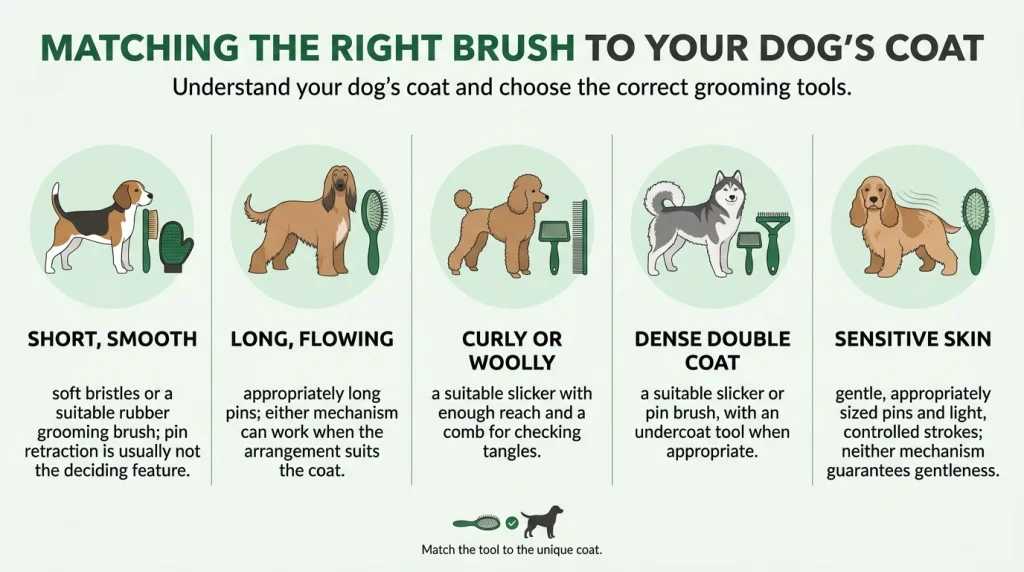
The best option depends on the coat, not simply on whether the pins retract. Length, density, curl, and the tendency to form mats should guide your choice.
Use the following as a starting point rather than a universal rule.
| Coat Type | Brush Features to Look For | Retractable or Fixed? |
|---|---|---|
| Short, smooth | Soft bristles or a suitable rubber grooming brush. | Pin retraction is usually not the deciding feature. |
| Long, flowing | Appropriately long pins that move through the coat without excessive pulling. | Either design can work if the pin arrangement suits the coat. |
| Curly or woolly | A suitable slicker with enough reach for the coat, plus a comb for checking tangles. | Prioritize reach, control, and gentle technique. |
| Dense double coat | A suitable slicker or pin brush, with an undercoat tool when appropriate. | Choose according to the job and the dog’s comfort. |
| Sensitive skin | Gentle, appropriately sized pins and a design that allows light, controlled strokes. | Neither mechanism guarantees a gentler brushing experience. |
For a long or curly coat, I would pay particular attention to whether the pins can reach through the hair without scraping the skin. A retractable feature is useful, but it cannot compensate for pins that are too short or a brush head that is too small.
For a short-coated dog, a metal-pin brush may not be necessary at all. A rubber grooming brush or suitable bristle brush may be more appropriate for routine loose-hair removal.
If your dog has a thick undercoat, see this guide on how to brush a dog with a thick undercoat for a coat-focused approach.
Can Retractable Pins Prevent Skin Irritation?
No. Retractable pins primarily make hair removal from the brush easier; they do not automatically protect your dog’s skin during grooming.
Skin comfort depends on pin tips, pin stiffness, pressure, coat condition, and technique. A retractable brush can still scratch or irritate skin if you press too hard or repeatedly brush the same spot.
- Use light strokes: Let the pins separate hair instead of forcing them against the skin.
- Check the coat first: Look for mats, burrs, sores, and tender areas before starting.
- Work in sections: Smaller sections make it easier to control the brush and notice hidden tangles.
- Watch your dog: Stop if your dog flinches, repeatedly turns away, freezes, or tries to escape.
- Inspect afterward: Check for redness, scratches, or other signs of irritation.
Severe mats deserve special care because brushing them can pull painfully on the skin. Don’t force a brush through a tight mat just because the pins retract for cleaning.
If brushing suddenly becomes uncomfortable, or you notice inflamed skin, wounds, or persistent sensitivity, stop and consult a veterinarian. You can also read how to tell if a brush is causing discomfort in your dog.
How Should You Choose Between Retractable and Fixed Pins?
I would decide in this order: coat compatibility first, comfort second, and cleaning convenience third. That order helps prevent an easy-to-clean brush from becoming an unsuitable grooming tool.
- Identify the coat: Decide whether your dog has a smooth, long, curly, wire, or dense double coat.
- Check the pins: Compare length, spacing, tip shape, and flexibility against the coat’s needs.
- Consider cleanup: Choose retractable pins if removing trapped fur manually is a recurring frustration.
- Assess construction: Check the release mechanism on retractable models and the pin attachments on fixed models.
- Test gently: Try a few light strokes on an untangled area and watch your dog’s reaction.
- Consider maintenance: Follow the manufacturer’s cleaning instructions and replace a damaged brush.
When comparing two brushes in a store, operate the retracting mechanism several times. It should move smoothly without obvious sticking, excessive looseness, or difficulty returning to its normal position.
Also consider the handle and brush-head size. A comfortable grip and manageable head can make grooming easier, especially when working around legs, behind ears, and other smaller areas.
What Are the Best Dog Brushes to Consider?
 Save
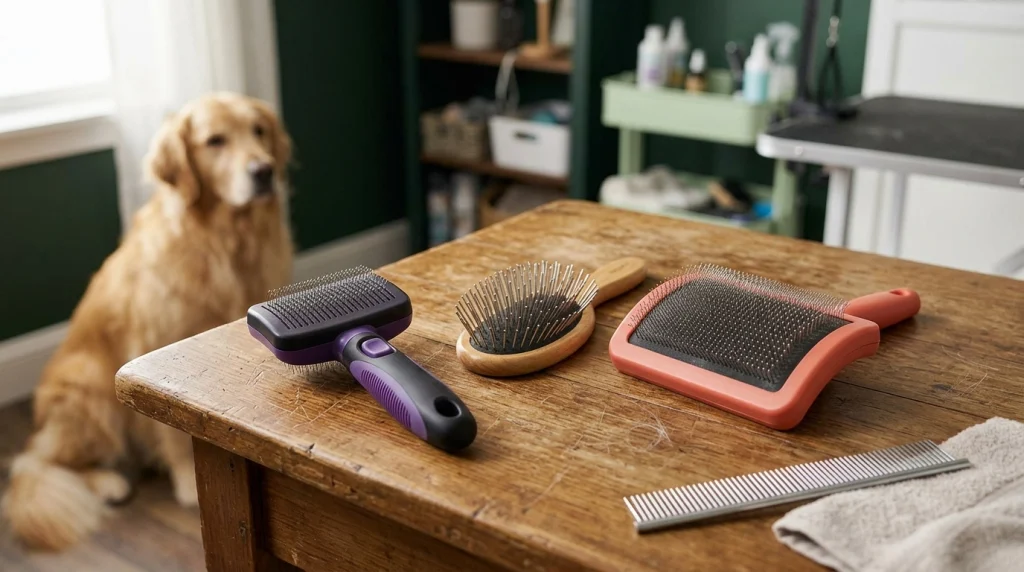
If you’ve decided that a brush upgrade makes sense, compare actual models rather than relying on a retractable or fixed label alone. These three options represent different grooming approaches, and their suitability depends on your dog’s coat.
EASIER CLEANUP
Hertzko Self Cleaning Slicker Brush
Its retractable-pin cleaning design is intended to help release collected fur from the brush. I’d consider it for suitable medium or long coats when cleanup convenience is a priority, while checking pin length and comfort before purchase.
FIXED-PIN ALTERNATIVE
Chris Christensen Pin Brush
A conventional pin brush is worth considering for maintaining suitable longer coats and feathering. Check the exact model’s pin arrangement and size, since this brush category is intended for a different grooming job than a dense slicker.
DENSE COATS
Chris Christensen Big G Slicker Brush
This slicker-style option is worth comparing for suitable dense, curly, or long coats where reach and coat separation matter. I would prioritize matching its pin length and firmness to the dog’s coat and using a gentle technique rather than choosing it solely for its design.
These are product options to compare, not a claim that each model has been personally tested or independently ranked. Verify the current model details, pin design, and manufacturer’s care instructions before ordering.
If you’re still unsure which brush category suits your dog, this overview of using multiple brush types for one dog explains why a single tool may not cover every grooming need.
Frequently Asked Questions
Are retractable-pin dog brushes better than fixed-pin brushes?
Retractable-pin brushes are generally more convenient to clean because their mechanism helps release trapped fur. Fixed-pin brushes offer simpler construction and avoid mechanism-related failures. Neither type is automatically better at grooming, so compare coat compatibility, pin design, and comfort before choosing.
Do retractable pins remove more dog hair?
Not necessarily. Retraction mainly helps remove hair that has already collected in the brush. The amount of loose coat removed during grooming depends more on the brush’s pin arrangement, its suitability for the coat, and the technique used.
Can retractable-pin brushes break easily?
They can develop problems if their release mechanisms become clogged, worn, or damaged, but quality varies between models. Keep the mechanism clean, follow the manufacturer’s instructions, and avoid forcing a stuck button or slider. A fixed-pin brush has fewer moving parts but can still suffer damaged pins or a broken handle.
Are fixed-pin brushes safer for dogs with sensitive skin?
Not automatically. Skin comfort depends on pin tips, stiffness, pressure, coat condition, and brushing technique rather than the presence of a retracting mechanism. Choose a brush suited to your dog’s coat, use gentle strokes, and stop if you notice flinching, redness, or discomfort.
Should I choose retractable pins for a long-haired dog?
Retractable pins can be convenient for long-haired dogs because frequent brushing may leave substantial fur in the brush. However, the pins must also reach through the coat appropriately without scraping the skin. For long coats, consider pin length, spacing, tangles, and whether a comb is needed for a final check.
Final Takeaway: Retractable Pins vs Fixed Pins
Choose retractable pins if easier fur removal is your main priority and you find a model with a reliable mechanism. Choose fixed pins if you prefer a straightforward brush with fewer moving parts and don’t mind cleaning it manually.
Either way, the right pin design matters more than the mechanism alone. Match the brush to your dog’s coat, inspect it regularly, and use light pressure to keep grooming comfortable.
For most owners, the best purchase isn’t the brush with the most features. It’s the one that fits the coat, works comfortably, and makes regular grooming easier to maintain.

Thomas Cutter is a lifelong dog owner and the founder of FindOutAboutDogs.com. With over 10 years of hands-on experience owning multiple breeds, Thomas created this site to provide honest, research-based dog advice that real owners can actually trust.
