Stainless Steel Pins vs Other Dog Brush Materials: Which Is Best for Your Dog’s Coat?
Quick Answer
When comparing stainless steel pins vs other dog brush materials, surgical-grade stainless steel wins for deep undercoat penetration, static control, and durability across medium-to-long coats. Natural boar bristles, rubber curry nubs, and wooden pins work better for short coats, sensitive skin, and surface shine, making your dog’s coat texture the deciding factor alongside proper daily coat care.
Key Differences by Brush Material
- Stainless steel pins: Glide deep through thick undercoats and dense tangles without bending, rusting, or building up static electricity.
- Natural boar bristles: Capture microscopic dander and spread natural skin oils across short or silky topcoats for a glossy finish.
- Rubber and silicone nubs: Massage sensitive skin and grip loose dead hair on short, single-coated breeds during bath time or dry brushing.
- Nylon and plastic pins: Offer a budget-friendly, flexible feel for light surface brushing, though they generate static and snap under heavy mats.
- Wooden and bamboo pins: Provide wide, gentle spacing with zero static charge for fragile coats, but lack the thin profile needed to separate tight knots.
Quick Selection Rule
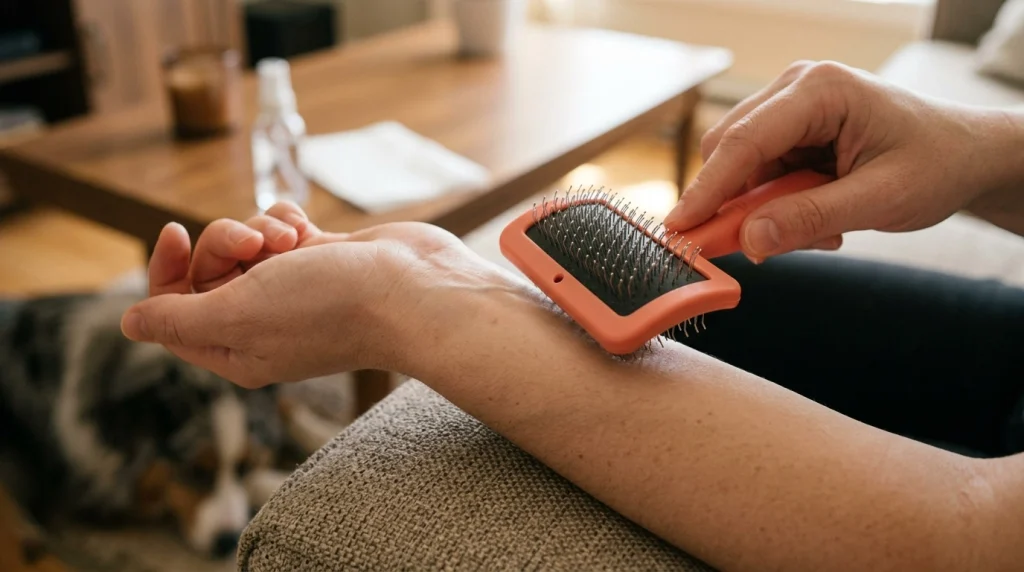
- Perform the forearm scratch test before brushing your dog: press the brush against your inner wrist at a 45-degree angle to verify the tips are polished smooth.
Walk down the grooming aisle of any pet store and you’ll see dozens of brushes that look nearly identical from five feet away. Once you run your thumb across the bristles, however, the difference between polished stainless steel, stiff nylon, natural boar hair, and soft rubber becomes obvious.
Over my ten-plus years testing grooming gear across multiple breeds, I’ve learned that picking the wrong pin material causes more than wasted money. It leads to painful static shocks, snapped guard hairs, and brush burn that makes your dog hide under the dining table the moment you open the grooming drawer.


What Are Dog Brush Pins Made Of?
Dog brush pins and bristles are manufactured from five primary materials: stainless steel, nylon or plastic, natural boar hair, molded rubber or silicone, and polished wood or bamboo. Each material carries a distinct friction coefficient, flex rating, and tip geometry that dictates how it interacts with canine hair follicles and skin.
Understanding how a brush behaves starts with its raw material. When you pull a pin through a coat, two physical forces take over: mechanical separation and surface friction.
Stiff, smooth materials part dense hair shafts to reach the skin. Softer, porous materials skim across the outer layer to polish the cuticle.
Groomer’s Definition: Pin gauge refers to the thickness of an individual wire pin, while pin density measures how many pins sit within each square inch of the rubber cushion pad. Finer gauges glide through silky hair, whereas thicker gauges push through heavy double coats.
Manufacturers choose specific materials to solve distinct coat problems. Here is how the five main categories break down in everyday home grooming:
- 304 Surgical-Grade Stainless Steel: High-tensile metal wire ground at the tip, engineered for slicker brushes, oval pin brushes, and undercoat rakes.
- Synthetic Nylon and Plastic: Extruded polymer filaments often topped with epoxy beads, built for inexpensive everyday detanglers.
- Natural Boar Bristle: Keratin-based animal hair harvested with natural microscopic scales that trap dust and redistribute sebum (skin oil).
- Thermoplastic Rubber (TPR) and Silicone: Flexible, high-friction cones molded into curry brushes and bath mitts to grab shedding short hair.
- Hardwood and Bamboo: Turned wooden pegs set into pneumatic pads for anti-static, low-pressure massage on delicate skin.
Why Do Professional Groomers Prefer Stainless Steel Pins?
 Save
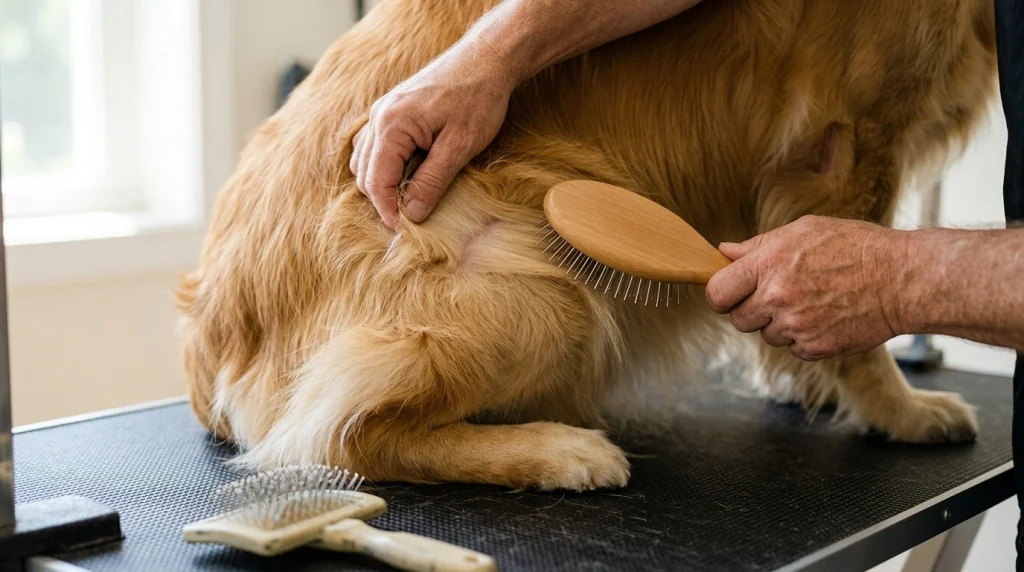
Professional groomers prefer stainless steel pins because the metal resists rust, maintains exact bend angles under heavy tension, and eliminates static electricity that frays the hair shaft. Unlike synthetic pins that drag on the coat cuticle, precision-polished steel slides through tangles without ripping healthy guard hairs from the follicle.
When I tested a cheap plastic pin brush against a stainless steel Chris Christensen Original Series Oval Pin Brush on a Golden Retriever’s feathering in early 2026, the difference showed up within thirty seconds. The plastic bristles bowed backward and crackled with static. The stainless steel pins parted the thick Furnishings down to the skin in two silent passes.
Metal performance comes down to four engineering advantages that no synthetic fiber can copy:
- Zero Electrostatic Buildup: Friction between plastic and dry dog fur strips electrons, creating static charge that causes hair to fly away and re-knot immediately. Stainless steel conducts and dissipates that charge on contact.
- Micro-Polished Surface Glide: High-end steel pins undergo tumbling and buffing until the metal surface is mirror-smooth. Low friction means you pull out dead shed hair instead of snapping live topcoat.
- Spring-Tempered Memory: Quality steel wires flex backward when they hit a stubborn mat, then snap right back to their original angle. They prevent painful yanking while holding their shape for years.
- Sanitation and Rust Resistance: Groomers soak tools in disinfectant daily and brush damp coats constantly. Grade 304 stainless steel won’t corrode, pit, or harbor bacteria along the shaft.
Are Ball-Tipped Stainless Steel Pins Better Than Bare Ground Pins?
Bare ground stainless steel pins are superior for thick, curly, or mat-prone coats because they exit the fur without snagging, whereas ball-tipped pins can catch inside tight tangles and pull hair. Ball tips only make sense for short-haired or thin-skinned dogs with zero matting where extra skin cushioning is the top priority.
Walk into a big-box pet store and ninety percent of the wire brushes feature tiny plastic or metal balls glued onto the tips. Buyers naturally assume those little beads protect the dog’s skin.
In reality, manufacturers add epoxy balls to cover up sharp, unfinished wire cuts that would otherwise gouge your dog. That shortcut creates a major hidden problem for anyone who owns a long-haired or double-coated breed.
The Hidden Snag Hazard: When you push a ball-tipped pin into a dense coat (like a Goldendoodle, Poodle, or Australian Shepherd), the wider bead slips behind a microscopic knot. As you lift the brush out, the neck beneath the ball hooks the hair like a fishhook, ripping healthy strands out by the root.
Premium brush makers skip the coated beads entirely. Instead, they grind and polish the raw tip of each stainless steel pin into a smooth dome.
You get a rounded, skin-safe point with the exact same diameter from base to tip. Nothing hooks, nothing pops off after three months of brushing, and the pin slides out of fleece or wool coats effortlessly.
How Does Stainless Steel Compare to Other Dog Brush Materials?
 Save
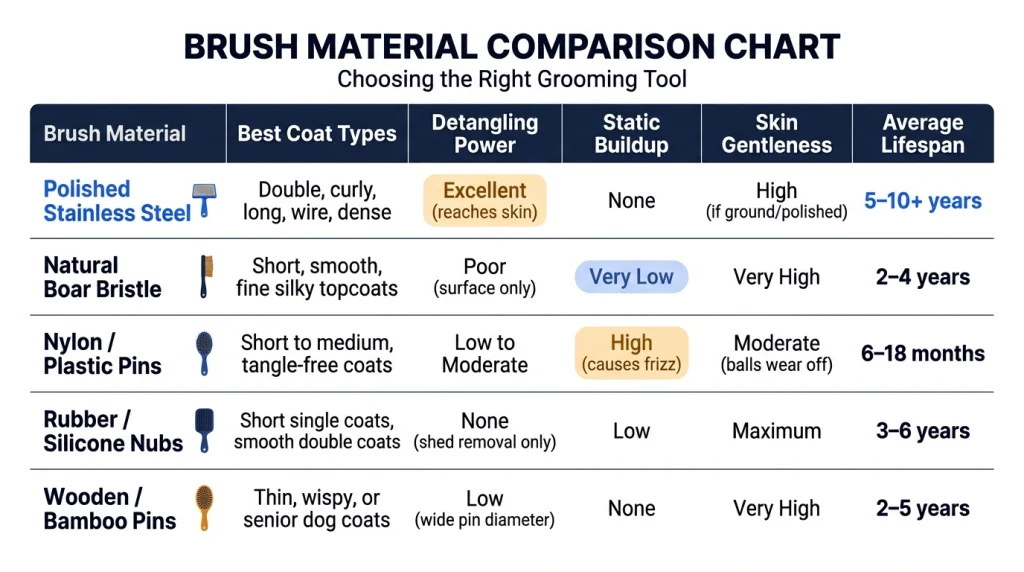
Stainless steel outperforms nylon, boar bristle, rubber, and wood in detangling power and longevity, while boar bristle and rubber win for oil distribution and bath-time scrubbing on short coats. Choosing between them requires matching the material’s stiffness and surface texture to your dog’s coat depth.
No single brush material handles every grooming task across every breed. While stainless steel forms the backbone of my grooming kit for popular beginner dog breeds like Golden Retrievers and Poodles, using a metal slicker on a Boxer or Greyhound will irritate their exposed skin.
Compare the five core brush materials across performance, static control, and durability in the table below:
| Brush Material | Best Coat Types | Detangling Power | Static Buildup | Skin Gentleness | Average Lifespan |
|---|---|---|---|---|---|
| Polished Stainless Steel | Double, curly, long, wire, dense | Excellent (reaches skin) | None | High (if ground/polished) | 5–10+ years |
| Natural Boar Bristle | Short, smooth, fine silky topcoats | Poor (surface only) | Very Low | Very High | 2–4 years |
| Nylon / Plastic Pins | Short to medium, tangle-free coats | Low to Moderate | High (causes frizz) | Moderate (balls wear off) | 6–18 months |
| Rubber / Silicone Nubs | Short single coats, smooth double coats | None (shed removal only) | Low | Maximum | 3–6 years |
| Wooden / Bamboo Pins | Thin, wispy, or senior dog coats | Low (wide pin diameter) | None | Very High | 2–5 years |
1. Stainless Steel vs. Nylon and Plastic Bristles
Nylon pins dominate the under-ten-dollar brush rack because polymer filaments cost pennies to mold. They work fine for a quick thirty-second pass over a clean, tangle-free coat.
Push nylon against a thick double coat or a damp mat, however, and the plastic bends sideways. Worse, the microscopic seams left by plastic injection molds saw against your dog’s hair cuticle, leaving the ends split and dull.
- Choose stainless steel when: Your dog has feathers, curls, or an undercoat that requires true line brushing down to the skin.
- Choose nylon only when: You want a disposable travel brush for a short-haired breed with zero knots.
2. Stainless Steel vs. Natural Boar Bristles
Boar bristles aren’t designed to compete with stainless steel pins—they actually finish the job that steel starts. Because real boar hair is made of keratin scales nearly identical to canine fur, it acts like a microscopic sponge for sebum.
When you brush a dog with boar bristles, the densely packed tufts lift sebaceous oils from the skin and coat the entire hair shaft. That natural barrier repels dirt and creates a show-ring shine that metal pins alone can’t produce.
However, boar bristles collapse on contact with dense fur. If you press a boar brush onto a Husky or Bernese Mountain Dog, the bristles flatten against the topcoat and leave 100 percent of the trapped undercoat untouched.
3. Stainless Steel vs. Rubber and Silicone Curry Nubs
Rubber curry brushes—like the KONG ZoomGroom or soft silicone mitts—rely on high surface grip rather than penetration. As you move the rubber cones in circular motions, the tacky material grabs loose, dead hairs and pulls them free.
For short-coated shedders like Pugs, French Bulldogs, Beagles, and Labrador Retrievers, rubber beats stainless steel hands down. Metal pins slide right past short, stiff hairs and scratch the skin underneath, whereas rubber nubs act like a magnet for dead fur and double as a lathering tool in the bathtub.
4. Stainless Steel vs. Wooden and Bamboo Pins
Bamboo pin brushes look great on a counter and offer two genuine perks: zero static electricity and wide, blunt tips that never poke tender skin. They feel like a gentle scalp massage for senior dogs with thinning fur or arthritic joints.
The limitation is physics. To keep a wooden pin from snapping in half, manufacturers must carve each peg roughly 2.5 to 3 millimeters thick.
That wide profile pushes tangles downward like a snowplow instead of slicing through them. Furthermore, if you use a bamboo brush with wet detangling sprays or wash it in warm water, the wood swells, warps, and eventually splits inside the cushion pad.
Which Dog Brush Material Should You Choose for Your Dog’s Coat Type?
Match your dog brush material directly to coat density: use stainless steel pins for double, curly, and long coats; rubber nubs and boar bristles for short single coats; and fine-gauge polished steel for delicate silky hair. Using the wrong material either leaves dead undercoat compacted against the skin or scrapes bare epidermis.
When owners email me asking why their dog hates being brushed, ninety percent of the time they are dragging a stiff wire tool across a single-coated breed or fighting a double coat with a flimsy plastic brush. According to veterinary dermatology guidelines from the American Veterinary Medical Association (AVMA), maintaining intact skin barriers during routine grooming prevents secondary bacterial infections and hot spots.
Use this breed-by-breed material matching guide to build the right toolkit for your household:
- Thick Double Coats (German Shepherds, Huskies, Malamutes, Golden Retrievers): Use a long-pin stainless steel slicker brush (20mm to 27mm pins) paired with a stainless steel undercoat rake. These breeds feature a dense, woolly undercoat that traps moisture and causes fungal skin infections if non-metal brushes only skim the surface.
- Curly, Wavy, and Fleece Coats (Poodles, Bichon Frises, Goldendoodles, Labradoodles): Stick strictly to bare, ground-tip stainless steel slicker brushes and a stainless steel Greyhound comb. Ball-tipped nylon or wood pins will snag inside spiraled curls and cause painful pulling.
- Long, Silky Drop Coats (Yorkshire Terriers, Shih Tzus, Maltese, Afghan Hounds): Choose a 27mm polished stainless steel oval pin brush (without balls) to detangle without static breakage, followed by a natural boar bristle brush to distribute oils down the long hair shafts.
- Short, Dense Double Coats (Labrador Retrievers, Corgis, Pugs, Rottweilers): Start with a rubber curry brush to loosen dead undercoat via friction, then finish with a short-tooth stainless steel deshedding tool or boar bristle brush. This combo keeps calm family dog breeds shedding far less on your living room rug.
- Ultra-Short Single Coats (Greyhounds, Boxers, Dobermans, French Bulldogs): Skip metal pins completely. Use a soft rubber curry brush during bath time and a 100% natural boar bristle brush when dry to buff away dander and boost coat shine.
- Wire and Harsh Coats (Schnauzers, Border Terriers, Airedales, Wirehaired Pointing Griffons): Use a firm stainless steel slicker brush alongside a stainless steel stripping comb to clear dead harsh hairs without softening the weather-resistant texture.
How Can You Tell High-Quality Stainless Steel Pins From Cheap Metal Wire?
 Save
High-quality stainless steel pins feel silky at the tips, sit securely inside a breathable pneumatic rubber pad, and flex up to 45 degrees without staying bent. Cheap carbon-steel wire brushes feature sharp burrs at the cut ends, stiff plastic backing pads, and thin plating that flakes off and rusts when exposed to grooming sprays.
Not every brush labeled “stainless steel” on the packaging deserves a spot in your grooming bag. Many bargain brands stamp pins out of cheap carbon steel wire, dip them in thin chrome plating, and set them into rigid plastic cushions that transfer 100 percent of your hand pressure straight into your dog’s ribs.
Before you touch a new metal brush to your dog, run these four hands-on quality checks:
- The Inner Forearm Glide Test: Hold the brush lightly and drag the pins across the thin skin of your inner wrist using only the weight of the brush head. Properly ground stainless steel feels smooth and cool; cheap sheared wire leaves white scratch lines immediately.
- The Cushion Vent Check: Look closely at the rubber pad holding the pins and find a single tiny air hole near the bottom or top edge. That vent allows air to escape when you press down, turning the pad into a pneumatic shock absorber that protects bony hips and spines.
- The Thumbnail Bend Test: Press a single angled slicker pin sideways with your thumbnail and release it. True 304 surgical steel springs back into alignment instantly, whereas soft pot-metal stays crooked and catches hair on the next stroke.
- The Wet Paper Towel Wipe: Mist the pins with water, let the brush sit overnight, and wipe the tips across a white paper towel. Any orange or gray residue means the manufacturer used low-grade plated steel that will stain light-colored coats.
Pro Grooming Tip: Even with polished stainless steel, technique matters as much as material. Always use the “pat and pull” motion rather than raking the pins across the skin like a garden hoe, a standard safety rule taught by the National Dog Groomers and Show Standards and veterinary educators at the Cornell Riney Canine Health Center.
When you match the right material with a breathable cushion pad, grooming stops feeling like a wrestling match. Busy households caring for low-stress dogs for working families or kid-friendly family breeds can cut weekly brushing time in half simply by retiring bent nylon pins.
Top Dog Brushes by Material: Tested Picks for 2026
If you’re ready to upgrade your dog’s grooming kit with the right material for their coat, here are the three brushes I actually recommend and use across different coat types:
🏆 BEST STAINLESS STEEL SLICKER
Chris Christensen Big G Dog Slicker Brush (Large, Coral)
★★★★★
Features 40% more surgical-grade stainless steel pins than standard slickers, set with precision ground tips into an ultra-flexible pneumatic cushion pad. I use this on every dense double coat and Doodle I test because it clears deep undercoat and mats in half the strokes without leaving a single red mark on the skin.
✨ BEST STEEL + BOAR COMBO
Safari by Coastal Dual-Sided Pin & Bristle Dog Brush
★★★★☆
Combines stainless steel pins on one side for everyday detangling with dense natural bristles on the reverse side for oil distribution and polishing. It’s my favorite budget-friendly two-in-one tool for owners who want steel detangling power and boar bristle shine without buying two separate brushes.
🐾 BEST RUBBER FOR SHORT COATS
Bodhi Dog Soft Rubber Curry Grooming Brush
★★★★☆
Built from 100% soft natural rubber with flexible split-tip nubs and an adjustable hand loop for wet or dry deshedding. Whenever metal pins are too harsh for a short-haired Lab, Pug, or Frenchie, I grab this curry brush to pull out loose fur while giving the dog a soothing massage.
Frequently Asked Questions
Do stainless steel dog brush pins scratch a dog’s skin?
High-quality stainless steel pins with ground, polished tips do not scratch a dog’s skin when used with normal brushing pressure. Skin irritation only happens when using cheap, unpolished sheared wire pins or pressing a slicker brush straight down at a 90-degree angle instead of gliding parallel to the body.
Why does my plastic dog brush cause so much static electricity?
Plastic and nylon bristles are electrical insulators that strip electrons from dry dog fur through friction, creating a strong static charge. Switching to a stainless steel pin brush or lightly misting the coat with water or conditioning spray before brushing neutralizes the charge immediately.
How often should you replace a stainless steel dog brush?
A well-made stainless steel pin or slicker brush lasts 5 to 10 years in a typical single-dog household. However, you should replace the brush immediately if several pins bend permanently out of alignment, as bent wires hook healthy hair and scratch the skin.
Can I use a stainless steel pin brush on a wet dog?
Yes, surgical-grade 304 stainless steel pins resist rust and work safely on damp coats when paired with a detangling spray. Avoid soaking brushes that have wooden handles or unsealed air-vent holes in the cushion pad, as trapped water inside the rubber pad can grow mold.
Is boar bristle or stainless steel better for a puppy’s first brush?
Start young puppies with a soft boar bristle brush or a gentle rubber curry brush during their first few weeks home so they associate grooming with a pleasant massage. Once their adult coat begins coming in around four to five months of age, transition medium- and long-coated puppies to polished stainless steel pins.
Final Takeaway: Upgrading Your Grooming Drawer
Choosing between stainless steel pins vs other dog brush materials comes down to respecting your dog’s coat structure. If your dog wears a double coat, curly fleece, or long feathering, polished stainless steel is the only material that reaches the skin without static or breakage.
Walk over to your grooming bin tonight and run your inner wrist across your current brush. If the bristles feel scratchy, bent, or stiff, swap it out for a polished stainless steel pin brush or a soft rubber curry tool that matches your dog’s coat—your dog’s skin will thank you at the very next brushing session.

Thomas Cutter is a lifelong dog owner and the founder of FindOutAboutDogs.com. With over 10 years of hands-on experience owning multiple breeds, Thomas created this site to provide honest, research-based dog advice that real owners can actually trust.
