What Is a Dog Brush? A Simple Guide to Types and Uses
Quick Answer
A dog brush is a grooming tool designed to remove loose hair, dirt, and debris while helping keep a dog’s coat neat and manageable. Different brushes suit different coat types, so a slicker that works well on a curly or long coat may be a poor choice for a smooth-coated dog; the AKC guide to dog brush types is a useful starting point for matching the tool to the coat.
What a dog brush can do
- Remove loose hair: Brushing collects hair before more of it ends up on furniture and clothing.
- Clear surface debris: The right brush can lift dirt, dead hair, and small bits of outdoor debris.
- Prevent tangles: Regular grooming helps catch loose hair before it contributes to knots and mats.
- Check the coat: Brushing gives you a chance to notice burrs, irritated skin, cuts, or unusual sore spots.
- Support routine care: A suitable brush makes regular home grooming easier and more comfortable.
The most important rule
- Choose the brush for your dog’s coat type and use light pressure rather than assuming one brush works for every dog.
When someone asks me what a dog brush is, I usually start with one important point: it isn’t just a smaller version of a human hairbrush.
A dog brush is a grooming tool chosen for a specific coat, grooming job, and level of hair density. Once you understand that, choosing and using one becomes much less confusing.


What exactly is a dog brush?
 Save
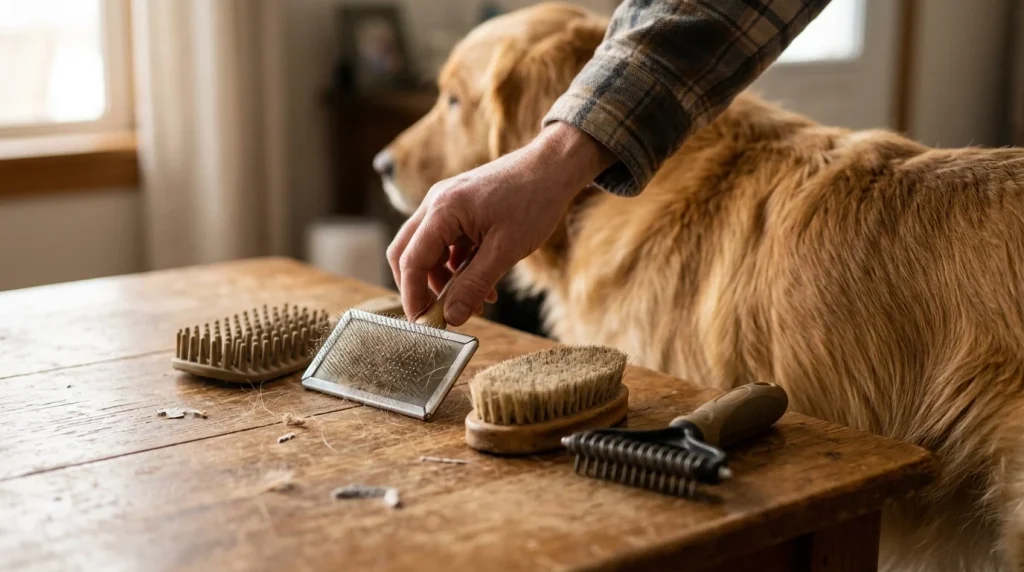
A dog brush is a grooming tool used to work through a dog’s coat and help remove loose hair, dirt, debris, or tangles. Its design can vary widely because dogs have very different coat lengths, textures, and layers.
Some brushes have soft bristles, while others use rubber teeth, wire pins, or long metal teeth. Each design interacts with the coat differently.
In practical terms, the brush you choose should match the job in front of you.
- Short, smooth coats: Usually need gentle surface contact to lift loose hair and dirt.
- Long coats: Often need a tool that can separate hair and reach developing tangles.
- Curly coats: Usually require regular brushing that reaches through dense curls before mats tighten.
- Double coats: May need tools that can deal with loose undercoat beneath the outer guard hairs.
- Wire or textured coats: Can require a different combination of grooming tools depending on the breed and maintenance routine.
The American Kennel Club recommends choosing grooming tools according to coat type and explains that brushing can remove dirt and dead hair while giving owners an opportunity to check the skin and coat. :chatgpt-content-reference{index=”1″}
Why do dogs need to be brushed?
Brushing helps keep the coat manageable, but the exact benefits depend on the dog. A short-coated dog and a long-haired dog won’t get the same results from the same grooming session.
For many dogs, regular brushing removes hair that has already loosened from the coat. That can make shedding easier to manage around the home.
- Loose-hair control: Brushing collects hair that is ready to shed.
- Cleaner coat: It can remove dirt and small debris caught in the fur.
- Tangle prevention: Regular grooming helps find small knots before they become larger mats.
- Skin inspection: Moving through the coat gives you a chance to notice cuts, sore spots, parasites, or irritation.
- Coat maintenance: The right tool helps keep hair separated and easier to manage.
The ASPCA also notes that regular brushing and grooming can remove dirt and help distribute natural oils through the coat while providing an opportunity to check for fleas and flea dirt. :chatgpt-content-reference{index=”2″}
I think of brushing as routine coat maintenance rather than a battle against every single loose hair. You don’t need to keep brushing forever just because a shedding dog still has more hair to lose.
What are the main types of dog brushes?
The main dog brush types differ in their bristles, pins, teeth, and intended purpose. Understanding those differences matters more than simply buying the most popular-looking brush.
Slicker brushes
A slicker brush usually has a flat or curved head covered with fine wire pins. It is commonly used to separate the coat, collect loose hair, and work through light tangling.
Slickers are often useful for medium, long, curly, wire, or dense coats. They should be used with light pressure because pushing fine pins hard against the skin can cause discomfort. :chatgpt-content-reference{index=”3″}
Bristle brushes
Bristle brushes use natural or synthetic bristles rather than long wire pins. They are commonly useful for shorter coats and for smoothing the surface of a coat.
Shorter, denser bristles and longer, more widely spaced bristles can serve different coat textures. A bristle brush generally does not perform the same deep coat work as a slicker or undercoat tool.
Pin brushes
Pin brushes resemble traditional hairbrushes and use longer, spaced pins. They are often used on longer, flowing, or feathered coats.
A pin brush can help separate hair and remove surface debris without compressing a long coat as heavily as some other tools. It may also be used as part of a broader grooming routine rather than as the only tool.
Rubber brushes and grooming mitts
Rubber brushes have flexible rubber teeth or nubs that make gentle contact with the coat. They are especially common for short, smooth coats.
These tools can help loosen dead hair and dirt without needing to penetrate deeply through thick fur. Rubber grooming tools are also available as mitts that fit over the hand. :chatgpt-content-reference{index=”4″}
Undercoat rakes
An undercoat rake uses longer teeth designed to reach through the outer coat toward loose undercoat. It is primarily associated with dense and double-coated dogs.
Pin length and spacing matter, so the tool should suit the coat rather than being dragged aggressively through it. The goal is to remove loose coat, not scrape the skin.
Which dog brush is right for each coat type?
 Save
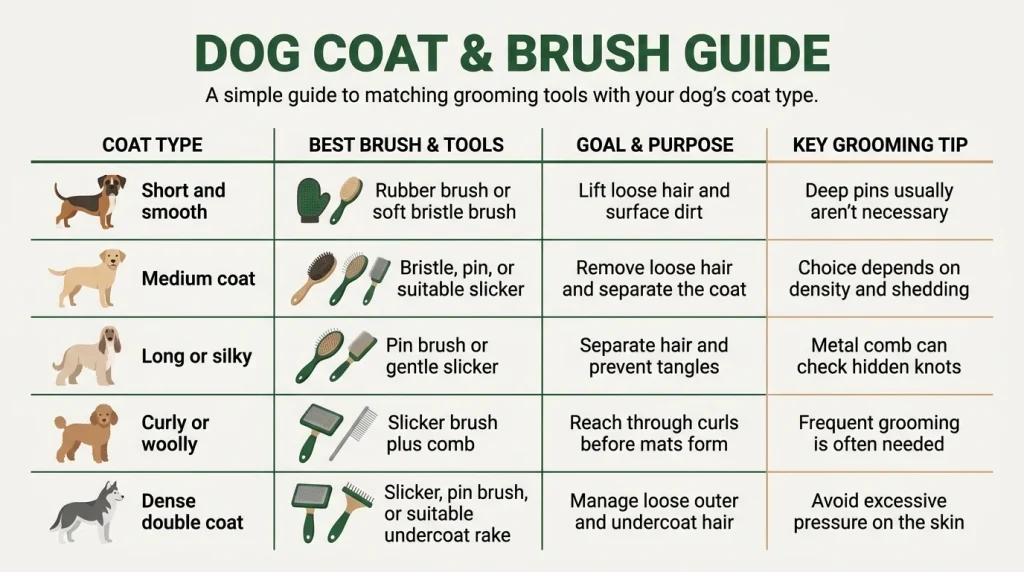
The best dog brush depends more on coat characteristics than on the dog’s size alone. Breed can offer useful clues, but looking at the actual coat is usually the better starting point.
| Coat type | Useful starting tool | Main purpose | Extra consideration |
|---|---|---|---|
| Short and smooth | Rubber brush or soft bristle brush | Lift loose hair and surface dirt | Deep pins usually aren’t necessary |
| Medium coat | Bristle, pin, or suitable slicker | Remove loose hair and separate the coat | Tool choice depends on density and shedding |
| Long or silky | Pin brush or gentle slicker | Separate hair and prevent tangles | A metal comb can check for hidden knots |
| Curly or woolly | Slicker brush plus comb | Reach through curls before mats form | Frequent grooming is often needed |
| Dense double coat | Slicker, pin brush, or suitable undercoat rake | Manage loose outer and undercoat hair | Avoid excessive pressure on the skin |
This table is a starting point, not a substitute for looking at your individual dog’s coat. Two dogs of the same breed can still have different coat density and grooming needs.
For a broader routine, you can also see our guide on how often to brush a dog by coat type.
How does a dog brush work?
A dog brush works by moving its bristles, pins, teeth, or rubber nubs through or across the coat. As it moves, the tool catches loose hair, separates strands, or lifts debris depending on its design.
The important part is matching how deeply the tool reaches with how deeply it needs to work.
- Surface tools: Rubber and soft bristle brushes mostly work across shorter coats.
- Pin tools: Pin brushes and slickers can move farther through longer or denser hair.
- Undercoat tools: Longer teeth can reach beneath the outer layer to manage loose undercoat.
- Combs: These provide a narrower, more precise check for tangles and packed areas.
That is why one brush isn’t automatically better than another. A brush can be excellent for one job and completely unsuitable for the next.
Do all dogs need the same kind of brush?
No. Dogs do not all need the same brush because their coats differ in length, density, texture, and shedding pattern.
A rubber brush that feels comfortable on a Boxer may do very little for a Poodle’s dense curls. A long-pin tool designed for a thick-coated dog may also be unnecessary for a smooth-coated breed.
This is one reason many owners eventually keep more than one grooming tool. Each tool can handle a different part of the routine.
For example, a long-coated dog may benefit from a brush for broad grooming and a comb for checking deeper tangles. Our guide explaining why a dog brush and comb work well together covers that two-tool approach in more detail.
How should you use a dog brush safely?
 Save
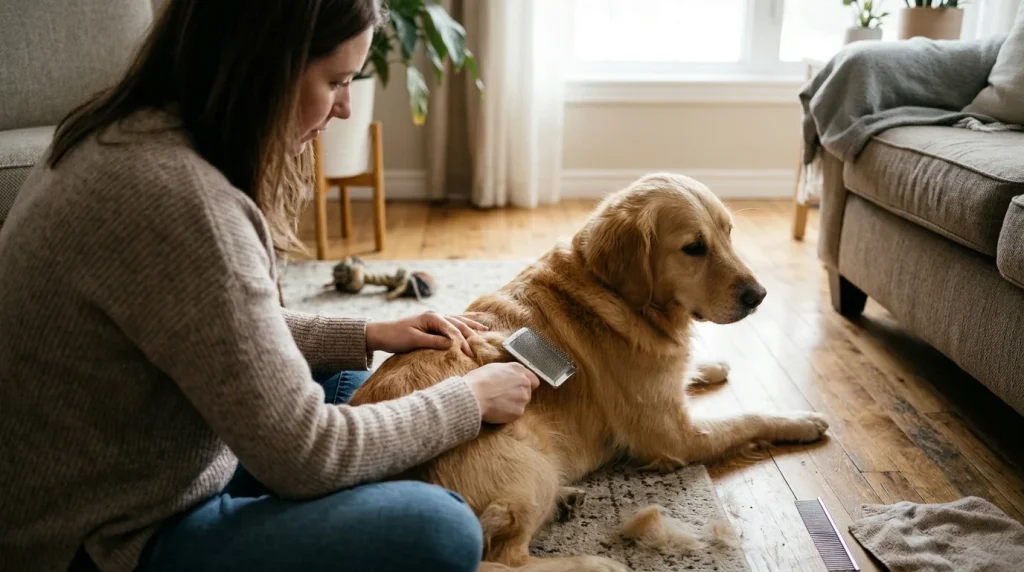
The safest brushing technique is gentle, controlled, and adjusted to the coat. Brushing harder does not make a grooming tool more effective.
Start with an area where your dog is comfortable and check the coat before trying to work through a difficult section.
- Inspect first: Look for burrs, mats, redness, cuts, or tender areas.
- Choose the right tool: Match the brush to the coat and the grooming job.
- Use light pressure: Let the pins or bristles move through the hair without pressing into the skin.
- Work in sections: Smaller sections reduce pulling and make tangles easier to find.
- Stop at resistance: Don’t keep pulling harder when the brush catches.
- Watch your dog: Flinching, repeated pulling away, or growing tension can signal discomfort.
The AKC advises working gently through the coat and checking for mats, debris, cuts, and other abnormalities during grooming. :chatgpt-content-reference{index=”5″}
If your dog repeatedly reacts badly to brushing, don’t assume the dog is simply being difficult. Check the tool, your pressure, the coat, and the skin.
You can also learn the warning signs in our article on how to tell if a brush is causing discomfort.
How often should you brush a dog?
There is no single schedule for every dog. Brushing frequency should follow the coat’s tendency to shed, tangle, or collect debris.
As of 2026, the basic rule remains straightforward: coats that mat easily generally need more frequent attention than short coats that stay smooth between sessions.
- Smooth short coats: Often need occasional or weekly brushing.
- Medium shedding coats: May benefit from several sessions each week during heavier shedding.
- Long coats: Often need frequent brushing to catch tangles early.
- Curly coats: Usually need regular brushing and checking because loose hairs can become trapped.
- Double coats: May need increased grooming when seasonal undercoat shedding becomes heavy.
VCA Animal Hospitals notes that long, silky, or curly coats can require daily brushing, while short-haired coats generally need less frequent grooming. :chatgpt-content-reference{index=”6″}
Can you use a dog brush too much?
Yes. A useful brush can still cause irritation when used too aggressively, with excessive pressure, or repeatedly over the same sensitive area.
More brushing is not always better, especially when the coat is already clean and free of loose hair or tangles.
Watch for redness, scratching after grooming, flinching, or repeated attempts to move away. If those signs appear, stop and reassess the tool and technique.
What should you look for when buying a dog brush?
Start with your dog’s coat rather than the packaging. The most expensive brush isn’t automatically the best choice.
- Coat compatibility: Check whether the tool suits short, long, curly, dense, or double coats.
- Pin or bristle design: The length, spacing, and stiffness should suit the grooming job.
- Brush size: A large brush may be awkward on a small dog, while a tiny head makes large coats slow to groom.
- Comfortable handle: A secure grip makes controlled, gentle strokes easier.
- Easy cleaning: Hair should be reasonably easy to remove after each session.
The AKC specifically lists brush size, ergonomic grip, and self-cleaning features among the factors owners may consider after choosing the correct brush type. :chatgpt-content-reference{index=”7″}
My own buying rule is simple: buy the tool for the coat you actually have, not the one that promises to solve every grooming problem.
Recommended dog brushes for different needs
If you’re ready to choose a brush, start with the tool category that fits your dog’s coat. These are practical search starting points rather than a claim that one model is perfect for every dog.
🏆 BEST FOR MANY LONG COATS
Self-Cleaning Slicker Brush
★★★★☆
Fine pins can help collect loose hair and separate many medium, long, curly, or dense coats. I like self-cleaning designs for convenience, but the pin length and pressure still need to suit the dog.
💰 BEST FOR SHORT COATS
Rubber Dog Grooming Brush
★★★★☆
Flexible rubber teeth provide gentle surface contact and can help loosen dead hair from smooth coats. This is the type of tool I’d consider first when deep pin penetration isn’t necessary.
🚛 BEST FOR DENSE UNDERCOATS
Dog Undercoat Rake
★★★★☆
Longer teeth are designed to reach loose undercoat beneath a thicker outer layer. I would choose the tooth length carefully and use it gently rather than treating it like a scraping tool.
Frequently asked questions about dog brushes
Is a dog brush different from a regular hairbrush?
Usually, yes. Dog brushes are designed around different coat lengths, densities, and grooming needs, with options such as slickers, rubber brushes, bristle brushes, pin brushes, and undercoat rakes. A human hairbrush may not reach or handle a dog’s coat appropriately.
What is the best dog brush for shedding?
The best choice depends on the coat. Rubber or bristle brushes can work well for short coats, while dense double coats may need a suitable slicker or undercoat tool. Choose the tool based on where the loose hair sits within the coat.
Can I brush my dog every day?
Some dogs benefit from daily brushing, especially long, curly, or easily tangled coats. Short smooth coats may need much less frequent grooming. Daily brushing should remain gentle, and repeated aggressive brushing can irritate the skin.
Should I brush my dog before or after bathing?
It is often helpful to remove loose hair and obvious tangles before bathing. After the coat is completely dry, another gentle brushing or comb-through can help separate the hair and reveal tangles that still need attention.
What should I do if the brush keeps catching in my dog’s fur?
Stop pulling harder. Work on the tangled area in smaller sections, use a tool appropriate for the coat, and avoid forcing a brush or comb through tight resistance. Dense mats close to the skin may require help from an experienced groomer or veterinarian.
The bottom line: a dog brush is a coat-care tool, not a one-size-fits-all product
A dog brush is simply a grooming tool, but choosing the right one can make a major difference in how useful and comfortable grooming feels. Slickers, bristle brushes, pin brushes, rubber tools, and undercoat rakes each perform different jobs.
Start with your dog’s coat type, use gentle pressure, and pay attention to how the dog responds. Once you match the tool to the coat, regular brushing becomes much easier to understand.
If you’re still building your grooming routine, don’t assume you need every brush available. Begin with one suitable primary brush, then add another tool only when it solves a different grooming problem.

Thomas Cutter is a lifelong dog owner and the founder of FindOutAboutDogs.com. With over 10 years of hands-on experience owning multiple breeds, Thomas created this site to provide honest, research-based dog advice that real owners can actually trust.
