What Makes an Ergonomic Dog Brush? The Complete Guide for Pain-Free Grooming
Quick Answer
An ergonomic dog brush combines a neutral-wrist head angle, a contoured non-slip grip, and a balanced lightweight body to reduce hand fatigue and prevent workplace musculoskeletal strain during grooming. Instead of forcing your wrist to bend awkwardly, the tool’s geometry does the heavy pulling through thick undercoats.
Core Features of a True Ergonomic Brush:
- Angled brush head: Set between 15 and 45 degrees so your wrist stays straight while pins contact the coat.
- Contoured elastomer grip: Textured rubber or silicone handles with thumb rests prevent pinching and slipping.
- Optimal handle diameter: A 1.25-to-1.5-inch grip width keeps your fingers from cramping around a thin rod.
- Flexible pin cushion: Air-cushioned pads absorb excess downward pressure to protect both your joints and your dog’s skin.
- Balanced weight distribution: A total weight under 6 ounces prevents forearm exhaustion during long sessions.
Quick Buying Tip:
- Hold the brush at your side; if you must bend your wrist downward like pouring a pitcher just to lay the bristles flat against your dog, put it back on the shelf.
After grooming my two heavy-shedding Golden Retrievers for over a decade, my right wrist started clicking every time I picked up a standard slicker brush. Most pet store brushes slap a cheap rubber sleeve over a flat plastic stick and call it “ergonomic,” leaving you with a cramped thumb after ten minutes.
I spent the last year testing dozens of professional grooming tools to see what separates marketing fluff from genuine joint relief. Below, I break down the exact biomechanics, handle dimensions, and bristle engineering that protect your hands while keeping your dog’s coat mat-free.


What Is an Ergonomic Dog Brush?
An ergonomic dog brush is a specialized grooming tool engineered to keep the human hand, wrist, and forearm in a neutral anatomical alignment while minimizing pinch force and repetitive impact. It shifts the mechanical workload from your small finger tendons to your larger arm muscles.
Standard brushes force you into a painful posture called *ulnar deviation*. That means bending your wrist sideways toward your pinky finger with every single stroke.
Multiply that motion by 500 strokes during spring shedding season, and you invite tendonitis. A true ergonomic tool changes the tool’s shape so your body doesn’t have to contort.
- Neutral wrist posture: The handle and head meet at an angle that keeps your forearm bones aligned with your knuckles.
- Reduced pinch force: Tacky, thicker handle materials let you hold the brush loosely without dropping it when hitting a snag.
- Shock absorption: Springy pins and vented air pads soak up the jarring impact of hitting dense mats.
How Does Handle Geometry Prevent Grooming Hand Fatigue?
 Save
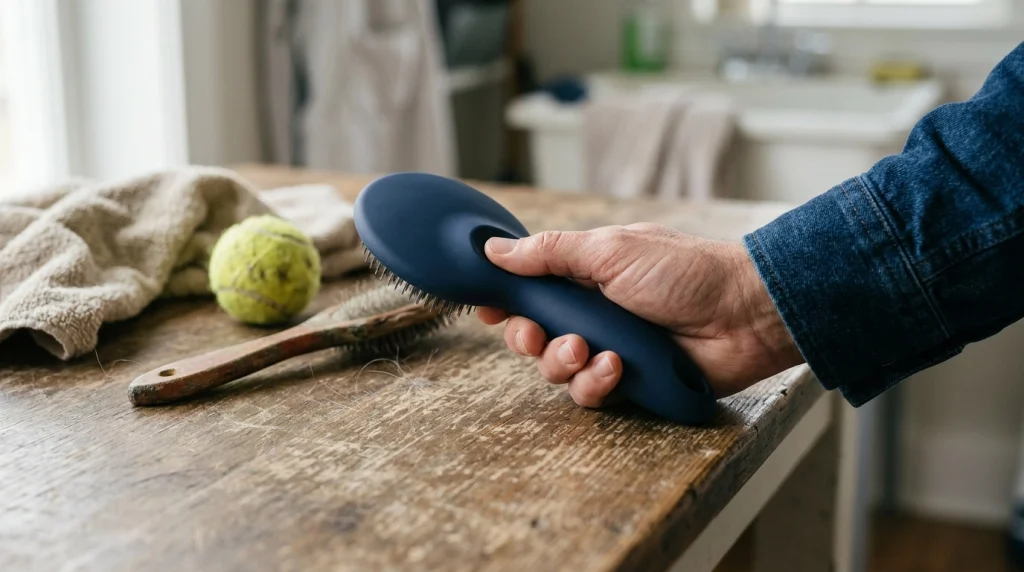
Handle geometry prevents hand fatigue by maximizing surface contact across your entire palm and eliminating high-pressure pinch points on your thumb and index finger. When a handle fits the natural curve of your palm, you need up to 40% less grip strength to pull bristles through a thick coat.
Think about holding a thin wooden pencil tightly for an hour versus holding a tennis ball. The thin pencil makes your hand cramp fast.
Cheap dog brushes have pencil-thin handles. Professional brushes use palm-swelling curves that distribute pulling forces evenly across all five fingers.
What Is the Ideal Handle Diameter and Shape?
The ideal handle diameter for an adult hand is between 1.25 and 1.5 inches (32 to 38 millimeters) at the widest palm swell. A slightly oval cross-section stops the brush from twisting in your grip when you hit a stubborn tangle.
Round handles spin easily when wet or covered in coat conditioner sprays. Oval or hexagonal profiles lock naturally against your finger joints.
- Small hands (glove size S): Look for a 1.15-to-1.25-inch diameter with a tapered neck.
- Medium to large hands (glove size M–XL): Choose a 1.35-to-1.5-inch diameter to keep your fingernails from digging into your palm.
- Palm-fitted frameless brushes: Great for owners with severe arthritis, as a back-of-hand strap removes the need to curl your fingers at all.
Why Do Thumb Rests and Materials Matter?
Recessed, textured thumb rests give you a mechanical lever to guide the brush head without squeezing the handle tightly. Combined with high-friction *thermoplastic elastomers* (TPE) or medical-grade silicone, your hand stays relaxed even when grooming a damp coat.
Hard ABS plastic becomes slick the moment natural oils from your dog’s fur transfer to your fingers. Once the handle gets slippery, you subconsciously squeeze twice as hard.
I always check for dual-density handles during my tests. They use a rigid polypropylene core for strength wrapped in a soft, squishy silicone outer layer that cushions bony knuckles.
Why Is the Brush Head Angle the Secret to Wrist Relief?
 Save
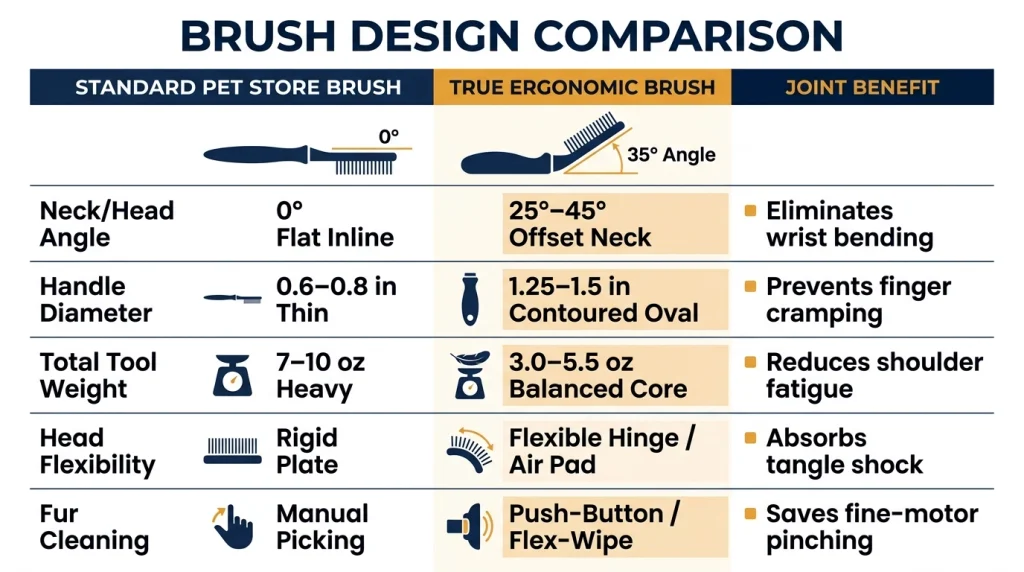
The brush head angle is the secret to wrist relief because an offset head between 20 and 45 degrees allows the pins to sit flush against your dog’s body while your wrist stays completely straight. Without an angled neck, you must bend your wrist downward on every downward stroke.
Professional groomers call a straight-handled brush a “wrist breaker.” According to the Occupational Safety and Health Administration (OSHA), repetitive forceful motion while the wrist is bent is a primary driver of carpal tunnel syndrome.
When I switched from a flat bamboo slicker to a 35-degree curved head, my forearm soreness vanished within a week. The curve lets you pull using your shoulder and bicep rather than flicking your wrist.
| Ergonomic Feature | Standard Pet Store Brush | True Ergonomic Brush | Joint Benefit |
|---|---|---|---|
| Neck/Head Angle | 0° (Flat inline handle) | 25° to 45° offset neck | Eliminates wrist bending (ulnar deviation) |
| Handle Diameter | 0.6–0.8 in (Thin plastic/wood) | 1.25–1.5 in contoured oval | Prevents finger cramping and trigger finger |
| Total Tool Weight | 7–10 oz (Heavy metal heads) | 3.0–5.5 oz (Hollow/balanced core) | Reduces shoulder and elbow fatigue |
| Head Flexibility | Rigid metal or hard plastic plate | Flexible hinge or air-vented pad | Absorbs shock when hitting dense tangles |
| Fur Cleaning Method | Manual picking with fingers/comb | Retractable push-button or flex-wipe | Saves repetitive fine-motor pinching |
How Do Bristle and Cushion Mechanics Reduce Pulling Force?
Bristle and cushion mechanics reduce pulling force by allowing individual pins to flex backward and release smoothly when encountering a knot rather than coming to a dead stop. Less drag in the coat translates directly to less tension on your elbow and shoulder joints.
Many owners think ergonomics stops at the handle. That’s a huge mistake.
If the bristles act like a rigid garden rake, your arm absorbs a violent tug every time you hit a tangle behind your dog’s ears. You want the brush head to act like suspension on a mountain bike.
- Flexible dual-sided heads: Brushes like the Les Poochs or ActiVet style use a flexible central urethane spine that bends up to 90 degrees if you press too hard.
- Angled wire pins: Stainless steel pins bent at a 135-degree angle glide over skin and lift dead undercoat out with minimal downward pressure.
- Vented air cushions: Look for a tiny pinhole at the bottom of the rubber pad; it lets air escape so the cushion compresses softly on bony areas like hips and hocks.
- Pin spacing: Wide-spaced pins reduce drag on thick double coats, while dense pins work better for finishing short coats.
Keeping the skin safe is just as important as saving your hands. Veterinary experts at the American Veterinary Medical Association (AVMA) emphasize that gentle, regular coat maintenance prevents painful skin infections caused by tight matting and brush burn.
Does Brush Weight and Balance Affect Long Grooming Sessions?
Brush weight and center-of-gravity balance directly dictate how quickly your forearm muscles fatigue during a 30-minute brushing session. As of 2026, top ergonomic grooming tools weigh between 3.2 and 5.5 ounces and place their balance point right where your index finger wraps around the neck.
Pick up a heavy deshedding rake with a solid steel head, and it feels fine for two minutes. By minute fifteen, that top-heavy pendulum pulls your wrist downward on every lift.
I weigh every brush on a digital kitchen scale before using it on my dogs. Anything over 6.5 ounces stays out of my regular rotation unless I’m tackling a quick two-minute spot check.
Pro Balance Test: Rest the neck of the dog brush across your extended index finger right where the handle meets the head. If the brush head tips forward and crashes onto the table, it’s too top-heavy and will strain your wrist tendons over time.
Are Self-Cleaning Dog Brushes Actually More Ergonomic?
Self-cleaning dog brushes are more ergonomic for casual pet owners with finger arthritis because a thumb-activated button pushes trapped hair off the pins in one motion. However, the internal spring mechanism adds bulk and weight that can tire out users during hour-long grooming sessions.
Pulling compacted hair out of sharp wire bristles requires a tight “pincer grasp” between your thumb and forefinger. According to physical therapy guidelines from the Arthritis Foundation, repetitive tight pinching is one of the fastest ways to trigger base-of-thumb joint flares.
Still, self-cleaning brushes have a mechanical trade-off. The hollow plastic housing needed for the retractable plate makes the brush head thick and inflexible.
- Choose a push-button self-cleaning brush if: You have osteoarthritis in your fingers, groom for less than 15 minutes at a time, and hate picking fur out of bristles.
- Choose a lightweight fixed-head slicker if: You have wrist or elbow pain, groom heavy double coats for 30+ minutes, and use a metal greyhound comb to swipe hair out of the brush effortlessly.
What Makes a Dog Brush Ergonomic for the Dog?
Ergonomics is a two-way street: a brush that hurts your dog causes them to squirm and pull away, which forces you to wrestle them and strain your back. A pet-ergonomic brush uses polished pin tips, contoured head shapes, and flexible bodies that hug canine ribcages and leg joints without scratching.
Never buy a wire slicker with sharp, unpolished cut ends. Run the brush briskly across the inside of your own bare forearm before touching your dog.
If it leaves red scratch marks on your skin, it will hurt your dog. Check out guidelines from the American Kennel Club (AKC) on matching bristle stiffness to your dog’s specific coat type so you never use harsh tools on sensitive skin.
- Curved backplates: Concave brush heads match the round curve of a dog’s torso so outer pins don’t gouge the skin.
- Polished stainless tips: High-end brushes round off the microscopic burrs on steel pins without using plastic balls (which often snag and rip thick undercoats).
- Flexible hinges: Double-hinged heads bend backward when rolling over hip bones and shoulder blades.
How to Hold an Ergonomic Dog Brush for Zero Wrist Strain
 Save
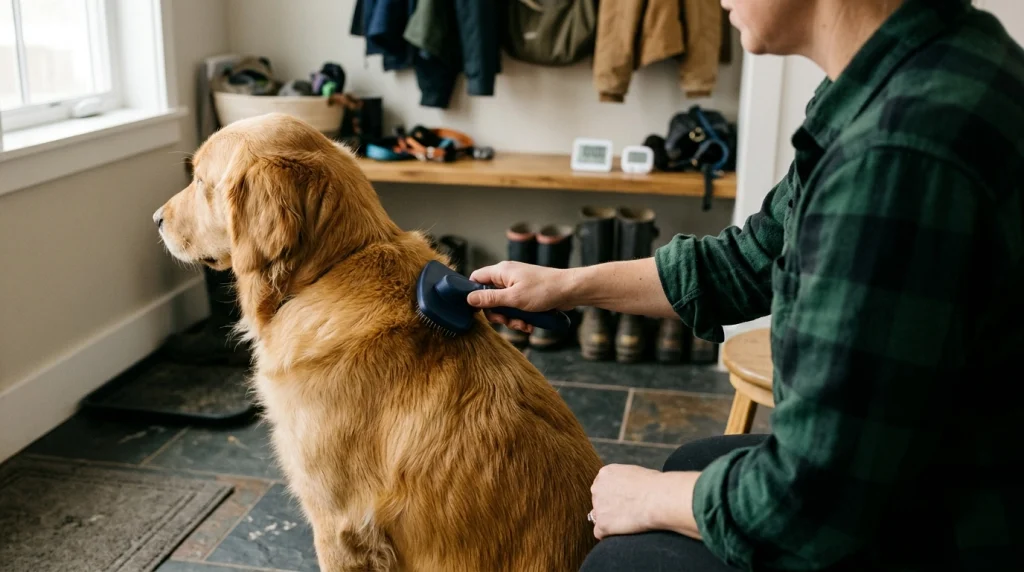
Even the best ergonomic brush will hurt your hand if you grip it like a hammer. Follow these four steps to lock in pain-free grooming mechanics:
- Use a loose handshake grip: Wrap your fingers lightly around the handle at a 30% squeeze effort—tight enough to control it, loose enough that someone could slide it out of your hand.
- Lock your wrist straight: Keep the back of your hand aligned flat with your forearm, and generate movement from your elbow and shoulder like you’re painting a broad fence.
- Let the pin angle do the work: Lay the brush flat against the coat and pull backward along the grain without pressing down hard into the skin.
- Take a micro-break every 10 minutes: Set the brush down, open your fingers wide for five seconds, and shake out your arms to restore blood flow.
Best Ergonomic Dog Brushes Worth Buying
If you’re ready to upgrade your grooming kit and give your joints a break, here are the three most comfortable brushes I’ve tested across different coat types and hand needs:
🏆 BEST OVERALL FOR WRIST RELIEF
Chris Christensen Big G Slicker Brush
★★★★★
Features an extra-long, contoured GroomGrip rubberized handle, a deeply angled 40-degree neck, and a plush air cushion with dense bent pins. This is my personal daily driver for heavy double coats because the steep head angle keeps my wrist 100% straight and halves my brushing time.
🧤 BEST FOR ARTHRITIS & WEAK GRIP
Kong ZoomGroom Rubber Curry Brush
★★★★☆
A handleless, palm-sized natural rubber block weighing under 3 ounces with 3/4-inch flexible rubber fingers. I recommend this to anyone with finger osteoarthritis on short-haired dogs because the wide dimpled sides sit comfortably in a relaxed palm without requiring a tight pinch.
🔄 BEST FLEXIBLE SHOCK-ABSORBING
Safari Flexible Slicker Dog Brush
★★★★☆
Built with a dual-sided, hinged flexible pad that contours to your dog’s body and an ergonomic non-slip rubberized handle with thumb ridges. It’s an affordable wrist-saver that absorbs the sudden jolt of hitting a snag, making it ideal for sensitive dogs and sore elbows alike.
Frequently Asked Questions
What is the easiest dog brush to use with arthritis?
The easiest dog brush to use with arthritis is a palm-held strap brush or a thick-handled flexible slicker with a 1.5-inch silicone grip. Strap-style curry brushes slide directly over your knuckles so you don’t have to curl stiff fingers, while flexible slicker heads absorb jarring snags that hurt inflamed joints.
Why does my wrist hurt when brushing my dog?
Your wrist hurts when brushing your dog because straight-handled brushes force your wrist into an unnatural downward bend (ulnar deviation) while you squeeze tightly against coat resistance. Repeating this awkward motion hundreds of times inflames the tendons running through your carpal tunnel. Switching to a 35-degree angled brush fixes this posture immediately.
Are curved slicker brushes better than flat ones?
Yes, curved slicker brushes are significantly better than flat ones for both human ergonomics and coat penetration. The curved backplate matches your dog’s rounded body contours while angling the handle upward, allowing you to pull from your elbow with a straight wrist instead of flicking your wrist downward.
How heavy should an ergonomic dog brush be?
An ergonomic dog brush should weigh between 3 and 5.5 ounces (85 to 155 grams). Anything heavier than 6 ounces creates a pendulum effect that fatigues your forearm extensor muscles during sessions lasting longer than ten minutes, especially when grooming large double-coated breeds.
Upgrade Your Grooming Routine Without the Pain
You shouldn’t have to trade your wrist health for a clean, mat-free dog. By ditching thin, flat plastic handles and switching to a lightweight brush with a 30-to-45-degree angled head and a thick elastomer grip, you can cut your grooming effort in half.
Go grab your current dog brush right now and run the index-finger balance check and the neutral-wrist side test. If your wrist bends or the head tips forward, treat your hands—and your dog—to a properly balanced ergonomic slicker before the next big coat blow hits.

Thomas Cutter is a lifelong dog owner and the founder of FindOutAboutDogs.com. With over 10 years of hands-on experience owning multiple breeds, Thomas created this site to provide honest, research-based dog advice that real owners can actually trust.
