Why Do Poodles Need Regular Brushing? Complete Coat Care Guide
Quick Answer
Poodles need regular brushing because their dense, curly coat can trap loose hair and form tangles close to the skin. Brushing separates the curls, removes loose hair and debris, helps prevent painful mats, and gives you a chance to inspect the skin. The American Kennel Club’s Poodle grooming guidance also stresses building regular brushing habits to help prevent matting.
- Prevents mats: Brushing separates curls before small tangles tighten into dense knots.
- Reaches loose hair: Shed hairs can remain caught inside the curly coat instead of falling away easily.
- Protects skin: Removing tangles reduces pulling and makes it easier to spot redness, bumps, or irritation.
- Keeps curls manageable: Regular coat separation makes bathing, drying, trimming, and professional grooming easier.
- Builds tolerance: Short, calm sessions teach a Poodle that routine handling is normal.
Simple rule
- For a curly Poodle coat, frequent brushing and a final comb-through are safer than waiting until you can see knots.
Poodles may be famous for elegant clips, but coat care starts long before scissors or clippers come out. Their curls make brushing one of the most important parts of everyday grooming.
I look at brushing as preventive maintenance rather than a beauty routine. A five-minute coat check today can catch a small tangle before it becomes a tight mat next week.


Why Do Poodles Need Regular Brushing Even Though They Shed So Little?
Poodles need regular brushing because low visible shedding does not mean the coat stays maintenance-free. Loose hair can remain trapped among dense curls, where it mixes with neighboring hairs and starts forming tangles.
This is the key difference many new owners miss. Less hair on your sofa can mean more loose hair stays inside the coat until brushing removes it.
Definition: Poodle brushing is the process of separating the curly coat from the outer tips toward the skin, removing loose hair and small tangles before they tighten into mats.
- Curly texture: Adjacent hairs easily twist around one another.
- Dense coat: Surface fluff can hide knots deeper down.
- Continuous growth: Longer coat creates more opportunity for friction and tangling.
- Low loose-hair shedding: Hair may remain caught within the coat instead of dropping freely.
The Poodle Club of America breed standard describes the curly coat as naturally harsh in texture and dense throughout. That density is one reason brushing only the visible surface is not enough.
What Happens If You Don’t Brush a Poodle Regularly?
 Save
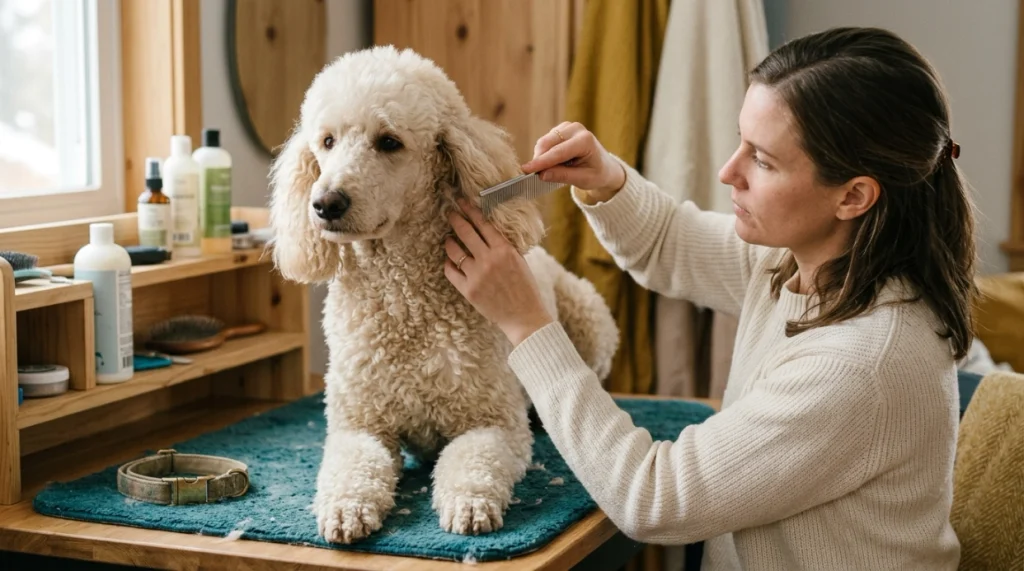
SaveWithout regular brushing, small tangles can tighten and join together. Eventually, they may form mats that pull on the skin and become difficult to remove comfortably.
The highest-risk areas are usually places where hair rubs against hair, harnesses, collars, legs, or body movement. These sections deserve extra attention during every coat check.
- Behind the ears: Soft hair moves constantly and can knot quickly.
- Armpits: Leg movement creates repeated friction.
- Collar area: Collars and harness straps compress the curls.
- Chest: Longer coat can rub while the dog walks or lies down.
- Legs: Fluffy furnishings collect moisture, dirt, and small debris.
- Tail: Longer hair can tangle where sections overlap.
A coat may look smooth from above while hiding tight tangles underneath. That’s why I prefer checking finished sections with a metal comb instead of judging them by appearance alone.
If the comb moves from near the skin through the ends without snagging, the section is usually properly separated. If it stops, I return to the brush rather than forcing the comb through the knot.
Does Brushing Help Keep a Poodle’s Skin Healthy?
Yes. Regular brushing exposes the skin for inspection while removing loose hair, debris, and material trapped inside the coat.
VCA Animal Hospitals’ coat-care guidance notes that regular brushing helps remove loose hair and dead skin cells while keeping coats clearer of dirt and debris. It recommends daily brushing for dogs with curly coats to reduce tangles and matting.
- Red patches: These can signal irritation from friction, moisture, or over-brushing.
- Bumps or scabs: Brushing makes hidden skin changes easier to notice.
- Parasites: Coat inspection may reveal fleas, ticks, or flea dirt.
- Sore areas: A dog that suddenly resists brushing in one spot may need closer inspection.
Brushing should never leave fresh scratches or persistent redness. Gentle technique matters just as much as brushing frequency.
How Often Should You Brush a Poodle?
 Save
SaveDaily brushing is the simplest safe default for a Poodle with enough coat length to curl and tangle. A very short pet clip may need less total brushing time, but friction-prone areas should still be checked frequently.
Coat length changes the workload. Longer ears, legs, topknots, and tails usually need more careful section-by-section brushing than a short sporting-style pet trim.
| Coat situation | Brushing priority | Main areas to check | Best final check |
|---|---|---|---|
| Very short pet clip | Frequent quick checks | Ears, tail, collar area | Steel comb |
| Medium pet coat | Daily is a useful default | Ears, chest, armpits, legs | Comb from skin outward |
| Long or fluffy trim | Daily section-by-section care | Entire body plus furnishings | Full-body comb check |
| After swimming or wet weather | Check as soon as coat is ready | Legs, belly, ears, friction areas | Comb after drying |
As of 2026, veterinary coat-care guidance still places curly-coated dogs among those needing particularly frequent brushing. That makes regular home care important even when a Poodle visits a professional groomer.
Professional appointments do not replace maintenance between visits. They work best when the coat arrives reasonably clean, separated, and free from severe matting.
What Is the Best Way to Brush a Poodle?
The most reliable method is to work in small sections instead of dragging a brush across the surface. Groomers often call this approach line brushing.
You expose a narrow line of coat, brush that section from the ends toward the roots, and then move to the next line. The goal is to reach through the coat gently without repeatedly scraping the skin.
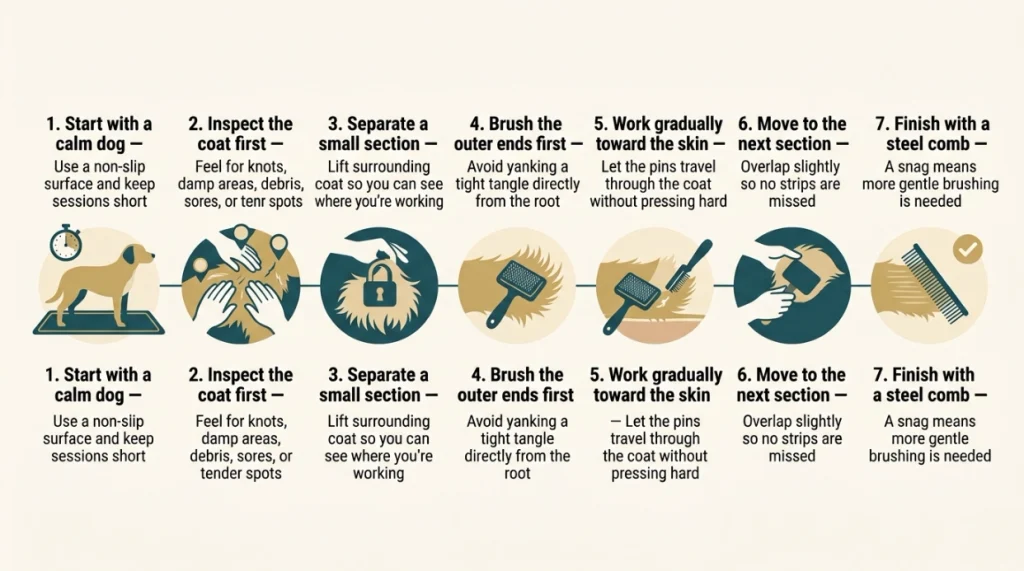
- Start with a calm dog. Use a non-slip surface and keep sessions short while a puppy learns.
- Inspect the coat first. Feel for knots, damp areas, debris, sores, or tender spots.
- Separate a small section. Lift the surrounding coat so you can see where you’re working.
- Brush the outer ends first. Avoid yanking a tight tangle directly from the root.
- Work gradually toward the skin. Let the pins travel through the coat without pressing hard.
- Move to the next section. Overlap slightly so you do not leave untouched strips.
- Finish with a steel comb. A snag tells you that more gentle brushing is needed.
I treat the comb as quality control, not as the main detangling tool. That one habit makes it much harder to accidentally leave hidden knots beneath a fluffy surface.
Should You Brush a Poodle Before or After a Bath?
Remove noticeable tangles before bathing whenever possible. Water and drying can make existing tangles more difficult to work through.
After the bath, careful drying and coat separation help restore the fluffy finish. Never leave a damp, tangled Poodle coat packed tightly against the skin.
Which Brush Works Best for a Poodle Coat?
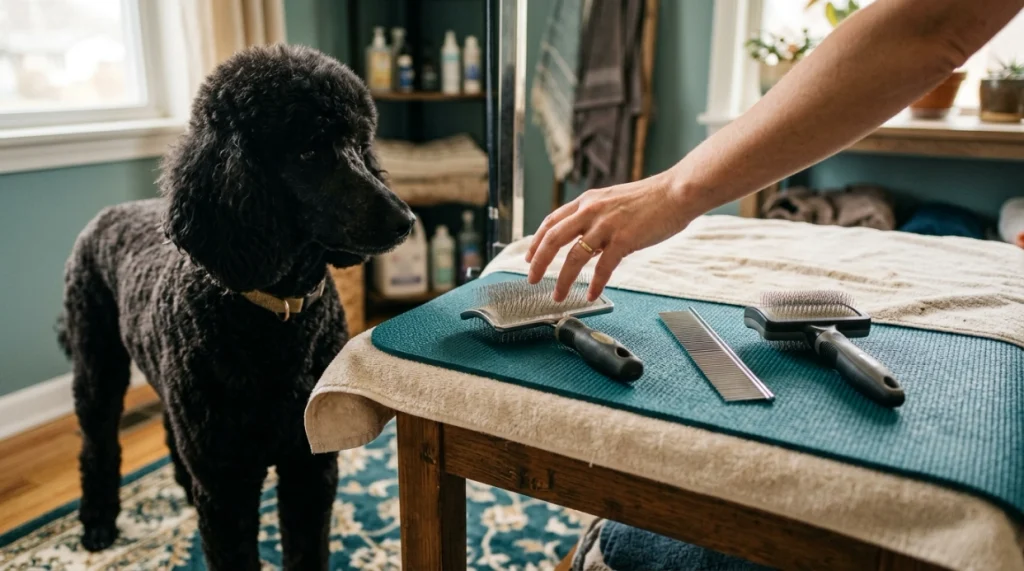
A quality slicker brush plus a metal comb covers most routine Poodle coat care. The slicker separates and detangles, while the comb checks whether the coat is truly clear near the skin.
Pin length and brush size matter. A small Toy Poodle’s face needs a different head size than the body of a Standard Poodle in a long trim.
| Tool | Main job | Best use | Common mistake |
|---|---|---|---|
| Long-pin slicker | Separates curls and small tangles | Body, legs, longer coat | Pressing too hard |
| Small slicker | Controlled detail work | Ears, feet, smaller dogs | Overworking one spot |
| Steel comb | Checks for hidden tangles | Final coat inspection | Forcing it through mats |
Can You Brush a Poodle Too Much?
Yes, especially when brushing means repeated hard strokes over the same skin. Frequent gentle brushing is different from aggressive over-brushing.
The goal is coat separation, not maximum hair removal. Stop if the skin becomes noticeably red, sore, scratched, or increasingly sensitive.
- Use light pressure: Long pins should do the reaching instead of your hand forcing them downward.
- Change sections often: Do not scrape one stubborn spot over and over.
- Watch body language: Turning, flinching, sitting suddenly, or trying to leave can signal discomfort.
- Do not fight severe mats: Tight matting may need a professional groomer to remove it safely.
Severe mats can sit close to delicate skin, making home removal risky. Scissors are especially dangerous because stretched skin can be pulled into a mat where you cannot see it clearly.
Does Regular Brushing Make Professional Grooming Easier?
Yes. A regularly brushed coat is easier to wash, dry, inspect, and trim because the hairs are separated instead of packed into knots.
AKC grooming guidance describes bathing and trimming intervals around four to eight weeks for many Poodles, depending on coat length and routine. Home brushing fills the gap between those larger grooming sessions.
- Less hidden matting: The groomer spends less time working through preventable knots.
- More styling options: A mat-free coat can usually support more length than a heavily tangled one.
- Shorter stressful sessions: Routine handling makes brushing, combing, feet, and body contact more familiar.
- Better coat awareness: Owners can tell the groomer about skin changes noticed at home.
If maintaining a long coat becomes unrealistic, choosing a shorter pet trim is reasonable. A manageable haircut is better than keeping extra length that repeatedly develops painful mats.
Common Poodle Brushing Mistakes to Avoid
Most coat problems are not caused by owners ignoring grooming completely. They often come from brushing in a way that leaves the lower coat untouched.
- Surface brushing only: The top looks fluffy while mats remain close to the skin.
- Skipping the comb check: Hidden knots stay unnoticed until they become larger.
- Brushing one huge section: Thick curls prevent the pins from reaching every layer.
- Using too much pressure: Hard strokes irritate skin without improving the result.
- Ignoring friction areas: Ears, armpits, collars, legs, and tails can mat before the back does.
- Waiting for visible mats: By the time a knot is obvious from across the room, it may already be tight.
The best routine is boring in a good way. Small, regular sessions are usually easier on both the dog and the person holding the brush.
Poodle Brushing Tools I Would Consider
 Save
SaveIf you’re ready to build a simple grooming kit, I would focus on one effective slicker and one reliable comb rather than buying a drawer full of similar tools.
🏆 Best for Dense or Longer Coats
Chris Christensen Big G Slicker Brush
★★★★★ 4.8/5
This professional-style slicker uses long, densely arranged pins and a curved head for working through substantial coat. I like this type of brush for medium-to-long Poodle coats where an ordinary shallow slicker struggles to reach beyond the surface.
🔎 Best for the Final Coat Check
Andis 7.5-Inch Steel Pet Comb
★★★★☆ 4.6/5
A steel grooming comb gives you coarse and finer teeth for checking different sections of coat. I consider the comb the most useful checkpoint because it reveals tangles a slicker may have passed over.
💰 Budget-Friendly Starter
Hertzko Self-Cleaning Slicker Brush
★★★★☆ 4.4/5
This consumer-friendly slicker has retractable pins that make collected hair easier to remove after brushing. I would consider it for shorter pet trims or owners starting a home routine before moving to a longer-pin professional brush.
Frequently Asked Questions
Do Poodles need to be brushed every day?
Daily brushing is a useful default for Poodles with medium or long curly coats because tangles can develop beneath the surface. Dogs kept in very short clips may need shorter sessions, but ears, tails, collars, armpits, and other friction areas still need frequent checks.
What happens if a Poodle gets badly matted?
Severe matting can pull continuously on the skin and may hide irritation underneath. When mats are tight or widespread, a professional groomer may recommend clipping them away rather than putting the dog through prolonged and uncomfortable detangling.
Should I use a slicker brush or a comb on my Poodle?
Use both for different jobs. A slicker brush helps separate curls and work through manageable tangles, while a steel comb checks whether the coat is clear from near the skin to the ends.
Can I brush mats out of my Poodle at home?
Small, loose tangles may be manageable with patient brushing, but tight mats should not be repeatedly pulled or cut with scissors. If the mat sits close to the skin, ask a professional groomer or veterinarian about the safest removal method.
Why does my Poodle look brushed but still have knots?
The brush may be moving only across the outer layer. Work in narrow sections and then run a metal comb from near the skin through the ends; any snag shows where more careful brushing is needed.
The Bottom Line
Poodles need regular brushing because their dense curls can hold loose hair and develop hidden tangles close to the skin. Frequent coat separation helps prevent mats, keeps grooming manageable, and lets you notice skin problems sooner.
Keep the routine simple: brush small sections gently, pay extra attention to friction areas, and finish with a metal comb. Consistency matters far more than trying to rescue a neglected coat in one long session.

Thomas Cutter is a lifelong dog owner and the founder of FindOutAboutDogs.com. With over 10 years of hands-on experience owning multiple breeds, Thomas created this site to provide honest, research-based dog advice that real owners can actually trust.
