Why Does Doodle Hair Tangle So Easily? Causes and Fixes
Quick Answer
Doodle hair tangles easily because its curls or waves trap loose strands, while friction, moisture, and surface-only brushing turn small knots into tight mats near the skin. Prevent matting with gentle, section-by-section brushing using the right curly coat brush, followed by a metal-comb check.
Five reasons tangles keep returning
- Trapped loose hairs: Released strands become caught in surrounding curls.
- Coat texture changes: Mixed or changing hair textures catch against one another.
- Everyday rubbing: Harnesses, collars, and movement create high-friction spots.
- Damp tangled hair: Rain and bathing can make existing knots harder to separate.
- Surface-only brushing: A fluffy topcoat can hide knots close to the roots.
Quick check: After brushing, gently pass a steel comb through a small section from near the roots outward. If it snags, stop and investigate rather than pulling.
If your Goldendoodle looks fluffy but feels lumpy underneath, the problem may be hidden tangles rather than dirt. I focus on the coat beneath that fluffy surface, where everyday brushing often misses the trouble.
This guide explains why doodles knot so quickly, how to prevent painful mats, and when to call a groomer. You’ll also see which tools are worth considering.


Why Does Doodle Hair Tangle So Easily?
Doodle hair often combines curl, length, and coat density in ways that hold loose strands against growing hair. Those trapped strands wrap around neighboring hairs and gradually form knots.
A tangle is a loose knot that may separate with gentle grooming. A mat is a tighter, compacted cluster of hair that can pull against the skin.
- Curly or wavy strands: Hair bends back toward neighboring strands instead of hanging straight.
- Retained shedding: Some loose hair stays caught inside the coat, even on low-shedding doodles.
- Longer coat length: More hair creates more opportunities for strands to overlap and knot.
- Friction: Walking, rolling, sleeping, and equipment repeatedly rub the same areas.
- Moisture and debris: Dampness, burrs, and dirt make neglected tangles harder to manage.
- Incomplete brushing: A brush may smooth the outer coat without separating hair near the roots.
Low shedding does not mean low maintenance. In fact, less loose hair on the couch can mean more loose hair to remove from the coat.
Does every doodle have the same coat?
No. Goldendoodles, Labradoodles, Bernedoodles, and other poodle mixes can have straighter, wavy, or tightly curled coats.
Two dogs from the same litter may need different grooming routines. I would choose brushing frequency by how quickly each coat knots, not by the breed label alone.
- Straighter coats: May release loose hair more readily but can still knot in longer areas.
- Wavy fleece coats: Often look smooth while developing tangles below the surface.
- Dense curly coats: Can hold loose strands deeply and require meticulous section brushing.
Where Does Doodle Fur Get Matted First?
 Save
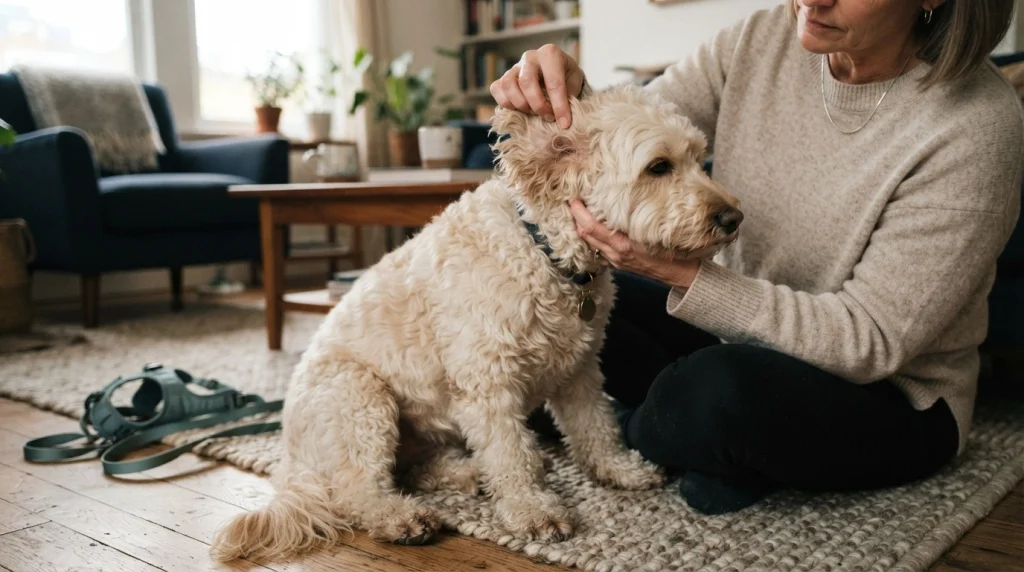
SaveMats usually begin where hair rubs against hair, skin, or grooming equipment. Check these places before you spend time fluffing the back and sides.
| High-risk area | Why it tangles | What to check |
|---|---|---|
| Behind ears | Scratching and head movement | Tiny knots beneath ear hair |
| Armpits and inner legs | Constant movement and contact | Hidden tightness near skin folds |
| Collar and harness line | Repeated strap friction | Compacted hair around neck and chest |
| Tail and hindquarters | Sitting, movement, and moisture | Knots at the tail base and rear legs |
| Feet and between toes | Outdoor debris and dampness | Small packed clumps and irritation |
My favorite practical check is to inspect the harness line immediately after a walk. A quick look there can catch a developing knot before it becomes uncomfortable.
The VCA grooming guidance recommends regular inspection of these hidden areas. It also explains why curly coats often need daily attention.
Why Does Doodle Hair Tangle More After a Bath?
Water does not remove mats. Wet hair can cling together, and existing tangles may tighten as a coat dries.
Rubbing a towel back and forth adds friction, while air-drying a dense coat can leave damp patches underneath. The American Kennel Club’s drying guide explains why thorough drying matters.
- Before bathing: Check the entire coat and gently clear manageable tangles.
- During bathing: Use dog-safe products and avoid scrubbing tangled sections aggressively.
- After rinsing: Blot with a towel instead of rubbing the curls into knots.
- While drying: Use safe, comfortable airflow and follow the coat’s direction.
- After drying: Recheck with a comb, particularly under the chest and behind the ears.
If the coat is already tightly matted, ask a groomer for advice before bathing. Shampoo cannot loosen a painful mat safely.
How Do You Brush a Doodle Without Creating More Tangles?
The key is line brushing, which means parting the coat into narrow layers and brushing each layer gently. This reaches hidden loose hair instead of polishing only the surface.
For a visual explanation of the technique, see this curly dog brushing guide. Here is the basic routine I recommend.
Step 1: Check the skin and identify knots
Run your hands gently across the coat before using a tool. Look for hard lumps, red skin, scabs, or an area your dog dislikes having touched.
Step 2: Set up the right tools
Keep a suitable slicker brush, stainless-steel comb, and small treats nearby. A dog-safe detangling spray may help with minor dry tangles when used as directed.
Step 3: Part the coat into narrow lines
Lift a layer of hair to reveal a small strip underneath. Work from a lower section upward, making sure you can see where the hair begins.
Step 4: Brush gently from near the roots outward
Use short, controlled strokes and avoid digging metal pins into the skin. Support the hair with your free hand so each stroke does not pull sharply.
Step 5: Follow each brushed section with a comb
Pass the metal comb slowly through the same section without forcing it. If the teeth catch, inspect the spot and work only on a small, loose knot.
Step 6: Finish the friction zones
Check behind the ears, under the collar, the inner legs, and the tail base. Give your dog breaks before grooming becomes frustrating.
- Good sign: The comb moves through comfortably and the skin looks normal.
- Warning sign: Hair pulls tightly or the dog flinches, cries, or repeatedly moves away.
- Stop sign: A mat lies flat against the skin, or the area is raw or painful.
Don’t mistake a glossy topcoat for a fully brushed coat. A relaxed dog and a snag-free comb are more useful measures of success.
How Often Should You Brush Doodle Hair?
Many long or curly doodle coats benefit from daily brushing, but the ideal schedule varies. Coat length, density, activity, and previous matting matter more than a fixed rule.
For a practical 2026 routine, use this starting schedule and adjust it with your groomer’s advice. Each session should include a gentle near-root comb check.
- Long or dense curls: Inspect and line brush daily, especially in friction zones.
- Medium-length wavy coats: Check daily and brush thoroughly every day or two as needed.
- Short, maintained trims: Check daily and brush several times weekly if the comb remains clear.
- After swimming or rain: Check for knots and dry the coat completely.
- During coat transition: Increase brushing when the puppy coat begins changing texture.
I would rather see five calm minutes in a problem area than a hurried full-body sweep. That is especially true when a doodle dislikes grooming.
The PDSA grooming advice also emphasizes gradual handling, suitable tools, and positive rewards. A predictable routine makes future sessions easier.
Why Is My Doodle Suddenly Matting During Puppy Coat Change?
Some doodles start tangling faster as their soft puppy coat changes into adult hair. Old and new textures may overlap, creating more opportunities for knots to form.
This transition does not begin at exactly the same age for every dog. Watch for new tangles, greater coat density, or a change from soft waves to tighter curls.
- Check the roots: New mats may form under fur that still feels silky.
- Increase short sessions: Add grooming time without turning brushing into a struggle.
- Ask for a trim: A manageable coat length can reduce pulling and stress.
If your adult doodle develops sudden coat changes alongside itching, redness, or unusual hair loss, contact your veterinarian. Not every coat problem is ordinary matting.
Can You Remove a Doodle Mat at Home?
 Save
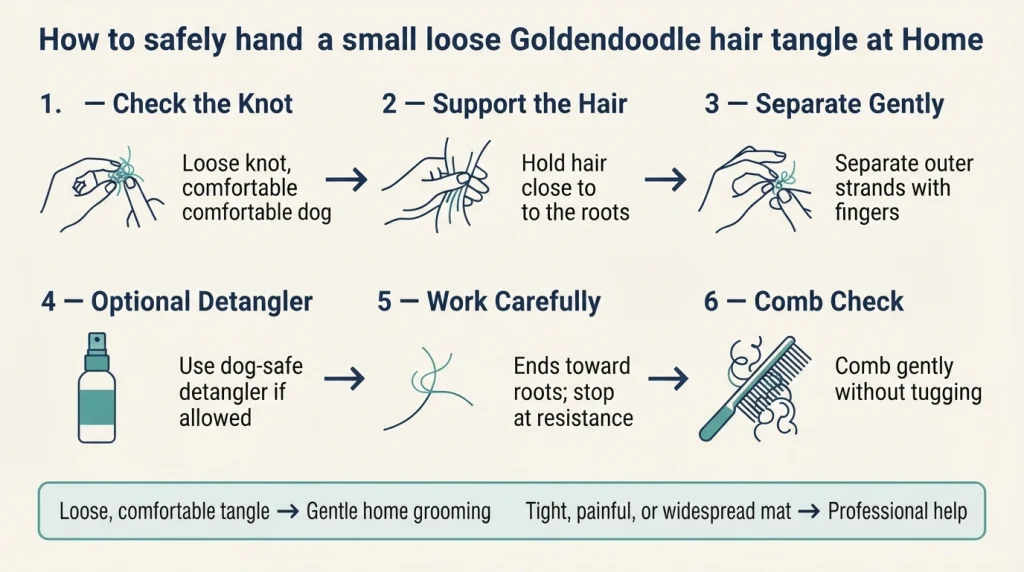
SaveSmall, loose tangles may respond to gentle finger separation and careful brushing. Tight, widespread, or painful mats belong with a professional groomer or veterinarian.
Never cut a mat out with household scissors. Skin can be folded into a tight mat, making accidental cuts surprisingly easy.
Try this only for a small, loose tangle
- Make sure the knot is not tight against the skin and your dog is comfortable.
- Hold the hair close to the roots to reduce pulling.
- Gently separate the outer strands with your fingers.
- Use an appropriate pet detangler if the label allows it.
- Work carefully from the ends toward the roots, stopping at resistance.
- Finish with a gentle comb check, without tugging.
The veterinarian-reviewed PetMD matting guide warns that severe mats can pull the skin and trap debris. Some need professional clipping rather than repeated brushing.
When should a groomer or veterinarian step in?
- Professional groomer: Mats are tight, extensive, close to delicate areas, or resistant to gentle work.
- Veterinarian promptly: Skin is raw, swollen, bleeding, moist, smelly, or painful.
- Veterinary assessment: Sudden widespread tangling comes with skin changes or unexplained hair loss.
A shorter professional clip is sometimes the kindest option. Saving coat length is never worth causing pain.
Which Grooming Mistakes Make Doodle Tangles Worse?
More brushing is not always better when the method is uncomfortable or incomplete. Avoid these common habits before buying another gadget.
- Brushing the surface: Leaves hidden knots beneath an attractive fluffy finish.
- Forcing a comb: Pulls hair and makes future grooming harder.
- Bathing over mats: Can make compacted hair harder to separate afterward.
- Skipping the harness line: Allows friction-related knots to return quickly.
- Waiting until the next haircut: Lets tiny tangles become large ones.
- Choosing the longest trim: Creates maintenance demands the household may not manage.
- Using human products: May irritate skin or be unsuitable for dogs.
A useful tool pairing matters more than collecting brushes. Read this brush versus comb comparison to understand why the two tools have different jobs.
What Grooming Tools Help Prevent Doodle Mats?
 Save
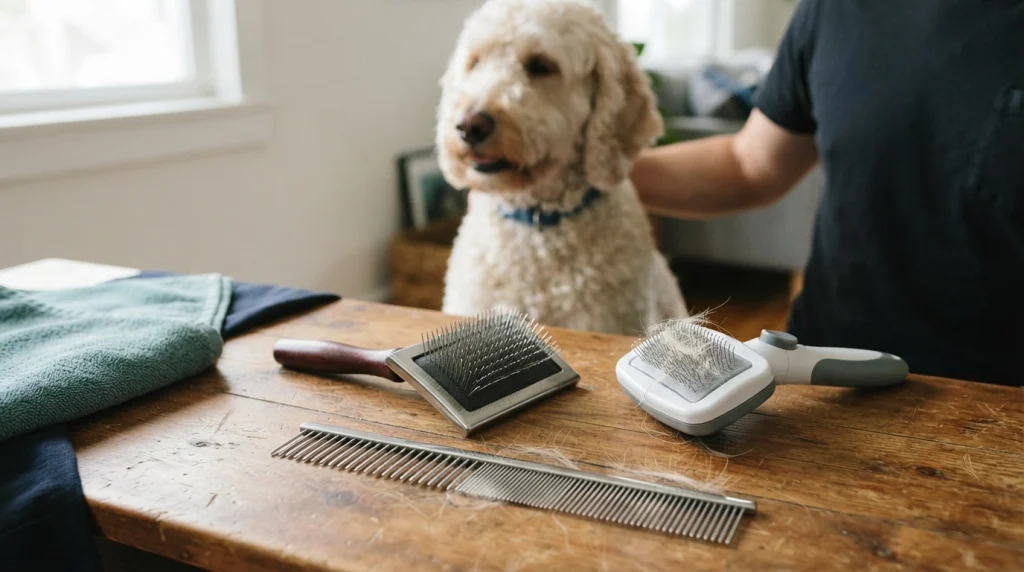
SaveFor most doodles, a slicker brush loosens hair while a steel comb checks for hidden knots. A detangling spray is optional support, not a solution for tight matting.
You can explore more coat-specific options in our Goldendoodle brush roundup. Below are three specific tools I would shortlist according to their published features.
Affiliate disclosure: Qualifying purchases through the Amazon links below may earn a commission. Scores are editorial suitability estimates based on published features, not customer star ratings or hands-on product tests.
🏆 Best for long, dense curls
Chris Christensen Big G Slicker Brush
★★★★½ 4.5/5 editorial fit
Its 27 mm angled pins and flexible cushion are designed for substantial, curly coats. This is my premium feature-based choice for maintaining longer hair, provided you use light pressure and the right head size.
💰 Simple everyday option
Andis Self-Cleaning Slicker Brush
★★★★☆ 4/5 editorial fit
Fine slicker pins target loose hair and light tangles, and the release mechanism makes cleanup straightforward. I would consider it for routine brushing, but check whether its pins reach your dog’s coat depth.
🐾 Essential finishing check
Andis 7½-Inch Steel Comb
★★★★½ 4.5/5 editorial fit
This 7.5-inch comb has coarse and fine tooth spacing for checking the coat after brushing. I regard a steel comb as the clearest way to find spots a slicker missed, not as a tool for dragging through mats.
Frequently Asked Questions
Why does my Goldendoodle mat even though I brush every day?
Daily brushing can miss tangles when the tool moves only over the surface. Part the coat into small layers, brush gently near the roots, and check for snags with a steel comb.
Pay special attention behind the ears and along the harness line.
Should I brush my doodle when the coat is wet or dry?
Routine detangling is usually easier on a dry coat or one lightly misted with a dog-safe conditioning spray. Clear manageable tangles before bathing, then dry the coat thoroughly.
Avoid pulling at wet knots or trying to wash tight mats loose.
Do doodles need brushing every day?
Many long-haired or densely curled doodles benefit from daily attention, especially around friction areas. Shorter coats may need less full-body brushing, but daily checks still help.
Ask your groomer to adjust the schedule to your dog’s coat, haircut, and activity.
Can conditioner prevent doodle mats?
A dog-safe conditioner or detangling spray may make small tangles easier to separate. It does not remove retained loose hair or replace thorough brushing and combing.
Tight, painful mats should be assessed by a professional rather than soaked with more product.
Will keeping my doodle’s hair short stop tangles?
A shorter trim can reduce the amount of hair available to knot and make maintenance easier. It does not eliminate tangles around ears, collars, legs, or the tail.
Continue regular checks and plan professional grooming according to how quickly the coat grows.
The Bottom Line: Keep the Coat Comfortable
Doodle hair tangles because loose strands get trapped in curls, then tighten with friction and moisture. The practical fix is gentle line brushing, a metal-comb check, and a coat length you can maintain consistently.
Start by checking behind the ears and along the harness line today. If you find a tight or painful mat, book professional help rather than forcing it apart.

Thomas Cutter is a lifelong dog owner and the founder of FindOutAboutDogs.com. With over 10 years of hands-on experience owning multiple breeds, Thomas created this site to provide honest, research-based dog advice that real owners can actually trust.
